
Category: Recommended Reading
How cancer hijacks the nervous system to grow and spread
McKenzie Prillaman in Nature:
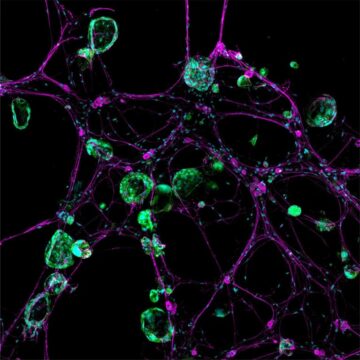 Lightning bolts of lime green flashed chaotically across the computer screen, a sight that stunned cancer neuroscientist Humsa Venkatesh. It was late 2017, and she was watching a storm of electrical activity in cells from a human brain tumour called a glioma. Venkatesh was expecting a little background chatter between the cancerous brain cells, just as there is between healthy ones. But the conversations were continuous, and rapid-fire. “I could see these tumour cells just lighting up,” says Venkatesh, who was then a postdoctoral researcher at Stanford University School of Medicine in Stanford, California. “They were so clearly electrically active.”
She immediately began to think about the implications. Scientists just hadn’t considered that cancer cells — even those in the brain — could communicate with each other to this extent. Perhaps the tumour’s constant electrical communication was helping it to survive, or even to grow. “This is cancer that we’re working on — not neurons, not any other cell type.” To see the cells fizz with so much activity was “truly mind blowing,” says Venkatesh, who is now at Harvard Medical School in Boston, Massachusetts. Venkatesh’s work formed part of a 2019 paper in Nature1, which was published alongside another article2 that came to the same conclusion: gliomas are electrically active. The tumours can even wire themselves into neural circuits and receive stimulation directly from neurons, which helps them to grow.
More here.
Black History Month 2024: African Americans and the Arts
From SWE and CMich:
 As we embark on Black History Month 2024, we proudly embrace the theme “African Americans and the Arts,” chosen by The Association for the Study of African-American Life and History (ASALH). This month, we celebrate the profound contributions of African American visionaries in the arts, highlighting the intersection of creativity and engineering/STEM. Join us in honoring the rich tapestry of talent that shaped not only history, but also the future of our diverse and dynamic community.
The theme for Black History Month 2024 focuses on “African Americans and the Arts”. This theme is infused with African, Caribbean, and Black American lived experiences. In the fields of visual and performing arts, literature, fashion, folklore, language, film, music, architecture, culinary and other forms of cultural expression the African-American influence has been paramount. African-American artists have used art to preserve history and community memory as well as for empowerment. Artistic and cultural movements such as the New Negro, Black Arts, Black Renaissance, hip-hop, and Afrofuturism, have been led by people of African descent and set the standard for popular trends around the world. In 2024, we examine the varied history and life of African-American arts and artisans.
…The suffering of those in bondage gave birth to the spirituals, the nation’s first contribution to music. Blues musicians such as Robert Johnson, McKinley ‘Muddy Waters’ Morganfield and Riley “BB” B. King created and nurtured a style of music that became the bedrock for gospel, soul, and other still popular (and evolving) forms of music. Black contributions to literature include works by poets like Phillis Wheatley, essays, autobiographies, and novels by writers such as David Walker and Maria Stewart. Black aesthetics have also manifested themselves through sculptors like Edmonia Lewis and painters like Henry O. Tanner.
More here.
Thursday Poem
Radio
the notes came
as light fell in soft patterns
from the window
Wherever you are
I am looking for you
his song stopped me
here on this side of the earth
he was African
from a tribe whose name was like a bird call
they said he had paid the invading tribe
to shoot his wife
instead of hacking her down by Machete
I might have wondered why he was spared
or tried to imagine his life and mine
existing in the same world
but his song was so beautiful
that I knew she heard it
as we all did then
pausing in the middle of our morning kitchens
by Nanci Dailey
from Poet Seat Poetry, 2017
Wednesday, January 31, 2024
Why Men Are Drifting to the Far Right
Rachel Kleinfeld at Persuasion:
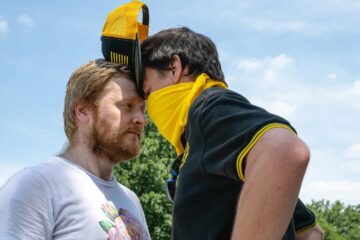 Last week, a widely-circulated analysis in the Financial Times confirmed what many researchers had long suspected: The ideological gap between men and women is growing.
Over the past fifteen years, men across the globe have voted for radical right-wing parties at much higher rates. Spain’s far-right, populist, and conspiracy-minded Vox party polls roughly twice as well among men compared with women. While men and women voted for Poland’s anti-democratic Law and Justice Party at similar rates last year, men voted for the even more extreme Konfederacja nearly three times as much as women. Data from a 2009 study of European parties that leaned authoritarian or populist found that men were generally around twice as likely as women to vote for them—and up to five times more likely in the case of the nationalist-populist Swedish Democrats.
It’s not just Europe: Brazil’s Jair Bolsonaro performed 10 points better among men than women in the 2018 election which brought him to power. Roughly the same gender difference pushed Argentina’s new populist libertarian leader, Javier Milei, over the top last November.
In some countries, gender aligns very closely with other social or demographic variables like class, education, and employment—but in a number of places, being male makes a big difference, independent of other factors.
The United States is no exception.
More here.
What do brain implants do and why is Elon Musk making them?
Matthew Sparkes in New Scientist:
 Neuralink was founded in 2016 by Elon Musk, who also runs SpaceX, Tesla and X, formerly Twitter, to create brain-computer interfaces: devices connected to the brain that allow people to communicate with computers by thought alone.
These devices could allow you to carry out simple tasks like searching for information or performing complex calculations with computers. They could theoretically also create technological telepathy, restore sight to people who are blind and enable paralysed people to control prostheses and regain their movement. Musk has said in the past that his company’s technology could allow humans to form “a sort of symbiosis” with AI.
More here.
In China, clean energy is now THE driver of overall economic growth
Adam Tooze at Chartbook:
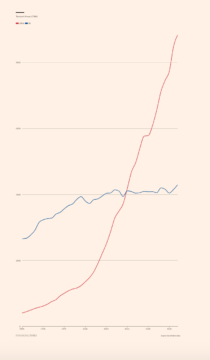 As data from the IEA confirm, the scale of China’s green energy push in the last couple of years dwarfs the much ballyhooed green energy programs in the West – NextGenEU, IRA etc.
Chinese manufacturers are expanding production of solar, wind, batteries and EV at a breakneck rate. Fierce competition is driving prices and costs down at a rate never previously imagined. Barring some unforeseen technological upset, China is set to be the leader in the first decades of the global clean energy transition.
But what is even more momentous is that China is the first large economy in which clean energy investment has become the principal driving force of overall investment and economic growth.
More here.
War, AI and the new global arms race
Taylor Swift, Donald Trump and the Right’s Abnormality Problem
Ross Douthat in The New York Times:
 There was a brief period in the later part of the Covid-19 pandemic, between the moment when Glenn Youngkin swept into the Virginia governorship and the full political return of Donald Trump, when I became convinced that American liberalism was headed for a truly epochal defeat in 2024.
It seemed then that — under the influence of progressive radicalism, institutional groupthink and coronavirus fears — the liberal establishment was untethering itself from American normalcy to a politically suicidal degree. Blue cities and regions were rerunning aspects of the left’s 1970s social program on fast-forward and generating spikes in crime and disorder. The Democratic Party’s economic agenda had yielded 1970s-style inflation. Joe Biden was elected as a moderate but was too aged and diminished to actually impose moderation on his party. And elite liberalism was increasingly associated with a mixture of Covid overreaction and ideological hysteria: Imagine a double-masked bureaucrat running a white-privilege workshop, forever.
Liberalism in 2024 is still in all kinds of trouble, but the truly epochal defeat seems less likely than it did back then. In part this is because of adaptations within the center-left. Blue-state Covid restrictions were unwound a bit faster than I expected — in part because of the political peril they created for Democratic politicians. Many of those same politicians have found ways to get some distance from their party’s activists, especially in swing states like Pennsylvania. And ideological fervor on the left seems to have passed its peak, yielding a more contested environment inside elite institutions and a modest left-wing retreat in the culture as a whole.
But the other reason that liberalism is surviving its disconnect from what remains of American normalcy is conservatism’s inability to just be normal itself, even for a minute.
More here.
Wednesday Poem
To the Young Who Want To Die
Sit down. Inhale. Exhale.
The gun will wait. The lake will wait.
The tall gall in the small seductive vial
will wait will wait:
will wait a week: will wait through April.
You do not have to die this certain day.
Death will abide, will pamper your postponement.
I assure you death will wait. Death has
a lot of time. Death can
attend to you tomorrow. Or next week. Death is
just down the street; is most obliging neighbor;
can meet you any moment.
You need not die today.
Stay here–through pout or pain or peskyness.
Stay here. See what the news is going to be tomorrow.
Graves grow no green that you can use.
Remember, green’s your color. You are Spring.
by Gwendolyn Brooks
from Poetic Outlaws
Forget Something? You’re Supposed To Do That
Shelby Bradford in The Scientist:
 Many people view forgetting as an inconvenience, and if it occurs extensively, they associate it with neurodegenerative diseases. However, some evidence suggests that nonpathological forgetting is an adaptive and active part of learning and memory maintenance.1 “The environment is changing, and to adapt to an environment that is constantly changing, we need to update our memories; and updating our memories also means forgetting,” said Livia Autore, a neuroscientist and postdoctoral researcher in the lab of Tomás Ryan at the Trinity College Dublin and author of a study published in Cell Reports.2 The findings indicate that forgetting is an active process that is important for the ability to remember and that it serves as a basis for understanding altered memory capacity.
The physical component of a memory consists of activated neurons and synapses formed during an event, collectively called an engram.3 To study changes in engram cells during forgetting, Autore’s team labeled neurons in the hippocampus with an adeno-associated virus cocktail that marked engrams formed during training experiences as well as all activated neurons during the testing phase. Autore’s group then set up an object context training experiment in which mice explored one set of objects, for instance, a pair of small water bottles, in a chamber with a pattern of triangles on the wall to provide contextual information. An hour later, the researchers exposed the mice to a different pair of objects, like small statues, in a different chamber with striped walls as interference.
More here.
Sofia Coppola’s Path to Filming Gilded Adolescence
Rachel Syme at The New Yorker:
There are plenty of distinguished bloodlines in the history of Hollywood—the Selznicks and the Mayers, the Warners, the Hustons, the Bergman-Rossellinis, the Fondas—but very few, like the Coppolas, in which one famous director has spawned another. After an early life spent in front of the camera, Sofia Coppola made a career behind it, becoming one of the most influential and visually distinctive filmmakers of her generation, with eight features to her name. Her second, “Lost in Translation,” from 2003, earned her an Oscar for Best Original Screenplay and a nomination for Best Director, making her the first American woman recognized in that category. Her career, of course, has been bolstered by an unusual wealth of resources. Francis’s company, American Zoetrope, has been a producer on all her movies. When she made her début, “The Virgin Suicides,” in 1999, she was able to cast an established star, Kathleen Turner, with whom she’d appeared as a teen-ager in her father’s movie “Peggy Sue Got Married.” She got permission to shoot “Somewhere,” her fourth film, inside the clubby Hollywood hotel the Chateau Marmont because in her youth she was a regular there, and even had a private key to the hotel pool. Still, no director can get a project green-lighted at a snap of the fingers, especially in today’s franchise-glutted Hollywood, and especially as a female director in an industry that remains dominated by men. Coppola is self-aware enough to know that it would be bad manners for someone in her position to complain. But she told me, “It’s not easy for anyone in this business, even though it looks easy for me.”
more here.
Sofia Coppola In Conversation
Chantal Akerman, 1968–1978: The Weight of Being
Beatrice Loayza at The Current:
 In the 1996 television documentary Chantal Akerman par Chantal Akerman, the Belgian filmmaker describes the life of her maternal grandmother, Sidonie Ehrenberg, an aspiring artist. As a wife and mother living in Poland, Ehrenberg painted despite the gendered restrictions imposed upon her by her Orthodox Jewish milieu. After the Nazis invaded the country, Ehrenberg was sent to Auschwitz, where she was killed in 1942 along with her husband. Her daughter Natalia survived; she was still a teenager when the camps were liberated. Ehrenberg’s artworks were never found after the war, yet Natalia, Akerman’s mother, preserved something of them in her memories of childhood. Ehrenberg used enormous canvases, and her subjects were straightforward: women’s faces gazing outward, “and that’s all,” Akerman explained in the documentary.
The genius and audacity of Akerman’s work lies in its recognition that such seemingly unremarkable images contain bounties, and that marginalized lives like Ehrenberg’s, decimated by time and silenced by tragedy, possess spectral qualities that, until Akerman began making films, had yet to be evoked in any art form.
more here.
Tuesday, January 30, 2024
Tuesday Poem
Thinking Thought
“Oh, soul,” I sometimes—often—still say when I’m trying to convince
………. my inner self of something.
“Oh, soul,” I say still, “there’s so much to be done, don’t want to stop
………. to rest now, not already.
“Oh, soul,” I say, “the implications of the task are clear, why procras-
……….. tinate, why whine?”
All the while I know my struggle has to do with mind being only some-
……….. times subject to the will,
that other portion of itself which manages to stay so recalcitrantly, ob-
……….. stinately impotent.
“Oh, soul, come into my field of want, my realm of act, be attentive to
………. my computations and predictions.”
But as usual soul resists, as usual soul retires, as usual soul’s old act of
………. dissipation and removal.
Oh, the furious elusive unities of want, the frail, false fusions and dis-
………. cursive chains of hope.
C.K. Williams
from C.K. Williams Selected Poems
The Noonday Press, 1994
Scientists might be on the cusp of curing autoimmune diseases
Cassandra Willyard in Nature:
 Back in 2001, immunologist Pere Santamaria was exploring a new way to study diabetes. Working in mice, he and his collaborators developed a method that uses iron oxide nanoparticles to track the key immune cells involved in the disorder.
But then Santamaria, who is at the University of Calgary in Canada, came up with a bold idea. Maybe he could use these particles as a therapy to target and quiet, or even kill, the cells responsible for driving the disease — those that destroy insulin-producing islet cells in the pancreas. It seemed like a far-fetched idea, but he decided to try it. “I kept doing experiment after experiment,” he says. Now, more than two decades later, Santamaria’s therapy is on the cusp of being tested in people.
It’s not alone. Researchers have been trying for more than 50 years to tame the cells that are responsible for autoimmune disorders such as type 1 diabetes, lupus and multiple sclerosis. Most of the approved therapies for these conditions work by suppressing the entire immune response. This often alleviates symptoms but leaves people at elevated risk of infections and cancers.
More here.
The Cognitive Foundations of Fictional Stories
Edgar Dubourg, Valentin Thouzeau, Thomas Beuchot, Constant Bonard, Pascal Boyer, et al, in a new paper:
 We hypothesize that fictional stories are highly successful in human cultures partly because they activate evolved cognitive mechanisms, for instance for finding mates (e.g., in romance fiction), exploring the world (e.g., in adventure and speculative fiction), or avoiding predators (e.g., in horror fiction). In this paper, we put forward a comprehensive framework to study fiction through this evolutionary lens.The primary goal of this framework is to carve fictional stories at their cognitive joints using an evolutionary framework. Reviewing a wide range of adaptive variations in human psychology–in personality and developmental psychology, behavioral ecology, and evolutionary biology, among other disciplines –, this framework also addresses the question of interindividual differences in preferences for different features in fictional stories. It generates a wide range of predictions about the patterns of combinations of such features, according to the patterns of variations in the mechanisms triggered by fictional stories. As a result of a highly collaborative effort, we present a comprehensive review of evolved cognitive mechanisms that fictional stories activate.To generate this review, we (1) listed more than 70 adaptive challenges humans faced in the course of their evolution, (2) identified the adaptive psychological mechanisms that evolved in response to such challenges, (3) specified four sources of adaptive variability for the sensitivity of each mechanism(i.e., personality traits, sex, age, and ecological conditions), and (4) linked these mechanisms to the story features that trigger them. This comprehensive framework lays the ground for a theory-driven research program for the study of fictional stories, their content, distribution, structure, and cultural evolution.
More here.
Prediction Markets Have an Elections Problem
Jeremiah Johnson at Asterisk:
 Some of the largest and most notable prediction markets to date have been around elections. The only problem? Prediction markets simply aren’t very good at political predictions. Markets for major U.S. elections are some of the deepest prediction markets anywhere: billions of dollars bet, millions of daily trades, and huge amounts of press. In theory, the larger the market, the more accurate the predictions. But in the markets with the biggest spotlight, we see a lot of strange stuff. Predictions that don’t line up with common sense. Odds that seem to defy reality. Obviously noncredible market movements. To figure out why, we’ll have to explore the underlying mechanisms that make markets work, and why the typical user of political prediction markets may not behave in the ways we expect.
Decoding Math’s Famous Fractal: The Mandelbrot Set
Carl Andre: The ‘OJ Of The Art World’
Adrian Searle at The Guardian:
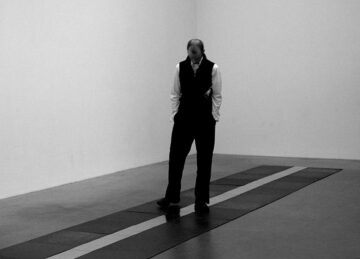 Coming upon an Andre as you turn a corner in a gallery can be a lovely surprise. But for all the smaller controversies it has generated, it has become almost impossible to look down at Andre’s bricks, to tread his floors of metal plates, or gaze at his constructions of cut ash and cedar timbers, without thinking of the death of the young Cuban American artist Ana Mendieta, Andre’s third wife, who died in a fall from Andre’s 34th floor apartment in lower Manhattan, one night in September 1985.
The two had been drinking, and were alone. Neighbours had heard them arguing. Mendieta was 36, and they had been married eight months. Two days later Andre was charged over her death. He was never found guilty. After Mendieta’s death, Andre’s career faltered. He was called “the OJ of the art world”, in reference to OJ Simpson, and his shows were picketed. At one New York opening, more than 500 protesters showed up with placards reading “Where is Ana Mendieta?”
more here.