
Julie Cadman-Kim in MQR:
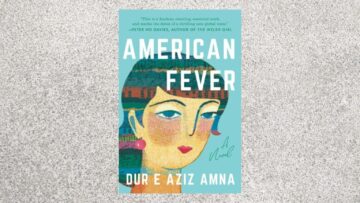 In Dur e Aziz Amna’s gorgeous debut, American Fever, readers can expect to find all the hallmarks of a bumpy adolescence—destructive confidence, crippling self-doubt, steamy crushes, social gaffes, obsession with looks and style, and pervasive loneliness. But within this jewel-box of a novel, these universal qualities unfold in a most unusual situation.
In late 2010, sixteen-year-old Hira is eager to leave Pakistan and begin a year-long exchange program in America. Only when she arrives in a woefully rural corner of the country, nothing quite measures up to her expectations. Hira’s host family seems to want little to do with her, her new high school is full of ignorant hayseeds, and she struggles even to get enough food to eat. To top it off, she’s falling in love with an older guy across the country, in New York, and carrying a dormant strain of tuberculosis. Underfed and way outside her comfort zone, she begins to deteriorate until her weakened immune system allows the virus to bloom, wreaking havoc not only on Hira, but also on the fragile community she’s built around herself.
All my life, I have observed a certain kind of person with baffled envy. The person who has never felt the desire to flee. I feel the least in common with this person, and yet I am endlessly fascinated by her. How can one be that content? Is she lucky, the draw of the universe birthing her in a place that fully aligns with her in temperament and ambition, or is she just complacent?
Throughout the novel, Hira must navigate complex cultural waters and a cloistered new reality in which self-preservation and personal growth are difficult to balance. She is expected to play ambassador, brush off xenophobic taunts, and feel grateful for all the United States has to offer, but the longer she spends in the U.S., the more she second-guesses exactly what she believes in and her decision to leave Pakistan in the first place. At the same time, she’s drawn more than ever to memories and ideals from home, the distance helping illuminate who she is and the magnitude of what she was so eager to leave behind.
More here.
 TAKE A GOOD LOOK
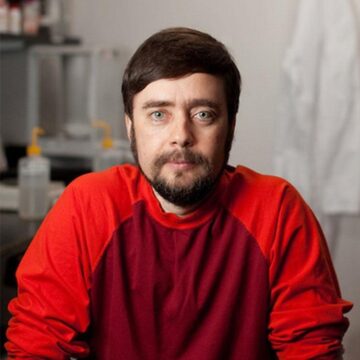 Michael Levin: Pretty much everything, birth defects, traumatic injury, aging, degenerative disease, cancer, all of these things boil down to the problem of a group of cells not knowing how or not being able to build the right thing. If we have the answer to this, how do you communicate an anatomical goals to a collection of cells? You could fix all of these things.
 “For generations in the mind of America, the Negro has been more of a formula than a human being—a something to be argued about, condemned or defended, to be ‘kept down,’ or ‘in his place,’ or ‘helped up,’ to be worried with or worried over, harassed or patronized, a social bogey or a social burden.” So wrote Alain Locke in the anthology The New Negro (1925), often considered the founding document of the Harlem Renaissance, the artistic movement of which Locke is generally recognized as intellectual impresario. “The thinking Negro even has been induced to share this same general attitude, to focus his attention on controversial issues, to see himself in the distorted perspective of a social problem. His shadow, so to speak, has been more real to him than his personality.”
 Modern pro wrestling branches off from vaudeville, loops back through the circus, launches off a theater balcony, and takes a detour past Muscle Beach before hammering together a space all its own. It’s held onto its malleability and perennial status as a home for misfits and weirdos who don’t quite fit in anywhere else. As an accessible working-class art form, it’s become a magnet for generations of performers who came into wrestling with little more than a dream and a high pain threshold. It’s not a coincidence that pro wrestling is one of the few theatrical arts in which a performer can still succeed wholly on their own merits. You don’t need rich parents or a degree from a prestigious institution to don the tights and become a star; it’ll still cost you and the view from backstage isn’t always pretty, but the barrier to entry is far lower. How do you get to Wrestlemania? Practice.
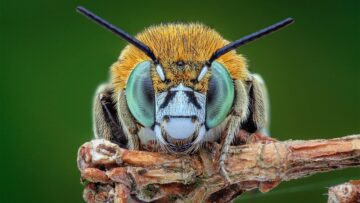 In 2022, researchers at the Bee Sensory and Behavioral Ecology Lab at Queen Mary University of London observed bumblebees doing something remarkable: The diminutive, fuzzy creatures were engaging in activity that
 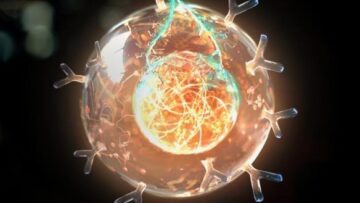 Dubbed “living drugs,” CAR T cells are bioengineered from a patient’s own immune cells to make them better able to hunt and destroy cancer. The treatment is successfully tackling previously untreatable blood cancers. Six therapies are already approved by the FDA.
 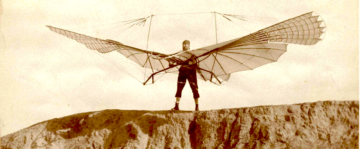 Years ago, for reasons I still don’t fully understand, I found myself writing about flight. It started as just a few paragraphs, a bit of spontaneous fiction jotted down in a notebook: a man stood on the roof of a barn, wearing a pair of enormous wings built from wood and cloth. His friend on the ground—the narrator—looked on nervously, ready to call an ambulance. And then the man jumped. Somehow, he flew.
 After they were released from prison in Paris in the late autumn of 1794, both having narrowly escaped the guillotine, new bosom friends Rose de Beauharnais and Térézia Tallien found they had nothing to wear. Dressmakers and milliners had all but disappeared from a city still reeling from the Reign of Terror. In an era of desperate need and rampant inflation, a time when even the most prosperous took candles and bread with them when they went out to dinner, who could afford a silk dress, still less stays, hoops, acres of petticoats and several maids to sew you into it?
 ‘At a quarter to eleven on August 12, 2022, on a sunny Friday morning in upstate New York, I was attacked and almost killed by a young man with a knife,” begins Salman Rushdie’s new memoir.
 NASA’s interstellar explorer Voyager 1 is finally communicating with ground control in an understandable way again. On Saturday (April 20), Voyager 1 updated ground control about its health status for the first time in 5 months. While the
 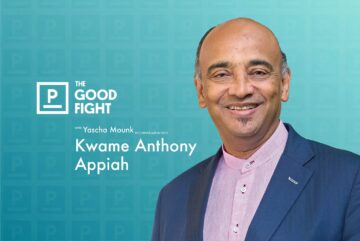 Kwame Anthony Appiah is a British-Ghanaian philosopher, Professor of Philosophy and Law and New York University, and the “Ethicist” columnist for The New York Times Magazine.