
Henry Wismayer at Noema:
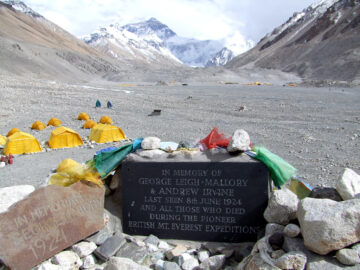 This month marks 100 years since Mallory’s last dance with the sublime. Debate persists over whether a 1920s climber in hobnail boots, even a phenom like Mallory, could have made it past the Second Step, a technical and challenging 100-foot promontory, to reach the summit.
“It’s the ultimate exploration detective story,” said Mick Conefrey, whose new book “Fallen” (2024), is the latest to dissect the 1924 expedition and its aftermath. “Mallory was the most romantic figure in the early history of mountaineering. The fact that he climbed ‘unplugged,’ without any down clothing, satellite phone or Kevlar oxygen bottle, means that people really want to believe he could have done it.” Definitive proof may never arrive. Irvine may have been carrying a Kodak Vest Pocket camera, the film inside which, were it ever recovered, might solve the question. But his body remains missing, imprisoned somewhere in the Himalayan deep freeze.
more here.
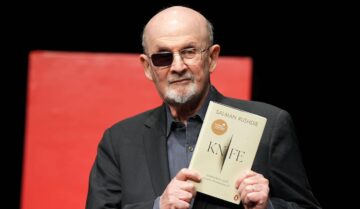 My copy of Salman Rushdie’s new book, Knife, arrived a few weeks ago, and before I had even opened the package, the news also arrived that Paul Auster had succumbed to cancer—and the confluence of Rushdie’s book and the information about Auster hit me harder than I would have predicted. Rushdie and Auster were friends. I knew this because in August 2022 there was a major assassination attempt on Rushdie—the assassination attempt is the topic of Knife—and a very few days later PEN America, the writers’ organisation, held a solidarity rally on the steps of the 42nd Street Library in New York. I attended, and I listened to Auster deliver a short speech. He celebrated Rushdie’s dedication to the storytelling imagination. He conjured the principle of freedom, and, in doing so, he expressed quietly an ardour of personal love, one friend for another in his moment of extreme trouble.
 Theory of mind
 History is repeating itself in Sudan. Tensions between rival security factions, which spilled out last April into open conflict, have rapidly created the world’s largest displacement crisis and food security crisis. Nearly half of the country’s 50 million people are in desperate need of food aid that is not reaching them, either because of access constraints or because it is simply not available.
 T
T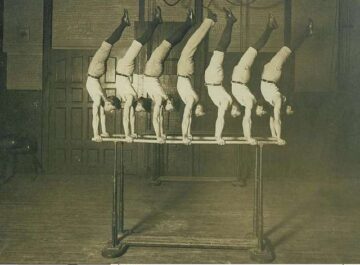 On August 16, 1918, a bookkeeper in Denver named George Eyser wrote a will. He was not married and had no children. And so it was to his only sibling, his sister Ottilie, with whom he lived in a two-story brick house at 420 Downing Street, that he bequeathed his property and possessions: money, the proceeds from an insurance policy, a gold watch and chain, a scrapbook that chronicled the nearly three decades he spent as an amateur gymnast, and his crowning glory—the six Olympic medals he won on a single October day in 1904.
 The difference between good art and bad art is that good art is subtle. Pakistan struggles to do subtle. There is certainly your everyday slapstick comedy, the tragic heroine, and the flippantly violent hero. But no, Pakistan is not at all good at subtle, which is why Sarmad Khoosat’s
  A
A  J
J For more than four years, reflexive partisan politics have derailed the search for the truth about a catastrophe that has touched us all. It has been estimated that
  After the murder of George Floyd in May 2020, former NBA player
  When Schwartz comes up in conversation today, two things are typically remarked of him. First, he is a man whose reputation has eclipsed his work, his stature as a poet having surrendered to the clamor for myth. Second, this myth is one of vertiginous and scandalous decline. Delmore Schwartz: an American tragedy. Both commonplaces have the unfortunate merit of being true.
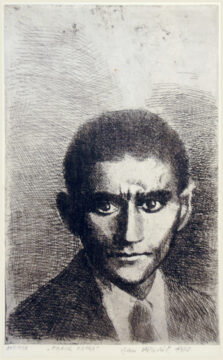 The coincidence of the centenary of Kafka’s death, on 3 June, and the publication of the first complete, uncensored