Race, genes, and sports

William Saletan in Slate:

ScreenHunter_04 Dec. 10 10.06 A few days ago, I wrote about a test, now being marketed in the United States, that predicts whether your toddler has more potential as a power athlete or as an endurance athlete. The test examines ACTN3, a gene that affects fast generation of muscular force. Fray poster Andrea Freiboden isn't impressed. “What a lot of crap. Just look at the race of the athlete,” she writes:

Generally, people of West African origin have more fast twitch muscles which allow intense bursts of power. This is why running backs, defensive linemen, and receivers are almost all black. We don't need any expensive test. All you have to do is look at the physique. Blacks in basketball are lean and musularly [sic] hard. Whites have softer muscles, which is why white basketball players have to rely more on skill than blacks who have the advantage of skill + great speed/strength.

Oy. I've been through this wringer before. It's true that some racial averages differ in part for biological reasons. It's also true that that this is one of them. But Freiboden is exactly wrong. Race is a less, not more, reliable gauge of physical characteristics than genes are. In fact, that's one of the chief consolations of nontherapeutic genetic testing: No matter how inaccurate genes are as a predictor of this or that ability, they're more accurate than predictions based on race. And the sooner we get past judging by race, the better.

More here.
Is Mumbai’s resilience endlessly renewable?

Arjun Appadurai at The Immanent Frame:

Arjun In other words, as we learn more about the deep geo-politics behind the terrifying attacks on Mumbai earlier this month, we need to recognize that there is a tectonic struggle going on in and near Mumbai on at least three axes: the deepest axis (from a historical point of view) is the struggle between the Indian Ocean commercial/criminal nexus and the land-based nexus that stretches from Mumbai to Delhi to Kashmir. The second, more recent struggle is the struggle between political and commercial interests now located in Maharashtra and Gujarat for control over Mumbai, a struggle that was superficially resolved in 1956, when Bombay was declared the capital of the new state of Maharashtra. The third, most subtle, is between a land-based, plebeian form of Hindu nationalism, best represented by the auto-rickshaw drivers and small street vendors of North Mumbai and Greater Mumbai, who would be happy to see South Mumbai destroyed; and the more slick, market-oriented face of the Bharatiya Janata Party, whose elite supporters know that South Mumbai is crucial to the mediation of global capital to India, and where business tycoons like Mukesh Ambani are building homes larger than many global hotels.

More here.

The Human Development Foundation of Pakistan

ScreenHunter_03 Dec. 10 09.11 I am proud to say that my sister, Atiya B. Khan, M.D., is one of the leaders of this organization which is doing tremendously useful work in bringing healthcare and secular education to thousands of poor children in many areas of Pakistan. In addition to maintaining a very busy medical practice in Maryland, my sister travels on weekends to raise funds for HDF and visits Pakistan frequently to oversee its work there, thereby providing my whole family with a role model worthy of emulation. This is from the Human Development Foundation website:

“Development is a process of enlarging people's choices—not just choices between different detergents, television channels or car models, but the choices that are created by expanding human capabilities and functioning—what people do and can do in their lives.

A few capabilities are essential for all levels of human development, without which, many choices in life would not be available. These capabilities are to lead long and healthy lives, to be knowledgeable and to have access to the resources needed for a decent standard of living-and these are reflected in the human development index.”

Human development in the words of Paul Streen is: “Human. But many additional choices are valued by people. These include political, social, economic and cultural freedom, a sense of community, opportunities for being creative and productive, and self-respect and human rights. Yet human development is more than just achieving these capabilities; it is also the process of pursuing them in a way that is equitable, participatory, productive and sustainable.”

The Project has a holistic approach to Human Development, based on the three criteria included in the Human Development Index, devised by Dr. Mahboobul Haq. The model was developed by specialists working in the field of social sciences. This successful model teaches responsibility and eliminates dependency. The main areas of intervention are:

a. Community Empowerment
b. Education
c. Health
d. Grassroots economic development
e. Community Physical Infrastructure

More here.

In this season of charitable giving, please consider donating to this worthy cause. To do so, use the topmost ad in the righthand column at 3QD. Thank you for your attention.

The Truth about Hypocrisy

Charges of hypocrisy can be surprisingly irrelevant and often distract us from more important concerns.

Scott F. Aikin and Robert B. Talisse in Scientific American:

ScreenHunter_02 Dec. 10 08.25 Former U.S. vice president Al Gore urges us all to reduce our carbon footprint, yet he regularly flies in a private jet. Former drug czar William Bennett extols the importance of temperance but is reported to be a habitual gambler. Pastor Ted Haggard preached the virtues of “the clean life” until allegations of methamphetamine use and a taste for male prostitutes arose. Eliot Spitzer prosecuted prostitution rings as attorney general in New York State, but he was later found to be a regular client of one such ring.

These notorious accusations against public figures all involve hypocrisy, in which an individual fails to live according to the precepts he or she seeks to impose on others. Charges of hypocrisy are common in debates because they are highly effective: we feel compelled to ­reject the views of hypocrites. But although we see hypocrisy as a vice and a symptom of incompetence or insincerity, we should be exceedingly careful about letting our emotions color our judgments of substantive issues.

Allegations of hypocrisy are treacherous because they can function as argumentative diversions, drawing our attention away from the task of assessing the strength of a position and toward the character of the position’s advocate. Such accusations trigger emotional reflexes that dominate more rational thought patterns. And it is precisely in the difficult and important cases such as climate change that our reflexes are most often inadequate.

More here. [Photo shows Spitzer.]

Tuesday, December 9, 2008

The Terrorists Want to Destroy Pakistan, Too

Asif Ali Zardari in the New York Times:

ScreenHunter_01 Dec. 09 15.48 The recent death and destruction in Mumbai, India, brought to my mind the death and destruction in Karachi on Oct. 18, 2007, when terrorists attacked a festive homecoming rally for my wife, Benazir Bhutto. Nearly 150 Pakistanis were killed and more than 450 were injured. The terrorist attacks in Mumbai may be a news story for most of the world. For me it is a painful reality of shared experience. Having seen my wife escape death by a hairbreadth on that day in Karachi, I lost her in a second, unfortunately successful, attempt two months later.

The Mumbai attacks were directed not only at India but also at Pakistan’s new democratic government and the peace process with India that we have initiated. Supporters of authoritarianism in Pakistan and non-state actors with a vested interest in perpetuating conflict do not want change in Pakistan to take root.

To foil the designs of the terrorists, the two great nations of Pakistan and India, born together from the same revolution and mandate in 1947, must continue to move forward with the peace process. Pakistan is shocked at the terrorist attacks in Mumbai. We can identify with India’s pain. I am especially empathetic. I feel this pain every time I look into the eyes of my children.

More here.

Tuesday Poem

///
In Praise of Dreams
Wistawa Szymborska

In my dreams
I paint like Vermeer van Delft.

I speak fluent Greek
and not with just the living.

I drive a car
that does what I want it to.

I am gifted
and write mighty epics.

I hear voices
as clearly as any venerable saint.

My brilliance as a pianist
would stun you.

I fly the way we ought to,
i.e., on my own.

Falling from the roof,
I tumble gently to the grass.

I've got no problem
breathing under water.

I can't complain:
I've been able to locate Atlantis.

It's gratifying that I can always
wake up before dying.

As soon as war breaks out,
I roll over on my other side.

I'm a child of my age,
but I don't have to be.

A few years ago
I saw two suns.

And the night before last a penguin,
clear as day.
.

simenon: was he human?

2193991.41

As one contemplates the life and work of Georges Simenon, the question inevitably arises: Was he human? In his energies, creative and erotic, he was certainly extraordinary. He wrote some 400 novels, under a variety of pseudonyms, as well as countless short stories and film scripts, and toward the end of his life, having supposedly given up writing, he dictated thousands of pages of memoirs. He could knock off a novel in a week or 10 days of manic typing — he never revised, as the work sometimes shows — and in Paris in the 1920s he is said to have broken off an affair with Josephine Baker, the expatriate American chanteuse and star of La Revue Nègre, because in the year he was with her, he was so distracted by his passion for her that he had managed to write only three or four books. He put himself in the way of many such distractions. In 1976, when he was in his 70s, he told his friend Federico Fellini in an interview in L’Express that over the course of his life he had slept with 10,000 women. True, he was an early starter. He lost his virginity at the age of 12 to a girl three years his senior, who got him to change schools so that they could continue to see each other and then promptly threw him over for another sweetheart. Young Georges had received his first lesson in the school of hard knocks.

more from the LA Weekly here.

The hard truth about animal research

Mg20026842.600-1_300

AN HOUR at the zoo is enough to convince most people that apes and monkeys are close kin to humankind. Some say that an hour watching proceedings in any parliament is enough to show that humans are close kin to monkeys. Either way, we know that the primate family is an intimate one, with the great apes – gorillas, chimpanzees, bonobos, orang-utans and humans – particularly closely related. It did not take genetics to tell us this, however, nor comparative anatomy. We now know that we share many of our genes with insects too, and the anatomies of all mammals are just resized and repositioned versions of one another. The key to understanding the true closeness of apes, ourselves included, is ethology. When Jane Goodall first sat in the Gombe rainforest, giving with fortuitous naivety anthropomorphic interpretations of the chimpanzee behaviour she witnessed, she was initiating a rethink: about apes, about humanity’s relationship with them, and ultimately about humanity itself.

more from the New Scientist here.

eagelton on milton

Milton300

Most poetry in the modern age has retreated to the private sphere, turning its back on the political realm. The two intersect only in such absurd anomalies as the poet laureateship. But whereas Andrew Motion does his bit to keep the monarchy in business, one of the greatest of English poets played his part in subverting it. John Milton, who was born in Cheapside 400 years ago today, published a political tract two weeks after the beheading of Charles I, arguing that all sovereignty lay with the people, who could depose and even execute a monarch if he betrayed their trust. We are not used to such revolutionary sentiments in our poets. When he left Cambridge, Milton refused to take holy orders and, in his first great poem Lycidas, he mounted a blistering assault on the corruption of the clergy. He was a champion of Puritanism at a time when that meant rejecting a church in cahoots with a brutally authoritarian state.

more from The Guardian here.

Towards responsible use of cognitive-enhancing drugs by the healthy

From Nature:

Society must respond to the growing demand for cognitive enhancement. That response must start by rejecting the idea that 'enhancement' is a dirty word, argue Henry Greely and colleagues.

Main_news_pic2008.12 Today, on university campuses around the world, students are striking deals to buy and sell prescription drugs such as Adderall and Ritalin — not to get high, but to get higher grades, to provide an edge over their fellow students or to increase in some measurable way their capacity for learning. These transactions are crimes in the United States, punishable by prison. Many people see such penalties as appropriate, and consider the use of such drugs to be cheating, unnatural or dangerous. Yet one survey estimated that almost 7% of students in US universities have used prescription stimulants in this way, and that on some campuses, up to 25% of students had used them in the past year. These students are early adopters of a trend that is likely to grow, and indications suggest that they're not alone.

In this article, we propose actions that will help society accept the benefits of enhancement, given appropriate research and evolved regulation. Prescription drugs are regulated as such not for their enhancing properties but primarily for considerations of safety and potential abuse. Still, cognitive enhancement has much to offer individuals and society, and a proper societal response will involve making enhancements available while managing their risks.

More here.

Primal, Acute and Easily Duped: Our Sense of Touch

Natalie Angier in The New York Times:

Touch Imagine you’re in a dark room, running your fingers over a smooth surface in search of a single dot the size of this period. How high do you think the dot must be for your finger pads to feel it? A hundredth of an inch above background? A thousandth? Well, take a tip from the economy and keep downsizing. Scientists have determined that the human finger is so sensitive it can detect a surface bump just one micron high. All our punctuation point need do, then, is poke above its glassy backdrop by 1/400,000th of an inch — the diameter of a bacterial cell — and our fastidious fingers can find it. The human eye, by contrast, can’t resolve anything much smaller than 100 microns. No wonder we rely on touch rather than vision when confronted by a new roll of toilet paper and its Abominable Invisible Seam.

Biologically, chronologically, allegorically and delusionally, touch is the mother of all sensory systems. It is an ancient sense in evolution: even the simplest single-celled organisms can feel when something brushes up against them and will respond by nudging closer or pulling away. It is the first sense aroused during a baby’s gestation and the last sense to fade at life’s culmination. Patients in a deep vegetative coma who seem otherwise lost to the world will show skin responsiveness when touched by a nurse.

More here.

When Hindus mourned Imam Hussain

Ruchira Paul in Accidental Blogger:

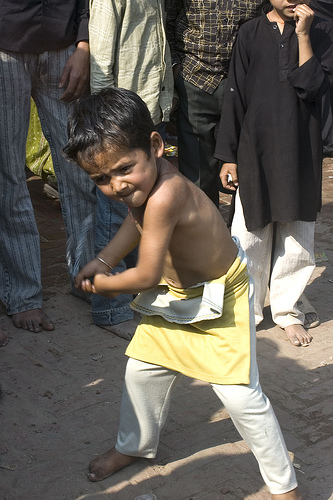
Hussaini Brahmins The student population of my school in New Delhi was composed of girls from practically every part of India belonging to several different linguistic groups and religions. Nearly fifty percent of the Punjabi and Bengali students came from families who had lost their ancestral homes in the partition of India in 1947, my own being among them. In middle school, a class mate whose folks had moved to India from the Pakistani city of Lahore, once casually commented that her father's family used to observe Muharram in their hometown before the partition. At the time I didn't think much of what my friend had said. We were young and many of us had heard interesting pre-partition tales from our parents. It is only now, on thinking back, that her story acquires a special meaning and given the subsequent deterioration in Hindu-Muslim relations in general and between India and Pakistan in particular, also a certain amount of poignancy. You see, the remarkable thing about my friend's Muharram story was that she was not a Muslim, but a Hindu Brahmin.

My class mate belonged to the Punjabi community of Dutts, in more communally harmonious times also known as the Hussaini Brahmins. They, along with their Shia Muslim friends and neighbors, used to commemorate and grieve the deaths of Imam Hussain and his disciples in the bloody battle of Karbala during the 7th century power struggle among early Muslims.

More here. [Photo by Feroz Shakir.]

Top 20 Top 10 Lists of 2008

The season of year-end lists is upon us. Here is a metalist, from Lifehacker:

  1. Top 10 Obscure Google Search Tricks
    “Dozens of Google search guides detail the tips you already know, but today we're skipping the obvious and highlighting our favorite obscure Google web search tricks.”
  2. Top 10 Harmless Geek Pranks
    “Since the dawn of time, geeks have been playing harmless pranks on their beloved (but unsuspecting) associates, and it's up to all of us to carry the torch forward.”
  3. Top 10 Ways to Stay Energized
    “You can overcome a late night of net surfing, a rough morning, or just the post-lunch stupor without becoming an over-wired mess.”
  4. Top 10 Software Easter Eggs
    “The best easter eggs aren't painted pink and stuffed with jelly beans—they're the undocumented and unexpected fun features hidden deep inside various software apps.”
  5. Top 10 BitTorrent Tools and Tricks
    “BitTorrent is the go-to resource for downloading everything from music and movies to software and operating systems, but as its popularity continues to grow, so do the number of tools available for making the most of it.”
  6. Top 10 Firefox 3 Features
    “The newest version of our favorite open source web browser, Mozilla Firefox 3, offers dozens of new features and fixes, but only a handful will make the most dramatic difference in your everyday browsing.”
  7. Top 10 How To Videos
    “Your crafty older relatives used to have to mail-order their video tutorials or wait for “This Old House” reruns to get their DIY on, but the age of streaming video has been good to those who like to tinker and try out neat tricks.”
  8. Top 10 Things You Forgot Your Mac Can Do
    “From pure eye candy to outright productivity-boosters, read on to get reminded of some of the more obscure things you can do with your Mac, fresh out of the box.”
  9. Top 10 Telephone Tricks
    “When getting things done involves making phone calls, you want to spend the least amount of time and money on the horn as possible—and several tricks and services can help you do just that.”
  10. Top 10 Computer Annoyances and How to Fix Them
    “Computers are supposed to make our lives easier, but too much of the time they can be frustrating, time-wasting, stubborn machines.”

More here.

The Italian Underground

Graeme Wood in Culture + Travel, reproduced on his own website:

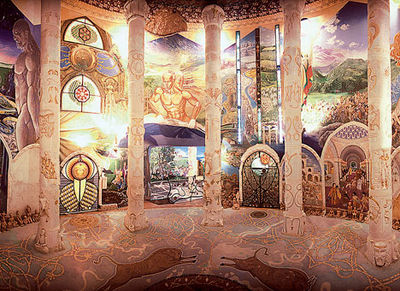
Damanhur Residents of Vidracco (pop. 500) knew the newcomers were different. Since 1977, they had been showing up one-by-one in the little Piedmontese valley, marching in from Turin like bugs following a trail of syrup. They kept to themselves. Their chitchat, when it came, zoomed right past the commonplace – nothing on the latest Juventus game, or the sorry state of farming in the valley. Instead, they spoke eagerly of “esoteric physics,” astral-plane travel, and Vidracco’s remarkable “synchronic energy lines,” supposedly unique on earth. And they rarely came out at night.

One day in 1992, Vidracco found out why. Backed by carabinieri and motivated by a tip, a magistrate showed up and demanded that the newcomers unlock a nondescript wooden door in the side of the mountain, next to their compound (called “Damanhur,” after the ancient Egyptian city). Inside, a cramped passage led to a section of wall decorated in pharaonic themes. The Damanhurians pointed a garage door opener at the flat stone surface, and clicked its button. Gears whirred, and a wall-section fell away.

Damanhur’s handful of citizens – dozens at first, but by now 330 — had been working in shifts, under cover of darkness, scratching at the earth with picks and shovels, and building shrines deep in the steep, forested mountain. Behind a series of false walls lay a revelation as mysterious as King Tut’s tomb, but grander — as ethereal as the Sistine Chapel, but weirder. In all, they had dug out over 8000 cubic meters, a space larger than Big Ben, excavated mostly by hand, with neither building permits nor technical expertise. They had decorated these “Temples of Humankind” with a rainbow of wall paintings, Tiffany stained glass, and mosaics. Endless halls snaked around the innards of the mountain, lit with candles and reeking of incense and paint.

More here.

Monday, December 8, 2008

3QD’s New Columnists

Hello Readers (and Writers!),

Well, we received around ninety submissions of sample essays in our search for new columnists. Most of them were very good (with a few incomprehensible and even insane pieces thrown in, just to test our sanity, I suppose) and it was hard deciding whom to accept and whom not to. So hard, in fact, that we ended up deciding that we will dramatically expand the number of 3QD columns by doubling them. Hence, today we welcome to 3QD the top twenty people (in the combined ratings of the editors). Without further ado, these are, in alphabetical order by last name (this is not a ranking of any kind):

  1. Fountain-pens-530 Namit Arora
  2. Evert Cilliers
  3. Norman Costa
  4. Gerald Dworkin
  5. Richard Eskow
  6. Sam Kean
  7. Affinity Konar
  8. Kris Kotarski
  9. Colin Marshall
  10. Katherine McNamara
  11. Maniza Naqvi
  12. Alan Page
  13. Jonathan Pfeiffer
  14. Daniel Rourke
  15. Olivia Scheck
  16. David Schneider
  17. Aditya Dev Sood
  18. Jeff Strabone
  19. Bryant Urstadt
  20. Manisha Verma

Three of these people (Norman Costa, Affinity Konar, and Aditya Dev Sood) will begin writing at 3QD today. I will be in touch with the rest of you to schedule a start date. The “About Us” page will be updated with short bios and photographs of the new writers no later than the day they start.

Thanks to all of the people who sent samples of writing to us. It was sometimes tiring, but still a pleasure to read them all. If you didn't make it this time, we will keep you in mind for the future. And congratulations to the new columnists!

Best wishes,

Abbas

Sunday, December 7, 2008

Tips For Clueless People Who Get Mugged

From Craig's List:

Super-mugging-redux So you've just moved into a new “gentrifying” neighboorhood that's full of urban culture, cheap(er) rents, and wonderful friendly people. An odd lack of organic food stores and greenmarkets, but you can't have everything. So one day you're doing something FUCKING RETARDED like walking back from the store alone at 1 am or walking home from the subway while texting your sorority sisters back in the fucking midwest or something while SIMULTANEOUSLY listening to an ipod with the bright white headphones and you get fucking mugged. Congrats, YOU'RE A FUCKING DUMBASS. No, it's not 1990, when men where men, crackheads would fucking cut you and the robbery rate was about a billion times higher than it is now, but it's still new york and you were still fucking dumb enough to think that paying $1200 for a studio in a shitty neighboorhood is somehow hipper than moving to fucking Queens.

Anyway, here's some helpful tips for the next time someone jacks your shit.

1) Pay attention. Granted, you weren't paying attention to start with or you wouldn't have gotten mugged, but now that you've been hit from behind / had a gun shoved in your face, pay attention.

2) Follow directions. Give the friendly mugger what he wants. Don't talk back or fight. In all likelyhood, you're a pussy hipster retard, and are, by NYC law, unarmed.

3) You've been paying attention right? Remember some simple things in this order: sex, clothing color, clothing type, headwear, and direction of flight.

4) Congratulations! You've just been robbed and you're still alive. What now? Well, don't go back to your apartment and call the cops thirty minutes later. Don't call your mom in Kansas and tell her first. CALL THE COPS AS FAST AS POSSIBLE. You'd be amazed at how many people fuck up this simple step. Pay phones still exist as do 24/7 bogies. Go there, call the cops.

5) It may take a while for the cops to show up. The 911 system, at best, will result in a five minute wait before we're even notified. Then we have to drive there without killing anyone. Be patient. For that matter, tell the 911 operator exactly where you are. Nothing makes a responding cop happier than having to scour the area for your dumb ass while the perp gets away.

More here.

How Bombay Became Mumbai

Mumbai-skyline

The talk at my Thanksgiving table—as no doubt at every Indian-American household—was all Bombay. We watched CNN through eating, with its hysterical headline blazing, “Mumbai: City Under Siege.” Years of suicide bombings had suddenly given way to a wholly unexpected takeover of the major hotels, more typical of James Bond-villainy than latter-day jihadism. They differed in their attire as well: News reports insisted on pointing out that the attackers and hostage-takers wore jeans and t-shirts. When I was younger, I used to travel through Bombay in order to get to my ancestral city, Bangalore. A bus would take you from the international to the domestic airport, along a vertiginous swath of blue-tarped slums. The air was oppressed by humidity; the rain didn’t wet you, it slimed you. And those slimed shantytowns, shadowed—as every traveler ritually points out—by white stalagmites of luxury towers everywhere, had always been proof to me that it was a city of absolute evil. But poverty was only one of its evils. A Hindu family friend once took me on a drive that led through a large Muslim ghetto, its streets dusty and narrow. “Everywhere the Muslims go, they make the place dirty,” he said.

more from n+1 here.