Physicians’ Tales

Sandeep Jauhar in The New York Times:

Jauhar-600 “A story like the one I’ve been telling you is unimaginable nowadays,” a physician proclaims in “The Soul of Medicine,” Sherwin Nuland’s new collection of medical tales. The stories — modeled on “The Canterbury Tales” — are intended to “describe that sacrosanct connection between two people that we call the doctor-patient relationship,” Nuland writes. Indeed, the tales, narrated by physicians recalling their most memorable patients, evoke a bygone era in medicine, though one that is thankfully over.

In “The Surgeon’s Second Tale,” a young man is whisked to the operating room to have a ruptured spleen removed on the basis of a history and physical exam — unthinkable nowadays, when a patient with a simple headache cannot get out of the emergency room without a CAT scan of the brain (though the diagnosis was correct). Another surgeon performs a radical mastectomy on a young woman who believes she is getting only a breast biopsy and a simple vaginal procedure, without even waking her up from anesthesia to tell her that the biopsy indicates cancer. Four hours later, the entire breast and mass of contiguous tissue have been removed. “There’s something we have to talk about,” the surgeon tells her at the bedside.

More here.

Closer Look at Einstein’s Brain

From Science:

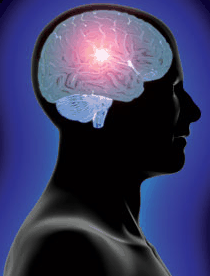
Brain When a rare genius like Albert Einstein comes along, scientists naturally wonder if he had something special between his ears. The latest study of Einstein's brain concludes that certain parts of it were indeed very unusual and might explain how he was able to go where no physicist had gone before when he devised the theory of relativity and other groundbreaking insights. The findings also suggest that Einstein's famed love of music was reflected in the anatomy of his brain.

When Einstein died in 1955 at Princeton Hospital in New Jersey, his brain was removed by a local pathologist named Thomas Harvey, who preserved, photographed, and measured it. A colleague of Harvey's cut most of the brain into 240 blocks and mounted them on microscope slides. From time to time, he sent the slides to various researchers, although few publications resulted. Harvey, who moved around the United States several times in the course of his career, kept the jar containing what remained of the brain in cardboard box. Finally, in 1998, Harvey–who died in 2007–gave the jar to the University Medical Center of Princeton, where it remains today.

More here.

Israel stands ready to bomb Iran’s nuclear sites

Sheera Frenkel in The Times of London:

Bushehr-nuclear-pow_492929a The Israeli military is preparing itself to launch a massive aerial assault on Iran's nuclear facilities within days of being given the go-ahead by its new government.

Among the steps taken to ready Israeli forces for what would be a risky raid requiring pinpoint aerial strikes are the acquisition of three Airborne Warning and Control (AWAC) aircraft and regional missions to simulate the attack.

Two nationwide civil defence drills will help to prepare the public for the retaliation that Israel could face.

“Israel wants to know that if its forces were given the green light they could strike at Iran in a matter of days, even hours. They are making preparations on every level for this eventuality. The message to Iran is that the threat is not just words,” one senior defence official told The Times.

Officials believe that Israel could be required to hit more than a dozen targets, including moving convoys. The sites include Natanz, where thousands of centrifuges produce enriched uranium; Esfahan, where 250 tonnes of gas is stored in tunnels; and Arak, where a heavy water reactor produces plutonium.

The distance from Israel to at least one of the sites is more than 870 miles, a distance that the Israeli force practised covering in a training exercise last year that involved F15 and F16 jets, helicopters and refuelling tankers.

More here.

Dr. Varmus Goes to Washington

Robert Cook-Deegan in American Scientist:

ScreenHunter_02 Apr. 18 08.46 Harold Varmus’s new book, The Art and Politics of Science, is a timely memoir of a remarkable career. It hits the stores just as that career is taking a new turn: Varmus will be one of the foremost scientific advisers to the Obama administration.

In this memoir, Varmus traces the trajectory of his career, outlining events in roughly chronological order. He moves rapidly over his early life, touching on his childhood in New York City, his undergraduate years at Amherst, his graduate studies in English literature at Harvard and his training at Columbia University’s College of Physicians and Surgeons. Armed with a medical degree but drawn to science, he did research in the U.S. Public Health Service at the National Institutes of Health (NIH) as an alternative to military service during the Vietnam War (the “yellow beret” era, which was a golden age for NIH research).

Then in 1970 he took a scientific faculty position at the University of California at San Francisco, where researchers such as J. Michael Bishop and Herbert Boyer were doing groundbreaking research in molecular biology. Varmus entered into a long and conspicuously productive collaboration with Bishop, studying the molecular biology of cancer genes. The two men became famous and influential, primarily because they discovered cellular genes that could cause cancer when mutated and hijacked by RNA viruses. To those in the field, their laboratory was a formidable competitive force, filled with talented graduate students and postdocs attracted by hot science.

More here.

Wall: A Monologue

David Hare in the New York Review of Books:

ScreenHunter_01 Apr. 18 08.40 Very well. I shall seek to describe the history of the wall.

On June 1, 2001, nine months into the second intifada, a Palestinian suicide bomber named Saeed Hotari crossed into Israel from the West Bank, and exploded himself at the entrance to the Dolphinarium discotheque on the beach in Tel Aviv, killing twenty-one civilians, most of them high school students. A further 132 people were injured. In response to the massacre, a grassroots movement grew up all over Israel calling itself Fence for Life. They argued, as Prime Minister Yitzhak Rabin had argued ten years earlier, that the only way of protecting the country from infiltration by terrorists was by sealing itself off from the Palestinian territories, by removing the points of friction between the two communities. But separation would not be a purely military tactic. No, before he was murdered by a fellow Israeli, Rabin had been arguing something much more radical. “We have to decide on separation as a philosophy.”

There it is. Not just a wall. A wall would be a fact. But this wall is a philosophy, what one observer has called “a political code for shutting up shop.”

More here.

U.S. experts: Pakistan on course to become Islamist state

Jonathan S. Landay at McClatchy:

_42773275_203crowd-ap A growing number of U.S. intelligence, defense and diplomatic officials have concluded that there's little hope of preventing nuclear-armed Pakistan from disintegrating into fiefdoms controlled by Islamist warlords and terrorists, posing a greater threat to the U.S. than Afghanistan's terrorist haven did before 9/11.

“It's a disaster in the making on the scale of the Iranian revolution,” said a U.S. intelligence official with long experience in Pakistan who requested anonymity because he wasn't authorized to speak publicly.

Pakistan's fragmentation into warlord-run fiefdoms that host al Qaida and other terrorist groups would have grave implications for the security of its nuclear arsenal; for the U.S.-led effort to pacify Afghanistan; and for the security of India, the nearby oil-rich Persian Gulf and Central Asia, the U.S. and its allies.

More here.

Friday, April 17, 2009

Is it fresh?

Jon Garvie in The Times of London:

416600_ab1bcdee3c_m Future social historians will note the extraordinary centrality of food to national discourse on both sides of the Atlantic. Celebrity chefs and lifestyle experts attempt to reform bad habits. Doctors debate the health benefits and risks of modish diets, from raw greens to bone marrow. Class warriors deplore as snobbish dismissals of cheap battery-farm chickens. And the gulping majority grow obstinately fat on salty, sugary, pre-packaged slop, swelling the coffers of the multinationals and delivering fiscal nightmares to those who must foot the bill. But, despite this glut of media coverage, the provenance of most food is little known or understood. Whether at Tesco or farmers’ markets, consumers must take vendors’ avowals of freshness on trust. Few question exactly what knowledge a sell-by date imparts. Societies rely instead on myths, as Freidberg’s double-edged subtitle implies. The numinous meaning of freshness, as with all cults, is apprehended only vaguely by its followers.

Ancient cultures used preservative methods, such as salting and pickling, in order to extend the durability of produce for domestic use. Refrigeration delivered a paradigm shift by removing the site of production from the sight of consumers. The idea of freshness emerged to fill the conceptual ellipsis that resulted.

More here.

The Platonic Imperative: Reality and the Many Worlds of Quantum Mechanics

Adamfrankweb Adam Frank in Reality Base:

Why should a perfectly good equation that describes the evolution of the world (the wave function) go away just because someone made a measurement? To deal with this strange state of affairs, Hugh Everett proposed what would become the Many-Worlds Interpretation in the late 1950s (Bryce Dewitt did a lot of development on the idea, too). The Many-Worlds solution is, in a sense, a platonic one. The mathematical physics stays put, but our notion of what constitutes reality changes. Well, that is an understatement—it really, really changes.

According to the Many-Worlds Interpretation, the wave function is never suspended. Every time a measurement is made, the world splits off into as many copies as there are pieces (terms) in the wave functions. If you are the lab technician making the measurement, you split off into multiple copies, as does the entire universe with you. In each copy, a different value of the measurement is recorded. After the measurement, each copy world goes on evolving and splitting as more quantum events occur.

Sounds wacky, don’t it? Why would anyone believe in a universe that is endlessly splitting into (as far as we know) unobservable slightly-different versions of itself? Here is the point at which, as a physicist or philosopher, your biases will likely show themselves.

People will line up behind the Many-Worlds Interpretation because of its consistency. Its advantage is that it keeps the math whole. There is no special pleading about consciousness intruding on the measurement. There is no sense that our access to the world is limited. You have a beautiful equation. It describes the evolution of physical reality, and that is that.

Is the World Ignoring Sri Lanka’s Srebrenica?

17lede_srilanka.map.480 Robert Mackey in the NYT's The Lede:

As Somini Sengupta reported in The Times earlier this week, despite a two-day pause in fighting, the Sri Lankan government has “rebuffed international appeals to protect civilians trapped in a war zone in its northeast.” Now some visual evidence of the damage that fighting has caused is coming to light.

Ms. Sengupta explained on Sunday why Human Rights Watch calls this small area of northern Sri Lanka “one of the most dangerous places in the world.”

An estimated 100,000 ethnic Tamils are trapped in a deadly and shrinking five-square-mile wedge of land in northeastern Sri Lanka, where the separatist Liberation Tigers of Tamil Eelam, or Tamil Tigers, fighting for an ethnic homeland for 25 years, have effectively held them hostage as a civilian shield.

A video report from Channel 4 News in London on Thursday (embedded below), showing scores of civilian victims killed last week in the crossfire between Sri Lanka’s government and the rebel Tamil Tigers (officially known as t is clear that the L.T.T.E.), in a part of the country off-limits to journalists, is difficult to watch. The images are as disturbing as those that filled television screens during the conflicts in Bosnia in the 1990s but, as Channel 4’s Lindsey Hilsum points out in her report, this bloody war, now possibly in its last throes, has been taking place largely out of sight of the international media. As in the final months of the war in Bosnia, the failure of the combatants to refrain from shelling encircled, densely-populated civilian pockets is producing shocking results. Channel 4’s Alex Thomson wrote on Thursday in an email newsletter, “You have to ask: is Sri Lanka becoming another Srebenica?”

Culture & Barbarism: Metaphysics in a Time of Terrorism

Terry Eagleton in Commonweal:

Why are the most unlikely people, including myself, suddenly talking about God? Who would have expected theology to rear its head once more in the technocratic twenty-first century, almost as surprisingly as some mass revival of Zoroastrianism? Why is it that my local bookshop has suddenly sprouted a section labeled “Atheism,” hosting anti-God manifestos by Christopher Hitchens, Richard Dawkins, and others, and might even now be contemplating another marked “Congenital Skeptic with Mild Baptist Leanings”? Why, just as we were confidently moving into a posttheological, postmetaphysical, even posthistorical era, has the God question broken out anew?

Can one simply put it down to falling towers and fanatical Islamists? I don’t really think we can. Certainly the New Atheists’ disdain for religion did not sprout from the ruins of the World Trade Center. While some of the debate took its cue from there, 9/11 was not really about religion, any more than the thirty-year-long conflict in Northern Ireland was over papal infallibility. In fact, radical Islam generally understands exceedingly little about its own religious faith, and there is good evidence to suggest that its actions are, for the most part, politically driven.

That does not mean these actions have no religious impact or significance. Islamic fundamentalism confronts Western civilization with the contradiction between the West’s own need to believe and its chronic incapacity to do so.

Friday Poem

“Sex is a political condition.” —Kate Millet

Toward a Better Love
Roque Dalton

No one disputes that sex
is a condition in the world of the couple:
from there, tenderness and its wild branches.

No one disputes that sex
is a domestic condition:
from there, kids,
nights in common
and days divided
(he, looking for bread in the street,
in offices or factories;
she, in the rear guard of domestic functions,
in the strategy and tactic of the kitchen
that allows survival in a common struggle
at least to the end of the month).

No one disputes that sex
in an economic condition:
it’s enough to mention prostitution,
fashion,
the sections in the dailies that are only for her
or only for him.

Where the hassles begin
is when a woman says
sex is a political condition.

Because when a woman says
sex is a political condition
she can begin to stop being just a woman in herself
in order to become a woman for herself,
establishing the woman in woman
from the basis of her humanity
on not of her sex,
knowing that the magic deodorant with a hint of lemon
and soap that voluptuously caresses her skin
are made by the same manufacturer that makes napalm
knowing the labors of the homes themselves
are labors of a social class to which that home belongs,
that the difference between the sexes
burns much better in the loving depth of night
when all those secrets that kept us
masked and alien are revealed.

Translation, Jack Hirschman
from the collection Poetry Like Bread; Curbstone Press, 1994

You’re . . . not . . . going . . . to . . . live

12seidel-600

One night after Christmas last year, in a dark, well-upholstered restaurant on Manhattan’s Upper West Side, the American poet Frederick Seidel, an elegant man of 73 with an uncommonly courtly manner, told me a story about poetry’s power to disturb. “It was years ago,” Seidel explained in his measured voice, “in the days when I had an answering machine. I’d left my apartment, briefly, to go outside to get something, and when I came back there was a message. When I played it, there was a woman’s voice, a young woman’s voice sounding deeply aroused, saying: ‘Frederick Seidel . . . Frederick Seidel . . . you think you’re going to live. You think you’re going to live. But you’re not. You’re not going to live. You’re not going to live. . . .’ All this extraordinary, suggestive heavy breathing, getting, in the tone of it, more and more intensely sexual, more gruesome, and then this sort of explosion of sound from this woman, and: ‘You’re . . . not . . . going . . . to . . . live.’ ” Seidel paused. The bright cries of a group of young women giving a baby shower in the adjoining booth rose and fell behind the bare crown of Seidel’s gray head. “So,” he continued, “the first thing I did was call a girlfriend. And the woman said, ‘I’m coming over.’ And did. And listened to this thing. And burst into tears. Because it really was horrific.” Another friend, a federal judge, also listened, insisting that Seidel call the police immediately and tell them he’d received a death threat. “They came by and they said: ‘It’s real. Have you published a book recently?’ I had. And that was it, really. Meaning nothing happened. But,” Seidel said, his large blue eyes brightening, “it was the most severe review I’ve ever received.”

more from the NY Times here.

half genius, half perversion

N284472

This book has divided the world. The French love it, and gave it not only the Prix Goncourt but the Académie Française’s Prix de la Littérature as well. The British are split – Antony Beevor loved it, Peter Kemp hated it. The survivor-writer Jorge Semprún admired it; Claude Lanzmann, the maker of Shoah, first hated it, then changed his mind. Most Americans and Canadians loathe it. Why? And who is right and wrong? That should be a naïve question, since wildly differing responses to the same book are perfectly normal. But here there is, I think, a right and a wrong answer, though not simple ones. Those who admire The Kindly Ones are right, but those who loathe it are not completely wrong. It is half a work of genius and half a work of gratuitous perversion.

more from Literary Review here.

the means of production

ID_BS_CRISP_MEANS_AP_001

Every once in a while some woman gets fed up with the constant news of war, poverty, greed, environmental degradation, and corruption, and publicly growls, “You know, if women ran the world, it would be a better place.” Detractors immediately howl back, reminding us of the plague that was Thatcherism, but it turns out that we don’t need a matriarchy to improve the world. Just improving the lives of women, guaranteeing their rights, and allowing them to decide their own fates independent of religious or societal control would help piece our world back together. Muhammad Yunus started the Grameen Bank to offer microloans to the rural poor, allowing them to start small businesses and work their way out of poverty. He quickly noticed that women allowed to earn their own incomes “show remarkable determination to have fewer children, educate the ones they have, and participate actively in our democracy.” By 2007, 97 percent of his borrowers were women, and he had won the Nobel Peace Prize.

more from The Smart Set here.

The Kissinger Saga

From The Telegraph:

Kissingerstory1_1385314f With his horn-rimmed glasses, dark suits and generally lugubrious demeanour, it is plain to see how Dr Kissinger, the Presidential National Security Advisor, was the chief inspiration for Peter Sellers’ Dr Strangelove – who, as the world is about to end, gleefully informs the bigwigs in the bunker that nuclear annihilation won’t be too bad: “I’m not saying we wouldn’t get our hair mussed. I am saying only 10 to 20 million people killed, tops, depending upon the breaks.”

Despite spending his adult life in America, Kissinger hasn’t lost or modified his sonorous Teutonic accent, “perhaps because he never wanted to,” according to Evi Kurz, in this fascinating and suggestive biography. Though he has ascended to great heights in the US – having been Nixon’s Secretary of State and the chairman, advisor or director of everything from the Chase Manhattan Bank to NBC and American Express – Kissinger remains the immigrant German: courtly, enigmatic, theatrical and somewhat furtive. There is nothing open or benign about his personality – his cunning commands respect, but not affection.

More here.

Jane Goodall’s animal planet

From Salon:

Jane Goodall has remained a fascinating figure partly because she's kept one foot outside of mainstream science. She's an outspoken advocate of animal rights and also the rare scientist who talks openly about mystical experiences — from her transformative encounters in the wild to a ghostly vision she once had of her dead husband. Now 75, Goodall is a larger-than-life figure who looms over the field of primatology. Today she spends less time with her beloved Gombe chimps than traveling the world as a U.N. messenger of peace, campaigning for environmental causes and promoting her Roots and Shoots program for young nature lovers.

I caught up with Goodall after she received the Leakey Prize, awarded to “scientists who transcend the boundaries of their disciplines.” The prize was fitting since it was famed paleontologist Louis Leakey who first asked Goodall to conduct a field study of chimpanzees. Leakey's choice was remarkable, as Goodall had not been to college and had no scientific training. As she explains, Leakey picked her “because he wanted to send somebody into the field with an unbiased mind.”

As I've read the accounts of your early field work at Gombe, I'm struck by how much time you were out in the field, alone with the chimpanzees.

It was absolutely amazing. It wasn't only a beautiful place, surrounded by this timeless world, but also, everything I saw with the chimpanzees was new. I mean, how lucky can you get?

More here.

Thursday, April 16, 2009

A Connection between Somali Piracy and the Illegal Dumping of Nuclear Waste in Somalia

Johann Hari in The Indpendent:

The words of one pirate from that lost age, a young British man called William Scott, should echo into this new age of piracy. Just before he was hanged in Charleston, South Carolina, he said: “What I did was to keep me from perishing. I was forced to go a-pirateing to live.” In 1991, the government of Somalia collapsed. Its nine million people have been teetering on starvation ever since – and the ugliest forces in the Western world have seen this as a great opportunity to steal the country's food supply and dump our nuclear waste in their seas.

Yes: nuclear waste. As soon as the government was gone, mysterious European ships started appearing off the coast of Somalia, dumping vast barrels into the ocean. The coastal population began to sicken. At first they suffered strange rashes, nausea and malformed babies. Then, after the 2005 tsunami, hundreds of the dumped and leaking barrels washed up on shore. People began to suffer from radiation sickness, and more than 300 died.

Read more »