In Worcester, Massachusetts,
I went with Aunt Consuelo
to keep her dentist’s appointment
and sat and waited for her
in the dentist’s waiting room.
It was winter. It got dark
early. The waiting room
was full of grown-up people,
arctics and overcoats,
lamps and magazines.
My aunt was inside
what seemed like a long time
and while I waited I read
the National Geographic
(I could read) and carefully
studied the photographs:
the inside of a volcano,
black, and full of ashes;
then it was spilling over
in rivulets of fire.
Osa and Martin Johnson
dressed in riding breeches,
laced boots, and pith helmets.
A dead man slung on a pole
—“Long Pig,” the caption said.
Babies with pointed heads
wound round and round with string;
black, naked women with necks
wound round and round with wire
like the necks of light bulbs.
Their breasts were horrifying.
I read it right straight through.
I was too shy to stop.
And then I looked at the cover:
the yellow margins, the date.
Suddenly, from inside,
came an oh! of pain
—Aunt Consuelo’s voice—
not very loud or long.
I wasn’t at all surprised;
even then I knew she was
a foolish, timid woman.
I might have been embarrassed,
but wasn’t. What took me
completely by surprise
was that it was me:
my voice, in my mouth.
Without thinking at all
I was my foolish aunt,
I—we—were falling, falling,
our eyes glued to the cover
of the National Geographic,
February, 1918.
I said to myself: three days
and you’ll be seven years old.
I was saying it to stop
the sensation of falling off
the round, turning world.
into cold, blue-black space.
But I felt: you are an I,
you are an Elizabeth,
you are one of them.
Why should you be one, too?
I scarcely dared to look
to see what it was I was.
I gave a sidelong glance
—I couldn’t look any higher—
at shadowy gray knees,
trousers and skirts and boots
and different pairs of hands
lying under the lamps.
I knew that nothing stranger
had ever happened, that nothing
stranger could ever happen.
Why should I be my aunt,
or me, or anyone?
What similarities—
boots, hands, the family voice
I felt in my throat, or even
the National Geographic
and those awful hanging breasts—
held us all together
or made us all just one?
How—I didn’t know any
word for it—how “unlikely”. . .
How had I come to be here,
like them, and overhear
a cry of pain that could have
got loud and worse but hadn’t?
The waiting room was bright
and too hot. It was sliding
beneath a big black wave,
another, and another.
Then I was back in it.
The War was on. Outside,
in Worcester, Massachusetts,
were night and slush and cold,
and it was still the fifth
of February, 1918.
by Elizabeth Bishop
From The Complete Poems 1927–1979 by Elizabeth Bishop,
Farrar, Straus & Giroux, Inc. 1979, 1983

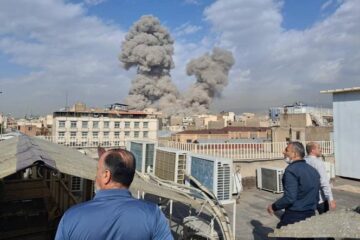 Across more than a century of modern warfare, one pattern stands out for its consistency. In war after war, cities have burned, infrastructure has collapsed, leaders have been targeted from the sky. Yet no regime in modern history has fallen solely because it was bombed from the air.
 W
W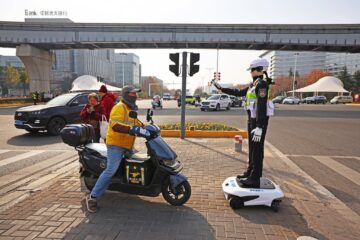 People in China are among the most excited in the world about A.I., according to a
  For the first time in more than half a century, there are no binding restraints on the buildup of the largest nuclear forces on Earth. The
  I
I Scott Shambaugh,
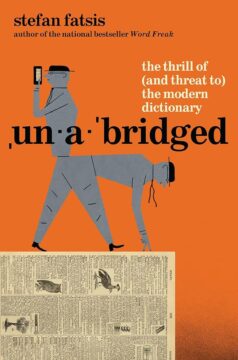 In 2014, at a small Stanford University lecture hall, the Merriam-Webster editor Peter Sokolowski introduced the crowd of assembled nerds to the idea that a dictionary is not a static document but a living object, constantly updated and remade in response to how people write and speak. In a talk titled “The Dictionary as Data,” Sokolowski emphasized that the editors at Merriam-Webster look to how the general public uses language to guide their work. He shared enticing tidbits, including that xi and za, classic Scrabble words, were popular late-night searches in the online dictionary, and that people regularly look up love ahead of Valentine’s Day. Awed, I wrote in a campus magazine a few days later that “we forget that the dictionary, a seeming bastion of objective reality, is compiled by people who use language, too.”
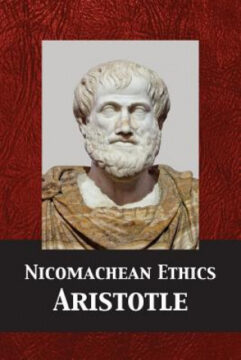 If you want a surefire way to incite hostility on social media, I suggest flaunting the fact that you work nights and weekends — or complaining about those who do. The sea of humans will suddenly part before you into two angry mobs: the workaholics, who are prepared to sacrifice their lives at the altar of capitalism, and the restaholics, whose highest ideal is slacking off and who seethe with resentment at those ruining the curve. Or so the two groups understand one another. Do we work in order to rest, or do we rest in order to work? Neither answer is very appealing. Working in order to rest sounds like a paraphrase of Freud’s death drive: as though, in an ideal world, we would just be sitting quietly, motionlessly, imitating corpses. Resting in order to work suggests the equally depressing thesis that the goal of a human life is to become a well-oiled cog in some kind of machine, a tool for the use of the leviathan called society. We need to work, because survival demands it, and we need to rest, because work is tiring, but are those two possibilities really exhaustive? Isn’t there a third state — one that we don’t need but freely choose?

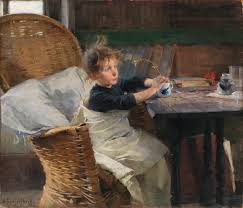 The best works by the Finnish painter Helene Schjerfbeck leave you convinced they might vanish from one moment to the next, just as a dream seems to grow sharper right before it ends. For all their winking tints and sinuous linework, the dominant mood is one of bittersweet calm, reminding us that fugacity, when it recurs often enough, eventually achieves a sort of permanence. Seeing Silence: The Paintings of Helene Schjerfbeck, on view at the Metropolitan Museum of Art through April 5, is a fittingly relaxed introduction to the artist, revealing Schjerfbeck’s discreet mastery, one cleverly understated canvas at a time.
 NEAR MANAUS, BRAZIL—