Slavoj Zizek on the bureaucracy of the Israeli occupation of the West Bank, in In These Times:
In Palestine Inside Out: An Everyday Occupation, Saree Makdis describes how, while the Israeli occupation of the West Bank is ultimately enforced by the armed forces, it is an “occupation by bureaucracy”: Its primary forms are application forms, title deeds, residency papers and other permits. It is with this micro-management of daily life that Israel secures its slow but steadfast expansion. One has to ask for a permit in order to live with one’s family, to farm one’s land, to dig a well, to go to work, to school, to a hospital.
Though it has been largely ignored by the media, Israel is clearly engaged in a slow, invisible process—a kind of underground digging of the mole—gradually undermining the basis of Palestinian livelihood so that, one day, the world will awaken and realize that there is no more Palestinian West Bank, that the land is Palestinian-free, and that all we can do is accept it.
The story has been going on since 1949: While Israel accepts the peace conditions proposed by the international community, it anticipates that the peace plan will fail. While condemning the openly violent excesses of “illegal” settlements, the State of Israel promotes new “legal” West Bank settlements. A look at the changing map of East Jerusalem, where the Palestinians have been gradually encircled and their space sliced, tells it all. The map of the Palestinian West Bank already looks like a fragmented archipelago.
The condemnation of unsanctioned anti-Palestinian violence obfuscates the true problem of state violence; the condemnation of illegal settlements obfuscates the illegality of the “legal” ones.
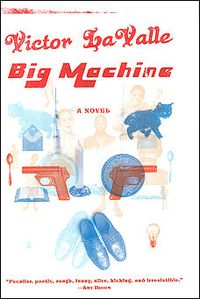
In Victor LaValle's spectacular new novel, “Big Machine,” race and religion are the subterranean tributaries that threaten to destroy America's underclass, even as they help to sustain it. Along with Junot Diaz, Lev Grossman, Kelly Link and Kevin Brockmeier, LaValle is part of an increasingly high-profile and important cohort of writers who reinvent outmoded literary conventions, particularly the ghettos of genre and ethnicity that long divided serious literature from popular fiction. In that spirit, the epigraph for “Big Machine” is from John Carpenter's remake of “The Thing,” and in LaValle's acknowledgments he thanks not just Thomas Paine but also Octavia Butler, Stephen King, Shirley Jackson and “my man Ambrose Bierce,” all of whom stand as spiritual godparents to this sprawling, fantastical work.
“Lurking in toilets was my job,” says Ricky Rice, the novel's narrator. Ricky is a 40-year-old janitor, a recovering junkie and childhood survivor of the Washerwomen, a communal religious cult whose catastrophic, bloody demise evokes that of the Branch Davidians and Philadelphia's MOVE organization. Ricky is cleaning a toilet stall in Utica, N.Y., when he opens a mysterious envelope addressed to him. Inside he finds a one-way bus ticket to Burlington, Vt., as well as a cryptic note: “You made a promise in Cedar Rapids in 2002. Time to honor it.”
ictures of grinning kids may reveal more than childhood happiness: a study from DePauw University shows that how intensely people smile in childhood photographs, as indicated by crow’s feet around the eyes, predicts their adult marriage success. According to the research, people whose smiles were weakest in snapshots from childhood through young adulthood were most likely to report being divorced in middle and old age. Among the weakest smilers in college photographs, one in four ended up divorcing, compared with one in 20 of the widest smilers. The same pattern held among even those pictured at an average age of 10.
The paper builds on a 2001 study by psychologists at the University of California, Berkeley, that tracked the well-being and marital satisfaction of women from college through their early 50s. That work found that coeds whose smiles were brightest in their senior yearbook photographs were most likely to be married by their late 20s, least likely to remain single into middle age, and happiest in their marriage; they also scored highest on measures of overall well-being (including psychological and physical difficulties, relationships with others and general self-satisfaction).
The Arab TV channel is visually stunning, exudes hustle, and covers the globe like no one else. Just beware of its insidious despotism.
Robert Kaplan in The Atlantic:
Has anyone watched the English-language version of Al Jazeera lately? The Qatar-based Arab TV channel’s eclectic internationalism—a feast of vivid, pathbreaking coverage from all continents—is a rebuke to the dire predictions about the end of foreign news as we know it. Indeed, if Al Jazeera were more widely available in the United States—on nationwide cable, for example, instead of only on the Web and several satellite stations and local cable channels—it would eat steadily into the viewership of The NewsHour With Jim Lehrer. Al Jazeera—not Lehrer—is what the internationally minded elite class really yearns for: a visually stunning, deeply reported description of developments in dozens upon dozens of countries simultaneously…
Al Jazeera is also endearing because it exudes hustle. It constantly gets scoops. It has had gritty, hands-on coverage across the greater Middle East, from Gaza to Beirut to Iraq, that other channels haven’t matched. Its camera crew, for example, was the first to beam pictures from Mingora, the main town of Swat, enabling Al Jazeera to confirm that the Pakistani military had, in fact, prevailed there over the Taliban.
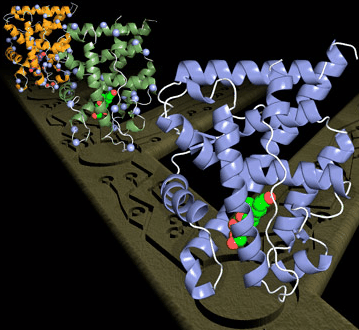
Evolution doesn't make U-turns, according to a new study of proteins. The study shows that simply reversing selective pressure won't make a biomolecule revert to an earlier form. The finding confirms a much-debated biological law that, evolutionarily speaking, there's no going back.
Since the late 19th century, evolutionary biologists have debated whether evolution can go in reverse. If not, then evolution may depend on more than just natural selection. Multiple evolutionary paths could be possible through small chance events. It hasn't been easy to examine reversibility. Previous studies have focused on complex traits such as whale flippers, and scientists often lack sufficient information about ancestral traits or how present-day traits evolved.
So evolutionary biologist Joseph Thornton of the University of Oregon, Eugene, and his colleagues picked a more tractable subject: a single protein.
Gordon Gekko got it wrong. In his new book The Age of Empathy: Nature's Lessons for a Kinder Society, primatologist Frans de Waal uses a variety of studies on empathy in animals to debunk the idea that humans are competitive to the core. He talked to TIME about contagious yawning, why we share and Bernie Madoff.
How do you define empathy?
Empathy is sometimes defined by psychologists as some sort of high-level cognitive feat where you imagine how somebody else feels or how you would feel in their situation. But my definition is more focused on the whole of empathy, and that includes emotions. If you are sad and crying, it's not just that I try to imagine how you feel. But I feel for you and I feel with you.
You explain in the book that empathy really starts with our bodies: running together, laughing together, yawning together. So yawning really is contagious?
Yeah. Dogs catch yawns from their owners. Chimpanzees yawn [in response to those] that we show them. Yawn contagion is very interesting because it's a very deep bodily connection between humans or between animals. Humans who have problems with empathy, such as autistic children, don't have yawn contagion.
Next month the Constitutional Court will rule on whether a tailor-made 2008 law granting Berlusconi full judicial immunity is constitutional. If the measure is knocked down, the prime minister could be exposed to prosecution in a corruption case. His leading ally in his Popolo della Libert party, Chamber of Deputies president Gianfranco Fini, has been marking his distance from Berlusconi and signaling he's ready to replace him. Berlusconi's European partners and the Obama administration are said to be annoyed about his effusive displays of friendship to Vladimir Putin and Muammar Qaddafi. The European Union has censured Italy for towing boatloads of desperate Eritreans and Somalis, many of them certainly eligible for refugee status, back to Libya from where they set out–and where they will be interned in barbaric prison camps. And the worst of the world economic crisis is expected to hit Italy this winter.
For the first time, there is talk about the end of Berlusconi. And for the first time, comparisons of this regime to Fascism are being advanced not just as rhetoric but in all seriousness.
Muslim Americans Answer the Call is a nationwide grassroots response to mobilise every single Muslim American in a united effort for community service. The Qur'an says: “Race one another in good works” (Qur'an 5:48). And since the campaign continued through Ramadan, many of us felt there was no better way to show our faith than in action. Beginning 22 June, the group committed to completing 1,000 community service projects, and we surpassed 3,000.
Projects ranged from partnering with the Salvation Army, an organisation dedicated to relieving poverty, to preparing thousands of meals for the homeless in our nation's capital, to working with publishers to provide textbooks for under-funded schools on Native American reservations.
Last week I attended Fast2Feed, an interfaith iftar dinner marking the end of the daily fast, at the Sixth and I Historic Synagogue in Washington, DC.
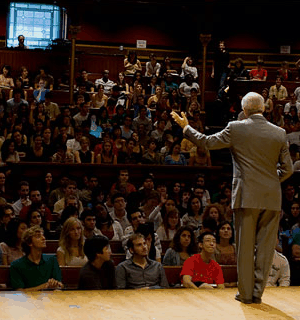
Many of the 14,000 or so students who have taken Harvard’s wildly popular course “Justice” with Michael J. Sandel over the years have heard the rumor that their professor has a television avatar: Montgomery Burns, Homer Simpson’s soulless ghoul of a boss at Springfield’s nuclear power plant.
The joke, of course, is that Mr. Sandel — who at one time or another taught several future writers for Fox’s “Simpsons” and shares a receding hairline with the evil-minded cartoon character — is the anti-Burns, a moral philosopher who has devoted his life to pondering what is the right thing to do.
Now Mr. Sandal gets to play himself on television, not to mention online, as Harvard and public television stations across the country allow viewers to sit in on his classroom discussions about Wall Street bonuses and Aristotle, same-sex marriage and Kant, for the next 12 weeks.
More here. And watch the first episode of Justice:
Well, this is unexpected — a comic book about the quest for logical certainty in mathematics. The story spans the decades from the late 19th century to World War II, a period when the nature of mathematical truth was being furiously debated. The stellar cast, headed up by Bertrand Russell, includes the greatest philosophers, logicians and mathematicians of the era, along with sundry wives and mistresses, plus a couple of homicidal maniacs, an apocryphal barber and Adolf Hitler. Improbable material for comic-book treatment? Not really. The principals in this intellectual drama are superheroes of a sort. They go up against a powerful nemesis, who might be called Dark Antinomy. Each is haunted by an inner demon, the Specter of Madness. Their quest has a tragic arc, not unlike that of Superman or Donald Duck.
The carriage moved on. Karol sat on the driver’s seat, next to the coachman. She, in the front—and where her little head ended, there he began above her as if placed on an upper story, his back toward us, a slim contour, visible yet featureless—while his shirt billowed in the wind—and the combination of her face with the absence of his face, the complement of her seeing face with his unseeing back struck me with a dark, hot duality. . . . They were not unusually good-looking—neither he nor she—only as much as is appropriate for their age—but they were a beauty in their closed circle, in their mutual desire and rapture—something in which practically no one else had any right to take part. They were unto them-selves—it was strictly between them. And especially because they were so (young). So I was not allowed to watch, I tried not to see it, but, with Fryderyk in front of me and sitting next to her on the small seat, I was again persistently asking myself: Had he seen this? Did he know anything? And I was lying in wait to see a single glance of his, one of those supposedly indifferent ones yet sliding by surreptitiously, greedily.
more from Danuta Borchardt’s new translation of Witold Gombrowicz’s masterpiece at The Quarterly Conversation here.
Naked Lunch, the chaotic masterpiece by William Burroughs, turned 50 this year, and odds are you probably haven’t read it. Not unlike Ulysses, War and Peace or anything by Thomas Pynchon, Naked Lunch is often lauded but seldom read, even by admitted bibliophiles. But for those who have indeed read it, the book packs a literary punch that continues to ripple through Western culture, particularly among avant-garde writers and (strangely enough) musicians. Which brings to mind the question: why is Naked Lunch still relevant 50 years later? Or, conversely, is it still relevant? Is this book just meaningful to a few fans and leftover NYC lit-punks who hope their special brand of shock still resonates long after the anger of youth has faded and the office job has begun to make sense? Or does Naked Lunch offer something more to the present day than anyone expected?
“David Byrne: singer, artist, composer, director, Talking Head.” I’m quoting the bartender Moe Szyslak from “The Simpsons” here, from an episode in which Byrne appeared. One could also add photographer, author, designer and, since the early 1980s, serious bicyclist. At first he just rode in downtown Manhattan, but as his career has taken him around the world he’s packed his full-size folding bike and carried it with him, sometimes resentfully paying a $125 “sports equipment” surcharge on airplanes. “Bicycle Diaries” contains accounts of his travels in distant cities like London, Berlin, Buenos Aires and Manila, as well as some closer to home — New Orleans, San Francisco and Detroit. His description of riding in Detroit is especially good: “I bike from the center of town out to the suburbs. It’s an amazing ride — a time line through a city’s history, its glory and betrayal.”
For Byrne bicycling is partly a means, partly an end. It helps him get places, makes him feel more connected to life on the streets, and also serves as a “form of meditation” that keeps him sane. Inevitably the diary format gives the book a random, scattershot quality: Byrne is in no sense a “programmatic” bike rider, and he admits he’s sometimes just skimming over the surface of the cultures he encounters. Even so, his interests and activities — cutting-edge art exhibitions, rock festivals, a subversive PowerPoint presentation about PowerPoint presentations, a belly dance party — and certainly his personality are singular enough to give the book consistency and coherence.
In 1927, Emily Carr was creatively blocked, financially insolvent, spiritually arid, and on the verge of becoming the greatest discovery in the history of Canadian art. The fifty-five-year-old spinster had largely given up art and was raising chickens in her backyard in Victoria when Eric Brown, the director of the National Gallery of Canada, knocked at her door and asked if he could look around. Painfully shy, she reluctantly hauled out a few of her “old Indian pictures,” experimental works that set faithful renderings of the totem poles and war canoes of the Haida Gwaii against dynamic, impressionistic landscapes. Brown was besotted. On the spot, he offered to feature her work in an upcoming exhibit in Ottawa focusing on modern Canadian landscape painters, including the Group of Seven. Carr, who’d never heard of the National Gallery or the loose collective of artists who had won international acclaim at the British Empire Exhibition three years earlier, initially declined the invitation. Brown recommended that she read A Canadian Art Movement: The Story of the Group of Seven, by Fred Housser, a Toronto journalist and good friend of the group. After he left, having secured her participation, Carr dashed to the bookstore.