Can You Believe How Mean Office Gossip Can Be?

From The New York Times:

Popup Could adults gossiping in the office be more devious than the teenagers in “Gossip Girl”? If you have a hard time believing this, then you must have skipped the latest issue of the Journal of Contemporary Ethnography. Perhaps you saw “ethnography” and assumed it would just be quaint reports from the Amazon and the South Seas. But this time enthnographers have returned from the field with footage of a truly savage native ritual: teachers at an elementary school in the Midwest dishing about their principal behind her back. These are rare records of “gossip episodes,” which have been the subject of a long-running theoretical debate among anthropologists and sociologists. One side, the functionalist school, sees gossip as a useful tool for enforcing social rules and maintaining group solidarity. The other school sees gossip more as a hostile endeavor by individuals selfishly trying to advance their own interests.

But both schools have spent more time theorizing than observing gossipers in their natural habitats. Until now, their flow charts of gossips’ conversations (where would social science be without flow charts?) have been largely based on studies in informal settings, like the casual conversations recorded in a German housing project and in the cafeteria of an American middle school.

More here.

Monday, November 2, 2009

From The Owls: L. S. McKee’s “Pow’r”

Powr Pow'r

By L. S. McKee

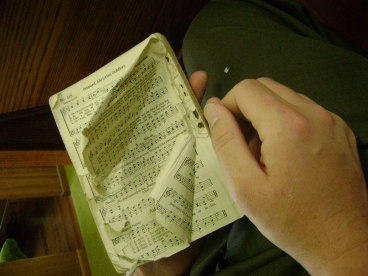
The first time I attended my father’s church, I was mortified, standing among my siblings, to realize we would be singing hymns without accompaniment: the sole piano player had defected to another church before my father’s arrival. With barely over a dozen members in the congregation, you couldn’t get away with mouthing the words. And trying to sing loudly enough to prove you have neither a heathen’s irreverence – though you are your very own, grown-up kind of heathen, singing out of respect for your parents’ belief – nor a tin ear while trying to keep your neighbors from hearing the cracks in your voice is akin be being strangled. Or slowly drowning. The necessary ratios of open throat to closed throat, of sound release to sound blockage, are tricky. Sure, it sounds pornographic, but anyone who has reluctantly joined in on the joys of communal singing knows it’s the truth. Your heart rate accelerates equally from oxygen deprivation as congregational stage fright. All this to say, trying to maintain privacy while singing in church is difficult enough without a conspicuously absent piano and twelve good country people singing acapella.

Read more »

Sunday, November 1, 2009

Margaret Thatcher’s German war

TLS_Kundnani_636292aHans Kundnani in the TLS:

It has long been known that tensions existed between Thatcher and the Foreign Office, including her Foreign Secretary, Douglas Hurd. To coincide with the twentieth anniversary of the fall of the Berlin Wall, the FCO has published a set of documents from its and the Cabinet Office’s archives that would normally have been released under the thirty-year rule. They illustrate the full extent of those tensions for the first time.

Although Britain had a long-standing commitment to German unity through self-determination, which Thatcher had herself reiterated in 1985, some mandarins appear to have had views on Germany that were not so different from the Prime Minister’s. The collection opens with a note from Sir Christopher Mallaby, the British ambassador in Bonn, which is almost Thatcherite in its analysis of German pathology (the Germans, he says, are “always yearning for something”). But during the course of 1989, the FCO became increasingly concerned about the possible effect of Thatcher’s reaction to events in East Germany on relations with Britain’s other allies. Sir Patrick Wright, the Permanent Under-Secretary of State in the FCO, worries at one point that “the Prime Minister’s views, if they became known, would raise eyebrows (at least) both in Germany and in the United States”. On November 10, Wright cautions Stephen Wall, Hurd’s Private Secretary, that Thatcher might be feeling “under siege” from her advisers.

The documents illustrate how quickly events in East Germany began to move after November 9. On November 27, Mallaby describes how the theme of reunification, “though still shunned by Kohl and [Foreign Minister Hans-Dietrich] Genscher, is becoming more prominent in political debate”, and says a growing number of Germans believe that it will take place within ten years. The following morning, his counterpart in East Berlin, Nigel Broomfield, reports to Hurd that a growing number of East Germans are now demanding immediate reunification. Later that day, Kohl announced his Ten-Point Plan in the Bundestag without consulting the British beforehand. Mallaby sends Hurd another telegram at the end of the day after finally being briefed by Kohl’s adviser Horst Teltschik, who has told Mallaby that even Kohl’s plan “could be overtaken by other views before long”. So it proved.

Research Confidential

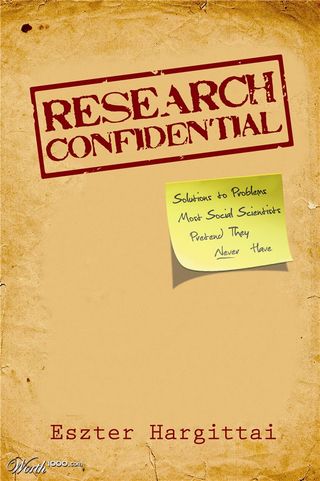
1163099_1cca_625x1000 An interview with Eszter Hargittai, editor of Research Confidential, in Inside Higher Ed:

For social scientists starting their careers, creating research models that work is crucial. A new book suggests that they may be unaware of problems they face in part because scholars don't share stories of what didn't work on their projects, and how to deal with particular challenges. Research Confidential: Solutions to Problems Most Social Scientists Pretend They Never Have has just been published by the University of Michigan Press. The essays in the collection are all by younger scholars, including the volume's editor, Eszter Hargittai, an associate professor of communication studies at Northwestern University, a fellow at the Berkman Center for Internet & Society at Harvard University and a career advice columnist for Inside Higher Ed. Hargittai responded to questions about the book.

Q: I was struck by the part of your subtitle where you say “pretend they never have.” Why do you think social scientists don't recognize or hide from problems with their research methods?

A: This title refers less to what social scientists recognize and more to what shows up in the final write-up of their projects. When one reads journal articles, the methodological sections tend to make the projects sound rather straight-forward. In books, details about methods are usually relegated to an appendix, at best, and do not tell the reader the reality of data collection. Instead, they are pretty, cleaned-up versions of what happened. For example, they will include the number of final interviews the researcher conducted, but they won't include details about how many attempts it took to get a person to come to an interview.

It is certainly the case that such detailed descriptions may be out of place in some such write-ups, but the problem is that then readers do not realize the true complexities involved with the process. For example, students will not understand what amount of effort went into securing all of the interviews and how much frustration was associated with last-minute cancellations and other hurdles that may have come up. Similarly, journal articles don't tend to explain that it took IRB three times as long to approve a project than expected and thus everything was delayed. Again, that information may not be useful for the final write-up of results, but without seeing such details, it is hard for new scholars to recognize that they are indeed the reality of actual research and must be accounted for in planning new projects. This probably contributes to why so many people — both students and faculty — underestimate the length of time any project will take.

In another vein, I also think some social scientists encounter fewer problems, because they compromise the quality of their research.

A Feminist Case for War?

091024_goldberg_leadMichelle Goldberg in The American Prospect:

Women for Afghan Women (WAW), a nongovernmental organization that runs women’s shelters, schools, and counseling centers in three cities in Afghanistan, has watched with alarm as American opinion has turned against the occupation. An American withdrawal, its board members say, would be catastrophic for the women they work with. “Every woman who we have talked to in Afghanistan, all the Afghan women in the NGOs, in the government, say the United States and the peacekeeping troops and NATO must stay, they must not leave until the Afghan army is able to take over,” says Esther Hyneman, a WAW board member who recently returned from six months in Kabul.

In fact WAW, which has over 100 staffers in Afghanistan and four in New York, is, with some reluctance, calling for a troop increase. “Women for Afghan Women deeply regrets having a position in favor of maintaining, even increasing troops,” it said in a recent statement. “We are not advocates for war, and conditions did not have to reach this dire point, but we believe that withdrawing troops means abandoning 15 million women and children to madmen who will sacrifice them to their lust for power.”

There is a growing consensus among both progressives and a few realist-minded conservatives that the Afghan war is futile. Today’s Washington Post reports on Matthew Hoh, a State Department official who, after serving in Afghanistan, resigned to protest the continuation of the war. “I have lost understanding of and confidence in the strategic purposes of the United States’ presence in Afghanistan,” he wrote in a letter to the department’s head of personnel. With such sentiments spreading, one of the few remaining rationales for maintaining the occupation is that it’s the only way to protect Afghan women against the return of the Taliban. But does it make sense to perpetuate America’s presence in Afghanistan on feminist grounds?

An Interview with Emily Bobrow

Tmntalks-Bobrow-1 Speaking of More Intelligent Life, an interview with the editor in The Morning News:

TMN: What’s it like to edit the online version of a magazine as opposed to the print product, in terms of behind-the-scenes?

EB: The cycle of editing a print product is distinct: slow beginnings, procrastination-friendly middles, bursts of pre-deadline activity, followed by a satisfying catharsis. Wash, rinse, repeat. Online, things are a bit different. The grind is daily and less rigid. We have a new story up on the site every day and an active blog; writers submit their work, which I then turn around, add graphics, and publish on the site (with help from an assistant editor and a contributing editor in New York). The effect is more like a churn—there are always more pieces than time. Catharsis is elusive.

I recently edited The Economist’s Books and Arts section for a couple of weeks, and I was surprised by how different it felt. The experience was much more collaborative, less isolated. Publication plans are announced at a big meeting; editing is compressed into a couple of days (with notes and feedback from the editor-in-chief); pages are created with help from people in graphics and art direction; stories are cut for space; and then—bam!—a physical product is born into the world. After years of online editing, the work of making pages was disconcertingly satisfying. What a pity no one wants to pay for print anymore.

TMN: Is the condition of print media as dire as everyone says?

EB: Of course it is. When was the last time you bought a newspaper? What was the last magazine subscription you shelled out for? We know information is valuable, and some of the hardest to acquire (war coverage, investigative studies) is also the most expensive to pay for. We learned in the last year that print advertising is too vulnerable to comfortably cover such costs. What we haven’t learned yet is just how publishers plan to pay for print journalism going forward, now that we all feel entitled to have our news instantaneously and for free.

Should We Eat Bugs?

Grasshopper_for Emily Salma Abdelnour in More Intelligent Life:

High in protein, low in fat, delicious, ubiquitous: why not eat bugs? A unique gourmet meal has Salma Abdelnour reconsidering her insectophobia …

New York City may be less bug-ridden than swampier towns to the south, but it still presents challenges for the insectophobe. Multi-legged critters large and small find their way into every kind of residential space (skyscrapers are no less vulnerable). Vanquishing them might involve anything from an army of exterminators to a late-night call to an ex, Annie Hall-style. But on a recent night in Brooklyn, two dozen New Yorkers with varying degrees of insectophobia gathered to face down the creatures in an altogether unusual way.

Marc Dennis, a local artist, had invited guests to a dinner party in an enormous loft space with spectacular views of the Manhattan skyline in the industrial-chic Dumbo neighbourhood. This being Dennis, who recently launched InsectsAreFood.com and whose crisply detailed paintings of bugs have been acclaimed in Town and Country magazine and the Chicago Tribune, the dinner had a very specific theme.

Around 7pm, as his guests began to arrive, Dennis stood behind the counter in the gleaming stainless-steel open kitchen and removed a few dozen Thai Jing Leed crickets from a bowl of Lapsang Souchong tea, where they had been soaking for nearly an hour. He then piled them on a pan to roast in the oven (pictured); meanwhile, on another tray, he laid out neat rows of roasted bamboo worms, then began chopping yellow, red, and green bell peppers into a colourful stack.

Are Liberals Smarter Than Conservatives?

From The American:

FeaturedImage Who are smarter, liberals or conservatives? This is the kind of question that could spark fierce and endless debates between political opponents, but what if we could know, scientifically, that one side has the edge in brainpower? Should that change how we think about political issues?

Though few partisans on either side are likely to admit it, most people at one time or another have suspected that their political opponents are dim bulbs. Sometimes these sentiments get aired publicly, and both the Left and the Right have been guilty of leveling the “you’re stupid” accusation. Last summer, for example, conservative activists pushed the view that Supreme Court Justice Sonia Sotomayor, then a nominee, is an intellectual lightweight who lacks the brainpower to be an effective justice. But questioning the IQ of opponents is a specialty of liberals. When John Stuart Mill labeled British Conservatives “the Stupid Party” in the 19th century, he apparently started a long-term trend. Ronald Reagan, after all, was an “amiable dunce,” according to Clark Clifford and other Democrats. And when Vice President Dan Quayle told a 12-year-old student in a spelling bee that potato had an “e” at the end of it, Democrats milked the incident for all it was worth and then some. They even had the same student lead the Pledge of Allegiance at their 1992 convention.

More here.

Sunday Poem

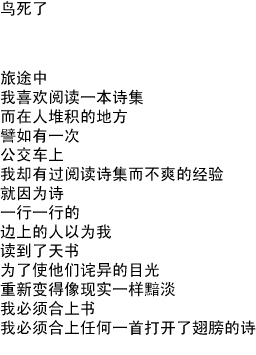
The Birds are Dead Now

I like reading books of poems
on my travels
and in places where people pile up
once
on a bus
I had an unhappy poetry reading experience
because poetry
is written in lines
the people round me thought
I had got my hands on some
weird gobbledegook
to turn their looks of astonishment
back to a dullness so like that of reality
I had no choice but to close the book
and any poems that had spread their wings

The birds are dead poem………………………….
………………………….
………………………….
……………………………..
………………………….
………………………….
………………………….
……………………………..

………………………….
………………………….
………………………….
……………………………..
………………………….
………………………….
………………………….
……………………………..

………………………………….
……………………………………..
………………………………………
…………………………………………
…………………………………..
…………………………………….

by Fang Xianhai
translation: Simon Patton and Guan Zhen, 2009

20 of the most shameless cultural franchises

From The Telegraph:

Cat_1513027c If the actor dies, the singer quits or the writer can't work fast enough, there is no reason to stop churning out culture. Here are 20 triumphs of money — or stubborn longevity — over art.

1) Robert Ludlum
The prolific thriller author behind the Bourne trilogy of novels didn't let the small matter of dying put an end to his career. More than a dozen books – written for the most part by jobbing hacks – have been published under his name since he passed away in 2001. And the gravy train doesn't look like stopping any time soon. ''People expect something from a Robert Ludlum book, and if we can publish Ludlum books for the next 50 years and satisfy readers, we will,'' the executor of his state told the New York Times.

2) Pussycat Dolls
This chart-topping US girl band does not have members, it has “representatives”. Under the guiding hand of Svengali Robin Antin, the group has morphed from burlesque troupe to Las Vegas stage act to reality television fodder, in the process shedding all of its original performers. The comedian Sacha Baron Cohen, in character as the offensive Kazakh television presenter Borat, introduced them at the 2005 MTV Europe awards as “international singing prostitutes”. An outrageous slur on their sexual morals, but arguably a fair précis of the financial motivations behind the project.

More here.

Saturday, October 31, 2009

Dreams of Better Schools

Andrew Delbanco reviews E.D. Hirsch Jr.'s The Making of Americans: Democracy and Our Schools and Mike Rosein's Why School? Reclaiming Education for All of Us in the NYRB:

Ever since its beginnings in antebellum Massachusetts, public education has been regarded as a national imperative, yet running the schools has generally been left to the states. Before the Civil War, when one western state school superintendent observed the “futility of attempting to operate a Free School System, without proper supervisory agents,” supervision was considered a state responsibility, and so it has remained ever since. During the short-lived experiment of Reconstruction, Congress did seek to influence local educational practices through its oversight of the new state constitutions, and through the Freedmen's Bureau, which set up schools in the South for black Americans who had previously been denied access to education. But it took nearly a century till the US Supreme Court, in Brown v. Board of Education (1954), issued its order that all public schools must be integrated. And it was not until the presidency of Lyndon Johnson that the federal government got substantially involved in school reform by directing funds to the states through the Elementary and Secondary Education Act of 1965 (ESEA), with the goal of improving schools in high-poverty neighborhoods.[5]

So it is all the more remarkable that it was under George W. Bush, a president full of platitudes about the virtue of local autonomy and the folly of “big government,” that Washington entered the field of public education more aggressively than ever before. The No Child Left Behind Act of 2002, supported by many liberal Democrats, notably the late Senator Edward M. Kennedy, required that states institute standards defining what students must learn grade by grade, test student achievement school by school and district by district, and improve—or, in the absence of improvement, eliminate—schools that fail to meet the standards.

In general, the Obama administration remains committed to such mandates.

teachout defends “civilization”

PT-AM889_SICLAR_D_20091029120405

Television can make you famous, but it can’t keep you famous. It’s a bit like heroin: No sooner do you stop taking your daily fix than you get all pale and clammy, after which you vanish in a puff of smoke. So far as I know, there’s never been a TV star who lingered in the public eye for very long after departing from the airwaves—least of all Kenneth Clark. Even among his fellow art historians, Clark is only modestly well remembered. Most of his books are now out of print, and you’re not likely to know his name if you’re much under the age of 50. But Clark became a full-fledged celebrity in his late 60s when, in 1970, the newly hatched Public Broadcasting Service aired a 13-part TV series called “Civilisation: A Personal View” in which he escorted his viewers through a thousand years of cultural history. The program had been a huge success when broadcast by the BBC the preceding year, and it made a similar splash in America: In addition to launching PBS with a bang, “Civilisation” spawned an eponymous coffee-table book that cracked the best-seller list. It was the first time that PBS aired the kind of show that has since been dubbed “appointment TV.” Everybody felt they had to see it—and talk about it.

more from Terry Teachout at the WSJ here.

WTV

50145491-30153526

Reporting from San Francisco – William T. Vollmann hardly looks like one of the most ambitious authors of his generation. Walking on Haight Street in his rumpled jeans, ball cap and black T-shirt, shoulders bowed beneath a heavy backpack, he seems an older version of the street kids who still congregate in the tawdry heart of Haight-Ashbury — young men mostly, carrying bedrolls, panhandling for change. In a lot of ways, these are Vollmann’s people: outsiders, on the fringes, whom society tends to disregard. Outsiders have motivated his writing, from his 1987 debut novel, “You Bright and Risen Angels,” which posits a war between insects and human beings, through his most recent effort, the monumental “Imperial” (Viking: 1,306 pp., $55), which tracks another kind of conflict: the battles, real and metaphorical, that define Imperial County — battles over immigration and water, identity and the reach and limitations of political power. The book, which came out in August, is perhaps the clearest expression of Vollmann’s career-long commitment to immerse himself in complexities.

more from David L. Ulin at the LA Times here.

The Rags of Time

Istanbul

Part of the delight in “The Museum of Innocence” is in scouting out the serious games, yet giving oneself over to the charms of Pamuk’s storytelling. He often makes use of genre, turns the expected response to his purpose. His 1998 book “My Name Is Red” may be claimed as a historical novel with an embedded mystery, and yet again as a political story — the miniatures of Eastern book art headed toward obsolescence, facing off with Western art, its perspective and freedom of invention. Such worldly engagement is of no concern to Kemal: “I have no desire to interrupt my story with descriptions of the street clashes between fervent nationalists and fervent Communists at that time, except to say what we were witnessing was an extension of the cold war.” It’s one of many denials that maintain his indifference to the political scene, and it’s in keeping with his character. A feckless soul, an aging bachelor living with his mother, he is dealt a position in a family business he barely attends to. Meanwhile, during the years of their separation, the beautiful Fusun has married a would-be movie director. Night after night Kemal joins them at her family’s dinner table, a threesome locked in a hopeless love story. It never occurs to the constant lover that Fusun may be ordinary — much like the adored girl in Nabokov’s “Lolita.” Kemal is chauffeured from his mother’s house in Nisantasi to Cukurcuma, passively watching the nightly news with Fusun’s family. Years flipping by, he tags along with the cinema crowd in Beyoglu, the beloved one aiming to be an actress. Kemal’s dogged endurance may try our patience, though his dead-end accounting provides a bleak comedy: “According to my notes, during the 409 weeks that my story will now describe, I went there for supper 1,593 times.” Maureen Freely’s translation captures the novelist’s playful performance as well as his serious collusion with Kemal. Her melding of tones follows Pamuk’s agility, to redirect our vision to the gravity of his tale: “This is not simply a story of lovers, but of the entire realm, that is, of Istanbul.”

more from Maureen Howard at the NYT here.

Taking the novel seriously

From The Guardian:

Rana-Dasgupta-001 The winner of a literary prize is sometimes surprised, often delighted, seldom ever disappointed. But when I finally caught up with the novelist Rana Dasgupta, speaking on a patchy mobile phone as he drove through rural India a couple of weeks after his novel, Solo, had been voted the winner of the Guardian's inaugural Not the Booker prize, he confessed that he found his victory “very depressing”. After a month-and-a-half of discussion on the Guardian books blog, Dasgupta was chosen from a shortlist of six by an open vote in an atmosphere which he describes as “incredibly chaotic”.

“I had loads of people emailing me, asking 'Can I post this to the discussion?',” he says. “A lot of people were immensely irate about the whole thing – I was amazed by the passion it raised. I was mostly saying 'Please don't post anything'.” A user with the postername John Self posted an invitation Dasgupta had sent via Facebook for friends to come and vote on the Not the Booker thread, and at that point “anything that was said about my book was a conspiracy,” Dasgupta continues, “and people were saying that I was behind it all.” It reached a point where Dasgupta felt there was “no way of arguing with any of this”, and posted on the thread himself to withdraw from the competition.

According to Dasgupta, this was partly because he'd transgressed on an unwritten assumption among those commenting on the blog. “One thing that really surprised me was the expectation that authors should be this completely separate group who wouldn't even know how to send an email,” he says. “There's this particular idea of what an author should or shouldn't do, and when you infringe that view there's an incredible violence. Most publishers are putting enormous pressure on their authors to publicise their own work, but it's as if a fiction must be maintained that you have no part in this; that if you were nominated for some prize you'd have no idea.”

More here.

Ayn Rand’s Revenge

From The New York Times:

Rand A specter is haunting the Republican Party — the specter of John Galt. In Ayn Rand’s libertarian epic “Atlas Shrugged,” Galt, an inventor disgusted by creeping American collectivism, leads the country’s capitalists on a retributive strike. “We have granted you everything you demanded of us, we who had always been the givers, but have only now understood it,” Galt lectures the “looters” and “moochers” who make up the populace. “We have no demands to present you, no terms to bargain about, no compromise to reach. You have nothing to offer us. We do not need you.”

“Atlas Shrugged” was published 52 years ago, but in the Obama era, Rand’s angry message is more resonant than ever before. Sales of the book have reportedly spiked. At “tea parties” and other conservative protests, alongside the Obama-as-Joker signs, you will find placards reading “Atlas Shrugs” and “Ayn Rand Was Right.” Not long after the inauguration, as right-wing pundits like Glenn Beck were invoking Rand and issuing warnings of incipient socialism, Representative John Campbell, Republican of California, told a reporter that the prospect of rising taxes and government regulation meant “people are starting to feel like we’re living through the scenario that happened in ‘Atlas Shrugged.’ ”

More here.