Kinkiness Beyond Kinky

Carl Zimmer in his excellent blog, The Loom:

Ruddy%20duck%20phallus There comes a time in every science writer’s career when one must write about glass duck vaginas and explosive duck penises.

That time is now.

To err on the side of caution, I am stuffing the rest of this post below the fold. My tale is rich with deep scientific significance, resplendent with surprising insights into how evolution works, far beyond the banalities of “survival of the fittest,” off in a realm of life where sexual selection and sexual conflict work like a pair sculptors drunk on absinthe, transforming biology into forms unimaginable. But this story is also accompanied with video. High-definition, slow-motion duck sex video. And I would imagine that the sight of spiral-shaped penises inflating in less than a third of second might be considered in some quarters to be not exactly safe for work. It’s certainly not appropriate for ducklings.

So, if you’re ready, join me below the fold.

More here.
Tuesday Poem

Losing Track

Long after you have swung back

away from me

I think you are still with me:

you come in close to the shore

on the tide

and nudge me awake the way

a boat adrift nudges the pier:

am I a pier

half-in half-out of the water?

and in the pleasure of that communion

I lose track,

the moon I watch goes down, the

tide swings you away before

I know I'm

alone again long since,

mud sucking at gray and black

timbers of me,

a light growth of green dreams drying.

by Denise Levertov

A Hidden Youthfulness

From Harvard Magazine:

Stem What if the stem cells in our bodies live on, even as we age? What if they are just asleep, quiescent, like forgotten sentinels nodding off at remote outposts, waiting for orders? If only scientists could discover how to send them messages, could they be reawakened? “When you’re little and fall off your bike,” says Cabot professor of the natural sciences Douglas Melton, “you barely remember it the next day and a week later you don’t remember it at all. I ride my bike all the time, and if I fall off now, I remember it for weeks.” Bruises last longer when you get older. But is the slowness of repair due to some deficiency that arises with age, that stops normal processes from working well? Or is it due to the absence of some youthful factor?

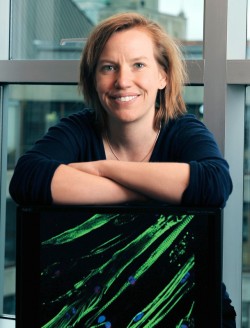
Amy Wagers, an associate professor of stem-cell and regenerative biology, has begun to answer this most provocative of questions—could we marshal the body’s own repair mechanisms to slow the process of aging?—with a simple experiment. Using mice that have been surgically joined so that their bloodstreams become shared, Wagers investigated whether the blood of a young animal might awaken the muscle stem cells in an old one and enhance muscle repair.

More here.

Sorry, Vegans: Brussels Sprouts Like to Live, Too

Natalie Angier in The New York Times:

Brussel In his new book, “Eating Animals,” the novelist Jonathan Safran Foer describes his gradual transformation from omnivorous, oblivious slacker who “waffled among any number of diets” to “committed vegetarian.” Last month, Gary Steiner, a philosopher at Bucknell University, argued on the Op-Ed page of The New York Times that people should strive to be “strict ethical vegans” like himself, avoiding all products derived from animals, including wool and silk. Killing animals for human food and finery is nothing less than “outright murder,” he said, Isaac Bashevis Singer’s “eternal Treblinka.”

But before we cede the entire moral penthouse to “committed vegetarians” and “strong ethical vegans,” we might consider that plants no more aspire to being stir-fried in a wok than a hog aspires to being peppercorn-studded in my Christmas clay pot. This is not meant as a trite argument or a chuckled aside. Plants are lively and seek to keep it that way. The more that scientists learn about the complexity of plants — their keen sensitivity to the environment, the speed with which they react to changes in the environment, and the extraordinary number of tricks that plants will rally to fight off attackers and solicit help from afar — the more impressed researchers become, and the less easily we can dismiss plants as so much fiberfill backdrop, passive sunlight collectors on which deer, antelope and vegans can conveniently graze. It’s time for a green revolution, a reseeding of our stubborn animal minds.

More here.

Pakistan continues to be Obama’s reluctant bride

Tony Karon in The National:

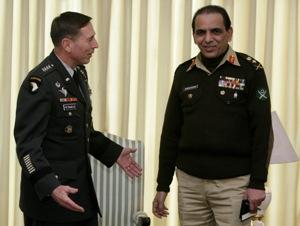
Petraeus-kayani The key character in the US president Barack Obama’s Afghanistan fairy tale is Pakistan – the erstwhile protector and enabler of the evil Taliban, but only out of ignorance, despair and an exaggerated fear of India. If only, goes the story, Pakistan could see that the Taliban is plotting to destroy it and recognise that its true interests lie with the noble purposes of the United States, it would ignore India, turn on the Taliban and flush out the insurgents to be crushed by US firepower. And so, a steady stream of US officials has traipsed through Islamabad this year, bearing carrots and brandishing sticks, trying to get Pakistan to see the light.

But the Pakistan of Washington’s imagination is a little like the Iraq of Bush Administration’s pre-war imagination – the one that was going to greet its invaders with sweets and flowers. But the US is choosing to ignore the writing on the wall. Just last week, back to back visits by two of the most senior commanders in the US military, General David Petraeus and Admiral Mike Mullen, failed to convince their Pakistani counterparts to go after the Pakistan-based Afghan Taliban and the allied Haqqani and Hekmatyar networks. Instead, Pakistan’s own counterinsurgency effort will be confined to the Tehrik e-Taliban Pakistan (TTP), the local extremist group challenging the Pakistani state.

The explanation given to the Americans by Pakistan’s generals is usually that Pakistan doesn’t have the resources to tackle all the militant groups on its soil at once. They ask the Americans, their key benefactor, to be patient, suggesting that once the TTP has been dealt with, they will be in a position to tackle other problems. That, of course, is a polite rebuff in the spirit of “maybe some other time”.

More here.

James Wood and Zadie Smith were doing battle in the sky

Our own Morgan Meis in The Smart Set:

Morgan Writing I had a dream, which was not all a dream. James Wood and Zadie Smith were doing battle in the sky. James was in silver armor and upon it the starlight did twinkle so. Zadie was in flowing white gowns. Her face was aglow with what I can only describe as a honey radiance. Still, I could see her freckles, which, I recall, pleased me to no end even as the terrible battle raged on and on. Twice, James smote her a heavy blow. Twice, Zadie raised herself up and hurled herself back upon him with swirling gowns and not an infrequent flash of thigh. Then the heavens went dark again and these two titans were seen to retire, he to one side of the galaxy and she to another. I thought I saw them both smile as the dream dissolved and the reality of a new day roused me from this nocturnal emanation.

James was mean to Zadie once in the real world. Without rehashing the whole thing, he accused her of laziness and self-absorption, of silly tricks and meager powers of concentration. He described what she — along with a few other young writers — was doing as Hysterical Realism. That now-famous piece in The Guardian included these devastating sentences:

This kind of realism is a perpetual motion machine that appears to have been embarrassed into velocity. Stories and sub-stories sprout on every page. There is a pursuit of vitality at all costs. Recent novels by Rushdie, Pynchon, DeLillo, Foster Wallace, Zadie Smith and others have featured a great rock musician who played air guitar in his crib (Rushdie); a talking dog, a mechanical duck and a giant octagonal cheese (Pynchon); a nun obsessed with germs who may be a reincarnation of J Edgar Hoover (DeLillo); a terrorist group devoted to the liberation of Quebec who move around in wheelchairs (Foster Wallace); and a terrorist Islamic group based in North London with the silly acronym Kevin (Smith).

This was in the early autumn of 2001, the heady days just after the 9/11 attacks when everyone felt that the world had changed somehow and that the frivolity of the recent past just wouldn't do. Zadie took the criticism standing up.

More here.

Telling stories about the weather

Joe Kloc in Seed Magazine:

MakeItRain_320x198 The Hopi people of the southwestern US have a story: During a long drought when corn wouldn’t grow, the tribe began running out of food. Two children made a toy hummingbird that, as they tossed it into the air, came to life. It flew to the center of the Earth and begged the god of fertility for help. And he made it rain.

For as long as we have been telling stories, we have been telling them about weather, trying, in the absence of scientific certainty, to understand its influence on our lives. In the small body of research there has been on the topic, we’ve found that wind and heat can make us cranky, violent, sick, and suicidal. We honk more horns, have more headaches, kill more people and, according to a recent study, even fight more wars.

“Warming increases the risk of civil war in Africa,” reads the title of a paper published in PNAS in November that looked at the relationship between temperature and armed conflict in the sub-Sahara. Researchers found that violence was more likely to erupt in years with hotter weather. “If the temperature goes up by just one degree, crop yields can decline by 20 percent or more,” explains Marshall Burke, one of the study’s authors. “Since 75 percent of poor Africans are engaged in agriculture for their livelihoods, these small changes can have big influence on their incentives to join rebellions.” It’s a frighteningly simple logic that suggests a frighteningly simpler one: The hotter Africa gets, the more violent a place it will become.

More here.

Monday, December 21, 2009

Perceptions

Garcin-2

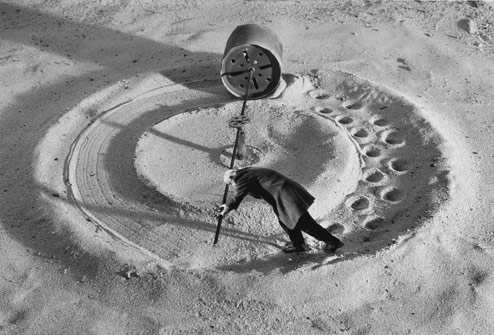
Gilbert Garcin. Le moulin de l’oubli – Mill of oblivion. 1999.

“Gilbert Garcin spent most of his life managing a lamp factory in France. At 65, he retired and took up a trick photography workshop. For the past ten years he has been creating comical, surrealistic photographs which warmly highlight sometimes cold, existential questions. Garcin inhabits this strange world and ponders it together with the viewer; with Garcin you have a dedicated, but perplexed, guide.”

In February, (2009) Gilbert's work was celebrated at the Festival at Rennes.

More here, here, and here.

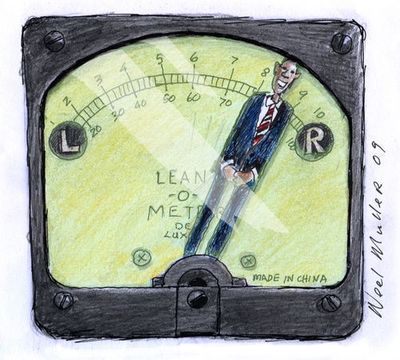
Who Will Be A Champion Of The Left We Can Believe In? As Bush-lite, Obama Ain’t It

By Evert Cilliers

Lean-o-meter Here's the story as I see it.

In 2008, after eight years of Bush/Cheney, the horrors and wrongs of this worst-of-all presidencies were plain to see — like Dresden after the fire-bombing, or a maroela tree after an elephant chomped it. The country had been wrecked by the dotty ideology-driven actions of extremist nutters: the false prophets of anti-science, anti-common-sense, anti-democracy, free-market-gone-crazy, conservatism-gone-fundamentalist, male-belligerence-gone-psycho.

Economically we were down the toilet and halfway to the sewer. Internationally we were pariahs. Psychologically we ping-ponged between genuine anxiety and false bravado. Worst of all: morally, we were hollowed out. Wars. Torture. Human rights abuses. Tora Bora. FEMA. Washington corruption. Wall Street fraud. Foreclosures. Unemployment. Deficits. Off-budget accounting. 30% interest charges on credit cards. Debt. Debt. Debt. Had we been ruled by the Kremlin, we couldn't have done worse. It was as if America had become a nation of 300 million suffering Jobs, struck down by the vengeful hand of an old-testament God.

It was the worst of times, and the best of times only for the nicely rich, dah-links.

But this most horrible of horrorshows opened up a great opportunity. The longing for change ached in every sensible American heart. The time for a progressive moment in our history had arrived.

Enter Barack Obama. Fueled by a compelling story, inspiring oratory, obvious decency, a challenging intellect and seemingly progressive liberal beliefs, he stepped into the moment with dazzling ability. He benefited from the progressive moment and took full advantage of it. After all, he was one of a very few voices who had spoken up against the Iraq War when it was political suicide to do so. He was the dewy rose in the scratchy patch of weeds.

Read more »

The Winners of the 3 Quarks Daily 2009 Prize in Politics

TopQuark_politics StrangeQuark Charm_quark_politics

Tariq Ali has picked the three winners:

  1. Top Quark, $1000: Glenn Greenwald: Greg Craig and Obama's worsening civil liberties record
  2. Strange Quark, $300: Black Agenda Report: The Great Black Hajj of 2009
  3. Charm Quark, $200: News From the Zona: Republican Virtue and Equality

Here is what he had to say about them:

Glenn Greenwald's well-argued and well-written critique of Obama's record on civil liberties with trials for some and not for others is my choice for the best piece. Interesting to note that the honeymoon with Obama has not lasted as long as the liberal love-affair with the Clintons. More was expected of Obama which is why disenchantment levels are much higher as this piece demonstrates.

Glenn Ford's 'The great Black Hajj of 2009' continues the tradition of black dissent at a time when black politics are in decline. The opportunist wing of Afro-American groups appears to have won out temporarily and the rainbow alliance consigned to the dustbin, while advancement through the Democrats is the rage. Ford's anger is understated but a good sign that there are many out there who might stay at home on election day in 2012 rather than countenance an administration on its knees before Wall Street with the motto: 'What is Good for Goldman Sachs is good for America'–caving in to the lobby system on health reforms and fighting a 'just war' in Afghanistan and Pakistan.

News from the Zona is a useful description of the differences between cold war liberalism and its successor. The lip-service (and not just that) to equality in the former was related to the needs of the system at the time. When communism collapse this was no longer considered necessary and neo-liberalism became the new mantra…till the Wall Street Crash of 2008.

Congratulations to the winners (please contact me by email, I will send the prize money later today–and remember, you must claim the money within one month from today). And feel free to leave your acceptance speech as a comment here! And thanks to everyone who participated. Thanks also, of course, to Tariq Ali for doing the final judging.

The three prize logos at the top of this post were designed, respectively, by Carlos, Matthew Daniels, and Jennifer Prevatt. Our thanks to each of them. I hope the winners will display them with pride on their own blogs!

Details about how the 3QD prizes work, here.

Sunday, December 20, 2009

An Interview with Shilpa Ray

Shilparay In Brooklyn Vegan:

It was approximately a year ago that Shilpa Ray left her band Beat The Devil to focus on her own project with her own band that she calls Shipa Ray and The Happy Hookers. That would make 2009 not only their year, but their first year.

My own excitement for the band came right around January/February when I first heard their 8-song unreleased CD-R. Soon after that they accepted my invitation to play the official BrooklynVegan SXSW showcase, and they've managed to keep busy all year. Shilpa ended up self-releasing their album, and she and her hookers have played numerous shows in NYC – too many to count, but they've included a Woodstock tribute at Castle Clinton, a residency at Pianos, and this year's CitySol festival. And they're ending the year strong. They just opened two NYC gigs for the Fiery Furnaces, are opening for Grant Hart of Husker Du this Saturday at 92YTribeca (12/19), and now have a glowing recommendation from Nick Cave.

Shilpa answered some questions about her year. Read them below…

You released a record in 2009. How'd that go?

Arduous and fun. I loathe tedious, mundane tasks, which works against me in this Golden Age of DIY. I guess I missed out on the “Golden Age” where all a musician had do was play music and snort big record company advances. Part of me wishes I was Rod Stewart. Hell, I don't even get to have a hopelessly devoted girlfriend to takes care of me or at least tolerate my “genius”, my tortured soul, and my many many mistresses.

Have you met Nick Cave? Did you know he was a fan at all before that interview came out?

Actually the story has more to do with my friend Ratso (aka Larry Sloman) than Nick Cave. Ratso's a badass writer who's written for Rolling Stone, High Times, and has authored/co-authored several biographies, namely Howard Stern, Bob Dylan and Harry Houdini. I met him after the Sly Stone Tribute Concert at Castle Clinton, and agreed to do his variety radio show at KGB bar on the Lower East Side. It was mind blowing. I felt like we were transported to 60s, 70s era New York. The kind of stuff I'd skip homework for and read about when I was a teenager. There was even a singer with a platinum white bee-hive hairdo, the spitting image of Dusty Springfield, who opened the show. The whole look and feel of this radio show against the commie red lit backdrop of the KGB bar was so complete.

Waterworld

WaterworldEvan Lerner in Seed Magazine:

The discovery of a new planet has always been exciting, but the bloom is starting to come off the rose now that we’ve done it more than 400 times. A University of California–Santa Cruz team announced the discovery of six new planets orbiting two stars earlier this week, but they weren’t even the toast of the exoplanetology world, much less international newsmakers. Those honors went to a team led by Harvard’s David Charbonneau.

Quality trumps quantity when it comes to such discoveries, and Charbonneau’s planet has a number of newsworthy traits. At more than six times our own planet’s mass, it’s a “super-Earth,” but this new world’s relatively low density means it’s likely made mostly of water. Though it orbits uncomfortably close to its star, the planet’s water may be kept liquid at 200° C by a dense, highly pressurized atmosphere. Not exactly a tropical paradise (though Dennis Overbye’s New York Times headline describes it as “sultry”), but easily the most Earthlike planet we’ve been able to characterize thus far.

Orbiting the red dwarf star GJ 1214 in the Ophiuchus constellation, the planet is also quite nearby by astronomical standards. At a distance of 42 light-years, it would still take several thousand lifetimes for us to get anything there, but its close proximity makes it an excellent target for ranged study by the James Webb Space Telescope scheduled to launch in 2014. In the meantime, the aging Hubble and Spitzer space telescopes may be used to study this bizarre waterworld.

Sunday Poem

It Denotes

If you walk by
And find me,
Lying on my side, curled
Like a comma
On a street corner
With no blanket
To cover myself
I am not in a coma
It denotes . . .
Stop briefly
And ponder over these times.

If you find me
Lying on my side
Legs stretched and straight
Head and shoulders
Bent forward, towards my loins
Like a question mark
It denotes . . .
Provide explanations . . .
Why certain people
Happen to sleep
On street pavements.

If you find me
Lying on my back
My whole body stretched
At a horizontal attention
like an exclamation mark
It denotes . . .
I am in shock
Do not bother
I will recover.

And when you find me coiled
My head between my legs
Round like a full stop
It denotes . . .
Stop and render first aid
Subject freezing.

by Julius Chingono

publisher: First published on PIW
in a special Zimbabwean edition,
10th June 2008, 2008

A Facebook Christmas Love Story

Walter Kirn in the New York Times Magazine:

ScreenHunter_05 Dec. 20 12.37 In Limbo, where I’ve so often spent the holidays, I sat down last year in front of my computer on the night before the night before Christmas and tried to soothe my balsam-scented loneliness by reaching out to my newfound social network (“social networks” being what we have now in place of “friends and families”). Outside, in the streets of my snowy Montana hometown, noisy drinkers were strolling from bar to bar as I typed out the sad word “Facebook” on my keyboard and scanned my screen for familiar names and pictures. I didn’t find many for the simple reason that I was a novice at silicon socializing, and 90 percent of the people I knew on Facebook were people I didn’t know at all.

More here.

A review of The Princeton Companion to Mathematics

Ronald Graham in American Scientist:

ScreenHunter_04 Dec. 20 12.25 This impressive book represents an extremely ambitious and, I might add, highly successful attempt by Timothy Gowers and his coeditors, June Barrow-Green and Imre Leader, to give a current account of the subject of mathematics. It has something for nearly everyone, from beginning students of mathematics who would like to get some sense of what the subject is all about, all the way to professional mathematicians who would like to get a better idea of what their colleagues are doing.

The 75-page introduction, which was written by Gowers, gives a very readable account of the basic branches of mathematics (algebra, geometry, analysis) and how these overlap and relate to one another, how they have developed and are continuing to do so, and how they are driven in large part by the types of questions mathematicians ask. This section should be mandatory reading for any prospective mathematics student.

Most of the articles that make up the rest of the book were written by leading experts. For example, Carl Pomerance has contributed a stimulating essay on computational number theory, Cliff Taubes provides a wonderful overview of differential topology, and Jordan Ellenberg gives a thoughtful summary of arithmetic geometry.

More here.

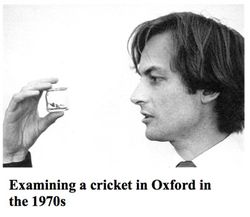
GROWING UP IN ETHOLOGY

Richard Dawkins in Edge:

Dawkins4 I should have been a child naturalist. I had every advantage: not only the perfect early environment of tropical Africa but what should have been the perfect genes to slot into it. For generations, sun-browned Dawkins legs have been striding in khaki shorts through the jungles of Empire. My Dawkins grandfather employed elephant lumberjacks in the teak forests of Burma. My father's maternal uncle, chief Conservator of Forests in Nepal, and his wife, author of a fearsome 'sporting' work called Tiger Lady, had a son who wrote the definitive handbooks on the Birds of Borneo and Birds of Burma. Like my father and his two younger brothers, I was all but born with a pith helmet on my head.

My father himself read Botany at Oxford, then became an agricultural officer in Nyasaland (now Malawi). During the war he was called up to join the army in Kenya, where I was born in 1941 and spent the first two years of my life. In 1943 my father was posted back to Nyasaland, where we lived until I was eight, when my parents and younger sister and I returned to England to live on the Oxfordshire farm that the Dawkins family had owned since 1726.

More here.

Decade of science highs and lows

From MSNBC:

2009

Science 50. Water on the moon: NASA sends a probe called Lunar Crater Observation and Sensing Satellite, or LCROSS, crashing into the moon. Weeks later, scientists report that an analysis of the impact debris confirms the existence of “significant” reserves of water ice. The mission followed up on indications from earlier probes (Clementine, Lunar Prospector, Chandrayaan 1, Cassini) and even from Apollo lunar samples. Some speculated that the findings could lead to a fresh round of lunar missions, but as the decade came to a close, NASA's plans for future exploration were still under review at the White House.

For the rest of the 50-year timeline, you can revisit the 1960s, 1970s, 1980s and 1990s separately, or see them all together on CASW's Web site.

Here are five more “Oh! Oh!” and “uh-oh” moments that are worth mentioning in a 10-year science review:

Oh! Oh! The International Space Station! The first expedition crew moves into the space station on Nov. 2, 2000, marking the beginning of full-time habitation that has continued for almost 10 years. The crew receives its first paying passenger in 2001 when millionaire investor Dennis Tito comes aboard. Six more have visited since then.

More here.