Battlefield city: Internecine political battles are making Karachi a dangerous place to live

Shamim-ur-Rahman in Himal SouthAsian:

Rahman_murad_ali_shah A new extremism has developed in Pakistan’s economic hub, Karachi, a city that is increasingly serving as a safe haven for extremist groups backed by criminal mafias and certain political elements. The reported arrest of a top Taliban leader, Mulla Abdul Ghani Baradar, from the outskirts of Karachi in mid-February has only made this new dynamic clearer, and more ominous. The arrest not only proved that the network of al-Qaeda- and Taliban-linked fighters is well-entrenched and active across the north-south length of Pakistan; but the joint operation, conducted by Pakistan and American intelligence operatives, also sent a message that Pakistan might no longer be the safe haven that it once was. However, if the government fails to address ‘bread and butter’ issues – providing employment, controlling inflation and ensuring the availability of essential items – and the political parties continue to fight among themselves for narrow vested interests, the Taliban could still spring a surprise. If this happened, it would most likely be with the support of the sizeable fundamentalist-minded and generally disgruntled segments of Pakistani society.

The sheer number, scale and consistency of the attacks on Karachi are all adding to the worries of already disoriented city citizens. From October 2009 through mid-February, about 200 people have been killed in both politically motivated targeted killings and extremist blasts in various parts of Karachi, while several hundred more have been injured. Alongside, billions of rupees have been lost due to looting, arson and the closure of businesses during strikes that have been called by various political parties to highlight the lack of security. Yet while extremist attacks are getting much of the headlines and anger, the city has been under particular pressure due to the targeted killing of activists aligned with various political outfits – the Sindh-based Muttahida Qaumi Movement (MQM), the Pakistan People’s Party (PPP) of the late Benazir Bhutto, the Pashtun-dominated Awami National Party (ANP), the sectarian Sunni Tehrik, the Islamist Jamaat-i-Islami and others. Incredibly, even as the violence mounts, the MQM, PPP and ANP technically remain in a coalition government together.

More here.
Surviving Death on Larry King Live

Michael Shermer in Scientific American:

Surviving-death-on-larry-king-live_1 Have you ever died and come back to life? Me neither. No one has. But plenty of people say that they have, and their experiences were the subject of an episode of Larry King Live last December on which I appeared as the token skeptic among a tableful of believers, including CNN’s medical correspondent Sanjay Gupta, New Age author Deepak Chopra, a football referee who “died” on the playing field, and an 11-year-old boy named James Leininger who believes he is the reincarnation of a World War II fighter pilot.

Dr. Gupta started us off by recalling that when he was in medical school the residents were taught to mark the time of death to the minute, when death can often take anywhere from a couple of minutes to a couple of hours to occur, depending on the conditions. As Gupta noted, people who have fallen into freezing lakes and “died” were not quite dead, and their core body temperatures dropped so rapidly that their vital tissues were preserved long enough for subsequent resusci­tation. In other words, people who have near-death experiences (NDEs) are not actually dead!

More here.

A small victory for Pakistan’s transgenders

Mark Magnier in the Los Angeles Times:

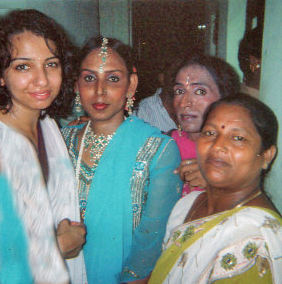
Asma-hijra-birthday-party-2 Hijra have long been stigmatized and subject to discrimination and abuse in the Islamic Republic of Pakistan, with its rigorously defined roles for men and women. But in a landmark decision in December, the Supreme Court ordered that they be protected from police harassment, be eligible for a separate gender category on ID cards and be recognized under inheritance laws.

“We need proper rights,” said Noor, a 21-year-old member of Nanni's household. “No one listens to our concerns.”

Although nascent legal status is a first step, social acceptance is likely to take far longer. Noor and the others said police officers and residents often beat, harass, rob and sexually abuse them.

More here.

Jonathan Safran Foer’s contingent vegetarianism

Mark Rowlands in the Times of London:

ScreenHunter_01 Mar. 04 11.02 Among philosophers of a certain persuasion, there is a basic argument for animal rights. Ethics isn’t mathematics; but by the standards of accuracy and precision involved in moral reasoning, this argument is about as unassailable an argument as you can get in moral philosophy. There is a problem with unassailable moral arguments however, and that is that it’s hard to make people care about them. In his book Philosophical Explanations, Robert Nozick entertained a little fantasy about a hypothetical and unspecified argument that is so powerful, so utterly compelling, that refusal to accept it sets up reverberations in the brain and kills the refuser. But bitter experience teaches us that there are no such, as we might call them, Arguments of Mass Destruction. Humans are not rational creatures in this sense; we don’t respond well to logical argument.

We do, however, respond well to pictures. Jonathan Safran Foer is the author of two novels, Everything is Illuminated (2002) and Extremely Loud and Incredibly Close (2005), and the genius of his new gripping, horrible, wonderful book, Eating Animals, lies in his novelist’s ability to take a simple argument, one with empirically unassailable premisses and a conclusion that follows logically from those premisses, and give this abstract argument concrete, detailed, pictorial form, a form grounded in the day-to-day realities of human lives.

Safran Foer’s trajectory (some might say “descent”) into vegetarianism will be familiar to many.

More here.

Israel and Apartheid

This is the Sixth Annual Israeli Apartheid Week. This article by Tony Karon in Rootless Cosmopolitan is a couple of years old, but still worth reading:

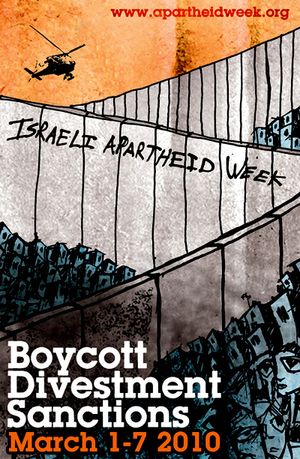
IAW_2010poster_Toronto … the comparison with the essence of apartheid remains valid — in South Africa, black people lived under the control of a state over which they had no control even as they participated in a shared economy, on the West Bank and Gaza Palestinians live under a state over which they have no control which seeks to keep them out of a shared economy. But in both cases, they found themselves ruled by a state that denied them the rights of a sovereign people. Even now, after it has ostensibly withdrawn from Gaza, Israel still tightly controls Palestinian life there, determining whether the lights work and whether salaries are paid, who may enter and who may leave, and much of the time who will live and who will die. Sure, the Palestinians have an elected government (which the Israelis together with the U.S. are doing their best to subvert), but it isn’t allowed to govern — post-pullout Gaza, in fact, looks rather a lot like what the apartheid regime had in mind in its original Bantustan policy: A separate geographic state within which Africans could “exercise their political rights” while still remaining under effective sovereign control of the Pretoria regime. In the West Bank, Israel is the effective political authority, and there it creates restrictions on the movement of Palestinians every bit as odious — if not even more so — than those imposed on black people under apartheid. That’s because on the West Bank, Israel is not only maintaining overall sovereign control, as in Gaza, but is also trying to “cleanse” of Palestinians vast swathes of the best land illegally settled since 1967, and the networks of roads that connect them.

More here.

Wednesday, March 3, 2010

did somebody say Kapuściński?

Kapuscinski My own thoughts on the Kapuściński “problem” here (from 2007):

I’ll admit that I came to writing about Kapuscinski with the intention of defending him, praising him. I think his writings are unique and that they traverse a ground between fiction and nonfiction that tells us something important about who we are. I think he is right that we need historians who are also storytellers, who understand that mode of human communication. But the more I’ve looked over those passages the more I think it is too complicated for simple praise or blame. If I’m right that Kapuscinski is defending himself in these pages, then it is an odd and troubling defense. It has the flavor of grandiosity to the point of feeling desperate, creepy. I don’t know if it is a healthy thing to think of yourself as someone tasked with interpreting the world and guiding everyone else through it, as the nucleus of human community. In the beginning of Travels with Herodotus, Kapuscinski talks about his youth and the beginning of his fascination with Herodotus. It arose out of the ashes of a nation and a community utterly destroyed. He writes, “We were children of war. High schools were closed during the war years and although in the larger cities clandestine classes were occasionally convened, here, in this lecture hall, sat mostly boys and girls from remote villages and small towns, ill read, uneducated. It was 1951.” 1951 in Poland is a big deal. It is the dazed landscape of civilization in ruins.

Kapuściński Wednesday!!!!!

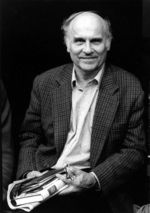
422px-ryszard_kapuscinski My friend Tom Bissell on Kapuściński’s death in 2007 from the NYT here:

Kapuscinski saw more, and more clearly, if not always perfectly, than nearly any writer one can think to name. Few have written more beautifully of unspeakable things. Few have had his courage, almost none his talent. His books changed the way many of us think about nonfiction and made many of us want to travel for ourselves and see for ourselves. Herodotus, Kapuscinski reasonably imagines, interviewed many of his subjects by campfire. “Later, these will be called legends and myths, but in the instant when they are first being related and heard, the tellers and the listeners believe in them as the holiest of truths, absolute reality,” he writes. And so “the fire burns, someone adds more wood, the flames’ renewed warmth quickens thought, awakens the imagination.” When the last page of this book is turned, note how much smaller and colder the world now seems with Kapuscinski gone.

Kapuściński defended

Ryszard-Kapuscinski-and-s-001

Ryszard Kapuściński kept two notebooks when he was on the road. One was for his job as an agency reporter, haring about the world, meeting deadlines and battling to file stories whose transmission was paid for out of the pittance of worthless communist currency he received from Warsaw. The other was for his calling as a writer, making reflective, creative, often lyrical sense out of what he was experiencing. To mix the two notebooks up is to miss the point of him. Artur Domoslawski’s book, from what is reported about it, suggests that Kapuściński was a dishonest reporter who made up stories about events he hadn’t seen, and invented quotes. This is to confuse his journalism with his books. Almost all journalists, except for a handful of saints, do on occasion sharpen up quotes or slightly shift around times and places to heighten effect. Perhaps they should not, but they – we – do. A few of us go beyond the unwritten rules of what is tolerable, and send our papers eyewitness accounts of events we never saw because we were somewhere else. That, in the profession’s general view, is right off the reservation – not on.

more from Neal Ascherson at The Guardian here.

Kapuściński accused

Polish-journalist-Ryszard-001

He has been voted the greatest journalist of the 20th century. In an unparalleled career, Ryszard Kapuściński transformed the humble job of reporting into a literary art, chronicling the wars, coups and bloody revolutions that shook Africa and Latin America in the 1960s and 70s. But a new book claims that the legendary Polish journalist, who died three years ago aged 74, repeatedly crossed the boundary between reportage and fiction-writing – or, to put it less politely, made stuff up. In a 600-page biography of the writer published in Poland yesterday, Artur Domoslawski says Kapuściński often strayed from the strict rules of “Anglo-Saxon journalism”. He was often inaccurate with details, claiming to have witnessed events he was not present at. On other occasions, Kapuściński invented images to suit his story, departing from reality in the interests of a superior aesthetic truth, Domoslawski claims. Domoslawski told the Guardian: “Sometimes the literary idea conquered him. In one passage, for example, he writes that the fish in Lake Victoria in Uganda had grown big from feasting on people killed by Idi Amin. It’s a colourful and terrifying metaphor. In fact, the fish got larger after eating smaller fish from the Nile.”

more from Luke Harding at The Guardian here.

Wednesday Poem

One Hundred and Eighty Degrees

Have you considered the possibility
that everything you believe is wrong,
not merely off a bit, but totally wrong,
nothing like things as they really are?

If you've done this, you know how durably fragile
those phantoms we hold in our heads are,
those wisps of thought that people die and kill for,
betray lovers for, give up lifelong friendships for.

If you've not done this, you probably don't understand this poem,
or think it's not even a poem, but a bit of opaque nonsense,
occupying too much of your day's time,
so you probably should stop reading it here, now.

But if you've arrived at this line,
maybe, just maybe, you're open to that possibility,
the possibility of being absolutely completely wrong,
about everything that matters.

How different the world seems then:
everyone who was your enemy is your friend,
everything you hated, you now love,
and everything you love slips through your fingers like sand.

by Federico Moramarco

Sex-Changing Herbicide Makes Amphibians Sick, Too

From Wired:

Treefrog Though less obvious than gender bending, immunosuppression could play just as large a part in the worldwide decline of amphibians, which have porous skin and easily absorb chemicals from rain, groundwater and even water vapor. “Numerous studies have documented the effects of environmental pollutants on the amphibian immune system. Nearly all of these studies suggest that amphibians are particularly sensitive,” wrote Tyrone Hayes, a University of California, Berkeley biologist, in a paper published in the March 15 Journal of Experimental Biology. “In particular, the widespread herbicide atrazine impairs immune function and increases disease rates.”

Hayes is also an author of a March 1 Proceedings of the National Academy of Sciences study on the developmental changes wrought in male frogs by groundwater atrazine concentrations regularly found in the United States, where 80 million pounds of the herbicide are used every year. The frogs had low levels of sperm and testosterone; some even produced estrogen, developed female reproductive organs and were ultimately impregnated by their former gender mates.

More here.

Let’s all be friends

From Prospect Magazine:

New research shows how our social ties can influence us for better—and worse: making us fatter, more likely to smoke, marry, divorce and even vote. Governments should take heed

Friends If friends of your friends begin to put on weight, you are likely to do the same—even if you don’t know the people in question, and even if they live hundreds of miles away. Obesity spreads like a fad; it is contagious. This striking finding about how obesity spreads through social networks was the result of a 30-year study in Massachussetts, as Nicholas A Christakis and James H Fowler note in their new book, Connected: The Surprising Power of Social Networks and How They Shape Our Lives (HarperPress). Research shows that the same is true for smoking, and a range of other behaviours and attitudes like drinking, depression, charitable giving, sexual practices—even the decisions to marry, divorce, reproduce, or vote.

Why is this important? Because from healthcare to climate change, governments today face a range of problems where they must persuade people to change their behaviour. But instead of relying on their powers of persuasion, politicians should consider taking a class in “network science.” True, many claims for the power of social networks are based on the hype surrounding websites like Facebook. But the basic idea is simple: people join together in groups with particular patterns of ties, and these patterns then have important effects on the way they behave. The shape of these networks has surprising effects. Take an unlikely example: Broadway musicals. Brian Uzzi is a sociologist at Northwestern University in Chicago. He is also a big music hall fan. From Cats to Spamalot, musicals have been big business for decades, but investors have to guess which shows will be a hit. Bye Bye Birdie, a profitable 1960 production starring Dick van Dyke, ran for 607 nights. Bring Back Birdie, its 1981 sequel, was a flop and closed after just four.

Intrigued, Uzzi used network science to find out why.

More here.

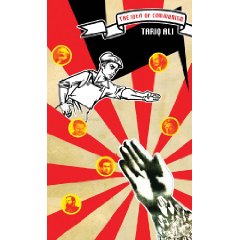
The Idea of Communism: An Interview with Tariq Ali

Ali In History News Network (via bookforum):

You write, that “Marx and Engels would have been horrified by the suggestion that their writing might one day be elevated to the status of religion.” Yet it seems to continually landed in the hands of folks looking for a roadmap to heaven. How do you see this conflict, essentially between the content and the application of Marxism?

The very fact the idea of communism took off in two of the most backward societies at the beginning of the 20th Century — China and Russia — meant that the way it was picked up by many people, especially peasants and not so well educated people who joined in that revolutionary ferment was that the only way they could see it was as a secular religion, as a secular faith. The intellectuals who were initially won over the idea were of course not at all religious minded and by-in-large did not go in that direction or take Marxism in that direction either. If you look at the early Bolsheviks, most of who were of Jewish origin, they were cutting loose from religion— the were very much the great-grandchildren of the French Enlightenment. That was also the impact on the intellectuals in China who founded the Chinese Communist Party.

I don’t think there was anything in the theory that meant it should go in that direction. It was, I’ve always felt that the emergence of one-Party state, the emergence of all powerful Politburos and Central Committees, the emergence of a total monopoly of information and of ideas by the Party made it almost inevitable that they would transmit these ideas as ideas that were unchallengeable. If you challenged them you were a heretic or much worse than that, a traitor or an enemy of the people.

It was that form of application of Marxism that reminded me very much of the Spanish Inquisition which the Catholic Church used to use against Muslims and heretics in medieval Spain. It was when this dictatorship was imposed and free thought was more or less banished that the process took on this particular form.

Our Board-Game Renaissance

Monopoly Alexander Ewing in More Intelligent Life (for Jane Renaud):

After decades of decline, board games are back in vogue. In 2008 board-game sales reached $808m, an increase of 23% over the previous year. Industry insiders suggest that sales grew another 20% last year. The recession has helped many to reconsider the joys that can be found in cardboard and plastic pieces. And this has been an especially snowy winter, particularly in my hometown of Washington, DC, where we recently enjoyed our third blizzard of the season. Monopoly, the most popular board game in history, was introduced during the Great Depression, when the fun of play-acting as a vicious real-estate mogul perhaps was most plain. Players wielding pewter thimbles and doggies could malevolently corner a market and penalise hapless neighbours; getting out of prison involved paying a little fee.

The return of board games as a diversion is good news (and something we've written about before), but let’s set some parameters. I’m not keen on board games 2.0. Many of the new games on the market are insipid recreations of Charades or Pictionary, and are far too concerned with entertainment utility. What about the needs of the hyper-competitive and the overly-sensitive (ie, an important niche of board gamers)? Any game that requires a battery is sacrilegious. I’m also sceptical of anything “hands-on”. No Jenga or Cranium please. But Trivial Pursuit counts; it is just cards and a board, with ample room for humiliation.

Classics such as chess and checkers (draughts to the Brits) endure, but they are limited to two players and have been hijacked by the computer. If you play checkers, try the multi-player Chinese variety. Backgammon is my two-person exception; it is near and dear to my heart. As a boy I played regularly with my father. At university, recovering from a protracted and messy break-up, I started playing on the internet for money (usually losing it) and tried to improve by reading books like “Backgammon for Blood”, a 1970s strategy classic by Bruce Becker. It was a dark time.

Board games are more than recession-friendly recreation; they are rich in sociology. The Game of Life, invented by Milton Bradley, the godfather of board games, is America at its best and worst. The game features plastic mini-vans that you drive from birth to death, accumulating fellow passengers (a spouse and kids) and making loads of cash along the way, regardless of career (journalism was not one of the choices).

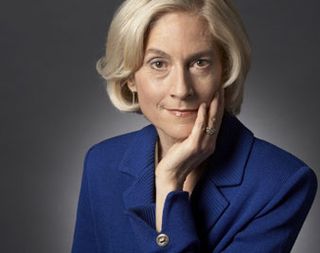
Christime Smallwood Talks to Martha Nussbaum

Nussbaum In The Nation:

You suggest that perhaps the state should get out of the marrying business altogether.

I guess the first thing to say is that they can't do it in a way that just simply takes away the possibility of marriage from gays and lesbians. During integration in the South there were attempts to get around mandatory integration by ending the program in question. They closed down the public swimming pools or the public schools rather than integrate them. That kind of thing has been held to be unconstitutional, and quite rightly so. But I guess I think that marriage as it currently exists is a weird institution. There are a bunch of civil benefits that could be captured in civil unions. There are religious elements, but they're not really part of state marriage. Then there's the expressive significance–we want the state to dignify or affirm our marriage. Should the state be in the business of dignifying certain unions? The answer would be no. If we were starting over again, we'd want to go back and look at the privileges associated with marriage–tax benefits, immigration status, etc.– and ask, Who do we want to give those benefits to? What do we want to do? That kind of thorough rethinking would be ideal, but it's also not likely to actually happen. How do we get from where we are to there? In the short run, I think the best thing is just to push on the equality issue and say, So long as marriage is offered by the state, it should be offered with an even hand.

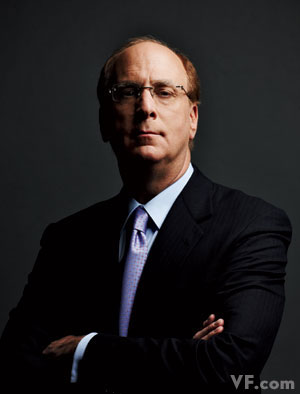
Larry Fink’s $12 Trillion Shadow

Suzanna Andrews in Vanity Fair:

Fink Considering the enormous power he is believed to wield, it’s remarkable how few people have heard of Larry Fink. In political and business circles—among the men who travel the now well-worn corridor between Washington and Wall Street—Fink, the chairman and C.E.O. of BlackRock, the giant asset-management firm, is described as possibly the most important man in finance today. But mention his name to most people and they draw a blank. Despite his considerable wealth, he is virtually unknown on the society circuit in Manhattan, where he has an apartment on the Upper East Side, or in Aspen, where he also has a home. In North Salem, the affluent enclave north of New York City where he and Lori, his wife of 35 years, have a 26-acre farm, he is perhaps slightly better known, if only because a number of Wall Street bankers have estates there. But still—just a few months ago—when one of his neighbors, a prominent New York agent, furious that a popular horse path through the Fink estate had been blocked off, was told who owned the property, her response was: “Who is Larry Fink?”

More here.

The Chicago boys and the Chilean earthquake

Andrew Leonard in Salon:

Md_horiz The ghost of Milton Friedman, writes Bret Stephens in the Wall Street Journal, “was surely hovering protectively over Chile in the early morning hours of Saturday.”

Thanks largely to him, the country has endured a tragedy that elsewhere would have been an apocalypse.

Stephens' logic is simple. After the U.S.-backed coup in 1973, in which Gen. Pinochet seized power from the democratically elected president Salvador Allende, a group of Chilean economists mentored by Friedman, and known to history as “the Chicago boys,” instituted a series of radical free market reforms. Since that point, averaged over the decades, Chile has experienced the strongest sustained economic growth in South America. Rich countries, argues Stephens, are more likely to institute and enforce building codes. Q.E.D. Milton Friedman saved lives.

Some might find it intellectually provocative to cite Milton Friedman's authority in an argument that depends on the foundation of successfully enforced government-mandated building code regulations. The building inspector is not exactly a libertarian hero. Others might wonder if a more important factor in Chile's relatively tough building codes might be the devastating 9.5 earthquake the country endured in 1960.

More here.

Tuesday, March 2, 2010

Why Israeli Prime Minister Netanyahu repeats his errors

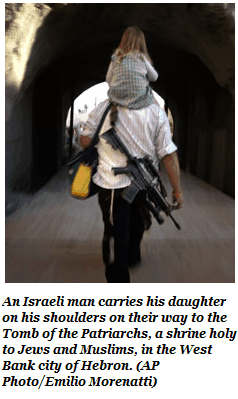
ScreenHunter_04 Mar. 03 06.59 By all accounts, Benjamin Netanyahu devoted very little thought to the two final sites added to a list of designated heritage sites set to benefit from a large government restoration budget. Never mind that the Tomb of the Patriarchs, known to Muslims as the Ibrahimi Mosque, is located in the West Bank town of Hebron. Likewise, Rachel's Tomb is in Bethlehem — also occupied territory. Just before Sunday's Cabinet meeting, rightist ministers noticed that the two shrines, regarded as the burial places of the biblical ancestors of the Jewish people, were missing from the list. They leaned a bit on Netanyahu, he added the tombs, and the Cabinet unanimously approved the plan.

From there, the reaction followed as if part of the playbill. Palestinian protests in Hebron turned into confrontations between demonstrators and troops that have grown larger each day. Palestinian negotiator Saeb Erekat described the heritage designation as a “unilateral decision to make Palestinian sites in Hebron and Bethlehem part of Israel,” and Palestinian President Mahmoud Abbas warned that the move “could cause a holy war.” A State Department spokesman condemned the Israeli step as “provocative.”

You might expect Netanyahu to be careful about playing with holy fire. In September 1996, early in his previous term as prime minister, he approved opening a tunnel alongside the Temple Mount, otherwise known as Haram al-Sharif. That set off a week-long mini war between Israel and Palestinians. How could he so easily give in to pressure and repeat the mistake of asserting ownership of contested holy places? While we're at it, how does a country declare that a place outside its borders is a national heritage site?

More here.