Tuesday Poem

Ballad

forgive me if i laugh
you are so sure of love
you are so young
and i too old to learn of love.

the rain exploding
in the air is love
the grass excreting her
green wax is love
and stones remembering
past steps is love,
but you. you are too young
for love
and i too old.

once. what does it matter
when or who, i knew
of love.
i fixed my body
under his and went
to sleep in love
all trace of me
was wiped away

forgive me if I smile
young heiress of a naked dream
you are so young
and i too old to learn of love.

by Sonia Sanchez

Apoca-lit Now

Sameer Rahim in The Telegraph:

Bookssumm_1604421c This weekend, a sad scene is playing itself out on a busy west London high street. The Kilburn Bookshop, which has served readers for 30 years, is closing its doors for the last time. Many factors are involved – the recession and rent increases among them – but the bookshop’s manager, Simon-Peter Trimarco, believes there are deeper reasons for the closure. One problem is that browsers now rarely put their hand in their pocket. “Only one in 10 customers will end up buying a book.” They find what they want and then go to Tesco or Amazon where there are heavy discounts. (There is even an iPhone app that lets you scan a book’s bar code and find the cheapest price.) The Kilburn Bookshop is friendly and has something of a literary pedigree: “Zadie Smith came in as a little girl,” Trimarco says. If this shop can’t survive, then which can? Very few, it seems. Last year, one in 10 independent bookshops closed, at a rate of three a week. “I’m despairing,” Trimarco says.

The death of independent bookshops is just one symptom of a much wider crisis in publishing. Discounted books, online bookselling and the advent of ebooks are destroying old patterns of reading and book buying. We are living through a revolution as enormous as the one created by Gutenberg’s printing press – and authors and publishers are terrified they will become as outdated as the monks who copied out manuscripts. How this happened is down to ambitious editors, greedy agents, demanding writers and big businesses with an eye for easy profit. Combine that with devilishly fast technological innovation and you have a story as astonishing as the credit crunch – and potentially as destructive.

More here.

No Matter What, We Pay for Others’ Bad Habits

Sandeep Jauhar in The New York Times:

Habits “I’m tired of paying for everyone else’s stupidity,” is a comment I read on the Internet last week after the health care bill was passed. It summed up the views of many Americans worried about shelling out higher premiums and taxes to cover the uninsured. Why should we pick up the tab when so much disease in our country stems from unhealthy behavior like smoking and overeating?

In fact, the majority of Americans say it is fair to ask people with unhealthy lifestyles to pay more for health insurance. We believe in the concept of personal responsibility. You hear it in doctors’ lounges and in coffee shops, among the white collar and blue collar alike. Even President Obama has said, “We’ve got to have the American people doing something about their own care.” But personal responsibility is a complex notion, especially when it comes to health. Individual choices always take place within a broader, messy context. When people advocate the need for personal accountability, they presuppose more control over health and sickness than really exists.

More here.

Monday, March 29, 2010

Sunday, March 28, 2010

Antinomies (not really) of Molecular Gastronomy: Industrial Processes as the New High Skill, Craft Cuisine

CryovacErica Westly in IEEE Spectrum:

The term molecular gastronomy conjures up images of strangely colored droplets and foams arranged on a plate. As a result, this scientific approach to cooking is often derided as cold and unfeeling—the opposite of what good food is supposed to be. At its heart, though, molecular gastronomy—or, as it’s sometimes called, molecular cooking—involves using technological tools to create dishes that are delicious as well as innovative. One of the genre’s best tricks is applying seemingly mundane technologies from the food-processing industry to high-end ingredients like oysters and lobster. As the following five examples illustrate—three of which premiered in February at the prestigious Flemish Primitives culinary festival, in Belgium—the resulting techniques stand to benefit restaurant chefs and even home cooks.

1. At this year’s Flemish Primitives, Bernard Lahousse, a food consultant with a bioengineering degree, used a high-pressure processing (HPP) machine to infuse oysters with tomato and other flavors without sacrificing freshness or textural integrity. This marked the first time an HPP machine was used for culinary purposes, but the technology is a staple of the seafood-processing industry, which started employing the technology to extract meat from shellfish in the late 1990s. At US $500 000 to $2.5 million, HPP machines are too expensive for most restaurant kitchens, but chefs have been known to create tabletop versions of industrial equipment. Take, for example, the Reveo meat tumbler, a miniature version of an industrial meat tenderizer that retails for about $170.

The Tenure Tracts

Tenuretracts_calmag Cathleen McCarthy profiles some academic bloggers, including Brad DeLong, Dan Drezner, John Holbo and Cosma Shalizi, in California Magazine (via bookforum):

Whether blogs are bringing anyone closer to the truth, Holbo’s not sure. “People aren’t nearly as blunt in academic writing as they often are in the blog space. Even so, when academics argue with other academics on a blog, it’s generally pretty well-mannered—sarcastic, but well- mannered,” he says.

Cosma Shalizi ’93 is a case in point. Of all the blogs that brainiacs love to love, Shalizi’s The Three-Toed Sloth is one of the most esoteric. His undergraduate degree from Berkeley is in physics and he is now an assistant professor in statistics at Carnegie Mellon University. Bloggers from every discipline comment on his posts despite the fact that, if you have no statistics training, they read like a foreign language. His posts are sporadic, well researched, and loaded with a scientist’s idea of tongue-in-cheek humor. Just one can effectively eviscerate the latest popular theory.

If there’s one thing Shalizi can’t stand, it’s misinformation bandied about in the name of science. “A lot of the time, when I’m motivated enough to post something, it’s because I think someone is ‘being wrong on the Internet,’ as the saying goes—and this cannot stand,” Shalizi says. “It’s usually something I’ve read more than once and it seems such a pack of lies, or utter misunderstandings, that I feel like writing something. I wish I wasn’t so destructively motivated, but I am.”

When asked how much time and effort that takes, he says, “Quite a bit, to be honest. Part of that is the fact that I’m way over trained as an academic, and part is also wanting to leave people no excuse or way out,” Shalizi says. “If I can show that they’re just totally wrong, thoroughly wrong, then I will try to do that.”

“Of all the things I’ve written about, IQ and Wolfram got the most reaction,” he says, referring to his dissection of Stephen Wolfram’s best-selling A New Kind of Science, and to a series of posts in 2007 debunking the theory of IQ—particularly “the statistical myth” of g, or general factor of intelligence. “I wouldn’t say Wolfram is lying as much as utterly self-deluded. The IQ people I do think are lying.”

Shalizi rebutted Wolfram’s book in a post titled “A Rare Blend of Monster Raving Egomania and Utter Batshit Insanity.” He opens with “It is my considered, professional opinion that A New Kind of Science shows that Wolfram has become a crank in the classic mold, which is a shame, since he’s a really bright man, and once upon a time did some good math ….”


Iceland: the World’s Most Feminist Country

Icelands-Prime-Minister-J-001Julie Bindel in The Guardian:

Iceland is fast becoming a world-leader in feminism. A country with a tiny population of 320,000, it is on the brink of achieving what many considered to be impossible: closing down its sex industry.

While activists in Britain battle on in an attempt to regulate lapdance clubs – the number of which has been growing at an alarming rate during the last decade – Iceland has passed a law that will result in every strip club in the country being shut down. And forget hiring a topless waitress in an attempt to get around the bar: the law, which was passed with no votes against and only two abstentions, will make it illegal for any business to profit from the nudity of its employees.

Even more impressive: the Nordic state is the first country in the world to ban stripping and lapdancing for feminist, rather than religious, reasons. Kolbrún Halldórsdóttir, the politician who first proposed the ban, firmly told the national press on Wednesday: “It is not acceptable that women or people in general are a product to be sold.” When I asked her if she thinks Iceland has become the greatest feminist country in the world, she replied: “It is certainly up there. Mainly as a result of the feminist groups putting pressure on parliamentarians. These women work 24 hours a day, seven days a week with their campaigns and it eventually filters down to all of society.”

The news is a real boost to feminists around the world, showing us that when an entire country unites behind an idea anything can happen. And it is bound to give a shot in the arm to the feminist campaign in the UK against an industry that is both a cause and a consequence of gaping inequality between men and women.

According to Icelandic police, 100 foreign women travel to the country annually to work in strip clubs. It is unclear whether the women are trafficked, but feminists say it is telling that as the stripping industry has grown, the number of Icelandic women wishing to work in it has not. Supporters of the bill say that some of the clubs are a front for prostitution – and that many of the women work there because of drug abuse and poverty rather than free choice. I have visited a strip club in Reykjavik and observed the women. None of them looked happy in their work.

So how has Iceland managed it?

How to Erase Fear–in Humans

How-to-erase-fear-in-humans_1Daniel Lametti in Scientific American:

“Memory”, wrote Oscar Wilde, “is the diary that we all carry about with us”. Perhaps, but if memory is like a diary, it’s one filled with torn-out pages and fabricated passages.

In January, a group of New York University neuroscientists led by Daniela Schiller reported in the journal Nature that they had created fearful memories in people and then erased them. Besides being rather cool, the result provides new insight into how to treat traumatic memories in people.

The research was based on the work of neuroscientist Joseph LeDoux, a coauthor on the paper. Ten years ago, while experimenting with rats, Ledoux made a discovery that changed the way neuroscientists view memory from that of Wilde’s tidy diary to something more along the lines of a James Frey memoir.

In that experiment, Ledoux conditioned rats to fear a bell by ringing it in time with an electric shock until the rats froze in fear at the mere sound of the bell. Then, at the moment when the fear memory was being recalled, he injected the rats with anisomycin, a drug that stops the construction of new neural connections. Remarkably, the next time he rang the bell the rats no longer froze in fear. The memory, it seemed, had vanished. Poof!

Ledoux concluded that the neural connections in which memories are stored have to be rebuilt each time a memory is recalled. And during rebuilding—or reconsolidation, as he termed it—memories can be altered or even erased. Neuroscientists now believe that reconsolidation functions to update memories with new information—something of an unsettling idea, suggesting that our memories are only as accurate as the last time they were remembered.

The Moral Equivalent of the Parallel Postulate

Seancarroll
Sean Carroll
on Sam Harris' TED talk:

He starts by admitting that most people are skeptical that science can lead us to certain values; science can tell us what is, but not what ought to be. There is a old saying, going back to David Hume, that you can’t derive ought from is. And Hume was right! You can’t derive ought from is. Yet people insist on trying.

Harris uses an ancient strategy to slip morality into what starts out as description. He says:

Values are a certain kind of fact. They are facts about the well-being of conscious creatures… If we’re more concerned about our fellow primates than we are about insects, as indeed we are, it’s because we think they are exposed to a greater range of potential happiness and suffering. The crucial thing to notice here is that this is a factual claim.

Let’s grant the factual nature of the claim that primates are exposed to a greater range of happiness and suffering than insects or rocks. So what? That doesn’t mean we should care about their suffering or happiness; it doesn’t imply anything at all about morality, how we ought to feel, or how to draw the line between right and wrong.

Morality and science operate in very different ways. In science, our judgments are ultimately grounded in data; when it comes to values we have no such recourse. If I believe in the Big Bang model and you believe in the Steady State cosmology, I can point to the successful predictions of the cosmic background radiation, light element nucleosynthesis, evolution of large-scale structure, and so on. Eventually you would either agree or be relegated to crackpot status. But what if I believe that the highest moral good is to be found in the autonomy of the individual, while you believe that the highest good is to maximize the utility of some societal group? What are the data we can point to in order to adjudicate this disagreement? We might use empirical means to measure whether one preference or the other leads to systems that give people more successful lives on some particular scale — but that’s presuming the answer, not deriving it. Who decides what is a successful life? It’s ultimately a personal choice, not an objective truth to be found simply by looking closely at the world. How are we to balance individual rights against the collective good? You can do all the experiments you like and never find an answer to that question.

Harris is doing exactly what Hume warned against, in a move that is at least as old as Plato: he’s noticing that most people are, as a matter of empirical fact, more concerned about the fate of primates than the fate of insects, and taking that as evidence that we ought to be more concerned about them; that it is morally correct to have those feelings. But that’s a non sequitur.

explore ancient sardis

P21_c1

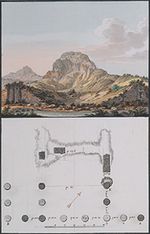
Sardis, Sardeis, Sardes, Sparda, and Sart are all names of a settlement in Anatolia located 60 miles east of Izmir, Turkey. Sardis has a long urban history which began over three thousand years ago and has been host to many cultures–Mycenaean and Hittite, Lydian, Persian, Greek, Roman, Byzantine, Selcuk, and Ottoman. For more than a millennium it was a major city of the ancient world. The Harvard University Art Museum’s exhibit, “The City of Sardis: Approaches in Graphic Recording” (2003), explores the topography and architecture of Sardis and approaches to graphic recording of the city since the middle of the 18th century. A guided tour of the exhibit, interviews with the curators and archaeologists, as well as slides and video from the exhibit and archeological dig are featured in this video. Explore the role of graphic recording over the last few centuries in preserving and recreating the ancient city of Sardis.

more from Harvard here.

Hydrology: Visions in Ice

Douglas Capron in Lensculture.com:

Ice I am inspired by transformations and transitions that occur within nature, people and music.

My photographic opportunities often arrive unexpectedly and I am always fascinated by how our perception of time alternates with various life experiences. I hope my work travels beyond graphic emotional impact and that it will provoke and sustain a subtle dialogue with the viewer.

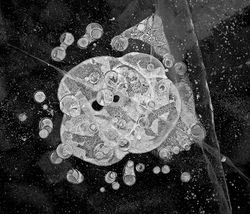
With my current series, Hydrology: Visions in Ice, my goal was to share with viewers the ephemeral mystery that occurs when water transforms into ice in
a natural setting. The resulting formations are surprisingly dynamic, organically expressive and complex, and pose more questions than are revealed beyond an aesthetic perspective in our relationship with the most basic element that sustains us all.

More here.

Burying the Bones: Pearl Buck in China

From The Telegraph:

Pb-desk Many years ago, my history tutor at Oxford snapped: “I am Anglo-Indian, by which I do not mean that I am half black.” I have thought of this often in the context of the term “mixed race”, not meaning what he meant, wondering why we have lost the words for cultural rather than racial crosses. Pearl Buck was American by birth but entirely Chinese by upbringing. A mission daughter born in 1892, she graduated to being an unhappily married mission wife and mother. The runaway success of her second novel, The Good Earth (1931), altered her life. She swapped China for the United States and her agrarian economist husband for her New York publisher. Her fiction continued to be set in Asia and to borrow from iconoclastic younger novelists in China producing richly plotted popular fiction in the previously despised vernacular. Buck took this one step further by writing about the agrarian poor. A Pulitzer and Nobel Prize followed.

The New York Times recently wrote that “in China [Buck] is admired but not read and in America she is read but not admired”. “Both views could do with reappraisal,” suggests Hilary Spurling. Her compelling examination of the imaginative sources of Buck’s fiction succeeds triumphantly in this aim.

More here.

Saturday, March 27, 2010

non-human persons?

Article-1056872-0328057D0000044D-720_233x312

The recent fatal attack of a SeaWorld trainer by the orca Tilikum has led to renewed questions about how humans should deal with potentially intelligent animals. Was Tilikum’s action premeditated, and how should that possibility influence decisions on the animal’s future treatment? Orcas, like their close relatives, dolphins, certainly seem smart, though researchers debate just how intelligent these cetaceans are and how similar their cognition is to humans. Should we ever treat such creatures like people? For centuries it seemed obvious to most people what separated them from other animals: Humans have language, they use tools, they plan for the future, and do any number of things that other animals don’t seem to do. But gradually the line between “animal” and “human” has blurred. Some animals do use tools; others solve complicated problems. Some can even be taught to communicate using sign language or other systems. Could it be that there isn’t a clear difference separating humans from other life forms?

more from Dave Munger at Seed here.

the hippie mafia

FC9780312551834

In the 1960s, a group of psychedelic-loving misfits from Orange County called the Brotherhood of Eternal Love figured it could turn the entire world on to the mystical power of LSD. It seemed like a reasonable idea at the time — the brotherhood had been founded on a shared belief in LSD’s transformative effects. But somewhere along the line, the spiritual message was squashed by thousands of kilos of smuggled marijuana and hashish. By decade’s end, the psychedelic messengers had sidetracked into a smuggling operation that made the group one of the largest drug cartels in America. Instead of enlightenment, the members of the brotherhood wound up making their mark as narcotics trailblazers: They distributed Orange Sunshine, arguably the most popular “brand” of LSD in history; created the strain of pot known as Maui Wowie; and were the first to bring Afghan hash to the U.S.

more from Erik Himmelsbach at the LAT here.

Pay, pack and follow, at convenience

Schiff-t_CA0-articleInline

She was neither the first nor the last diplomatic wife to receive the directive, later reduced to six words: “Pay, pack and follow, at convenience.” The version that reached Louisa Catherine Adams in January 1815 was less succinct — her husband was John Adams’s son after all — but she could hardly have complied more swiftly. In three weeks she had crated up the St. Petersburg household, settled the accounts and prepared to set off, across 2,000 miles, to join her husband in Paris. It was winter. Europe remained pockmarked by the Napoleonic Wars. With her Mrs. Adams would take knives and forks; hidden bags of gold and silver; a governess; two servants, one of them trustworthy; and 7-year-old Charles Francis Adams, whose third language was English. They set out late on the afternoon of Feb. 12. It was Mrs. Adams’s 40th birthday. There was some reason for the eager departure from Russia, to which John Quincy Adams had been posted in 1809. His was largely a ceremonial office. A St. Petersburg winter lasts from six to eight months. Neither Adams took naturally to diplomatic life, which in the court of Alexander I consisted of a debilitating round of balls, all-night marathons that left the Adamses to crawl from their beds the next afternoon with aching heads and parched throats. They endured as well the tribulation of every early American envoy abroad: how to survive in the most opulent of European courts on a preposterously low Congressional allowance? Especially to the London-bred Louisa Adams — she remains America’s only foreign-born first lady — the wardrobe-related indignities abounded. She had moreover held down the fort alone for nearly a year.

more from Stacy Schiff at the NYT here.

Saturday Poem

Stone Poem

The doorstep of your existence
is the morning’s clean slate,

a stone on my soul’s roof-hurdle,
a single necessary step
by love’s wall. Simple, stable.

I’ve never understood why people hunt
for crystal, or a lump of gold,
or a diamond. I’m simply

grateful for the stones at hand,
meteorites from the sky at times,
the magnet that holds two ships in harbour,

the loadstone of sensibility,
and the long stone that in an age of gravel
rolls, and gathers no moss,

the whetstone of my brain,
flints demanding an explosion
beneath the tissue, a fresh quarry.

Stone upon stone. Milestones
I walk towards happily,
chirping like a stonechat.

by Menna Elfyn

The History of White People

Linda Gordon in the New York Times Book Review:

ScreenHunter_02 Mar. 27 11.08 Nell Irvin Painter’s title, “The History of White People,” is a provocation in several ways: it’s monumental in sweep, and its absurd grandiosity should call to mind the fact that writing a “History of Black People” might seem perfectly reasonable to white people. But the title is literally accurate, because the book traces characterizations of the lighter-skinned people we call white today, starting with the ancient Scythians. For those who have not yet registered how much these characterizations have changed, let me assure you that sensory observation was not the basis of racial nomenclature.

Some ancient descriptions did note color, as when the ancient Greeks recognized that their “barbaric” northern neighbors, Scythians and Celts, had lighter skin than Greeks considered normal. Most ancient peoples defined population differences culturally, not physically, and often regarded lighter people as less civilized. Centuries later, European travel writers regarded the light-skinned Circassians, a k a Caucasians, as people best fit only for slavery, yet at the same time labeled Circassian slave women the epitome of beauty. Exoticizing and sexualizing women of allegedly inferior “races” has a long and continuous history in racial thought; it’s just that today they are usually darker-skinned women.

More here.