With Les Murray, you have to get the speed

Les_MurrayIn the majesty of his years and accomplishments, Les Murray, sole author of the several increasingly massive editions of his New Collected Poems – one of the great books of the modern world – is in the position of a monarch who, having successfully constructed Versailles all on his own, is now pottering in the grounds building sheds. Six years ago The Biplane Houses was such a shed, and very prettily done. Now Taller When Prone is another. Perhaps I would not have had the idea of an enormous building and its satellite bâtiments if the first poem in the new book had not been about the Taj Mahal. The poem, called “From a Tourist Journal” starts like this.

In a precinct of liver stone, high
On its dais, the Taj seems bloc hail.

Immediately he’s got you in. He has always been able to do that. The way he can register, in words nobody else would quite choose, a perception nobody else could quite have, is at the centre of his art, ensuring almost infallibly that a poem will work like a lucky charm for as long as he pours in the images. A Taj made of hail: you and I might say that we would have seen that to be true eventually, and we might even argue learnedly that the word “Mahal” phonically suggested the word “hail” (points for an essay there), but the daunting truth is that he doesn’t just think that way, he sees that way.

more from Clive James at clivejames.com here.

the worship of a cosmic principle

100628_r19745b_p233

“May all that emerges from me be beautiful,” Yves Klein prayed, with what seems like utter sincerity, in the handwritten text of a reliquary-like work, enshrining blue and pink pigment and gold leaf in little Plexiglas boxes, from 1961. The last French artist of major international consequence, Klein, who died the following year, at the age of thirty-four, was entreating Rita of Cascia, a saint of lost causes, abused women, and baseball. He was likely unmoved by the last. Klein’s sport was judo, which he wrote a book about, after studying it at a prestigious school in Tokyo and earning a black belt. The refusal of the French Federation of Judo to recognize his Japanese diploma, in 1954, frustrated his career plans in that line, to the benefit of his commitment to art. Hanging in a gallery near the St. Rita piece, in a sumptuous retrospective at the Hirshhorn Museum, in Washington, D.C., is a drawing in which the word “humility” is repeated twenty times.

more from Peter Schjeldhal at The New Yorker here.

that mysterious force, sensed in childhood and scrutinized in maturity

TLS_Barnes_725915a

I was nine years old when I first encountered the Creeping Man. Having wolfed down nearly all Sir Arthur Conan Doyle’s Sherlock Holmes stories in approximate order of publication, I had reached, with a feeling of regret, the final volume, The Case-Book of Sherlock Holmes. Composed of a dozen short tales, the Case-Book dates from the 1920s, a decade when Conan Doyle’s interest in his most famous creation had dwindled to a kind of mercenary contempt and the bulk of his time and attention were spent evangelizing for the spiritualist cause. Unaware of any of this, I noted no downturn in quality and found the eighth item in the collection, “The Adventure of the Creeping Man”, to be one of the richest and most singular investigations of Holmes’s long career – an opinion which I have had no reason to change. The story begins as Dr Watson is summoned to Baker Street, “one Sunday evening early in September of the year 1903”, by means of a splendidly terse telegram (“Come at once if convenient – if inconvenient come all the same”) in order to hear an account of the mystery of Professor Presbury, “the famous Camford physiologist”. The Professor, a “staid, elderly” widower, has recently become engaged to a much younger woman and “the current of his life” has been disrupted. Formerly “the frankest of men”, his behaviour has turned “furtive and sly”. He “lives as in a strange dream”, ventures out on unexplained expeditions and receives envelopes in the post, “marked by a cross under the stamp”.

more from Jonathan Barnes at the TLS here.

Friday Poem

The Fourfold

Automobiles are flowing like droplets down the string of the highway,
then all of a sudden they’re absorbed into housing estates and courtyards,
the reinforced concrete gardens of hypermarkets. Water

does not wash anything clean, it insistently drums on the brow, seeking
the plumb-line; droplet asking droplet what’s the way.
I turn onto my other side, here naked trees

flex themselves, as if trying to use their youthful branches
to prop up the sky’s support wall, on which weevils
are skillfully pretending to be seagulls and a damp mark is just as

remarkably spreading to form some artificial rose.
I get up, wake up, switch on the TV; the world goes
back to the beginning.

by Tadeusz Dabrowski
translated from Polish by Antonia Lloyd-Jones
from The Boston Review

The Runaway General

Michael Hastings in The Rolling Stone:

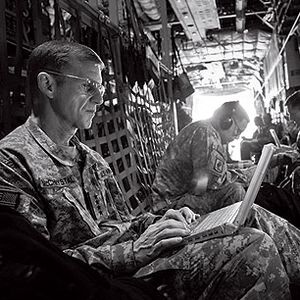
Mcchrystal_nato 'How'd I get screwed into going to this dinner?” demands Gen. Stanley McChrystal. It's a Thursday night in mid-April, and the commander of all U.S. and NATO forces in Afghanistan is sitting in a four-star suite at the Hôtel Westminster in Paris. He's in France to sell his new war strategy to our NATO allies – to keep up the fiction, in essence, that we actually have allies. Since McChrystal took over a year ago, the Afghan war has become the exclusive property of the United States. Opposition to the war has already toppled the Dutch government, forced the resignation of Germany's president and sparked both Canada and the Netherlands to announce the withdrawal of their 4,500 troops. McChrystal is in Paris to keep the French, who have lost more than 40 soldiers in Afghanistan, from going all wobbly on him.

“The dinner comes with the position, sir,” says his chief of staff, Col. Charlie Flynn.

McChrystal turns sharply in his chair.

“Hey, Charlie,” he asks, “does this come with the position?”

McChrystal gives him the middle finger.

More here.

Researchers design more reliable invisibility cloak

From PhysOrg:

Glasscloak Researchers have proposed a new design for an invisibility cloak – a device that could make objects invisible by guiding light around anything placed inside the cloak.

In the study, Elena Semouchkina from Michigan Technological University and Pennsylvania State University and her coauthors designed an invisibility cloak made of glass for the infrared range. Currently, most metamaterial cloak designs require that the metamaterial response be homogeneous. However, the new design relies on simulations of a true multi-element cloak structure and takes into account the inhomogeneity of a real metamaterial response. “This is one of the first designs of an optical cloak, in particular, of a cylindrical shell,” Semouchkina told PhysOrg.com. “This is a non-metallic low-loss all-dielectric cloak. … In contrast to the previous designs, the design of our cloak has been developed at a careful control of interactions between resonators, since a true multi-resonator structure has been simulated. It makes the design essentially more reliable.”

The structure of the proposed cloak consists of identical nanosized chalcogenide glass resonators arranged in a concentric pattern. In simulations, the researchers found that glass resonators in the shape of a cylinder with a diameter of 300 nm and a height of 150 nm provided the best results for the light wavelength of 1 micron. “The design employs identical resonators in all layers of the cloak, which, from the point of view of fabrication tolerance, presents a tremendous advantage versus fabricating nano-sized elements of different prescribed dimensions,” Semouchkina said.

More here.

Thursday, June 24, 2010

AfPak: Punjab’s growing militant problem

Conversation with Hassan Abbas in Foreign Policy:

1. Your article in the CTC Sentinel last spring defined the conglomeration of militant groups known collectively as the ‘Punjabi Taliban.' We hear most often, however, about the Tehrik-i-Taliban Pakistan militant groups based in the tribal regions. What are some similarities and differences between the two? How has the ‘Punjabi Taliban' developed since your CTC article?

ScreenHunter_05 Jun. 25 13.13 First, I would prefer to tweak the title of the group to ‘Punjabi militants,' for there are many differences between the band of militants operating in Punjab and those based in Federally Administered Tribal Areas (FATA) and Khyber Pukhtunkhwa province (previously NWFP). Though this classification may sound purely academic, it has policy implications also. These Punjabi militants, who had drifted away from their parent organizations (such as Jaish-e-Mohammad and Sipah-e-Sahaba), had moved towards FATA after 2005 because they considered the area safer to live, train, and operate from. These were called ‘Punjabi' not because they were all ethnically from Punjab province — in fact, a few Sindhi and Urdu speaking militants were also present in this group. Hence, all non-Pashtuns (with the exception of non-Pakistanis like Uzbeks) came to be called “Punjabi Taliban.”

Relations between Pakistani Taliban (Tehrik-i-Taliban Pakistan — TTP) and these Punjabi militants were complicated. They never merged and the nature of this collaboration remained restricted to distribution of tasks for a limited number of terrorist attacks in Punjab. Of course, they learned from each other, provided useful information and training to each other but their larger goals remained distinct. The Pakistani Taliban are partly a reaction to U.S. and Pakistani policy in Afghanistan and FATA, whereas Punjabi militants are frustrated from Pakistan's policies vis-à-vis Kashmir. Unacknowledged by India as well as the U.S., Pakistan achieved some success in stopping militants from going towards the Kashmir conflict zone in recent years. There are some exceptions here of course, but by and large, Punjabi militants started challenging the state after getting frustrated that they were abandoned.

More here.

Collaborating with Citizen Scientists

MonarchButterflyResearch_NSF_160Lucas Laursen in Science:

Climbing one of the world's biggest granite walls is different from climbing trees, as National Park Service botanist Martin Hutten discovered while dangling from a cliff in the spray of Vernal Falls high above the Yosemite Valley. Hutten apprenticed in the logging industry before he started graduate school, so he new how to climb trees. “I could trust myself to a rope,” he recalls, “but I'd definitely never hung off a cliff or collected [samples] from a cliff.”

So when Hutten — who is seeking a Ph.D. in forest ecology at Oregon State University, Corvallis — and his fellow park rangers needed help surveying the park's lichen, they enlisted experienced rock climbers. Over 2 weeks in 2007 and 2008, those volunteer climbers helped collect 394 lichen specimens. This year, the researchers are asking volunteers to help with other parts of their biodiversity survey, such as counting birds from the valley floor.

Hutten's project is one of many worldwide in which volunteers help scientists collect data in ways that range from mundane to vital. Such help, although voluntary, is not free. Recruiting volunteers, finding appropriate ways for them to contribute, training them, keeping them motivated, and ensuring the quality of the data they collect requires time, money, and management expertise.

One of the keys is to communicate well and keep the volunteers plugged in to the scientific big picture, says Chris Lintott, an astronomer at the University of Oxford in the United Kingdom and a coordinator of the Galaxy Zoo project which uses volunteers to catalog a database of galaxies. “You really need to treat the volunteers as collaborators,” he says.

How I Stopped Being A Slut, And Learned To Cash Massive Book Advances

Chastity-belt Amanda Marcotte in Pandagon:

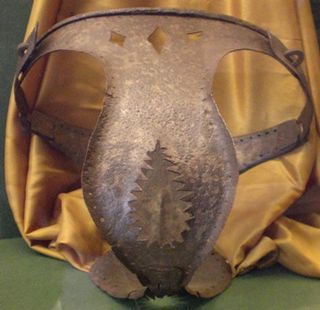
Another day, another sweet book deal for a woman who lambasts her former slutty self as unloveable, and renounces sex (because men don’t love women they stick it to). Reading this interview with Hephzibah Anderson, the author of Chastened, I realized something about the women trotting out the “no one will marry sluts” line—they are the flip side of the “pick-up artist” world.

At first, this seems like a weird thing to say. PUAs are all about the casual sex, right? But if you look a little deeper, you see the born-again non-sluts and the PUAs are singing the same tune. David Wong at Cracked describes the PUAs this way:

They believe the male/female relationship is adversarial in nature, and that sex is a way of conquering you.

Agreed. And that is exactly the attitude taken by the champions of chastity:

Did you pinpoint what changed in a relationship after sex? Was it a perceived shift in the power dynamic, was it one-sided or mutual?

Yes, I felt that I needed so much more from them. And, to me, it felt like I needed much more than my right. At the end of the year, I would be able to say, “Well, that’s ridiculous.” I think we’ve lost any sense of healthy emotional entitlement. I think if you go to bed with somebody, it is a kind of bond; it’s not nothing, however much we try to say it’s nothing. Whether you’re a man or woman, you’re absolutely in your rights to expect there to be some kind of emotional gain.

In both cases, the relationship between men and women is basically seen as a game of Capture The Flag, or in this case, Capture The Pussy.

Two Poets

Article_hassRobert Hass in The Believer:

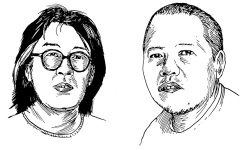
The film, 24 City, directed by Jia Zhange Ke and written by him and a poet named Zhai Yongming, tells the story of the closing of a factory in the city of Chengdu, in Sichuan Province. The factory, a dinosaur of the planned economy, was situated in an immense, paternalistic company town where thousands of people had worked at jobs and lived their lives, performing the tasks involved in fabricating airplane engines and refrigerators. The combination of long, slow pans of empty buildings, the animated faces of the storytellers, the way their stories made a fifty-year history of their country, the sudden, meditative cuts to spaces of silence in which objects spoke, made for a sense of elegy and wonder at the shapes lives take and the way people live inside the worlds given to them—a mix which also gave the film a terrific sense of aesthetic risk and surprise.

Zhai Yongming, the poet who had cowritten the film, was born in 1955 in Chengdu, so she was writing about a world that she was familiar with. I knew that she had been sent away for two years of rural reeducation during the Cultural Revolution, and that she had published her first book of poems, a work about the lives of women, in 1984. That was about the time that a new generation of poets appeared in China who had broken with the official aesthetic line of the Communist Party. Critics, disapproving of their militant subjectivity, labeled them the “Misty School,” and many of them went into exile after the Tiananmen Square massacre of 1989. But they were a clear sign that Chinese poetry had come alive, and settling in to hear another generation of poets, I had no idea what to expect.

The reading consisted of one live and surprising voice after another. The poets, men and women, ranged in age from their late thirties to early fifties. They belonged, as did Zhai Yongming, to what critics were calling the New Generation. All of them seemed to me interesting, and—the most surprising thing about them—interesting in different ways.

Thursday Poem

The Ant

The ant moves on tiny Sephardic feet.
The flute is always glad to repeat the same note.
The ocean rejoices in its dusky mansion.

Often bears are piled up close to each other.
In their world it's just one hump after another.
It's like looking at piles of many melons.

You and I have spent so many hours working.
We have paid dearly for the life we have.
It's alright if we do nothing tonight.

I am so much in love with mournful music
That I don't bother to look for violinists.
The aging peepers satisfy me for hours.

I love to see the fiddlers tuning up their old fiddles,
And the the singer urging the low note to come.
I saw her trying to keep the dawn from breaking.

You and I have worked hard for the life we have.
But we love to remember the way the soul leaps
Over and over into the lonely heavens.

by Robert Bly

Pakistan, a nation?

From Himal Southasian:

News_539579365 Right from the time of Independence, Pakistan has been troubled. The country’s psyche has been scarred since it emerged from the turmoil and bloodletting of Partition. Further trauma was in store when, in 1971, the eastern wing broke away, calling into question the very basis – ostensibly, religion – on which Pakistan was established. Today, the evolution of a composite Pakistani nationalism is being stringently challenged by a spectrum of sub-nationalisms. Still, one must not give in to the temptation to make too much of even this litany of woes and challenges – many of the other countries in Southasia, as in the rest of the world, live with such tensions. Perhaps Pakistan only reflects the problems more clearly.

Our cover image for this issue, taken by photojournalist Muhammad Danial Shah, presents a detail from the National Monument in Islamabad. The very design of the monument, inaugurated in 2007, is one that fervently seeks to forge a composite Pakistani nationalism, with four main petals and three smaller petals representing the extant four provinces and three territories (see pic). But bas relief in marble can only do so much to develop a unitary identity as a sum of the parts. Local and regional aspirations will have to be recognised in a ‘nations within nations’ formula – and the question is how successful Pakistan will be, given that the country is still a work in progress? There is no one answer, and the articles in this issue reflect the possibility of a multi-faceted formula. While some would claim that Pakistan is a failed state, others would say that it is stable enough to stand alone, the result of six decades of cohabitation. The hope is that Pakistan overcomes its existential angst before too long, because Pakistani stability and self-confidence would do wonders to the idea of Southasia.

More here.

The genome’s shield from sunlight

From Nature:

Sun After a decade-long struggle, researchers have determined the structure of an enzyme that repairs damage wreaked by the Sun on DNA and has an important role in preventing skin cancer. Ultraviolet light from the Sun can cause DNA damage by fusing together two of the nucleotide bases that sit side by side on a DNA strand. This forms a bulky lesion that distorts the DNA helix, making it impossible for most of the enzymes involved in DNA replication to read past the altered site correctly.

In 1999, researchers reported that one enzyme, DNA polymerase η ('eta'), a member of a family of proteins that copes with DNA damage, is able to bypass this error. The enzyme is mutated in some patients with a condition called xeroderma pigmentosum, which causes extreme sensitivity to sunlight. For such patients, the briefest exposure to the Sun can be enough to cause skin cancer. This week, two research groups report in Nature1,2 that they have at last determined precisely how DNA polymerase η manages this feat. The teams have captured a molecular snapshot of the enzyme — both from the yeast Saccharomyces cerevisiae and from humans — as it reads damaged DNA and produces a pristine, unmutated copy. “These two papers represent a major step forward in understanding the basic mechanisms responsible for skin cancer,” says Thomas Kunkel, a biochemist at the National Institute of Environmental Health Sciences in Research Triangle Park, North Carolina, who was not affiliated with either study.

More here.

Caught Between Opium and Lithium

Ruchira Paul in Accidental Blogger:

ScreenHunter_04 Jun. 24 14.33 The current and future problems of the beleaguered nation of Afghanistan may go well beyond war, the Taliban, Al Quaida, US occupation, poverty and heroin trafficking. The land locked nation of rough and rugged terrain is apparently the repository of vast mineral wealth, including large quantities of lithium, an essential component of many electronic gadgets. But like an uninformed (and unstable) nouveau riche individual, a poor, backward, politically fractious, war torn country may find its sudden wealth to be a burdensom and even a lethal liability. Prosperity is as much about managing one's assets as it is about owning them. The savvy rich get richer when blessed with goodies and the poor often become bewildered, murderous and vulnerable when in possession of sudden new riches.

More here.

Wednesday, June 23, 2010

Heroes, Martyrs, and the Rise of Modern Mathematics

Martin Gardner in The New Criterion:

ScreenHunter_03 Jun. 24 10.14 The title of Amir Alexander’s new book (his second) and the beautiful unidentified landscape painting on its jacket, refer to an early dawn duel on a deserted street in Paris. On May 30, 1892. Éveraste Galois, a brilliant young mathematician who pioneered the study of groups, a branch of abstract algebra, was killed in a ridiculous pistol duel over a woman. The duel was so little newsworthy that to this day no one knows for sure who shot Galois in the stomach and left him to die. He was twenty. As soon as Galois was buried, a legend formed about him. He became a martyr unjustly scorned by the French establishment, a scorn that contributed to his poverty and early death. This myth found its strongest expression in a flawed chapter on Galois in Eric Temple Bell’s bestseller Men of Mathematics.

But as Alexander, a science historian who lives in Los Angeles, makes clear, Galois was a thoroughly obnoxious nerd, suffering from what today would be called a “personality disorder.” His anger was paranoid and unremitting. He insulted friends. His ardent Republicanism, with its hatred of the king, sent him twice to prison. He railed against the French establishment, even though it published many of his papers. “If any person was ultimately to blame for the short and tragic life of this brilliant young mathematician,” Alexander writes, “it was inescapably himself.”

More here.

How A Quiet Revolution in Shiism Could Resolve the Crisis in Iran

Mohamad Bazzi in Foreign Affairs:

ScreenHunter_02 Jun. 24 10.00 For many Shiite Muslims, whose religion was born of rebellion, last year's popular uprising in Iran was just the latest in a centuries-long struggle against injustice and tyranny. Now, as the clerical regime consolidates its grip on power a year after the tainted reelection of President Mahmoud Ahmadinejad, Iran remains torn by what seems to be a hopeless conflict between Islam and democracy. But the 2009 unrest and violent crackdown in Iran were actually battles in a larger war that has been raging for centuries within Shiism — a war over who should rule the faithful, and how. There is a more moderate, democratic vision of Shiism — one that has been stifled ever since Iran's 1979 Islamic Revolution — that could ultimately resolve the current conflict.

Shiite clerics have long debated their role in politics. The “quietist” school — rooted in the sect's tradition of seeking to avoid confrontation with powerful rulers — argues against direct engagement in political matters. The more activist school emphasizes the martyrdom of Shiism's founding figure, Imam Hussein, who advocated rebellion and confrontation. But even within the activist school, there is a debate over the extent of clerical power.

More here.

We Must Stop the Avalanche of Low-Quality Research

Photo_5802_landscape_largeMark Bauerlein, Mohamed Gad-el-Hak, Wayne Grody, Bill McKelvey, and Stanley W. Trimble in the Chronicle of Higher Education:

Everybody agrees that scientific research is indispensable to the nation's health, prosperity, and security. In the many discussions of the value of research, however, one rarely hears any mention of how much publication of the results is best. Indeed, for all the regrets one hears in these hard times of research suffering from financing problems, we shouldn't forget the fact that the last few decades have seen astounding growth in the sheer output of research findings and conclusions. Just consider the raw increase in the number of journals. Using Ulrich's Periodicals Directory, Michael Mabe shows that the number of “refereed academic/scholarly” publications grows at a rate of 3.26 percent per year (i.e., doubles about every 20 years). The main cause: the growth in the number of researchers.

Many people regard this upsurge as a sign of health. They emphasize the remarkable discoveries and breakthroughs of scientific research over the years; they note that in the Times Higher Education's ranking of research universities around the world, campuses in the United States fill six of the top 10 spots. More published output means more discovery, more knowledge, ever-improving enterprise.

If only that were true.

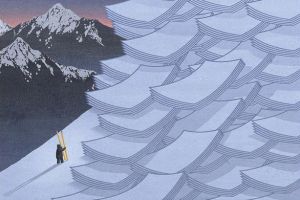
While brilliant and progressive research continues apace here and there, the amount of redundant, inconsequential, and outright poor research has swelled in recent decades, filling countless pages in journals and monographs. Consider this tally from Science two decades ago: Only 45 percent of the articles published in the 4,500 top scientific journals were cited within the first five years after publication. In recent years, the figure seems to have dropped further.