Parenting Makes People Miserable. What Else Is New?

From The Atlantic:

Doyle_july07_parents_post It's easy to mock New York magazine's recent article on “why parents hate parenting.” So many of its points seem obvious: Children decrease romance between spouses, diminish one's social life, and can be unholy terrors. (Jennifer Senior, its author, relates an awful-sounding interlude in which her son dismantled a wooden garage and then proceeded to pelt her with the pieces of it as she made repairs.) Still, there's one conclusion Senior makes that merits a bit of skepticism. She suggests that the hatred of parenting is recent, and raises “the possibility that parents don't much enjoy parenting because the experience of raising children has fundamentally changed.” In some important ways, it has. But the complaints raised by the piece aren't new at all; in fact, people—women, most notably—have been voicing them for the better part of the last 60 years.

In The Second Sex, Simone de Beauvoir wrote of the mother who finds that “her child by no means provides that happy self-fulfillment that has been promised her.” Instead, when this woman is busy, and “particularly when she is occupied with her husband,” she finds that “the child is merely harassing and bothersome. She has no leisure for 'training' him; the main thing is to prevent him from getting into trouble; he is always breaking or tearing or dirtying and is a constant danger to objects and to himself.” Adrienne Rich opened her 1976 book on motherhood, Of Woman Born, with one of her own journal entries, in which she noted that her children “cause [her] the most exquisite suffering… the murderous alternation between bitter resentment and raw-edged nerves, and blissful gratification and tenderness.” Later in the book, she would go on to argue that a mother of eight who dismembered her two youngest children and laid them on the lawn as “a sacrifice” was not precisely crazy, just fed up.

More here.

On Caregiving

From Harvard Magazine:

Med In 1966, as a visiting medical student at a London teaching hospital, I interviewed a husband and wife, in their early twenties, who had recently experienced a truly calamitous health catastrophe. On their wedding night, in their first experience of sexual intercourse, a malformed blood vessel in the husband’s brain burst, leaving him with a disabling paralysis of the right side of his body. Stunned and guilt-ridden, the couple clutched hands and cried silently as they shared their suffering with me. My job was to get the neurological examination right and diagnose where the rupture had taken place. I remember the famous professor, who went over my findings, repeating the neurological examination and putting me through my paces as a budding diagnostician. He never once alluded to the personal tragedy for the sad lovers and the shock to their parents. Finally, I found the courage to tell him that I thought the failure to address what really mattered to them—how to live their lives together from here on—was unacceptable. Surely, it was our medical responsibility to offer them some kind of caregiving and hope for the future. He smiled at me in a surprised and patronizing way; then he said I was right to insist that there was more to this case than the neurological findings. The professor had the patient and his wife brought to the lecture hall where he presided over the teaching rounds, and he gave them as sensitive an interview as I might have hoped for, including empathic suggestions for rehabilitation, family counseling, and social-work assistance.

More here.

India arrives in the American imagination

Kroll-Zaidi_1-B

TWO WINTERS AGO, making their way through Bombay’s Victoria Terminus, two young Muslim men became famous. One was Jamal Malik, a fictional orphan in a movie. The other was Ajmal Amir Kasab, said to be from a clan of butchers in small-town Pakistani Punjab. The former, in the closing scenes of the film, is weedy, gawky; lets his mouth hang open in a pantomime of nervous exhilaration; is newly rich from winning a game show; kisses the girl and then dances with the rest of the cast. The latter, in the most widely seen photo, is stout, steroidful; wears too-short cargo pants, a knockoff VERSACE T-shirt, two backpacks filled with ammunition and snacks; carries a double-banana-clipped AK-47 that blurs as it swings through the depopulated space before him. On May 6, 2010, he was sentenced to be hanged.

more from Rafil Kroll-Zaidi at Triple Canopy here.

pariah status in perpetuity

TLS_Baker_726417a

From cries of “Long live dynamite!” to arguments for vegetarianism, the anarchist cause has been a very broad church. Often naive and under-theorized – although it has always had highly intelligent proponents and sympathizers, a current example being Noam Chomsky – anarchism has also been dogged by a reputation for ill-directed violence, leading to what Alex Butterworth describes as “the movement’s pariah status in perpetuity”. Although The World That Never Was is an unashamedly popular book and concentrates on the more lurid end of the anarchist tendency, Butterworth at least tries to treat his pariah subjects with a counterbalancing sympathy. United – if at all – by a resistance to imposed authority, the characters here range from the almost Tolstoyan figure of Peter Kropotkin to the far wilder François Koenigstein, better known as Ravachol. Disgusted by Thomas Huxley’s 1888 Darwinian essay “The Struggle for Existence”, Kropotkin was the great theorist of Mutual Aid who had a soft spot for the rabbit as a species, admiring it as “the symbol of perdurability [that] stood out against selection”. Ravachol, on the other hand, began his career by disinterring an old woman’s corpse, murdered a ninety-five-year-old man, and then embarked on a terror bombing campaign which some commentators romanticized for the perpetrator’s “courage, his goodness, his greatness of soul”.

more from Phil Baker at the TLS here.

Krasznahorkai

Timetravelling

All that is transitory is but a parable. Goethe, Faust II This line, meant by Goethe to indicate that our worldly lives are but symbols for a greater, permanent afterlife, carries with it ambiguities that Mahler never considered when he used it rather clumsily at the climax of his Eighth Symphony. If we are all Christians, how easy to dispose of the travails of this life by casting them as imperfections of a greater, lesser-known world. But if we do not know that world, how do we construct that parable, and how do we sustain it in the face of reality’s constant resistance to conform to it? This is the question that the Hungarian author László Krasznahorkai pursues in his fiction. In the post-war years, many European authors, especially those from Communist states, engaged in surrealism, parable, and allegory as a way of containing the mid-century chaos that spilled over from the war, where the psychology and rationality of modernism no longer seemed capable of fighting the irrationality of Nazism and Communism. While there have been some stunning works by Ludvik Vaculik (The Guinea Pigs), Bohumil Hrabal (I Served the King of England, Too Loud a Solitude), Imre Kertész (Detective Story, Liquidation), and others, this general approach has more frequently produced limp sentimentality and disposable weirdness (Milan Kundera and Victor Pelevin, spring to mind). Within their own works, Günter Grass and Ismail Kadare have met with both success and disaster plowing this field.

more from David Auerbach at The Quarterly Conversation here.

Wednesday, July 7, 2010

The Future of Ethnic Studies

Photo_6065_landscape_largeGary Y. Okihiro in The Chronicle of Higher Education:

On May 11, 2010, less than a month after signing SB 1070, which many people hold legalizes racial profiling, Arizona's Gov. Jan Brewer signed HB 2281 into law. That law bans schools from teaching classes that are designed for students of a particular ethnic group or that promote resentment, ethnic solidarity, or overthrow of the U.S. government. “Public school pupils should be taught to treat and value each other as individuals and not be taught to resent or hate other races or classes of people,” it reads.

According to Tom Horne, the state's superintendent of public instruction and one of the bill's principal sponsors, the law was aimed at Chicano studies as taught in the Tucson school system. He called the program “harmful and dysfunctional.” Judy Burns, president of the Tucson Unified School District's governing board, disagreed, declaring that Chicano studies benefits students by promoting critical thinking.

The caricatures and falsehoods implied in the language of HB 2281 and in the arguments in its favor are as old as the field of ethnic studies, of which Chicano studies is a part. And while the Arizona law deals with primary and secondary schools, the issue is very much alive in higher education as well. There, too, ethnic studies, now almost half a century old, is facing threats: from budget cuts that often hit the smallest and newest programs first, from scholars who have transformed ethnic studies into multiculturalism and the study of difference, from critics who say ethnic studies is divisive—and from ethnic studies itself.

In light of the “culture wars” of the 1980s and 90s, the arguments of Arizona's political leaders appear positively old-fashioned. They say that ethnic studies has been created only by and for particular racial groups, and that it promotes hatred of whites and minority-group solidarity. Thus the “harmful” and “dysfunctional” nature of ethnic studies is allegedly that it creates social cleavages where, presumably, none existed before. Those battles were waged and resolved years ago—in favor of multiculturalists. Even former advocates of a single national culture now agree that the United States is and has always been a diverse nation, and that its study, accordingly, must reflect that fact.

Reconsidering Birthright Citizenship

20089_article_main Will Wilkinson makes a case against birthright citizenship in the United States, in The Week:

Even as Arizona continues to distinguish itself as America's undisputed leader in hare-brained xenophobia, the state has stumbled upon a very good idea. Hot on the heels of SB 1070, the controversial Arizona law that hands cops expansive powers to detain anybody who gives off an insufficiently American vibe, Republican lawmakers in the state have set their sights on a new state law to deny citizenship to babies born on American soil whose parents lack proper papers.

Currently, anyone born within U.S. boundaries counts as a U.S. citizen, and it doesn’t matter a bit how mom got in. The proposal to end “birthright citizenship” for the children of unauthorized immigrants springs from less than generous motives, and almost surely runs afoul of the U.S. Constitution. But ending it altogether is a better idea than you might think. (And if you already think it's a good idea, it's good for reasons you might find surprising.) For one, it would likely achieve the opposite of its intended result by making America more, rather than less, welcoming to newcomers.

Mothers Who Care Too Much

Ndf_35.4_mothers Over at the Boston Review, a debate: Nancy J. Hirschmann makes the case for the proposition that “Stay-at-home mothering is bad for mothers, their kids, and women’s equality.” Shannon Hayes, Ann Friedman, and Lane Kenworthy respond. (Other responses to come.) Hirschmann:

Since 1986 I have been teaching “Introduction to Feminist Political Thought.” In 2003 something unusual happened in the course. In each of the first five classes, my students initiated a discussion of mothering.

Surprised by this development, I asked the students if they expected to have children. Every woman’s hand went up, but the men thought I was crazy. When I asked how many of the women expected to be stay-at-home mothers, three-quarters raised their hands. Mothering, they said, is the most important job anyone could do. They wanted other options available, but they planned to choose mothering. This pattern has held, more or less, in subsequent years.

Some feminists will cheer this development. Significant trends within feminism, grouped under the label of care feminism, have long emphasized the socially important work that women do rearing children. I have pursued such arguments in my own work but lately I have grown worried that feminists such as me have exaggerated the importance of care, ignored the inadequate ways in which it is often performed. We have failed to acknowledge that the louder we applaud it, the more we enable its perversion.

We hear a lot about the evils of working mothers, how they are too busy or selfish to pay attention to their children. And everyone loves to pile on rich men’s wives who are obsessed with getting their children into the right preschool yet consign them to the care of nannies. But we don’t often talk—either within the academy or outside of it—about the comparable failings of full-time mothering, about the women like Susan’s and Anthony’s mothers who devote their lives to caring for their families, while producing outcomes that arguably undermine such basic political values as freedom, equality, and engaged citizenship.

The students in my feminist theory course are a useful barometer. When they read about the financial and economic vulnerability of married stay-at-home moms, they are skeptical: good mothers, they say, devote themselves to caring for their children; and their husbands should support them; they’re a team. Yet when they read about women on public assistance— often single mothers—they argue that the women should work, and they excoriate them for being bad mothers who set a poor example for their children by not working for a wage, and, implicitly, for not hanging on to their husbands.

Their lack of empathy and identification is both breathtaking and remarkably consistent.

Why We Talk to Terrorists

Axelrod200 Scott Atran and Robert Axelrod over at Edge:

In our own work on groups categorized as terrorist organizations, we have detected significant differences in their attitudes and actions. For example, in our recent interactions with the leader of the Palestinian militant group Islamic Jihad Ramadan Shallah (which we immediately reported to the State Department, as he is on the F.B.I.’s “most wanted” list), we were faced with an adamant refusal to ever recognize Israel or move toward a two-state solution.

Yet when we talked to Khaled Meshal, the leader of Hamas (considered a terrorist group by the State Department), he said that his movement could imagine a two-state “peace” (he used the term “salaam,” not just the usual “hudna,” which signifies only an armistice).

Atran200

In our time with Mr. Meshal’s group, we were also able to confirm something that Saudi and Israeli intelligence officers had told us: Hamas has fought to keep Al Qaeda out of its field of influence, and has no demonstrated interest in global jihad. Whether or not the differences among Al Qaeda, Islamic Jihad, Hamas and other violent groups are fundamental, rather than temporary or tactical, is something only further exploration will reveal. But to assume that it is invariably wrong to engage any of these groups is a grave mistake.

In our fieldwork with jihadist leaders, foot soldiers and their associates across Eurasia and North Africa, we have found huge variation in the political aspirations, desired ends and commitment to violence.

Wednesday Poem

Self Portrait in a Men's Room Mirror

Moustasche: roan — red flecked with grey.
Aquiline nose: from some Roman Gaius
who slipped off crested helmet, greaves and boots,
to pleasure some Semitic Ruth.

Eyes: subdued, muddy blue, dark bags below
all packed and ready to go.
Lines: one for every woe —
six divorces, ten runaway horses.

But nothing, nothing left to comb:
I'd die for a parted red sea of hair,
to toss about, fiddle with, and braid.

I figure, girls go wild for men with manes.
Or so I'm told. That's what I hear.

What else? A mole. A zit. That's it.

by Norbert Hirschhorn
from Anon Seven, 2010

Noam Chomsky interview

From The Telegraph:

Noam-1_1672796c In an almost empty hotel bar, around the corner from the British Museum, an 81-year-old American professor is sipping tea and talking in a monotone so muted I wonder whether he is having me on. I soon conclude that he isn’t; that he doesn’t do jokes; that he, Noam Chomsky, does not, in fact, possess a sense of humour. Sacha Baron Cohen came to the same conclusion when, as Ali G, he asked Chomsky: ‘How many words does you know, and what is some of them?’ Chomsky didn’t even smile, he simply informed his interviewer how many words the average Westerner knows, and then, as requested, revealed what is some of them. Baron Cohen’s question may have been amusing but it wasn’t entirely random. Chomsky found global fame in the Sixties, in the unlikely field of linguistics. He more or less founded the discipline, becoming to it what Freud became to psychoanalysis and Einstein to cosmology.

In contradiction of the prevailing ‘behaviourist’ view that language was learned, Chomsky argued that the human mind is actually hard-wired for grammatical thought. The way children successfully acquire their native language in so little time suggested, for him, that the structures of language were innate, rather than acquired, and that all languages shared common underlying rules. This he called Universal Grammar but don’t worry, I won’t be testing you later, and linguistics is not what this interview is about. Although I should perhaps add that the debate about language has moved on since Chomsky’s theories in the Sixties. And Chomsky has moved on, too. In fact he is better known these days as a political activist. The man the American Right love to hate. The American Left aren’t exactly wild about him either. As a self-styled anarchist and Enlightenment liberal, he collects political enemies the way sticky paper collects flies. You somehow imagine that a man with his rhetorical clout and reputation will have a booming voice, or at least some basic oratory skills. Yet here he is, barely 4ft away from me, and I am straining to hear him. It’s nothing to do with his age or health – he is a slender, fit looking, slightly stooped man with greying wavy hair, a diffident manner and a tendency to glance sideways at you through wire-rimmed glasses.

More here.

Skip the Small Talk: Meaningful Conversations Linked to Happier People

From Scientific American:

Skip-the-small-talk_1 Feeling down? Having a stimulating conversation might help, according to a new study published in Psychological Science. Researchers at the University of Arizona and Washington University in St. Louis used unobtrusive recording devices to track the conversations of 79 undergraduate students over the course of four days. They then counted the conversations and determined how many were superficial versus substantive, based on whether the information exchanged was banal (“What do you have there? Pop­corn?”) or meaningful (“She fell in love with your dad? So, did they get divorced soon after?”). They also assessed subjects’ overall well-being by having them fill out question­naires and by asking their friends to report on how happy and content with life they seemed.

The happiest subjects spent 70 percent more time talking than the unhappiest sub­jects, which suggests that “the mere time a person spends in the presence of others is a good predictor of the person’s level of happi­ness,” says co-author Matthias Mehl, a psy­chologist at Arizona. The happiest subjects also participated in a third as much small talk and had twice as many in-depth conversations as the most unhappy participants.

More here.

see no evil

Eve_apple

Terry Eagleton has written a book about evil in order to demonstrate that there is no such thing. Evil, he writes, is boring, supremely pointless, lifeless, philistine, kitsch-ridden, and superficial. Lacking any substance, it “is not something we should lose too much sleep over.” People can be wicked, cruel, and indifferent. But the concept of evil, with which theologians and philosophers have wrestled for centuries, can be safely tucked away. When it comes to evil, we must be social and economic realists. “Most violence and injustice are the result of material forces, not of the vicious dispositions of individuals.” On a subject that does not exist, Eagleton nonetheless has found a great deal to say. This should come as no surprise. Widely known for books refuting what he confidently proclaimed in his earlier ones, Eagleton is not one to let a seeming contradiction stand in the way of strongly declared convictions. Perhaps this explains why his Marxist musings seem so obligatory, tacked on to the end of a book that primarily deals with writers pondering the many ways we are disobedient to God and his commands. Eagleton believes as fervently in everything as he does in nothing. On Evil is theology without a supreme being. As much as he wants to hold onto class struggle, Eagleton cannot let go of the catechism.

more from Alan Wolfe at TNR here.

this rubble of days

17382_2

As a young man, he flew. He had always wanted to be a fighter pilot; then, during training, he crashed into a house, and he flew transport for six years until he became a fighter pilot after all. He flew an F-86 mostly. He wasn’t one of the greats, he once said, he wasn’t an ace, but he was “in the show.” He was twenty, in 1945, when he graduated from West Point and took his commission in the United States Army Air Force. That date might make you think he missed the war, but there is always another war, and his was Korea. He flew a hundred combat missions. You can read about it in The Hunters, his first novel: the barracks life, the waiting for action, then taking off, hunting the sky over the Yalu River for Soviet MIGs, the dogfights, the hunger for a kill, coming back to base on the last drop of gas—or not coming back. The book was published in 1957, and with that, after twelve years as a pilot, he resigned from the Air Force to be a writer. The pilot was called, as he had been from birth, James Horowitz. The writer called himself James Salter. He was handsome, and he had style. He lived in Europe. His prose announced itself with a high modernist elegance. He made language spare and lush all at once—strong feelings made stronger by abbreviation, intense physicality haunted by a whiff of metaphysics: for everything that is described, even more is evoked.

more from Philip Gourevitch at Threepenny Review here.

In the caves, it is too dark to read the book

Lewis_07_10

Some 15,000 years ago, in what is now the Dordogne region of France, someone – man or woman, we don’t know – crawled hundreds of metres through a dark underground passage no more than one metre high. Then he or she scratched a few lines on a bulge of rock. Suddenly, the rock was transformed: an image of a horse appeared. No one else could witness the appearance of the animal: only one person at a time could fit into the confined space. Then he or she retreated back down the passage to the world of light. A few kilometres away a different scene was enacted. In a large subterranean chamber a number of people gathered to mix paint and to erect scaffolding. Then, with broad sweeps and different colours, they created a procession of horses, aurochs, deer and, hidden amongst them, a solitary bear. The diversity of Upper Palaeolithic imagery is staggering. The period and its efflorescence of art lasted from about 35,000 to 10,000 years ago. Today we are still able to appreciate these ancient accomplishments because a number of the embellished caves in France and Spain, miraculously preserved, are open to the public. That is true of those that are easy of access; others that entail crawling, squeezing and sometimes subterranean wading are, understandably, closed. But enough are open to permit us all to marvel at what is one of the greatest triumphs – and mysteries – of humanity.

more from David Lewis-Williams at Literary Review here.

Tuesday, July 6, 2010

What Soccer Says About Us

Gary Younge in The Nation:

Sport can only do so much, and as a metaphor it can be crude and problematic. The nationalism it produces can be vile, violent and susceptible to manipulation. Immediately after Egypt won the Africa Cup of Nations in 2006, the government raised food prices. “It was the only time the government thought they could get away with it,” argues Steve Bloomfield in his book Africa United. “And they were right.” After Cameroonian President Paul Biya stole elections in 1992, a general strike was called on the day before a World Cup qualifier against Zimbabwe. Biya announced that if Cameroon won, the next day would be a national holiday. The strike was called off.

Finally, having a national identity funneled through an exclusively male tournament (women’s soccer is growing but still has nowhere near the cultural reach) is inherently limiting.

But for all that, the symbolic significance cannot be denied, lest symbols, in the words of George Carlin, be left to the symbol-minded. During a sensitive period in the Ivory Coast after a peace deal had been signed, Didier Drogba, the national star, insisted that one of the qualifying games be played in the north where regional alienation was considerable, and many argued it made a big difference. In England a new generation of nonwhites has started to embrace the national team in a way that was rare for their forebears.

Flying Cars

CarimageDavid Albert in n+1:

Flying cars come in two types. Vertical takeoff and landing (VTOL) cars were originally to be adaptations of the helicopter. But the high-speed rotors on helicopters are too likely to slice someone’s head off, given day to day use, and anyway your average chopper is just too delicate and complex to be used daily. So while the helicopter will always remain ideal for reporting on land-car traffic jams, spiriting victims of land-car crashes to the hospital, and filming land-car thieves for sensationalist television broadcasts, it will never become the Chevrolet of the future.

In the past decade, two other VTOL designs have begun to look feasible. They are perfect foils: one from an Israeli company with a sober business plan and links to heavy hitters in the aerospace industry and military, the other a West Coast company headed by Paul Moller, whose other interests include a company that sells “life extension” almond butter.

Urban Aeronautics, based in Tel Aviv, has been developing a concept first explored by the US military in the 1950s. And the design for their X-Hawk is only modestly more inspiring than a Merkava tank—it’s similar to a 1960 De Soto but not so pretty. Usually shown in banana yellow, the X-Hawk is essentially two eight-foot fans set horizontally with the payload on a flat sled in between.

You can literally step from the 25th-floor into your X-Hawk, just don’t look down. Initial plans are for rescue and combat operations in close urban environments, and the company has already made a sale to an Israeli hospital. They predict the X-Hawk will enter the personal vehicle market within twenty years.

If the world wants a flying penis car, on the other hand, Paul Moller’s M400 Skycar is it.

The Mind and The Brain

SarahBlakemoreSarah-Jayne Blakemore recommends 5 books on the topic, over at Five Books:

Saturday by Ian McEwan. I really like Ian McEwan, and partly because he has an interest in the brain. Saturday is all about a neurosurgeon called Henry Perowne, who works at UCL. McEwan is a very good friend of the head of a neuroscience department at UCL, and he spent many months shadowing neurosurgeons at the National Hospital of Neurology and Neurosurgery in Queen Square. The story takes place on one Saturday: the Saturday of the anti-Blair, anti-Iraq war demonstration of 2004 in which millions of people took part. Perowne is walking around Bloomsbury, and gets into a tussle with some men near Tottenham Court Road. It’s not so much the event that matters, but his description of his emotions: it’s like time stands still, and he describes all these different emotions that he feels for pages and pages. Perowne is describing all of his thought processes during this day, and it’s an incredible moment-by-moment interpretation of events, and an amazing insight into the way that emotions cause you to act in the way you do, and the idea we’re in control of our actions – or are we? As one of the guys is beating him up, Perowne is looking at him and recognises that he has the early symptoms of Huntingdon’s disease, which is hereditary, with a relatively early onset – symptoms usually start to appear in the mid-30s – and which affects your motor system and cognition. Perowne starts to diagnose him, and starts to really worry the man, by describing the symptoms the man has been feeling but isn’t really aware of because they’re such early symptoms.

But the book is really a journey into the brain, and how from a physiological point of view things can go wrong in the brain, and that some of those things can be alleviated by surgery, and some can’t. And the substance of the book is about things like emotion and perception of the world, and how the brain controls behaviour. It’s really, really interesting: Ian McEwan does his research so well, and he’s such an eloquent speaker on the topic of the brain. Not having been trained in medicine or science, he is sometimes able to have insights and a perspective that if you’re a specialist in the field you can’t have.

Christopher Hitchens: The scrapper faces the enemy within

From The Guardian:

Cusl01_hitchens0710 Recently, Martin Amis noted, half-jokingly, that becoming a grandfather was like receiving a telegram from the mortuary. If so, then the news last week that his closest friend, Christopher Hitchens, has cancer of the oesophagus is more like getting a generational summons from the grave. That is not to overstate the seriousness of Hitchens's diagnosis – although oesophageal cancer is indeed a grim condition – but simply to recognise the legend of an indestructible constitution that has long attended the celebrated journalist, polemicist, author, anti-theist and bon vivant. And no less to acknowledge the vitality habitually displayed by Hitchens in the dissemination and discussion of political and cultural ideas. While history's recent tectonic movements have left the co-ordinates of Hitchens's politics subject to fierce debate, few would argue that for more than three decades he has consistently occupied the position of the hardest-working, hardest-living man of letters on either side of the Atlantic.

The author of 11 books (and co-author of six more), including the bestselling God Is not Great, and four pamphlets and four collections of essays, Hitchens is also a columnist for Vanity Fair, lead book reviewer for the Atlantic Monthly, has a weekly column with the online magazine Slate, and is a contributor to countless other publications. Taking his former friend Gore Vidal's advice, he tries never to decline an invitation to appear on TV, where he is a familiar presence on American cable politics shows. He is a formidable participant in public debates, a regular on the lecture circuit and he has also been a visiting professor at the New School in New York and Berkeley in California. In between, he makes a point of going somewhere “dangerous or difficult” each year, usually a war zone or some military dictatorship.

More here.

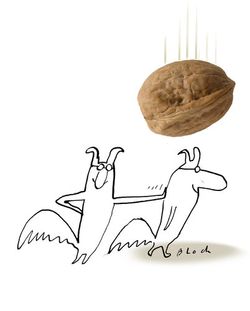
Nut? What Nut? The Squirrel Outwits to Survive

Natalie Angier in The New York Times:

ANGI-popup I was walking through the neighborhood one afternoon when, on turning a corner, I nearly tripped over a gray squirrel that was sitting in the middle of the sidewalk, eating a nut. Startled by my sudden appearance, the squirrel dashed out to the road — right in front of an oncoming car. Before I had time to scream, the squirrel had gotten caught in the car’s front hubcap, had spun around once like a cartoon character in a clothes dryer, and was spat back off. When the car drove away, the squirrel picked itself up, wobbled for a moment or two, and then resolutely hopped across the street. You don’t get to be one of the most widely disseminated mammals in the world — equally at home in the woods, a suburban backyard or any city “green space” bigger than a mousepad — if you’re crushed by every Acme anvil that happens to drop your way. “When people call me squirrely,” said John L. Koprowski, a squirrel expert and professor of wildlife conservation and management at the University of Arizona, “I am flattered by the term.”

The Eastern gray tree squirrel, or Sciurus carolinensis, has been so spectacularly successful that it is often considered a pest. The International Union for Conservation of Nature includes the squirrel on its list of the top 100 invasive species. The British and Italians hate gray squirrels for outcompeting their beloved native red squirrels. Manhattanites hate gray squirrels for reminding them of pigeons, and that goes for the black, brown and latte squirrel morphs, too. Yet researchers who study gray squirrels argue that their subject is far more compelling than most people realize, and that behind the squirrel’s success lies a phenomenal elasticity of body, brain and behavior. Squirrels can leap a span 10 times the length of their body, roughly double what the best human long jumper can manage. They can rotate their ankles 180 degrees, and so keep a grip while climbing no matter which way they’re facing. Squirrels can learn by watching others — cross-phyletically, if need be. In their book “Squirrels: The Animal Answer Guide,” Richard W. Thorington Jr. and Katie Ferrell of the Smithsonian Institution described the safe-pedestrian approach of a gray squirrel eager to traverse a busy avenue near the White House. The squirrel waited on the grass near a crosswalk until people began to cross the street, said the authors, “and then it crossed the street behind them.”

More here.