How old people will remake the world

From Salon:

World These days people are living longer lives than ever before. Ancient Romans expected to live an average of 25 years. Today, thanks to advanced medicine and nutrition, the worldwide average is 64. In all, we will enjoy 250 billion more years of life than if we had been born a century ago. Few people, of course, would argue that's a bad thing — but, as more and more people get older, it means that our world is about to undergo some very dramatic changes.

According to journalist Ted C. Fishman's new book “Shock of Gray,” those changes are already being felt in parts of the world. By reporting from cities that are ahead of the overall aging curve, Fishman deftly forecasts the larger problems that will soon consume the globe. Professionals and skilled laborers will be pushed out of their jobs before they can afford to retire, forcing many into service industries that pay a small fraction of their former salaries. Rural communities will struggle with acute aging as young people leave for the cities. That in turn will create opportunities for immigrants, thus accelerating globalization. Builders will need to accommodate more people with greater mobility issues, which will drive up costs for infrastructure. At the same time, scientists will continue to tweak the human life span to the point, perhaps one day, of near immortality.

More here.

Tuesday Poem

Getting Laundry Done in Rampur

Dobiwallah, please take my socks;
these ragged trousers and shirts;
and the shalwar kameez I bought
in the town upstream of here
between one bus and the next.

Beat them clean for me. Hurl them
into the cold waters, against
sharp-edged volcanic rocks — don’t let
the fear of crowding, the stupid words
spilled as answers to strangers
stay in their cloth. Hammer it out.

If a button comes off the shirt,
let it float all the way past Agra
(if they let such a tourist
so close to the Taj Mahal for free).
Let it come to Delhi and be gathered
by a hand glad for one more thing
the river brings. I will follow.

by Hanna Coy
from You Are Here, 2010

Seeing the Natural World With a Physicist’s Lens

Natalie Angier in The New York Times:

ANGI-sfSpan If you’ve ever stumbled your way through a newly darkened movie theater, unable to distinguish an armrest from a splayed leg or a draped coat from a child’s head, you may well question some of the design features of the human visual system. Sure, we can see lots of colors during the day, but turn down the lights and, well, did you know that a large bucket of popcorn can accommodate an entire woman’s shoe without tipping over?

Yet for all these apparent flaws, the basic building blocks of human eyesight turn out to be practically perfect. Scientists have learned that the fundamental units of vision, the photoreceptor cells that carpet the retinal tissue of the eye and respond to light, are not just good or great or phabulous at their job. They are not merely exceptionally impressive by the standards of biology, with whatever slop and wiggle room the animate category implies. Photoreceptors operate at the outermost boundary allowed by the laws of physics, which means they are as good as they can be, period. Each one is designed to detect and respond to single photons of light — the smallest possible packages in which light comes wrapped.

More here.

Caucasian Nation

Marco Roth in n + 1:

ScreenHunter_02 Nov. 02 10.10 The present blooming fantasy of white victimization has roots in the peculiar violent institutions of the 19th-century American South. In the distant mirror of history, it’s easy to spot the irony and the guilt: even before the Civil War began, whites worried that their slaves would rise up and repay their masters in kind — filch the fruit of their labor, rape them, and beat them, sometimes to death. As soon as the balance of power shifted and news of Lee’s surrender at Appomattox Courthouse circulated throughout the former slave states, those fears ran amok. Mark Summers, a historian of the disastrous “Reconstruction” that condemned recently freed blacks to another century of oppression, has observed that the South, unlike the North, had no truly independent newspapers or magazines. What fair and balanced organs then existed reported rumors and falsehoods, like the arrival of a “liberating” French army sent by Napoleon III the same week of Lee’s surrender, or the forced seizure of former plantations by mobs of roving blacks. In Summers’s telling phrase, “the white south saw with dreadful clarity things that did not exist.”

More here.

The signature of the bluffing brain

Ed Yong in Not Exactly Rocket Science:

Poker The best poker players are masters of deception. They’re good at manipulating the actions of other players, while masking their own so that their lies become undetectable. But even the best deceivers have tells, and Meghana Bhatt from Baylor University has found some fascinating ones. By scanning the brains and studying the behaviour of volunteers playing a simple bargaining game, she has found different patterns of brain activity that correspond to different playing styles. These “neural signatures” separate the players who are adept at strategic deception from those who play more straightforwardly.

In the game, a buyer and a seller negotiate over the sale of an imaginary object. The buyer is told about the object’s value in private and suggests a price to the seller, who then sets the actual price. If the price is less than the value, the deal goes ahead, the seller gets the price and the buyer gets the difference between that figure and the object’s value. If the seller’s price is too high, the deal is called off and no one gets anything. This goes on for 60 rounds and at the end of each, the players aren’t told about the outcomes.

Because of this set-up, buyers do best if they set low prices, because they stand to gain the most profits if the sellers accept. Sellers, however, prefer high prices to make the most from their sale. To play successfully, buyers have to keep in mind the object’s real value, the price that they offer, how they think the seller will react to their move, how they could make the most money, and how they can manipulate the seller to accomplish that.

More here.

The Phantom Left

Chris Hedges in Dandelion Salad:

Jon-stewart-rally The loss of a radical left in American politics has been catastrophic. The left once harbored militant anarchist and communist labor unions, an independent, alternative press, social movements and politicians not tethered to corporate benefactors. But its disappearance, the result of long witch hunts for communists, post-industrialization and the silencing of those who did not sign on for the utopian vision of globalization, means that there is no counterforce to halt our slide into corporate neofeudalism. This harsh reality, however, is not palatable. So the corporations that control mass communications conjure up the phantom of a left. They blame the phantom for our debacle. And they get us to speak in absurdities.

The phantom left took a central role on the mall this weekend in Washington. It had performed admirably for Glenn Beck, who used it in his own rally as a lightning rod to instill anger and fear. And the phantom left proved equally useful for the comics Jon Stewart and Stephen Colbert, who spoke to the crowd wearing red-white-and-blue costumes. The two comics evoked the phantom left, as the liberal class always does, in defense of moderation, which might better be described as apathy. If the right wing is crazy and if the left wing is crazy, the argument goes, then we moderates will be reasonable. We will be nice. Exxon and Goldman Sachs, along with predatory banks and the arms industry, may be ripping the guts out of the country, our rights—including habeas corpus—may have been revoked, but don’t get mad. Don’t be shrill. Don’t be like the crazies on the left.

“Why would you work with Marxists actively subverting our Constitution or racists and homophobes who see no one’s humanity but their own?” Stewart asked. “We hear every damn day about how fragile our country is—on the brink of catastrophe—torn by polarizing hate, and how it’s a shame that we can’t work together to get things done. But the truth is we do. We work together to get things done every damn day. The only place we don’t is here [in Washington] or on cable TV.”

The rally delivered a political message devoid of reality or content.

More here.

Monday, November 1, 2010

Last Call: 3 Quarks Daily is looking for New Monday Columnists

Dear Reader,

AbbasHere's your chance to say what you want to the large international audience of highly educated readers that make up the 3QD audience! Several of our regular columnists have had to cut back or even completely quit their columns for 3QD because of other personal and professional commitments, and so we are looking for new voices. We cannot pay, but it is a good chance to draw attention to subjects you are interested in, and to get feedback from us and from our readers.

You would have a column published at 3QD every fourth Monday. It should generally be between 1000 and 2500 words and can be about any subject at all. To qualify for a Monday slot, please submit a sample column to me by email (s.abbas.raza.1 at gmail.com) as an MS Word-compatible document, which I will then circulate to the other editors, and we will let you know our decision fairly quickly after we have a vote on it a fews days after November 1. If you are given a slot on the 3QD schedule, your sample can also serve as your first column. Feel free to use pictures, graphs, or other illustrations in your column. Naturally, you retain full copyright over your writing.

To browse previous columns, go to our Mondays page.

Please DO NOT submit more than one piece of writing, and also do not send the URL for a whole blog or website. I do not have the time to look through multiple postings. Select one piece of writing that you think is representative of the kinds of things you'd like to do at 3QD and just send that.

Several of the people who started writing at 3QD have gone on to get regular paid gigs at well-known magazines, others have written well-received books. Even those who have not, have written to me saying that it has been a uniquely rewarding experience. (See, for example, Aditya Dev Sood's note in the comments section of this post.) If you have a blog or website of your own, please help us to spread this invitation by linking to this post.

The absolute deadline for sample submissions is 11:59 PM EST, November 1, 2010, (that's today) so start writing!

All best,

Abbas

Sunday, October 31, 2010

The Great Indian Love Affair With Censorship

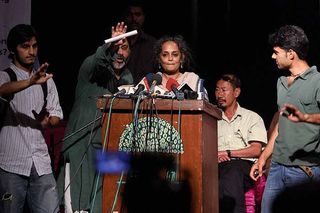
Arundhati-Roy_20101021 Ashis Nandy in Outlook India:

“Patriotism,” Samuel Johnson said nearly 250 years ago, “is the last refuge of a scoundrel.” These days in India, the adage can be safely applied to nationalism. There is no other explanation of the threat to arrest and try Arundhati Roy on charges of sedition for what she said at a public meeting on Kashmir, where Syed Ali Geelani too spoke. I was not there at the meeting, but I have read her moving statement defending herself afterwards. I feel both proud and humbled by it. I am a psychologist and political analyst, handicapped by my vocation; I could not have put the case against censorship so starkly and elegantly. What she has said is simultaneously a plea for a more democratic India and a more humane future for Indians.

I faced a similar situation a couple of years ago, when I wrote a column in the Times of India on the long-term cultural consequences of the anti-Muslim pogrom in 2002. It was a sharp attack on Gujarat’s changing middle-class culture. I was served summons for inciting communal hatred. I had to take anticipatory bail from the Supreme Court and get the police summons quashed. The case, however, goes on, even though the Supreme Court, while granting me anticipatory bail, said it found nothing objectionable in the article. The editor of the Ahmedabad edition of the Times of India was less fortunate. He was charged with sedition.

I shall be surprised if the charges of sedition against Arundhati are taken to their logical conclusion. Geelani is already facing more than a hundred cases of sedition, so one more probably won’t make a difference to him. Indeed, the government may fall back on time-tested traditions and negotiate with recalcitrant opponents through income-tax laws. People never fully trusted the income-tax officials; now they will distrust them the way they distrust the CBI.

In the meanwhile, we have made fools of ourselves in front of the whole world. All this because some protesters demonstrated at the meeting that Arundhati and Geelani addressed! Yet, I hear from those who were present at the meeting that Geelani did not once utter the word “secession”, and even went so far as to give a soft definition of azadi. By all accounts, he put forward a rather moderate agenda. Was it his way of sending a message to the government of India? How much of it was cold-blooded public relations, how much a clever play with political possibilities in Kashmir?

We shall never know, just because most of those who pass as politicians today and our knowledge-proof babus have proved themselves incapable of understanding the subtleties of public communication. They are not literate enough to know what role free speech and free press play in an open society, not only in keeping the society open but also in serious statecraft. In the meanwhile, it has become dangerous to demand a more compassionate and humane society, for that has come to mean a serious criticism of contemporary India and those who run it. Such criticism is being redefined as anti-national and divisive. In the case of Arundhati, it is of course the BJP that is setting the pace of public debate and pleading for censorship. But I must hasten to add that the Congress looks unwilling to lose the race. It seems keen to prove that it is more nationalist than the BJP.

Scientific evidence for psychic powers?

Jerry Coyne in Why Evolution is True:

ScreenHunter_01 Oct. 31 16.10 A respected peer-reviewed journal in psychology, The Journal of Personality and Social Psychology, is about to publish a paper that presents scientific evidence for precognition. The paper, by Daryl Bem of Cornell University, is called Feeling the future: Experimental evidence for anomalous retroactive influences on cognition and affect,” and you can download a preprint on his webpage. I’ve scanned the paper only briefly, and am posting about it in hopes that some of you will read it carefully and provide analyses, either here or elsewhere.

The paper purports to show that a choice that you make in a computer test can be influenced by stimuli you receive after you’ve already made the choice. This implies you have some way, consciously or unconsciously, of detecting things that haven’t yet happened. In an article in Psychology Today, Have scientists finally discovered evidence for psychic phenomena?“, psychologist Melissa Burkley at Oklahoma State University summarizes two of Bem’s studies:

However, Bem’s studies are unique in that they represent standard scientific methods and rely on well-established principles in psychology. Essentially, he took effects that are considered valid and reliable in psychology – studying improves memory, priming facilitates response times – and simply reversed their chronological order.

More here.

Economic Recessions, Banking Reform and the Future of Capitalism

Jesús Huerta de Soto delivers the Hayek Memorial Lecture at the London School of Economics:

Show I would like to start off by stressing the following important idea: all the financial and economic problems we are struggling with today are the result, in one way or another, of something that happened precisely in this country on July 19, 1844… What happened on that fateful day that has conditioned up to the present time the financial and economic evolution of the whole world? On that date, Peel’s Bank Act was enacted after years of debate between Banking and Currency School Theorists on the true causes of the artificial economic booms and the subsequent financial crises that had been affecting England especially since the beginning of the Industrial Revolution.

The Bank Charter Act of 1844 successfully incorporated the sound monetary theoretical insights of the Currency School. This school was able to correctly discern that the origin of the boom and bust cycles lay in the artificial credit expansions orchestrated by private banks and financed not by the prior or genuine savings of citizens, but through the issue of huge doses of fiduciary media (in those days mainly paper banknotes, or certificates of demand deposits issued by banks for a much greater amount than the gold originally deposited in their vaults). So, the requirement by Peel’s Bank Act of a 100 percent reserve on the banknotes issued was not only in full accordance with the most elementary general principles of Roman Law regarding the need to prevent the forgery or the over-issue of deposit certificates, but also was a first and positive step in the right direction to avoid endlessly recurring cycles of booms and depressions.

However Peel’s bank Act, not withstanding the good intentions behind it, and its sound theoretical foundations, was a huge failure. Why? Because it stopped short of extending the 100 percent reserve requirement to demand deposits also (Mises 1980, 446-448).

More here.

The pros of a rapidly aging planet

Stefany Anne Golberg in The Smart Set:

ID_PI_GOLBE_ELDER_AP_001 The world has never aged like this before, and the aging of the world is happening everywhere. It is true that, now, developed countries are aging fastest, but it won’t be this way for long. Countries such as Brazil and Sri Lanka may not experience rapid aging now, but when they do, it will happen in just a couple of decades, while the rest of the world needed the entire 20th century.

People worry whether our social welfare systems will collapse. Whether we will have enough hospitals and housing. Whether overall human productivity will decrease. In the New York Times Magazine, Ted C. Fishman worries that global power may be determined by how much a country is willing to invest in care for its elderly, that the old may be pushed aside if they prove too costly. He worries that the old, unable to work, will live in poverty, but that the very act of an old country taking young workers from young countries will just hasten the aging of our last remaining young nations.

And yet, we haven't really asked ourselves just what it will feel like to live in an old world. Will reminiscing replace love songs? Will wisdom replace surprise?

More here.

Sunday Poem

Browsing the Annual Tree Ring Data Bank

I found your Himalayan chronology:
a comprehensive set of cores
from a ski area in Kashmir.
I know you were there in 1973
and you likely felt the stay of November,
before snow slams down
the airplanes — mountain-shine
through long blue needles, shadows
and cores fresh on the snow in stripes.
I can picture the measurement, later:
Ashok bringing in tea, sweet, gingery,
goat-milk thick and held far
from the calipers. You drank
the first half in 1790 between the earlywood
and latewood. In 1600, you remembered
the rest of it but it had a skin by then.
The oldest pith came from a seedling
in the year of Babur’s first arrival,
complete with court painters to capture
wild Hidustani beasts. (There’s a moment of privacy
before uploading data onto the Persian vellum
of the internet like a miniature painting
before the gold leaf.)

by Hanna Coy
from You Are Here–
The Journal of Creatrive Geography, 2010

Spartan Means, Splendid Spaces

From Harvard Magazine:

Space In the summer of 1991, as a new North Carolina State University graduate in environmental design in architecture, Elizabeth Whittaker, M.Arch. ’99, wore a hard hat, pouring concrete over rebars at Arcosanti, a planned community in the Arizona desert designed by the celebrated architect Paolo Soleri. “It was a hippie-throwback place,” she recalls. “Living off the land in a progressive, communal atmosphere. A hilarious place.” Today, as principal of MERGE Architects, Inc. (www.mergearchitects.com) in Boston, Whittaker still dons a hard hat occasionally, but now she’s overseeing the pours, and the buildings under construction are her own designs.

The hard hat suggests the hands-on, intimate involvement with details of a project that Whittaker specializes in, a way of working that she calls “extreme collaboration.” It’s a modus operandi that took form in the early days of her firm, which she founded in 2003, when “we were flying by the seat of our pants, doing these small, quick, needs-to-be-built-in-three-weeks-for-10-dollars kind of projects,” she explains. “We would be inventing the construction details right in the shop or on site with the artists and craftsmen—the steel fabricators, woodworkers, structural engineers, concrete fabricators. Every architect collaborates; this is extreme only in that it is so immediate. We’re inventing it with the tradesmen. I’ve built a practice on learning from these people—it’s more inventive when there are more voices.”

More here.

The Cancer Sleeper Cell

Siddhartha Mukherjee in The New York Times:

Main_fit_300 The word “relapse” comes from the Latin for “slipping backward,” or “slipping again.” It signals not just a fall but another fall, a recurrent sin, a catastrophe that happens again. It carries a particularly chilling resonance in cancer — for it signals the reappearance of a disease that had once disappeared. When cancer recurs, it often does so in treatment-resistant or widely spread form. For many patients, it is relapse that presages the failure of all treatment. You may fear cancer, but what cancer patients fear is relapse. Why does cancer relapse? From one perspective, the answer has to do as much with language, or psychology, as with biology. Diabetes and heart failure, both chronic illnesses whose acuity can also wax and wane, are rarely described in terms of “relapse.” Yet when a cancer disappears on a CT scan or becomes otherwise undetectable, we genuinely begin to believe that the disappearance is real, or even permanent, even though statistical reasoning might suggest the opposite. A resurrection implies a previous burial. Cancer’s “relapse” thus implies a belief that the disease was once truly dead.

But what if my patient’s cancer had never actually died, despite its invisibility on all scans and tests? CT scans, after all, lack the resolution to detect a single remnant cell. Blood tests for cancer also have a resolution limit: they detect cancer only when millions of tumor cells are present in the body. What if her cancer had persisted in a dormant state during her remissions — effectively frozen but ready to germinate? Could her case history be viewed through an inverted lens: not as a series of remissions punctuated by the occasional relapse, but rather a prolonged relapse, relieved by an occasional remission?

More here. (Note: Congratulations to dear friend and brilliant colleague, Sid. My MDS patients have hope because of you! BRAVO!)