
dispatch from lebanon

1310561571882

I was looking for Syrian kind of trouble but couldn’t get into Syria. Due in Beirut for a work trip, I had arrived a few days early to head up to Wadi Khaled in Lebanon’s far north. A small lick of land up there juts into Syria just south of Krak des Chevaliers and thousands of people from towns on the Syrian side of the border had fetched up in the preceding weeks before, fleeing house to house searches and outright invasion by their own army. Just the intense awareness of being in the line of sight of an invisible sniper’s rifle, on open ground. I’d met refugee families camped on open farmland, others who still commuted to Lebanon freely from the city of Homs as business owners or day labourers, and the many extended families whose members straddled the border. I’d walked across a freshly cropped field of hay to the edge of the Kabir River and looked twenty yards across the knee-deep muddy water to Syria, its reed beds, market garden hothouses and dirty, small-town concrete buildings indistinguishable from the Lebanese side on which I stood. No barbed wire or walls, no flags even. Just the intense awareness of being in the line of sight of an invisible sniper’s rifle, on open ground. Evidence of the crisis was everywhere. I forgot the rules of journalism and found myself stuffing a paltry wad of Lebanese lira into the hand of a reluctant elder, only to curse myself and the young man who trailed me back to my car looking for his own handout. But the humanitarian crisis itself was generic, much as it must have been in Kosovo or Bosnia, Libya or Iraq. As mobile, affluent, privileged outsiders, our questions to these refugees who had so recently had to flee their homes were just points along the single vector of suffering – how much have you suffered, are you suffering, will you suffer, and in what ways? That accumulated suffering, weighed and conveyed, becomes a kind of combustible fuel that feeds the news cycle.

more from Johnny West at Granta here.

in defense of pop

Lyricopener110718_560

So far, I’m not quite old enough to entertain any worries about the youth of the nation or the deficiencies of their character. Plenty of today’s young adults actually strike me as irritatingly great: Growing up with the Internet means they knew by age 10 what I learned last week, and a lot of them seem awfully bold and brave about asserting themselves all over everyone. My opinion might be in the minority. Lately, the conventional wisdom is that young people think far too much of themselves—they’re coddled little zeppelins of ego in desperate need of shooting down. The cover of July’s Atlantic is emblazoned with the headline how THE CULT OF SELF-ESTEEM IS RUINING OUR KIDS; inside, quotes from psychologist Jean M. Twenge explain how we’re producing generations of feckless narcissists. Earlier this year, the online equivalent of applause greeted a study of pop lyrics from 1980 to 2007 in which a whole team of psychologists, Twenge included, claimed there’s been a rise in narcissism, self-regard, and antisocial hostility at the top of the Billboard charts: Songs have moved from we and us to me and I, and come over all ornery in the process. Surprised? New York Times columnist David Brooks, for one, already saw that as self-evident: “It’s nice,” he wrote, “to have somebody rigorously confirm an impression many of us have formed.” “Rigorously” is a stretch. The study consists of little more than running ten lyrics per year through a word-counting computer program, which I can’t imagine taking longer than an afternoon.

more from Nitsuh Abebe at New York Magazine here.

Cell signalling caught in the act

From Nature:

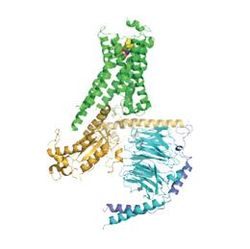
Gp Brian Kobilka knew that his postdocs didn't like him peeking at their experiments until they were finished. But he couldn't resist a quick look — after all, he and his entire field had been waiting for this result for more than 20 years.

As Kobilka peered through the microscope, the dream finally came into focus. Nestled in a drop of viscous liquid were tiny crystals, each trapping millions of copies of a fragile protein complex. The structure of this complex could finally reveal how one of biology's most important signalling mechanisms, G-protein-coupled receptors (GPCRs), do their job. This structure, published online in Nature1 by a team led by Kobilka at Stanford University in California and Roger Sunahara at the University of Michigan in Ann Arbor, now reveals the complete three-dimensional atomic structure of an activated GPCR — the β2 adrenergic receptor (β2AR) — in a complex with its G protein. GPCRs sit in the membranes of cells throughout the body, where they detect signals from the outside world — such as light, odours and flavours — and signals from within the body, such as hormones and neurotransmitters. These signals are transmitted to the inside of the cell where they activate intracellular G proteins, which then trigger a variety of biochemical pathways.

More here.

grange’s england

Kenneth-Granges-designs-007

Somewhere in the backslapping fest that was the final issue of the News of the World, there were the stirrings of something worth reading. Under the headline “Cream of Britain”, the article revealed what MPs had chosen as the greatest designs from their constituencies. These included the custard cream, the fish finger and McCain Smiley Potato Faces. Not to belittle the cultural impact of anthropomorphised potato powder, but MPs should probably head down to the Design Museum. In a retrospective entitled Kenneth Grange: Making Britain Modern, which opens tomorrow, they’ll encounter a more apt selection of the cream of Britain – and it’s the work of just one man. Kenneth Grange, who turned 82 over the weekend, has designed much of the domestic and public landscape that we’ve taken for granted over the last 50 years. Indoors we’ve used his Kenwood food mixers, Wilkinson Sword razors and Parker pens. Outdoors we ride his InterCity 125 train and his London taxi cab, we sit at his bus stops and on his benches, and for decades we fed change into his parking meters. His output has had such a subtle and pervasive influence on our daily behaviour that it’s almost worrying.

more from Justin McGuirk at The Guardian here.

Wednesday Poem

The Kiss

for David

Not the mosaic couple made famous by Klimt,
bodies cleaved close, so thin they could be
construed as one person.
Not the floating lovers Chagall lifted,
praised with brush strokes of color.
But us, seconds before
you were transported to surgery,
our kiss witnessed by a few
who dared not look away.
They still carry the moment like a postcard
purchased at the Louvre, a souvenir
against forgetting what might
or might not be, the last—our portrait
rendered without an artist, love
sculpted more naked than Rodin's nudes.
How my feet could not feel the ground.
How your heart refused letting go
all that between us shimmered.

by Donna Doyle
from JAMA, June 22/29, 2011

Tuesday, July 19, 2011

Is Shame Necessary?

Jacquet640 Jennifer Jacquet in Edge:

Financial executives received almost $20 billion in bonuses in 2008 amid a serious financial crisis and a $245 billion government bailout. In 2008, more than 3 million American homes went into foreclosure because of mortgage blunders those same executives helped facilitate. Citigroup proposed to buy a $50 million corporate jet in early 2009, shortly after receiving $45 billion in taxpayer funds. Days later, President Barack Obama took note in an Oval Office interview. About the jet, he said, “They should know better.” And the bonuses, he said, were “shameful.”

What is shame's purpose? Is shame still necessary? These are questions I'm asking myself. After all, it's not just bankers we have to worry about. Most social dilemmas exhibit a similar tension between individual and group interests. Energy, food, and water shortages, climate disruption, declining fisheries, increasing resistance to antibiotics, the threat of nuclear warfare—all can be characterized as tragedies of the commons, in which the choices of individuals conflict with the greater good.

Balancing group and self-interest has never been easy, yet human societies display a high level of cooperation. To attain that level, specialized traits had to evolve, including such emotions as shame.1 Shame is what is supposed to occur after an individual fails to cooperate with the group. Shame regulates social behavior and serves as a forewarning of punishment: conform or suffer the consequences. The earliest feelings of shame were likely over issues of waste management, greediness, and incompetence. Whereas guilt is evoked by an individual's standards, shame is the result of group standards. Therefore, shame, unlike guilt, is felt only in the context of other people.

Rescuing Books

Brian Thill in his blog:

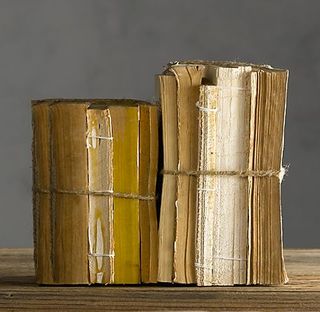
Antique_coverless_book_bundles_$29_from_restoration_hardware_2 Periodically the corporate headquarters would provide us with a new itemized inventory, and we would spend several days scouring the shelves to cull the proper number of books from the stock. Inevitably we would be left with great mounds of mass-market paperbacks that some obscure set of calculations had determined were no longer profitable for us to keep in stock. These were often books that had arrived in great numbers, loaded down with promotional displays, back-to-school promotional inserts, and more. What was necessary to have on hand in great numbers one month was literally garbage the next. The procedure in this case would be to rip the covers from each of the books, scan and bundle the covers and mail them to headquarters, and toss the piles of naked books in the trash compactor out behind the mall. In addition to being prohibited from selling coverless books, we were also forbidden to give them away; just as, each night, after having spent hours baking our fresh bread at the Italian restaurant where I worked every night cooking pasta, we were told to scoop up the heaping trays full of uneaten bread and throw them in the trash. When you’re poor, the pain of participating in the discarding of perfectly good things is particularly acute; it eats at you, you take it personally, as if that part of the world that can spare these things (a part you are kept from) is going out of its way to rub your face in it.

So I started making off with the coverless books. I’d volunteer to haul the great carts laden with garbage-books out to the compactor, and as I tossed the overstocked romance novels and spy thrillers into the bin, I would set aside the abject copies of Virginia Woolf or Philip K. Dick and tuck them behind the wall, retrieving them at the end of the night, when I would take them home and add them to my humble shelves. Neatly stacked, you could hardly tell they lacked covers. And who needed a cover anyway: hadn’t the old adage taught us how meaningless a cover was?

More here.

One big yawn: boredom is not just a state of mind

From The Guardian:

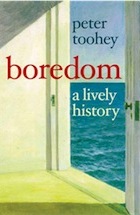
Boredom-A-Lively-History It may not be the most heart-pounding news of the moment, but boredom is coming back into fashion. Not boredom in the sense of lying around blank-faced in a brown study, a practice which in my experience has never really gone out of style, but boredom as a subject (rather than a product) of academic study. In recent years several scholarly books have reanimated a topic that had fallen into analytical torpor, the latest being Boredom: A Lively History by Peter Toohey, an Australian professor of classics who now lives and works in Canada – a country, alas, that bears an unfortunate reputation for being boring.

What is boredom? Is it a mood, an emotion, an affliction, a form of social protection, a gateway to the essence of the self, the human condition, or a modern affectation? These are questions that have concerned philosophers and thinkers dating back to the Enlightenment, not least because boredom occupies territory that overlaps with capital letter concepts like Being and Time. I can't pretend that my own interest in the matter has always been quite so elevated. Mostly when I think about boredom it is out of base self-interest, as a state that I'm very keen to avoid. Ever since I was a child, I have held an extreme aversion to situations that have the potential to be boring.

More here.

The Joy of a Sun Bath, a Snuggle, a Bite of Pâté

From The New York Times:

Animal Two ring-tailed lemurs, perhaps a pair, perhaps just two guys out to catch a few rays, sit side by side tilted back as if in beach chairs, their white bellies exposed, knees apart, feet splayed to catch every last drop of the Madagascar sun. All they need are cigars to complete the picture.

There’s a perfectly good evolutionary explanation for this posture. Scientists use the term “behavioral thermoregulation” to describe how an animal maintains a core body temperature. But as the animal behaviorist Jonathan Balcombe points out in his exuberant look at animal pleasure, “The Exultant Ark,” they are also clearly enjoying themselves. A scientist through and through, Dr. Balcombe can’t help giving the study of animal pleasure a properly scientific name: hedonic ethology. True to its subtitle — “A Pictorial Tour of Animal Pleasure” — “The Exultant Ark” showcases surprising, funny, touching, sad, heartwarming pictures by photographers all over the world. Dr. Balcombe’s text is a serious examination of the subject of animal pleasure, a study that “remains nascent and largely neglected in scientific discourse.” But it also delights us along the way with Dr. Balcombe’s observations and examples. On the subject of food as pleasure, for instance, he tells us, “Rats will enter a deadly cold room and navigate a maze to retrieve highly palatable food (e.g., shortbread, pâté or Coca-Cola).” If they happen to find rat chow instead, “they quickly return to their cozy nests, where they stay for the remainder of the experiment.”

More here.

Aatish’s personal fire

Ejaz Haider in The Express Tribune:

ScreenHunter_03 Jul. 19 15.05 The father was killed because he supported a Christian woman. How does that fit in with the article’s thesis that the father hated India (and Pakistan has to hate India and be Muslim) because that religious distinction lies at the core of its ‘other’-isation of India? Or is Pakistan more complex than is hinted in the article?

Aatish’s father did not ‘hate’ India. He was one of those who did much to open up Lahore — to Indians — by using the Basant festival. There is not a single viable political party in Pakistan that does not want to normalise with India. That is a matter of record. But Salmaan Taseer (Aatish’s eye for detail doesn’t inspire much confidence since he gets the spellings of his father’s name wrong), like others, was a proud Pakistani. We don’t need to ‘other’ India to be Pakistanis but neither can we ignore real problems that need to be addressed. Tackling those problems requires mature analysis, not reducing everything to Pakistan’s identity crisis vis-a-vis India.

But what of the Pakistani military, the villains in all this? Since Aatish began with India’s failed GSLV rocket test, let me put in some facts here for him.

The Indian Army, standing at over 1.1 million active-service personnel and 1.8 million reserves, is configured under six area commands (operational) and one army training command (ARTRAC). Three of these area commands — western, northern and southwestern — are totally Pakistan-specific. A fourth, central command, with one corps (1 Corps) is also primarily Pakistan-specific. The Indian Army has 13 corps, out of which eight, including one from the central command, are specific to Pakistan.

More here.

Why My Father Hated India

Aatish Taseer in the Wall Street Journal:

ScreenHunter_02 Jul. 19 11.56 Ten days before he was assassinated in January, my father, Salman Taseer, sent out a tweet about an Indian rocket that had come down over the Bay of Bengal: “Why does India make fools of themselves messing in space technology? Stick 2 bollywood my advice.”

My father was the governor of Punjab, Pakistan's largest province, and his tweet, with its taunt at India's misfortune, would have delighted his many thousands of followers. It fed straight into Pakistan's unhealthy obsession with India, the country from which it was carved in 1947.

Though my father's attitude went down well in Pakistan, it had caused considerable tension between us. I am half-Indian, raised in Delhi by my Indian mother: India is a country that I consider my own. When my father was killed by one of his own bodyguards for defending a Christian woman accused of blasphemy, we had not spoken for three years.

To understand the Pakistani obsession with India, to get a sense of its special edge—its hysteria—it is necessary to understand the rejection of India, its culture and past, that lies at the heart of the idea of Pakistan. This is not merely an academic question. Pakistan's animus toward India is the cause of both its unwillingness to fight Islamic extremism and its active complicity in undermining the aims of its ostensible ally, the United States.

More here.

half Eeyore, half Falstaff

Sad_sack

It pains me to say this, given that I don’t just admire Bloom, but also find him a surprisingly endearing cultural icon, half Eeyore, half Falstaff. When he’s not going around all sad-eyed and plangent, he’s likely to be complaining that “there live not three good critics unhanged in all America, and one of them is fat, and grows old.” Besieged by ravening hordes of ideologues, Bloom has long proclaimed himself the last champion of aesthetic criticism. When Childe Harold to the Ivory Tower Came, he soon discovered that the barbarians of ideology and political correctness were within the gates. In years past, he duly fretted about “theory” and cultural studies, though more recently he has begun to worry that “visual culture will end imaginative literature.” In one splendid diatribe, Bloom derides the academy’s current flood of “comma counters, ‘cultural’ materialists, new and newer historicists, gender commissars, and all the other academic impostors, mock journalists, inchoate rhapsodes, and good spellers.” Against their advocacy of what he calls “the New Cynicism,” he now argues—like any good Augustinian—that love should be the basis for all worthwhile criticism.

more from Michael Dirda at The American Scholar here.

SECRETS & LYRES

Raphael_07_11

Ann Wroe’s favourite activity, it seems, is to plunge into the lacunae between myth and reality, history and fable. As she proved by her lively descant on Pontius Pilate (who she dared to suggest might have been born in Britain), she has a flighty capacity to spin webs of words, anchored in myth and anecdote, which supply a bridge between what others have said and what fancy supplies. Both erudite and eclectic, in Orpheus she seems as much at home in Greek myth as she was, several books ago, dealing with life in the Middle Ages in the French city of Rodez, in the Aveyron. Like Dionysus, who shares some of his distracting characteristics (both led people a pretty dance), Orpheus was an alien enchanter. Never quite fully Greek, he was born in bristling Thrace, where his father was said by some to be the king and by others to be a ‘sheep-herder and a lone dweller in the fields’. The lyrical Orpheus was a marginal and, at times, a commanding figure. As keleustes on the voyage of the Argo, he stood by the mast and gave the beat to the rowers, who included the A-list of heroic and semi-divine celebrities (that other hell-raiser Heracles not least of them). When the Argo put in at Lemnos, a flat island populated by fatal women (they had all killed their husbands in an earlier episode), the crew pleasured the dangerous females, but Orpheus refrained. He was literally the guiding spirit in the quest for the Golden Fleece, and his well-timed steersmanship later squeezed the Argo between the clashing rocks of the Symplegades.

more from Frederic Raphael at Literary Review here.

he has urinated on us all

Kinkade1

THE LOVE AFFAIR between the intellectuals and the trashmeisters, now more than a hundred years old, has just overtaken the man who is by some measures the most popular painter in America. Thomas Kinkade: The Artist in the Mall is an essay collection that exudes a creepy fascination. While a number of the contributors manage to provide level-headed assessments of Kinkade’s place in the American imagination, I am not remotely convinced that such attention should be lavished on Kinkade’s sugar-drenched Middle America, with its frosted gingerbread domiciles, dew-kissed old-fashioned small-town Main Streets, and farmlands so fertile they look as if they’re on steroids. Alexis L. Boylan, who edited the book, would no doubt protest that the size of Kinkade’s reputation justifies the attention on sociological or cultural grounds, pure and simple. I know that many intellectuals believe we overlook middlebrow tastes at our own risk. But there is a large dose of reverse snobbery threaded through this collection. More than a generation after Pop Art became holy writ, it is rather tiresome to be announcing yet again that we live in a democracy where one person’s treasure is another person’s trailer trash, and that their masterworks are not necessarily inferior to the Picasso’s and Matisse’s in our museums. Many of the contributors to Boylan’s anthology want to devour every last bite of their middlebrow cake, but only after each tasty morsel has been skewered on a highbrow fork. The problem is not that they respect Kincade anthropologically, it is that they respect him as an artist.

more from Jed Perl at TNR here.

Monday, July 18, 2011

Sunday, July 17, 2011

Stage Animal/Out of the Comfort Zone

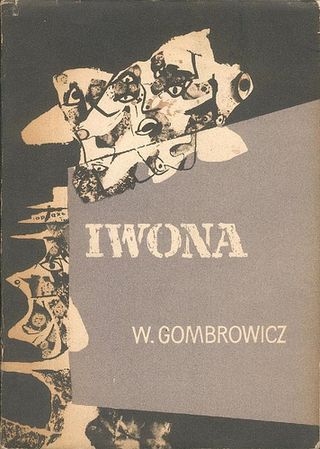
4994475333_d690a4968d Michael Handelzalts on Witold Gombrowicz's play “Yvonne, Princess of Burgundy” and its new staging, in Ha'aretz:

The situation in Witold Gombrowicz's play “Yvonne, Princess of Burgundy,” written in Poland in 1935, is simple yet challenging: in a small European kingdom of the sort that existed in mid-20th century films, the royal family (king, queen and princess ) admires the sunset, in full view of their subjects.

The prince, on his daily stroll, has suddenly come across a young woman. She is not pretty and does not present herself as a potential princess. Ugly, hard to size up and silent, she is accompanied by an aunt who apologizes for the strangeness of her niece.

The prince, tired of meaningless rounds of courtship, is challenged by the fact that the girl, whose name is Yvonne, radiates nothing in his presence; she is the very embodiment of passivity. It appears that anything may be done with her, and he decides to marry her. Where is it written that the prince must marry a beauty?

What begins as a game and a whim takes on monstrous proportions: Yvonne, in as much as she exists at all, wants nothing, says nothing, plans nothing, and so makes everyone uncomfortable. No one knows how to approach her. After all, there can be no creature which supplies not even a hint of its own significance and its relationship to us.

Notes on a Voice: W. G. Sebald

IL Sebald2 A.D. Miller in Intelligent Life magazine:

The essential theme of W.G. Sebald’s books is memory: how painful it is to live with, how dangerous it can be to live without it, for both nations and individuals. The narrators of his books—of which “Austerlitz” and the four linked narratives of exile in “The Emigrants” are the most compelling—live in a state of constant reminder. Everything blends into everything else: places, people, their stories and experiences, and above all different times, which seep into each other and blur together, often in long, unmoored passages of reported speech. The narrator of “Vertigo” gives a concise account of this method: “drawing connections between events that lay far apart but which seemed to me to be of the same order”.

Sebald, born in Bavaria in 1944, spent most of his adult life as an academic in Britain. He died in Norfolk in 2001, after having a heart attack at the wheel of his car. He wrote in German, but worked closely with his English translators, Michael Hulse and Anthea Bell. In either language, his voice is mesmeric.

Key decision

To invent his own hybrid form. Sebald’s main works blend travelogue and meditation, fiction with history and myth. They have a narrator who both is and is not Sebald himself: a spectral character who is sensitive, digressive and restless, compulsively peregrinating around Europe and its past.

Strong points

Finding a voice to fit his preoccupations. His sentences are looping, reflexive, moving forward yet endlessly turning back on themselves. By the time he wrote “Austerlitz”, the last book he published before his death, Sebald had more or less dispensed with paragraph breaks altogether. This fluidity creates a feeling, as the character Austerlitz says of his own sense of history, that “time will not pass away, has not passed away, that I can turn back after it”—clauses that are themselves part of a much longer, circular sentence. This is a style that tries to unbury the dead through syntax.

Eric Foner on the Evolution of Liberalism

E-f A Five Books interview by Eve Gerber:

Finally Christine Stansell’s The Feminist Promise examines the sweep of American women’s history. What can we learn by reading it?

Stansell shows why women’s rights became a central element of modern American liberalism. And she helps us understand how liberalism evolved to embrace individual rights and privacy in the most intimate areas of personal life. That came through the women’s movement. Stansell gives a very good account of how these feminist issues, on the one hand, go very deep back in American history, and, on the other hand, reached a critical mass of popular engagement during the 1960s.

Why did women’s rights become so aligned with the left?

In the 1970s social issues became more important to the Republican Party, and the notion that the women’s movement was a threat to the family and the stability of society became a mantra among conservatives. I think it’s important to remember that it wasn’t always that way. A century ago the movement for women’s suffrage was just as likely to get support from Republicans. Even in the 1960s plenty of conservatives supported legal equality. But today women’s rights are a dividing line between liberalism and conservatism.