A Library Without Walls

Robert Darnton in the New York Review of Books:

Dartnon_1-102810_gif_210x860_q85 Can we create a National Digital Library? That is, a comprehensive library of digitized books that will be easily accessible to the general public. Simple as it sounds, the question is extraordinarily complex. It involves issues that concern the nature of the library to be built, the technological difficulties of designing it, the legal obstacles to getting it off the ground, the financial costs of constructing and maintaining it, and the political problems of mobilizing support for it.

Despite the complexities, the fundamental idea of a National Digital Library (or NDL) is, at its core, straightforward. The NDL would make the cultural patrimony of this country freely available to all of its citizens. It would be the digital equivalent of the Library of Congress, but instead of being confined to Capitol Hill, it would exist everywhere, bringing millions of books and other digitized material within clicking distance of public libraries, high schools, junior colleges, universities, retirement communities, and any person with access to the Internet.

More here.

Monday, October 4, 2010

Monday Poem

Last Zucchini

But for two still-green plants
the zucchini have been pulled

a heap of hollow stalks and yellow leaves
lies at the end of their once-lush row

the reaper’s been through
the day of zucchini is done

The sun-starved weeds that hunkered tenuously
under the zuke’s broad fronds sprout now
in the short late sun unaware of their
cramped circumstances: the late hour,
the short days, the persistence of cosmic
revolutions, the meaning of the cant of axes:
the pinch of relativity—

Just 10 weeks ago I wrote of the first zucchini:
a compliant stud swelling in shade, I said,

bound for succulent sacrifice in a sauté
and I spoke true —it was like savoring sun

but now, from one of two remnants plants,
I pluck Mr. Last without remorse hoping

that in this or some other inevitable revolution
in one certain approaching autumn or another

I’ll be attuned enough to know
what it means to be myself
matter-of-factly plucked

by Jim Culleny;
9/22/10

Sunday, October 3, 2010

One-Stop Living

Pilar Viladas in the New York Times:

ScreenHunter_02 Oct. 04 08.50 In 1953, the architect Benjamin Thompson (1918-2002) opened a store called Design Research on Brattle Street in Cambridge, Mass. Thompson, a former partner of the Modernist master Walter Gropius, wanted a place where people could buy everything they needed for contemporary living. He made Marimekko dresses and Iittala glasses must-haves, eventually opening stores in New York and San Francisco and designing a striking new glass-and-concrete home for the Cambridge store that opened in 1969. ‘‘The architect’s place on this planet,’’ he said, ‘‘is to create that special environment where life can be lived to its fullest.’’ D/R, as it was known, closed in 1978, but many people, including me, never got over it.

The history and influence of D/R are examined in ‘‘Design Research: The Store That Brought Modern Living to American Homes’’ (Chronicle), a new book by Jane Thompson and Alexandra Lange. Thompson, a respected urban planner (who won this year’s Lifetime Achievement honor at the National Design Awards), is the architect’s widow and, after meeting him in the 1960s, worked with him on pioneering projects like Faneuil Hall Marketplace and the South Street Seaport.

More here.

Austerity: the Pain after the party, right?

After what seems like an orgy of bad economic decision making, not just on the part of the bankers and hedge fund managers on Wall Street, but really all of us, it appears at first blush quite correct when we hear that we all must pay a price for the “good times” of the late 90s and the early part of this decade. Unsurprisingly, politicians across the world are taking advantage of this guilty sentiment to call for “austerity,” meaning cuts in government spending. Take a look at this Newsweek article, for example:

With a deficit set to top 11 percent of gross domestic product this year, and a debt of $1.12 trillion and rising, [David] Cameron prescribed a harsh regimen of spending cuts and possible tax increases. Tony Blair’s motto was “Cool Britannia.” Cameron’s is likely to be “Austerity Now!”

It seems to make economic sense: we all borrowed too much to indulge our inflated sense of our own status in the last decade, so we must now live with less. It is quite naturally thought of as the “pain after the party,” as professor of political economy at Brown University Mark Blyth characterizes the popular view of the downside of economic cycles. But economics is never that simple, is it? No, it isn’t. The bedrock of our economy is confidence in the market, and in this column, Paul Krugman explains why fiscal austerity will not assure markets:

For the most part, this debate has been between those like me and Brad DeLong, who assert that budget-cutting should be postponed until we’re no longer in a liquidity trap, and those who insist that we must cut immediately, even though it would inflict economic damage and do little to improve the long-run budget position, because immediate cuts are necessary to achieve credibility with the markets.

My response, and Brad’s, has been to say that right now there’s no hint in the data that the United States (or the UK) has a problem with the markets, and to question why the deficit hawks are so sure about what the market will want in the future, even though it doesn’t want it now.

But I suddenly realized this morning that there’s yet another question for the deficit hawks: what evidence do you have that fiscal austerity of the kind you’re demanding would reassure markets, even if they did lose confidence?

Consider, if you will, the comparative cases of Ireland and Spain.

Go ahead and read the rest of Krugman’s piece. (He does have a Nobel after all!) And Brad DeLong has his own comment on Krugman here. One of the bigger problems is that “austerity” would not affect all economic classes equally. But let me let the aforementioned Mark Blyth explain that better: as the last word, and to make things as simple as they should ever be (Einstein’s purported comment on the presentation of science to the public was something like, “It should be made as simple as possible but not more so!”), I give you Dr. Blyth:

From Currency Warfare to Lasting Peace

Best_Eichengreen Barry Eichengreen in Vox:

If the financial press is to be believed, the world is on the verge of a currency war. Central bankers have pulled out their bazookas in a desperate, take-no-prisoners effort to weaken their currencies.

* The Fed is preparing for another round of quantitative easing. If this results in a weaker dollar that boosts US exports, then no one on the FOMC will complain.

* The Bank of Japan, disconcerted by the conjuncture of a strong currency and weak economy, has already intervened in the foreign exchange market to push down the yen.

* The ECB has extended the term of its special bank credit facilities and will ramp up its government bond purchases if Europe’s sovereign debt crisis worsens. * China continues to limit the appreciation of the renminbi

. * Brazil and India, having seen their currencies rise to painful levels, may feel compelled to take countermeasures.

The repercussions could be devastating. Congress, seeing the US denied the benefits of a more competitive currency, is threatening China with a putative tariff. China has already fired a warning shot across America’s bow by slapping a tariff on US poultry exports. This dangerous dynamic, if allowed to spiral out of control, could bring down the global trading system.

Is the danger real?

Is the situation really so worrisome? Yes and no. Yes, sharp currency swings create tensions and have unintended consequences. But there is no need for sharp swings in the exchange rates between the dollar, euro and yen. The US, Japan and Europe all have weak economies. They all would benefit from a round of quantitative easing. If their central banks ease simultaneously, there is no reason for investors to favour one of their currencies over the others.

The problem is that the Fed, BOJ and ECB have not indicated when they will move and what kind of easing they will undertake.

* If the Fed moves but the ECB hesitates, the dollar will fall against the euro.

* If the ECB, seeing the European economy weaken, then follows, the initial currency swing will be reversed, wrong-footing investors who chose to ride the trend.

These are precisely the circumstances in which currency volatility demoralizes financial markets and fans trade tensions.

Games India Isn’t Ready to Play

3837802_f520 Pankaj Mishra in the New York Times:

So who is anxious over India’s image in the wealthy world? That particular burden is borne by India’s small affluent elite, for whom the last few months have been full of painful and awkward self-reckonings. Certainly, the fear of violence over Ayodhya was only the latest in a long line of reminders that, as the columnist Vir Sanghvi put it, “as hard as we try to build a new India … old India still has the power to humiliate and embarrass us.”

Since June, a mass insurrection, resembling the Palestinian intifada, has raged in the Indian-held Valley of Kashmir. Defying draconian curfews, large and overwhelmingly young crowds of Kashmiri Muslims have protested human rights abuses by the nearly 700,000 Indian security forces there. Ill-trained soldiers have met stone-pelting protesters with gunfire, killing more than a hundred Kashmiris, mostly teenagers, and ensuring another militant backlash that will be exploited by radical Islamists in Pakistan.

A full-blown insurgency is already under way in central India, where guerrilla fighters inspired by Mao Zedong’s tactics are arrayed against a government they see as actively colluding with multinational corporations to deprive tribal people of their mineral-rich lands. In recent months, the Maoists have attacked the symbols of the state’s authority — railroads, armories, police stations — seemingly at will, killing scores of people.

Yet the greatest recent blow to wealthy Indians’ delusions on the subject of their nation’s inexorable rise has been the Commonwealth Games, for which Delhi was given a long and painful facelift. For so many, the contest was expected to banish India’s old ghosts of religious and class conflict, and cement its claims to a seat at the high tables of international superpowers.

But the games turned into a fiasco well before their scheduled opening.

Happy 200th, Snow White!

ID_PI_GOLBE_SNOW_AP_001Stefany Anne Golberg in The Smart Set:

In 1810, the Grimm Brothers first wrote down the story of Snow White, as told to them by some anonymous German folks. I’ve read this story countless times since discovering it in my adolescence. Even so, it’s the Disney version, Snow White and the Seven Dwarfs, that is the definitive Snow White story for me, though I hadn’t seen it since I was a child. The look of Snow White — her blue-and-red capped sleeves, her cherry-colored Clara Bow lips — and the seven dwarfs with their funny names, are all from Disney’s telling. This Snow White is so palpable for me, and for most Americans, that one might believe Snow White an American invention.

How is it that fairy tales can be so far removed in content from our daily experience, and yet have so much power over it? We sing fairy tale songs and our sleep is dappled with fairy tale leitmotifs. We tell fairy tales to our children. Why? To improve them? To delight them? To terrorize them? To learn the consequences of good and evil? As those who have read them can confirm, the stories recorded by the Brothers Grimm (Snow White included) are horrifying and grisly. They are not at all what we mean today by “child-friendly.” Do you remember how, in the original Cinderella, the stepsisters tried to force the glass slipper to fit them by slicing off parts of their feet?

Experts will tell you that fairy tales — folk tales — were never meant for children at all. In the not-so-long-ago days of yore, the people of the world were illiterate, intransient, and in need of entertainment. It might be that folktales, they say, had no moral or even practical purpose. Fairy tales were outrageous because they were soap opera, full of the melodramatic fantasies of average people: dirty beautiful maids rescued by princes; animals punished for greed; children punished for greed; blood; revenge; true love. If your child happened to be listening to this pulp and became terrified into obedience, well that was merely a bonus.

Nemesis

From The Guardian:

Young-boy-collecting-mone-005 Philip Roth's recent novels have often gestured playfully towards the idea of a serene late style. Simon Axler in The Humbling (2009) broods on Prospero's “Our revels now are ended” speech from The Tempest; Nathan Zuckerman, Roth's most famous mask, sets a scene in Exit Ghost (2007) to Richard Strauss's Four Last Songs – music chosen “for the profundity that is achieved not by complexity but by clarity and simplicity . . . The composer drops all masks and, at the age of 82, stands before you naked. And you dissolve.” Do these references mean that Roth, who is now 77, is abjuring furious artifice for a sage-like calm? Of course not. Late Roth has more in common with the late Ibsen described in an essay by Edward Said: “An angry and disturbed artist who uses drama as an occasion to stir up more anxiety, tamper irrevocably with the possibility of closure, leave the audience more perplexed and unsettled than before.” Said called this kind of style, which he found deeply interesting, a “deliberately unproductive productiveness, a going against”.

More here.

Midnight’s Other Children

Issac Chotiner in The New York Times:

Granta In the spring of 1997, the literary quarterly Granta published an issue devoted to India’s Golden Jubilee. The tone was cautious but celebratory: on the cover, the country’s name was printed in bright red letters, followed by an exclamation point. Fifty years after partition, an independent India was rapidly establishing itself as an international power. The issue, which consisted largely of contributions from native Indians writing in English, was a testament both to the country’s extraordinary intellectual and artistic richness, and to one of the few legacies of British colonialism that could be unequivocally celebrated by readers in South Asia and the West: a common language. Seventeen years after Salman Rushdie’s shot across the bow with “Midnight’s Children,” a new generation of Indian writers was, in Granta’s words, “matching India’s new vibrancy with their own.”

Now, Granta has assembled another well-timed issue devoted to the subcontinent, but this time the subject is Pakistan, partition’s other child.

More here.

Sunday Poem

The Laws of Probability in Levittown

I've been smoking so much pot lately,
I figure out what my poems are going to do
before I write them, which means when I finally
sit down in front of the typewriter . . . well . . . you know . . .

I moved back in with my parents,
and I'm getting really good at watching TV.
Soon as I saw the housewife last night on Inevitable Justice,
I knew her husband was the killer and I told her so and I was right.

Remember whenever Jamie Lee Curtis would come on
TV and we'd yell, Hermaphrodite! all happy? I maintain
her father, Tony, is an American treasure, and have prepared a mental
list of examples why, so should we happen to meet again, my shit's backed up.

There were too many
therapists in the city—97% of all therapists
are certifiable ding-dongs by nature, which is fine
if you live in Platteville, Nebraska, where there's only

like three therapists in the whole town
(the odds are in your favor), but if ten thousand
therapists are lurching around the streets, chances are
one thousand will be 100% batshit nuts.

I had a choice between watching
Robert Frost talking about his back yard
on Large American Voices and Farrah Fawcett on True Hollywierd.
I chose Farrah, because I knew what was going to happen, and I was right.

Here's something I've been trying
to work in: 10 rations = 1 decoration.
What do you think? 10 monologues = 5 dialogues,
10 millipedes = 1 centipede, .000001 fish = 1 microfiche . . .

I've got a million of those.
I wrote them down, back when I was
writing things down. But I've been thinking I should
tip the Domino's kid more than a buck on 14. Should I?

by Jennifer L. Knox
from the Best American Poetry – 2006

dragonflies, dinosaurs, and lourdes

Images5-e1285710109622

For all the ground and pound, for all the down-in-the-trenches dirtiness of the New York Jets, they are essentially a northern team. They like to swarm in the clear, crisp air of an autumn night, like bats feasting on the insects at twilight. Rex Ryan loves nothing more than the quick brutality of a single blitzer, unimpeded on the way to the quarterback, ending a play before it ever started. In short, the New York Jets are not a swamp team. The difficulty in going to Miami is thus a difficulty of geologic eras. It is a Cenozoic Era team (The Jets) traveling back in space and time in order to do battle with a Mesozoic Era team (The Dolphins). Or it is air (Jets) versus water (Dolphins)? Or it is man versus dinosaur? Sometimes, when the Miami Dolphins go in to their wildcat offense and all hell breaks loose as a pocket of running-backs-cum-quarterbacks dash madly into the scrum I am sure that I’m watching the dinosaurs play. Somehow, the New York Jets rose above the ferns and the algae-clogged water and the reptilian scales. Perhaps it was because they had one of the dinosaurs on their own team, Jason Taylor, a man who, after twelve long seasons in Miami’s Mesozoic lost world, had become a Jet in the off-season. Who knows what kind of strange physiological changes had to occur for this transformation to become reality? Probably, he went through a summer’s agony, writhing and squirming in a football-shaped egg with all the other new Jets while the necessary changes were wrought upon them.

more from me at The Owls here.

Saturday, October 2, 2010

Art vs. the World

Our own Morgan Meis in The Smart Set:

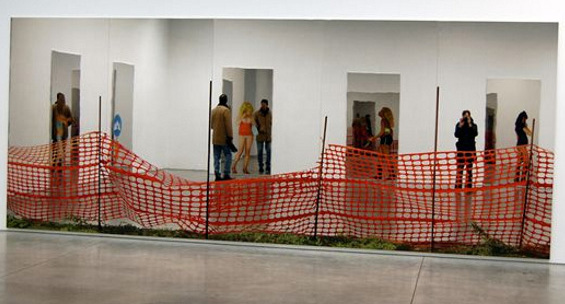
Untitled I find Berlin overwhelming. I experience the city as one giant gaping wound, a trauma. You are walking down the street and there, at your feet, are two cobblestones that have been replaced with tiny memorials to people once living there, who were shipped off to Auschwitz and killed. Here's a memorial to Peter Fechter, the East German kid who tried to get over the Wall and was shot dead by border guards. Here are bullet holes in the side of a building from street-to-street fighting that doesn't seem all that long ago. Here's the Kaiser Wilhelm Memorial Church far in the former West of the city, bombed to smithereens by an Allied air raid and left that way as a memorial. See the empty hole where the rose window once stood? Is there an emptier hole, a more desolate monument to destruction, in any city on the planet?

Every street in Berlin is ghosted. Every memorial is plastered in 20 layers of tragedy, heroism, and shame. To spend time in Berlin right now, to live here, takes a skill for living in the moment, for bracketing the past, that I do not sufficiently possess. I walk around the city in a daze, waiting for the next historical shock, cringing at the prospect of what memorial might be waiting for me around the next corner. I admit, of course, that it is possible to experience the city of Berlin in a less traumatized way. People do it all the time. Good people. Just not me.

Walking around Berlin, I simply did not feel a great need for art. When I poked my head from the FischGrätenMelkStand installation and gazed out at the sights of Berlin, the installation couldn't measure up to the meaning and impact that was being achieved on every street and in every square. Reality was a better and more meaningful work, here in Berlin, than anything contrived by the cleverest of artists.

More here.

Why fight wars our president doesn’t believe in and we can’t pay for?

Jake Whitney interviews Andrew Bacevich in Guernica:

Bigsmall Sacrifice. It’s a word Andrew Bacevich uses when discussing U.S. national security policy. While he pays respect to the tiny percentage of Americans who currently fight our wars, he also laments that more Americans don’t help shoulder those wars, and decries our politicians for having stopped asking anything of the American people. Bacevich, though, knows what it means to sacrifice. A retired U.S. Army colonel, Bacevich served in post-war Germany, fought in Vietnam, and taught at West Point. In 2007, he lost his twenty-seven-year-old son, Andrew, Jr., in Iraq. While Bacevich refuses to speak about this in interviews (“what is private ought to remain private”), one can surmise that the tragedy was compounded by Bacevich’s profound opposition to the war. Indeed, Bacevich fundamentally disagrees not only with current U.S. militarism in the Middle East but with the unwieldy behemoth that the American national security state has become.

Bacevich’s opposition, however, was not born of a father’s anger over a lost son. It is the opposition of a scholar, teacher, and author who has spent nearly half his life studying American foreign policy and seeing, sometimes from the inside, its uneven, often terrible results. It is an opposition that gathered particular urgency after 9/11, and since then Bacevich has proved an unrelenting and increasingly influential critic of U.S. national security policy. As Bacevich views it, that policy continues to follow a playbook that was penned sixty years ago and no longer makes sense, if it ever did. Blind adherence to this playbook has resulted in our current predicament: 370,000 troops stationed in more than thirty-five countries, a Middle Eastern war that looks increasingly like a quagmire, a defense budget that is bankrupting the country, and, worst of all, a political system that has become little more than theater.

More here.

Saturday Poem

Moon Poem

How did I lose track of the moon?
Living as I do in a place with no streetlights,
a place dark as the inside of my eyelids,
black as the bottom of a burnt pot.

You used to call me, and I'd run out to see the full
moon, a silver hubcap hovering at the top of the hill,
or waning, a wedge of melon ripe as any in the field.

Some nights I'd wake on my own, my bed lit white
and wonder what it was my Swedish ancestors feared
when they said, “Don't let the moon shine on you
while you're sleeping.”

If I rise then, go into the kitchen for a glass of water,
the moon follows and I realize the danger –
I might wander off looking for something I lost,
something I loved, something that won't
come around again.

Call me melancholy.
I've been called worse.
The moon knows life leans
and fattens, one part joy
two parts loss, and our job
is to make it come out even.

Maybe it was just a long month of cloud cover.
Maybe it was because your house burned down
and you moved. Or maybe I just forgot
how much I needed to see it –
pizza pan, squashed balloon,
thin edge of a dime,
spinning.

by Trish Crapo
from 5-Minute Pieces;
Arms Library Reading Series, 1998

Scrunched-up dimensions untangled

From MSNBC:

Dimensions British physicist Stephen Hawking may claim that extra dimensions provide the key to understanding the “grand design” of the universe, but it's Chinese-American mathematician Shing-Tung Yau who actually figured out how those extra dimensions work.

In his new book, “The Shape of Inner Space,” Yau and his co-author, Steve Nadis, touch upon the work that led to the discovery of theoretical “Calabi-Yau spaces” — and the cosmic implications of multidimensional geometry. The typical representation of a Calabi-Yau space looks like twisted web of a crumpled-up piece of paper. There's something elegant about its look — in fact, Calabi-Yau paperweights were voted the most popular gewgaw for holiday giving in last year's Cosmic Log Geek Gift Guide contest. But these shapes aren't just abstract art: String theorists believe that every single point in our universe is actually a compactified Calabi-Yau space in six dimensions.

More here.

U.N. Report finds Israel “summarily executed” U.S. citizen on flotilla

Glenn Greenwald in Salon:

Untitled Last week, the Office of the U.N. High Commissioner for Human Rights released a comprehensive report detailing its findings regarding the May, 2010, Israeli attack on the six-ship flotilla attempting to deliver humanitarian aid to Israel-blockaded Gaza. The report has been largely ignored in the American media despite the fact (or, more accurately: because) it found that much of the Israeli force used “was unnecessary, disproportionate, excessive and inappropriate and resulted in the wholly avoidable killing and maiming of a large number of civilian passengers”; that “at least six of the killings can be characterized as extra-legal, arbitrary and summary executions“; and that Israel violated numerous international human rights conventions, including the Fourth Geneva Conventions (see p. 38, para. 172).

Even more striking in terms of U.S. media and government silence on this report is the fact that one of the victims of the worst Israeli violations was a 19-year-old American citizen.

More here. And see also “What You Get for Not Rocketing Israel” by Sam Sedaei in The Huffington Post:

Throughout its short life, Israel has engaged in many actions that the world democracies have deemed dubious and inconsistent with Israel's claim to be “the only democracy in the Middle East.” One can mention the Israeli wall in the West Bank, Wars on Lebanon and Gaza, a choking and indiscriminate blockade on the citizens of Gaza, ethnic discrimination against Arabs and attack on and killing of a number of individuals on board a Turkish flotilla in international waters just over the past few years alone. Israel has consistently countered condemnations and repeated U.N. Security Council resolutions denouncing its actions with one argument: those actions are necessary because of the actions of Hamas, the Palestinian militant group that controls Gaza has refused to accept the existence of Israel and repeatedly fired rockets into Israel.

So is that Israeli claim true? Are Israel's actions truly a reaction to hostilities against its existence and security? Let's look at this claim in the context of the ongoing negotiations between the Palestinians and Israelis.

More here. [Thanks to Nikolai Nikola for both items.]

Flat-Nose, Stocky and Beautugly

James Davidson in the London Review of Books:

26names In the early 1800s, nearly 25 per cent of all females in the United Kingdom were called Mary. If you add to these many Marys the crushing numbers of Elizabeths, Sarahs, Janes and variform Anns (Nancys, Nans and Hannahs), you would have the Christian names of something close to 80 per cent of the female population. There was a similar pattern with Johns. About one fifth of all males in the UK between 1800 and 1850 were christened John and the vast majority of the other men and boys around at the time were Joseph, James, Thomas or William.

Around 1850, however, the repertoire of names in regular use began to increase rapidly. As Gothic-looking steeples rose around the country, so medieval-sounding names crowded around the font: Arthur, Walter, Harold and Neville, Ethel, Edith and Dorothy, soon to be supplemented by endless Geoffreys. This remarkable efflorescence has been described as a ‘personalisation’ of names, although since in this period the ‘proper’ name one gave to registrars and census enumerators might very well be supplemented by a highly personalised nickname – Old Tom, Long Tom, Short Tom, or even, according to Rev. Alfred Easther, a 19th-century Yorkshire dialectologist, Wantem, Blackcop and Muddlinpin – it might better be described as an outbreak of name-consumerism, as parents increasingly invested their energies in baptismal choice.

Children were no longer necessarily named after parents, grandparents, aunts and uncles. Indeed, parents began to choose names and forms of names simply because they liked them or because they reminded them of someone they liked, in life, in fiction or in a Shakespeare comedy: Olivia, for example.

More here.