
Category: Recommended Reading
Interview with Daniel Bell
Roberto Foa and Thomas Meaney in The Utopian:
Are you a utopian?
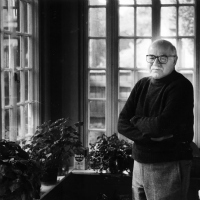
But the historical difficulty of utopianism is precisely that it doesn’t have a messiah, or a similarly overarching, emotionally powerful actor. So that the tension between utopianism and messianism is frequently to the unfair advantage of the messianic. I believe more and more that if we can have utopian movements we’ll do better than if we have messianic movements.
More here.
tahia carioca
366 Fast Facts
Fact #56 
In 1980, singer and performer Michael Jackson secured the highest royalty rate in the music industry—37 percent of the album's profit.
Fact #78

As a child Muhammad Ali was refused an autograph by his idol, boxer Sugar Ray Robinson. When Ali became a prize-fighter, he vowed never to deny an autograph request, which he has honored to this day.
Fact #271
Soul singer Aretha Franklin became the first female artist to be inducted into the Rock and Roll Hall of Fame in 1987.
Fact #356
Black civil rights activist Ida B. Wells was one of the first American women to continue to keep her last name after her marriage.

dalida’s egypt song
Ella Fitzgerald: 1917-1996
From Biography.com:
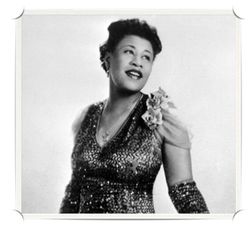
Ella Jane Fitzgerald was born in Newport News, Va. on April 25, 1917. Her father, William, and mother, Temperance (Tempie), parted ways shortly after her birth. Together, Tempie and Ella went to Yonkers, N.Y, where they eventually moved in with Tempie's longtime boyfriend Joseph Da Silva. Ella's half-sister, Frances, was born in 1923 and soon she began referring to Joe as her stepfather. To support the family, Joe dug ditches and was a part-time chauffeur, while Tempie worked at a laundromat and did some catering. Occasionally, Ella took on small jobs to contribute money as well. Perhaps naïve to the circumstances, Ella worked as a runner for local gamblers, picking up their bets and dropping off money. Their apartment was in a mixed neighborhood, where Ella made friends easily. She considered herself more of a tomboy, and often joined in the neighborhood games of baseball. Sports aside, she enjoyed dancing and singing with her friends, and some evenings they would take the train into Harlem and watch various acts at the Apollo Theater.
More here.
Three books about Nelson Mandela
J. M. Ledgard in the New York Times Book Review:
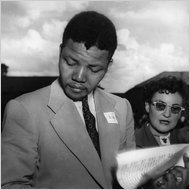
The surprise in these three very different books is how darkly and deeply the former South African president’s life reads like an African quest narrative.
More here.
Sunday Poem
Tulsa
Sex is in the eyes and the smell and the past. The hint
of sweat from straw-colored hair. The taste
of a smile. The lilting voice. The slow catch of silk
on nipples. No man covets shoes, though some
covet memory. Delilah, I miss you. I miss
Tulsa dying in the rearview, the sickly linger
of your cigarettes. But I’m not humping the passenger seat
anymore. Remember the time we got stuck in a ditch chasing
a field fire? A farmer called a sheriff, refused to tow us,
and kept his snake-rifle on us while we scrambled
to find wood to shove under the tires. He was afraid
we’d steal the night, the fire, the slow death of not knowing
what to believe that choked his heart. But we were
all first sons, whistle-britches, all looking for a place
to stick our hearts for safe-keeping. The boarded-over windows
of our mothers’ eyes watched from graves half dug
but not full yet. We were forever looking back, saying:
we will stand tall when the winds die down.
by C.L. Bledsoe
from Blast Furnace, Jan. 2011
Pakistan after the Arab Insurrections
Anjum Altaf in The South Asian Idea:
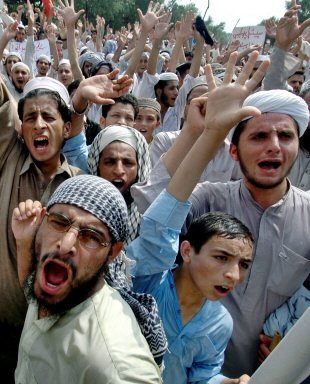
Given this perception, what form of governance would the people prefer instead? It is here that things get complicated and the main differences from Egypt and Tunisia become clear. Pakistan has not been frozen in time under authoritarian rulers who have been around for three or more decades, who routinely get elected by over 90 percent of the vote, who have crippled all secular opposition, cracked down on the religious parties, and muzzled the expression of popular opinion.
Quite the contrary: the media are free, political parties form and disband at will, elections are held from time to time, and religious elements are patronized and given extensive leeway in the service of power. Over the 60-plus years of its existence virtually all modes of governance have been tried in Pakistan – feudal, military, populist, left socialist, Islamic socialist, technocratic, corporate, etc. All have failed to deliver tangible benefits to the vast majority of the population that in economic terms is now gasping for survival.
One implication of this is that the overwhelming yearning in Pakistan, unlike the Arab countries, is not for freedom or release from suffocation. People in Pakistan are quite free – they may be free to die of many preventable causes but they are free nonetheless. The latent demand is for good governance.
More here.
Saturday, February 12, 2011
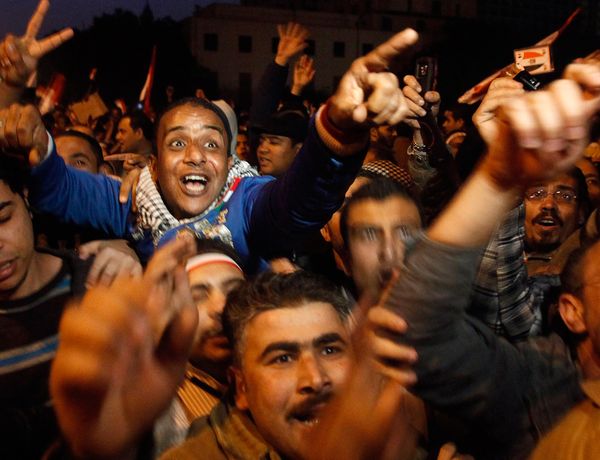
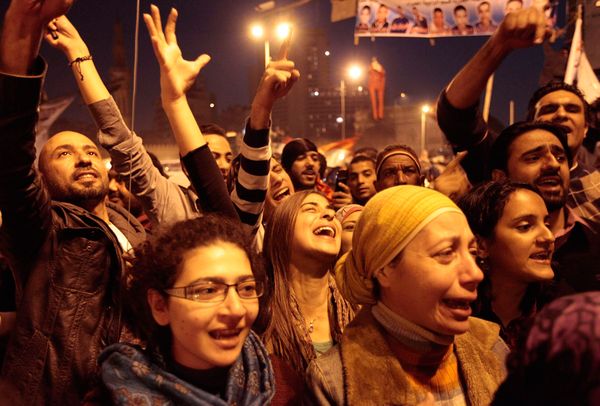
Great Pictures from Tahrir Square After Munarak’s Resignation

The Apostate: Paul Haggis vs. the Church of Scientology
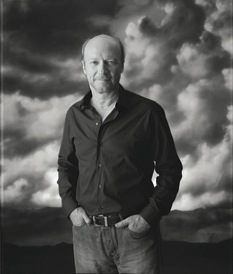
Lawrence Wright in The New Yorker:
More here.
Video of Tahrir Square at the moment of Mubarak’s resignation
[I am told the chant means, “The army and the people are one hand.”]
How history will judge Obama on Egypt
Hamid Dabashi at CNN:

Mubarak is now lost in ignominy in history. But what will American children read in their history books a decade or a century from now? How will Obama, once seen as a visionary statesman, be viewed?
When he received the Nobel Peace Prize at the outset of his presidency, I was among those who said publicly that he deserved it. So early in his career as a president, he had not done anything meaningful to lend credence to that honor. But I thought he had awakened a sense of pride, purpose and dignity among the younger generation of Americans that would commit them to contribute greatly to humanity at large. In the events of the past month in Tunisia and Cairo, he has had a gift from history to justify the prize after the fact — but alas he did very little to show he deserved it.
More here.
Fred Zackel

 | Fred Zackel has taught literature and the humanities for twenty years at Bowling Green State University. He has written several novels and more than 90 short stories and essays. His darker works are available through Kindle, smashwords and the Nook. Email: fzackel [at] bgsu.edu List of writings at 3QD, in reverse chronological order:
|
The painterly pessimist
That is a very famous painter!” exclaims the taxi driver at Antwerp station when I present Luc Tuymans’ address. “Are you his model?” If only … Or perhaps the suggestion is not so flattering. Using photographic sources, Tuymans paints subjects that are emotionally or morally loaded – Albert Speer or Condoleezza Rice, a patient just diagnosed with cancer or a lamp made from human skin in Buchenwald – only to transform them into bleached-out, blurry, depersonalised images, at once banal and sinister. When these quiet, subversive pictures appeared at the end of the 1980s, they challenged the era’s neo-expressionist art scene so successfully that Tuymans was hailed as the saviour of late 20th-century painting. Conceptual but painterly, engaging with the big themes of history and of today, he has not put a foot wrong since. An impressive retrospective recently toured the US and now comes home to Belgium, opening at Bozar in Brussels next week. The taxi drops me at a sleek, neutral-looking office, and it is at once obvious that, for an artist who made his name painting corruption in the corridors of power, establishment success sits uneasily. “Yes, it had a good reception,” Tuymans answers warily, as I take a seat at a desk opposite him and ask about the US tour. “Because the work is understated and clearly European, an element of exoticism played itself out. European painting is about deliberate space, American painting is about accidental space.”
more from Jackie Wullschlager at the FT here.
stormy weather
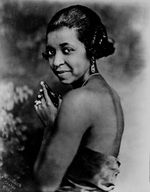
From the 1920s through the early ’40s, Ethel Waters was probably the most famous black woman in America: a bestselling recording artist, a popular nightclub performer, the star of five Broadway shows and several Hollywood movies. After a grim period of little work as she aged and gained weight, Waters triumphed again as an African American matriarch in the 1949 film “Pinky” and in the lyrical 1950 stage adaptation of Carson McCullers’ novel “The Member of the Wedding.” By the time Waters died in 1977, however, she was better known to most Americans as an elderly, large, devoutly religious woman who frequently appeared at Billy Graham’s fundamentalist Crusades. People had largely forgotten the glamorous crossover artist who belied stereotypes, the first black woman to headline on Broadway at the Palace — the mecca for all vaudeville performers, the star of a groundbreaking Broadway drama (“Mamba’s Daughters” in 1939) that empathetically depicted three generations of African American women. One of Waters’ biggest hits, the sultry, heartbreaking “Stormy Weather,” is remembered instead as Lena Horne’s signature song.
more from Wendy Smith at the LA Times here.
Saturday Poem
Blacksmith
—in memory of Auld Andra Fraser of Carnwath
he bit on his pipe
smoked long round vowels through lips
fixed in the thinnest of scribbles
and gripped each word in tongs like those
once found in the smithies
where his consonants were fired and burred
in the tales he told he spoke of kye pairks
of doors left onsneck’t
of men wha’d been gassed in the war
his craft was mainly bicycles by then
cannibaled constructions and repairs
but occasionally on a fancy
just to entertain us
he would fire up the cold furnace
and spit sparks from the anvil
then e’s powie wad dirl
as e pín’t oot the airn
bruntin the win wi e’s darg
by Andrew McCallum
from Blast Furnace, Jan 2011
kye pairks: cattle fields
onsneck't: unlocked
wha'd: who'd
e’s powie wad dirl
as e pín’t oot the airn
bruntin the win wi e’s darg:
his hammer would ring
as he struck out the iron
scorching the wind with his labour
salinger and the smell of bruning flesh
For this reader, the great achievement of Slawenski’s biography is its evocation of the horror of Salinger’s wartime experience. Despite Salinger’s reticence, Slawenski admirably retraces his movements and recreates the savage battles, the grueling marches and frozen bivouacs of Salinger’s war. It’s hard to think of an American writer who had more combat experience. He landed on Utah Beach on D-Day. Slawenski reports that of the 3,080 members of Salinger’s regiment who landed with him on June 6, 1944, only 1,130 survived three weeks later. Then, when the 12th Infantry Regiment tried to take the swampy, labyrinthine Hürtgen Forest, in what proved to be a huge military blunder, the statistics were even more horrific. After reinforcement, “of the original 3,080 regimental soldiers who went into Hürtgen, only 563 were left.” Salinger escaped the deadly quagmire of Hürtgen just in time to fight in the Battle of the Bulge, and shortly thereafter, in 1945, participated in the liberation of Dachau. “You could live a lifetime,” he later told his daughter, “and never really get the smell of burning flesh out of your nose.”
more from Jay McInerney at the NY Times here.
Gwendolyn Elizabeth Brooks: 1917-2000
From aalbc.com:
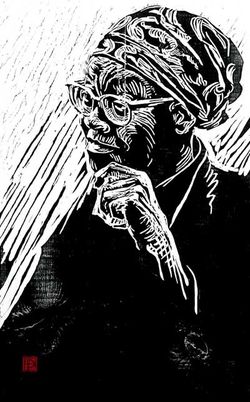
Two of her poems that I personally love best:
We Real Cool
The Pool Players
Seven at the Golden Shovel
We real cool. We
Left school. We
Lurk late. We
Strike straight. We
Sing sin. We
Thin gin. We
Jazz June. We
Die soon.
The Bean Eaters
They eat beans mostly, this old yellow pair,
Dinner is a casual affair.
Plain chipware on a plain and creaking wood,
Tin flatware.
Two who are Mostly Good.
Two who have lived their day,
But keep on putting on their clothes
And putting things away.
And remembering…
Remembering, with twinklings and twinges,
As they lean over the beans in their rented back room
that is full of beads and receipts and dolls and
cloths, tobacco crumbs, vases and fringes.
More here. (One of my great joys of living in Chicago was to know that I shared a city with the grand Ms. Brooks)
Robert Fisk: A tyrant’s exit. A nation’s joy
From The Independent:
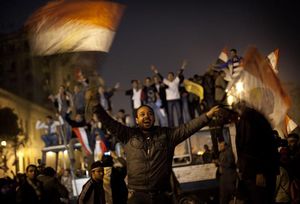
Forever, it will be known as the Egyptian Revolution of 25 January – the day the rising began – and it will be forever the story of a risen people. The old man had gone at last, handing power not to the Vice-President but – ominously, though the millions of non-violent revolutionaries were in no mood to appreciate this last night – to Egypt's army council, to a field marshal and a lot of brigadier generals, guarantors, for now, of all that the pro-democracy protesters had fought and, in some cases, died for. Yet even the soldiers were happy. At the very moment when the news of Mubarak's demise licked like fire through the demonstrators outside the army-protected state television station on the Nile, the face of one young officer burst into joy. All day, the demonstrators had been telling the soldiers that they were brothers. Well, we shall see.
More here.