The Intelligent Homosexual’s Guide to Natural Selection and Evolution, with a Key to Many Complicating Factors

Jeremy Yoder in Scientific American:

ScreenHunter_08 Jun. 24 17.08I'm looking forward to celebrating Pride for the first time in my new hometown of Minneapolis this weekend–but as an evolutionary biologist, I suspect I have a perspective on the life and history of sexual minorities that many of my fellow partiers don't. In spite of the progress that LGBT folks have made, and seem likely to continue to make, towards legal equality, there's a popular perception that we can never really achieve biological equality. This is because same-sex sexual activity is inherently not reproductive sex. To put it baldly, as the idea is usually expressed, natural selection should be against men who want to have sex with other men–because we aren't interested in the kind of sex that makes babies. An oft-cited estimate from 1981 is that gay men have about 80 percent fewer children than straight men.

Focusing on the selective benefit or detriment associated with particular human traits and behaviors gets my scientific dander up, because it's so easy for the discussion to slip from what is “selectively beneficial” to what is “right.” A superficial understanding of what natural selection favors or doesn't favor is a horrible standard for making moral judgements. A man could leave behind a lot of children by being a thief, a rapist, and a muderer–but only a sociopath would consider that such behavior was justified by high reproductive fitness.

And yet, as an evolutionary biologist, I have to admit that my sexual orientation is a puzzle.

More here.

Biologists discover how yeast cells reverse aging

From PhysOrg:

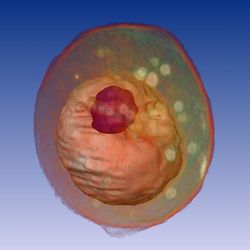
Biologistsdi Human cells have a finite lifespan: They can only divide a certain number of times before they die. However, that lifespan is reset when reproductive cells are formed, which is why the children of a 20-year-old man have the same life expectancy as those of an 80-year-old man.

…When yeast cells reproduce, they undergo a special type of cell division called meiosis, which produces spores. The MIT team found that the signs of cellular aging disappear at the very end of meiosis. “There’s a true rejuvenation going on,” Amon says. The researchers discovered that a gene called NDT80 is activated at the same time that the rejuvenation occurs. When they turned on this gene in aged cells that were not reproducing, the cells lived twice as long as normal. “It took an old cell and made it young again,” Amon says. In aged cells with activated NDT80, the nucleolar damage was the only age-related change that disappeared. That suggests that nucleolar changes are the primary force behind the aging process, Amon says. The next challenge, says Daniel Gottschling, a member of the Fred Hutchinson Cancer Research Center in Seattle, will be to figure out the cellular mechanisms driving those changes. “Something is going on that we don’t know about,” says Gottschling, who was not involved in this research. “It opens up some new biology, in terms of how lifespan is being reset.” The protein produced by the NDT80 gene is a transcription factor, meaning that it activates other genes. The MIT researchers are now looking for the genes targeted by NDT80, which likely carry out the rejuvenation process.

More here.

A Painter Framed

From The Daily Beast:

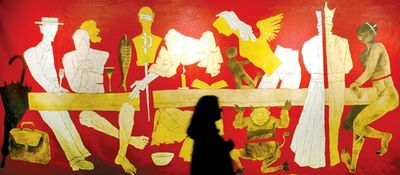
Mf Maqbool Fida Husain, who died on June 8, was India’s most prominent painter—but in the last year of his life, he had become a national of Qatar, and he died in London, far from the city he loved, Mumbai. That rootlessness, in essence, captures the poignancy of the artist’s life—he became controversial, but didn’t choose to be so. He was born in pre-independence India around 1915 and lived there until the 1990s, when Hindu nationalists launched a vicious campaign against him. They were upset after a magazine found some of his old paintings and sketches, some dating back to the 1970s, which showed Hindu deities in the nude. That wasn’t really controversial; in sculptures in many ancient temples, including Khajuraho and Konarak, and in some paintings and manuscripts, Hindu deities have appeared without clothes, or wearing little.

But Husain was born a Muslim, and Hindu activists saw an opportunity to lead a sustained campaign against him. This included vigilantes damaging artworks and art galleries that showed his work in India and abroad; filing lawsuits against him throughout India for offending religious sensibilities; and attacking a television station that ran a poll among viewers asking them if Husain should be given India’s highest civilian honor, besides threatening him with violence. Instead of protecting Husain’s right of free expression, authorities filed charges under colonial-era Indian laws, which restrict freedom of expression, and judges admitted cases against him. Even after higher courts ruled in his favor, the hounding continued. Husain, who only wanted to paint, lived outside India for most of the past two decades.

Husain’s decision to leave a secular, democratic India for Qatar, an authoritarian theocracy in the Middle East, was a blot on India.

More here.

Friday Poem

High-Speed Bird

At full tilt, air gleamed –
and a window-struck kingfisher,
snatched up, lay on my palm
still beating faintly.

Slowly, a tincture
of whatever consciousness is
infused its tremor, and
ram beak wide as scissors

all hurt loganberry inside,
it crept over my knuckle
and took my outstretched finger
in its wire foot-rings.

Cobalt wings, shutting on beige
body. Gold under-eye whiskers,
beak closing in recovery
it faced outward from me.

For maybe twenty minutes
we sat together, one on one,
as if staring back or
forward into prehistory.

by Les Murray
from Taller When Prone
Publisher: Black Inc., Melbourne, © 2010

Thursday, June 23, 2011

against reviews

Image

Who reads reviews? Occasionally a lot of people. But usually just the book’s author, if she Googles herself, plus any pals, parents, exes, etc. who also search for her. Otherwise, our only readers are our friends, who feel obligated to at least skim our boring review because we liked theirs on Facebook. Why do we prioritize some imaginary “public” over people we actually know, and who read our work? Why don’t we want to write, and read, for our friends? Perhaps we fear our freedom. If we could read and write anything we wanted, what would we read and write? Probably not book reviews. Choices would have to be made. Imagine a literary culture in which the relationship between reader and writer was as intimate and direct as the relationship between poet and patron. This would not be, and never was, a recipe for health or contentment—most marriages are unhappy. But the “passion” that Arnold thought needed to be neutralized could proudly speak its name. Why should a writer be ashamed to write for someone she knows? Why should her friends and enemies feign a lack of interest in her work? Affection, attraction, admiration, rivalry, resentment: all are aphrodisiacs, and heighten our interest in what’s before us. Nobody insists we fuck strangers—why must we read them? If the privacy of pure patronage is impossible or undesirable, the traditional courtship can be replaced by the orgy.

more from Elizabeth Gumport at n+1 here.

conjure beings and invoke spirits

Art110613_198

Mark Grotjahn’s large new paintings abound with torrents of ropy impasto, laid down in thickets, cascading waves, and bundles that swell, braid around, or overlap one another. Noses and mouths appear in kaleidoscopic furrows. Eyes, too—sometimes in clusters, other times alone. Often these eyes are gouged out, opaque, blank, like those of some simian being or blind oracle. There are echoes of Cubism here and Vlaminck’s Fauvism, of mid-century abstraction, German and neo-Expressionism, rock painting, folk art, and fabric design. I’m tantalized by the facture and physicality of these paintings. What Grotjahn (pronounced groat-john) paints doesn’t stay put on these variegated surfaces; instead, it shifts around the involuting centerless space. You can discern the ways in which this work is made, yet no formal system appears. (I surmise that the artist himself is sometimes caught off guard by what he’s produced.) His strangely shamanic art gives me a remnant of the pow I get from those ancient eternal faces in Picasso’s Les Demoiselles d’Avignon. The winding rows of oil paint have been carefully laid on, wet-on-wet. Sometimes these lines look like colored grubs or raffia, in tones that are rich and saturated, ranging from mauve and apple to emerald and blood red. I think of magic carpets and magnetic fields. I spy networks of Martian canals and landscapes folding over themselves. I glimpse one of painting’s oldest purposes: the uncanny ability to conjure beings and invoke spirits.

more from Jerry Saltz at New York Magazine here.

who’s afraid of the late essays?

TLS_Broughton_738213a

As an essayist she had cut her teeth on the outermost crusts of literary minority, reviewing the long-forgotten work of the pointlessly pseudonymous. In 1907 she was sent five dramas in verse to review: “my mind feels as though a torrent of weak tea has been poured over it”, she complained in a letter. Here we see her learning the ropes: forging an argument out of unprepossessing materials (“these stories were meant to be read swiftly on a train, and to preserve them in a book is to imprison them unkindly”); experimenting with the avuncular and the urbane and the knowingly fogeyish (Rose Macaulay’s characters “say a great many very clever things”); and mastering the delicate art of praise never quite so faint as to descend to a sneer: “It would seem inexcusably bad taste to pull such innocent work to pieces; it seems to confide in you”. The apprenticeship gave her a respect for “ingenuity and good workmanship”, however mistakenly applied. (In later life she wrote of her friend Roger Fry that, because he was a painter himself, his criticism was “full of respect and admiration for the artist who has used his gift honourably and honestly even though it is a small one”.) It also gave her a lifelong appreciation of the variegatedness of the experience of reading, and of the fact that sometimes, as she said of Frederick Marryat, “our critical faculties enjoy whetting themselves upon a book which is not among the classics”.

more from Trev Broughton at the TLS here.

Barking Island

Colin Dayan in the Boston Review:

Dayan_36_4_dogs A sound of gulls, a sunlit port, human voices, barking dogs. In a city market, dogs are sitting, lying down, walking past. Dogs gather in the center of the screen. Night falls. A dog gives birth; she nurses her babies. A constable in sharp silhouette comes and looks on as, growling, she huddles over her young.

So begins Serge Avedikian’s fifteen-minute animated film Barking Island (originally Chienne d’histoire in French), which, in 2010, won the Palme d’Or as the best short film at Cannes. The images are paintings by Thomas Azuélos, made deep and weighty, contoured yet dissolving at the edges, almost palpable.

Once the music changes, the scene shifts to humans at a long table discussing how to eliminate the dogs. Newspapers announce that there are more than 60,000 dogs on the streets of Constantinople. The Turkish authorities appeal for an end to them. After exploring various options—gassing, incineration, turning corpses into meat for human consumption—offered by the Pasteur Institute in Paris and other European experts, the Turks decide to round the dogs up and abandon them on a deserted island in the Bosporus.

More here.

Paul Krugman on Inspiration for a Liberal Economist

From The Browser:

I wanted to start by saying how pleased I am you call yourself a liberal, because there are a lot of people – politicians – who are reluctant to be associated with the word.

ScreenHunter_07 Jun. 23 14.02As I see it, there has been a lot of effective propaganda. As a result, a lot of people adopted the term “progressive” as a somehow less charged way of saying the same thing, which I don’t think works. I consider myself both – liberal and progressive. It’s not too different from what would be called a social democrat in Europe – you believe in a decent-sized welfare state, you believe that we are our brothers’ keepers. Of course I’m not a politician so I can afford to label myself in a way that might lose some votes…

The first book you’ve chosen isn’t about economics at all; it’s a work of science-fiction, Isaac Asimov’s Foundation trilogy. But was it part of what inspired you to become an economist?

Yes. This is a very unusual set of novels from Isaac Asimov, but a classic. It’s not about gadgets. Although it’s supposed to be about a galactic civilisation, the technology is virtually invisible and it’s not about space battles or anything like that. The story is about these people, psychohistorians, who are mathematical social scientists and have a theory about how society works. The theory tells them that the galactic empire is failing, and they then use that knowledge to save civilisation. It’s a great image. I was probably 16 when I read it and I thought, “I want to be one of those guys!” Unfortunately we don’t have anything like that and economics is the closest I could get.

More here.

The Scientific Case for Masturbation

Sharon Begley in Newsweek:

ScreenHunter_06 Jun. 23 13.53Since Christine “I’m Not a Witch” O’Donnell is campaigning for the U.S. Senate and not the directorship of the Kinsey Institute, maybe we should give her a pass when it comes to her views on sex and, specifically, masturbation. But that would be a mistake: the stakes are simply too high, going all the way up the very survival of our species. For while O’Donnell crusaded against masturbation in the mid-1990s, denouncing it as “toying” with the organs of procreation and generally undermining baby making, the facts are to the contrary. Evidence from elephants to rodents to humans shows that masturbating is—counterintuitively—an excellent way to make healthy babies, and lots of them. No one who believes in the “family” part of family values can let her claims stand.

The science is straightforward. Whenever a behavior is common in the animal kingdom, biologists suspect it has an adaptive function. That is, the behavior enabled individual animals to survive better and leave more offspring than animals that did not engage in the behavior. As a result, genes for the behavior spread throughout that population until it became essentially ubiquitous. And so it is with autoeroticism, which is common—really common. As the Science in Seconds blog noted this week, what with “spanking the monkey,” “charming the snake,” and “freeing willy,” a remarkable number of the slang terms for pleasuring oneself refer to animals. That reflects reality: the practice has been documented in Japanese macaques, gibbons, baboons, chimps, elephants, dogs, cats, horses, lions, donkeys, “and walruses that manage to flog the bishop with their fins.” (Bonus for clicking on the blog link above: excellent photo of an elephant in flagrante dilecto.)

What, then, might be its adaptive function?

More here.

Marko Ahtisaari: Nokia N9 Design Story

My old friend from the philosophy department at Columbia University, Marko Ahtisaari, got me started in blogging and I also started 3QD at his suggestion and encouragement. Marko has been head of design at Nokia for the last couple of years. Here, he introduces Nokia’s flagship phone, the N9, of which Marko and his design team are justifiably proud. It is creating huge buzz in tech circles and basically leaves other smartphones looking and feeling clunky and obsolete. It even has an 8 mega-pixel camera with Carl Zeiss optics! Sorry, don’t mean to sound like I am doing an ad for Nokia, but having worked for Nokia myself in the past, I am proud of Marko and his team’s achievement. Check it out:

Here with the Windies

From The Paris Review:

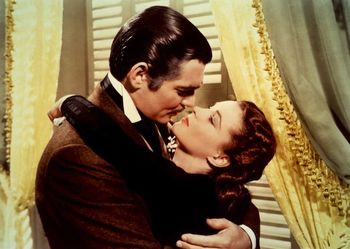
Annex-Leigh-Vivien-Gone-With-the-Wind_16 Margaret Mitchell was on her way to see a movie when she was struck by an off-duty cabbie driving too fast down Peachtree Street one night in Atlanta in 1949. Her death five days later cemented certain facts of her life, most notably that her first novel would also be her last. But she had made the most of her debut: in its nearly 1,500 pages, Gone with the Wind captured the romance and demise of America’s Old South like none other before or since, sold one million copies within six months of its publication, secured a Pulitzer Prize for literature in 1937, and inspired one of the most beloved motion pictures of all time.

Little was said about Mitchell’s death one recent evening in Atlanta, when several dozen of her fans—Windies, as they like to be called—gathered for a tour and graveside toast at the historic Oakland Cemetery, where Mitchell is buried and where her plot is among the most visited. The soiree was one of many held in and around the city this month in honor of Gone with the Wind’s seventy-fifth anniversary. The crowd was almost entirely female; Gone with the Wind handbags abounded, and at least one wristwatch bore the iconic image of Rhett and Scarlett’s smoldering onscreen embrace. Though most wore street clothes, some ladies had arrived in 1860s-ish period dress, their dedication eclipsing both the melting late-afternoon heat and the outfits’ flagrant anachronisms—clip-on chignons, hemlines revealing reputation-shattering amounts of ankle, synthetic fabrics not invented in Mitchell’s lifetime.

More here.

The smell of a meat-eater

From Nature:

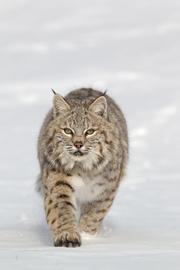
Cat If you are a small animal, it is useful to know whether there is anything around that might want to eat you. Stephen Liberles from Harvard Medical School in Cambridge, Massachusetts, and his colleagues have analysed urine samples from a variety of zoo inhabitants, including lions and bears, and discovered how rodents can use smell to do just that. In a research published today in the Proceedings of the National Academy of Science, the team identifies a chemical found in high concentrations in the urine of carnivores that makes mice and rats run for cover1. Chemicals have already been identified that allow prey to recognize a known predator. But this is the first example of a generic clue that allows an animal to detect any potential predator, irrespective of whether the two species have ever come into contact.

The researchers started by analysing an engimatic group of olfactory receptors discovered in 2001 called trace amine-associated receptors (TAARs)2. They are found in most vertebrates, in varying numbers. Mice, for example, have 15, rats 17 and humans have just 6. Very little is known about what chemicals bind to them. Liberles and his colleagues found that one member of the receptor family, TAAR4, is strongly activated by bobcat urine, which is sold online and used by gardeners to keep rodents and rabbits away. They managed to extract the molecule responsible for activating the receptor, called 2-phenylethylamine. They then wondered whether the molecule was specific to the bobcat. But the urine from other animals cannot always be bought as easily. “Also, commercial products may be contaminated, whereas we wanted to be sure we were studying only natural substances,” says David Ferrero, a graduate student in Liberles's lab and first author of the study. So the researchers collected urine samples from a range of sources, including zoos in New England and South Dakota. Their collection covered 38 species from predators such as lions, snow leopards and servals to herbivores including cows, giraffes and zebra. They also tested humans, cats and various rodents. The operation was not trivial. A giraffe had to be trained to urinate in a cup, and Ferrero had a nose-to-nose encounter with an uncooperative jaguar when the animal jumped against the bars as he approached its cage.

More here.

Thursday Poem

A Color of the Sky
.
Windy today and I feel less than brilliant,
driving over the hills from work.
There are the dark parts on the road
when you pass through clumps of wood
and the bright spots where you have a view of the ocean,
but that doesn’t make the road an allegory.

I should call Marie and apologize
for being so boring at dinner last night,
but can I really promise not to be that way again?
And anyway, I’d rather watch the trees, tossing
in what certainly looks like sexual arousal.

Otherwise it’s spring, and everything looks frail;
the sky is baby blue, and the just-unfurling leaves
are full of infant chlorophyll,
the very tint of inexperience.

Read more »

Wednesday, June 22, 2011

Ahmadinejad vs. The Ayatollah

Abbas Milani in The National Interest:

Ahmad2Ahmadinejad and his oligarch cronies have been having a rough couple of months. The ayatollah is out for blood, and those in “elected” office are under attack. In fact, the dominant narrative taking over the Islamic Republic has lately sounded a great deal more like the magical realism of Gabriel García Márquez than the realpolitik of Hans Morgenthau. It has been two months of bizarre allegations of voodoo and venal sins taking place in the offices and homes of the president’s closest aides and confidants—not to mention the far more run-of-the-mill charges of their financial corruption and sweetheart deals in places like Belarus. It has been a time of repeated open threats of the president’s impeachment, the same president who was not too long ago the darling of Ayatollah Ali Khamenei, close as Mahmoud Ahmadinejad was to the supreme leader’s own ideas and ideals. It has been a time when more than a hundred members of Iran’s parliament, the Majlis, have requested an investigation into the last presidential election and the allegation that 9 million votes were purchased through cash payments from government coffers. Amazing how the tables can turn. Indeed, just like the police chief in Casablanca, these conservative (ayatollah-backing) members of the Majlis are “shocked, shocked” that electoral cheating is going on in Iran. Lest we forget, Mir Hussein Moussavi (the “losing candidate” in that same presidential election), his wife, Zahra Rahnavard, Mehdi Karroubi (the other “losing” candidate) and his wife, Fatemeh, have been under house arrest for months—for making the same accusations of fraud. Thousands of Iranians have been imprisoned, and about a hundred of the regime’s past ministers, deputy ministers and directors were put on Stalinist-era-like show trials to confess to the crime of alleging a bought-and-paid-for vote. Hundreds of young women and men were tortured, dozens raped and thousands forced into exile for questioning the June 2009 presidential-election results. It was of course all, according to Khamenei, a sinister U.S. plot to create a “velvet revolution” using Gene Sharp’s model and George Soros’s money.

More here.

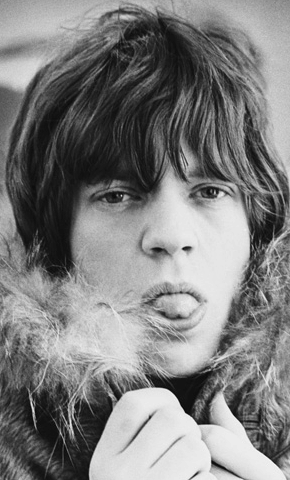
MICK JAGGER: “EXCESS WAS THE ORDER OF THE DAY”

From The Talks, a new online magazine of interviews:

ScreenHunter_05 Jun. 23 10.45Mr. Jagger, what kept you from completely going off the deep end?

I mean we all did excessive things and I had a lot of unstable moments as I’m sure everyone does in their life. Maybe it helped me that I had a very centered upbringing.

So your parents basically.

Yeah, I think so. When you are young and you have a sort of close family life and stuff, it helps you to be centered for later. If you don’t have a centered upbringing, I think it is much more difficult.

You still had a very destructive lifestyle back then.

Excess was the order of the day. But that was just a period. You know you get excessive people nowadays as well. Today people are excessive consuming things, like consumer goods.

But you were even chased by the police for your drug abuse. How do you remember those days?

At the time it wasn’t very funny. It wasn’t very good because it completely took over our lives creatively and we couldn’t do this and couldn’t do that. You had to spend all your time trying to deal with all the police and you didn’t have time to do anything else.

More here.

A Review of Jon Cotner’s Spontaneous Society

James Yeh in The Faster Times:

1-300x215

Is it possible, in this age of earbuds and smart phones, to spread “good vibes” among strangers on the street through something as simple as conversation? The poet Jon Cotner thinks so. That’s why Cotner—who, along with Andy Fitch, co-authored Ten Walks/Two Talks—created Spontaneous Society, a walking tour designed to create “gentle interventions” aimed at “replacing urban anonymity with something bordering on affection—even if it’s fleeting.”

The premise is simple: to each participant, Cotner gives two very simple, very basic lines to recite to passersby. The lines (which Cotner lovingly describes as “oceanic”) are, generally and in essence, positive observations about something that passerby is currently doing as a means of initiating a brief, but positive, social exchange. For example, “That looks like a good spot for a picnic,” said when passing someone eating on a bench, a blanket, or doorstep; or “It’s a good day to have the feet out,” said when someone approaches with a carriage in which at least one inhabitant is shoeless.

More here.

Rule Breaker

From The Chronicle of Higher Education:

Photo_12955_carousel Patricia S. Churchland, the philosopher and neuroscientist, is sitting at a cafe on the Upper West Side, explaining the vacuousness, as she sees it, of a vast swath of contemporary moral philosophy. “I have long been interested in the origins of values,” she says, the day after lecturing on that topic at the nearby American Museum of Natural History. “But I would read contemporary ethicists and just feel very unsatisfied. It was like I couldn't see how to tether any of it to the hard and fast. I couldn't see how it had anything to do with evolutionary biology, which it has to do, and I couldn't see how to attach it to the brain.” For people familiar with Churchland's work over the past four decades, her desire to bring the brain into the discussion will come as no surprise: She has long made the case that philosophers must take account of neuroscience in their investigations.

While Churchland's intellectual opponents over the years have suggested that you can understand the “software” of thinking, independently of the “hardware”—the brain structure and neuronal firings—that produced it, she has responded that this metaphor doesn't work with the brain: Hardware and software are intertwined to such an extent that all philosophy must be “neurophilosophy.” There's no other way. Churchland, professor emerita of philosophy at the University of California at San Diego, has been best known for her work on the nature of consciousness. But now, with a new book, Braintrust: What Neuroscience Tells Us About Morality (Princeton University Press), she is taking her perspective into fresh terrain: ethics. And the story she tells about morality is, as you'd expect, heavily biological, emphasizing the role of the peptide oxytocin, as well as related neurochemicals.

More here.

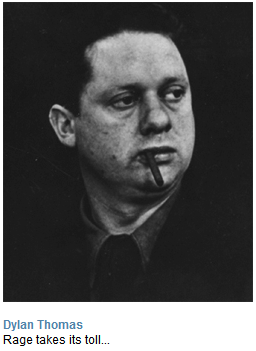
D.J. and Dylan Thomas

Stefany Anne Golberg in The Smart Set:

ScreenHunter_04 Jun. 22 15.24As a boy, D.J. was a promising student. He had received a scholarship to study English at the University College of Wales at Aberystwyth where he graduated with first-class honors. Like many promising students of English, D.J. had dreams of being a poet. Instead, he became a grammar school teacher. He watched in anger and shame as colleagues of clearly inferior worth gained appointments to higher university positions while he remained where he was. D.J. was often ill, and wondered why he had no visitors. He cultivated a devastating schoolmaster’s sarcasm that shielded his fragile pride. Students of Schoolmaster Thomas remember an unforgiving tyrant who cursed stupid boys and dirty boys. But he made Shakespeare come alive and became known for getting his boys into Oxford and Cambridge. D.J.’s great passion for English literature was available for any boy willing to receive it. To his son Dylan, however, the clever, disappointed father gave his entire dream of a poet’s life.

From childhood, Dylan Thomas accepted the poet’s life as his fate and set out to prove that his father’s rage, along with his love of language, would live on. He cultivated a big sonorous voice and a big sonorous presence in which rage and poetry thrived. Dylan was doughy, curly-headed, soft, and at the same time asthmatic, wild, and prone to nightmares and depression. Dylan would lie awake at night thinking of “God and Death and Triangles,” and would develop an alcoholism as famous as his poetry. Just as D.J.’s eccentric mannerisms and dramatic storytelling made people uncomfortable, the same mannerisms, performed by the son, became a trademark. D.J.’s hypochondria became Dylan’s sensitivity. Just as D.J. used rage to hide from regret, Dylan used it to further his poet’s identity. The father and son would feed off each other, each raging himself into a state that was alternately more wronged and more poetic than the other. It was the rage that allowed them to be larger than life, larger than themselves. The rules of this father/son project were catalogued in Dylan’s most famous poem, “Do not go gentle into that good night.” The poem was written during D.J.’s declining years, after the father had allowed himself to become quiet and frail and resigned.

More here.

The most ridiculously poisonous animal in America

Carl Zimmer in his excellent blog, The Loom:

ScreenHunter_03 Jun. 22 14.20

The scientific tale of the rough-skinned newt begins five decades ago, with a story about three dead hunters in Oregon. Reportedly, the bodies of the hunters were discovered around a camp fire. They showed no signs of injury, and nothing had been stolen. The only strange thing about the scene was the coffee pot. Curled up inside was a newt.

In the 1960s, a biologist named Butch Brodie got curious about the story. The newt in the coffee pot–known as the rough-skinned newt–has a dull brown back, but when it is disturbed, it bends its head backward like a contortionist to reveal an orange belly as bright as candy corn. Bright colors are common among poisonous animals. It’s a signal that says, in effect, “If you know what’s good for you, you’ll leave me alone.” Brodie wondered if the newts were toxic, too.

Toxic, it turns out, doesn’t do the newts justice. They are little death machines. The newts produce a chemical in their skin called tetrodotoxin, or TTX for short, that’s made by other poisonous animals like pufferfish. Locking onto sodium channels on the surface of neurons, TTX blocks signals in the nervous system, leading to a quick death. In fact, TTX is 10,000 times deadlier than cyanide. While we may never know for sure what killed those three Oregon hunters, we do know that a single rough-skinned newt could have easily produced enough TTX to kill them, and have plenty of poison left over to kill dozens more.

More here.