Remembering Stieg Larsson

From The New York Times:

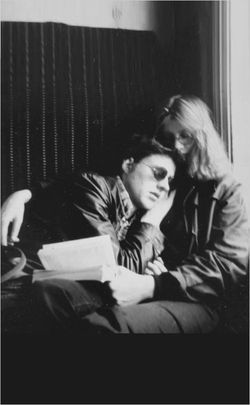
Larsson Eva Gabrielsson and Stieg Larsson spent 32 years together in Sweden and were soul mates, collaborators and fellow travelers. But one thing they were not was husband and wife, a fact that became critical when Larsson died unexpectedly in 2004 at the age of 50. That Larsson wrote an improbably successful trilogy of novels that began with “The Girl With the Dragon Tattoo” and went on to sell more than 50 million books worldwide complicated every aspect of his passing. Sweden has no “automatic right of inheritance” provision for common-law spouses, so Larsson’s brother and father have come to control his lucrative literary estate. Gabrielsson’s book, “ ‘There Are Things I Want You to Know’ About Stieg Larsson and Me,” is an attempt to regain custody of Larsson’s legacy, not only from his family but also from a world hungry to commercialize his every aspect, with films both Swedish and American, companion books and journalistic examinations of the “Girl” phenomenon and the man who created it.

Famous only in death, Larsson was a fervent feminist, an author of numerous books and articles about right-wing Swedish extremism, and a socialist to his core. As Gabrielsson explains, much of his life’s work was embodied in Expo, a small political magazine that struggled to stay afloat. The crime novels were “like therapy,” she writes. “He was describing Sweden the way it was and the way he saw the country: the scandals, the oppression of women, the friends he cherished and wished to honor.” Fans of his books looking for an intimate peek into the life of a man who summoned a dark, scary version of Sweden will not be disappointed, but that understanding does not come easily. The book is a short, highly emotional tour though a widow’s grief and dispossession, and the details of the couple’s life together are jarringly juxtaposed with blood feuds and score-settling.

More here.

Friday, July 8, 2011

The Genius of Buster

Jana Prikryl on Buster Keaton, in the NYRB:

More than fifty years have passed since critics rediscovered Buster Keaton and pronounced him the most “modern” silent film clown, a title he hasn’t shaken since. In his own day he was certainly famous but never commanded the wealth or popularity of Charlie Chaplin or Harold Lloyd, and he suffered most when talkies arrived. It may be that later stars like Cary Grant and Paul Newman and Harrison Ford have made us more susceptible to Keaton’s model of offhand stoicism than his own audiences were. Seeking for his ghost is a fruitless business, though; for one thing, film comedy today has swung back toward the sappy, blatant slapstick that Keaton disdained. There’s some “irony” in what Judd Apatow and Adam Sandler do, but it’s irony that clamors to win the identification of the supposedly browbeaten everyman in every audience. Keaton took your average everyman and showed how majestically alone he was.

Zoobotics

20110709_stp003 In the Economist:

UNTIL recently, most robots could be thought of as belonging to one of two phyla. The Widgetophora, equipped with claws, grabs and wheels, stuck to the essentials and did not try too hard to look like anything other than machines (think R2-D2). The Anthropoidea, by contrast, did their best to look like their creators—sporting arms with proper hands, legs with real feet, and faces (think C-3PO). The few animal-like robots that fell between these extremes were usually built to resemble pets (Sony’s robot dog, AIBO, for example) and were, in truth, not much more than just amusing toys.

They are toys no longer, though, for it has belatedly dawned on robot engineers that they are missing a trick. The great natural designer, evolution, has come up with solutions to problems that neither the Widgetophora nor the Anthropoidea can manage. Why not copy these proven models, the engineers wondered, rather than trying to outguess 4 billion years of natural selection?

The result has been a flourishing of animal-like robots. It is not just dogs that engineers are copying now, but shrews complete with whiskers, swimming lampreys, grasping octopuses, climbing lizards and burrowing clams. They are even trying to mimic insects, by making robots that take off when they flap their wings. As a consequence, the Widgetophora and the Anthropoidea are being pushed aside. The phylum Zoomorpha is on the march.

Is Palestine Next?

Adam Shatz in the London Review of Books:

441px-Palestine_COA_(alternative)_svg No one in the Arab world was watching the news more closely than the Palestinians during the revolutions in Tunisia and Egypt. The first emotion they experienced was disbelief; the second – particularly when they saw Palestinian flags being raised in Tahrir Square – was relief that they were no longer alone. Arab lethargy has been a virtual article of faith among Palestinians, who felt that their neighbours had betrayed them in 1948 and had done nothing to help them since. The Palestinian national movement, which rose to prominence under Yasir Arafat’s leadership in the late 1960s, was defined in large part by its belief that Palestinians had to rely on themselves. Mahmoud Darwish was not the only one to note that during the siege of Beirut in 1982, when Israel invaded Lebanon in an attempt to crush the PLO, tens of thousands of Israelis protested in Tel Aviv but the Arabs were too busy watching the World Cup Final to take to the streets.

The old Arab order was buried in Tahrir Square. Young revolutionaries rose up against a regime which for three decades had stood in the way of Palestinian aspirations. It seemed too good to be true and some pundits in Palestine wondered whether it wasn’t an American conspiracy. But it wasn’t, and Palestinians began to re-examine what had been one of their most disabling convictions: the belief that the US controls the Middle Eastern chessboard, and that the Arab world is powerless against America and Israel. ‘There has been a kind of epistemic break,’ a young Palestinian said to me. The excitement among Palestinians sometimes seems to be mixed with unease, even envy: the spotlight has been stolen from them. As a Hamas councilwoman in Nablus put it, ‘For 60 years they were watching us. Now we are watching them.’ But Palestinians have prided themselves on being the vanguard of protest in the Arab world and they will not be content to remain spectators for long.

More here.

A little cis story

PZ Myers in Pharyngula:

Pzm_profile_pic I found a recent paper in Nature fascinating, but why is hard to describe — you need to understand a fair amount of general molecular biology and development to see what's interesting about it. So those of you who already do may be a little bored with this explanation, because I've got to build it up slowly and hope I don't lose everyone else along the way. Patience! If you're a real smartie-pants, just jump ahead and read the original paper in Nature.

Svbmap Let's begin with an abstract map of a small piece of a strand of DNA. This is a region of fly DNA that encodes a gene called svb/ovo (I'll explain what that is in a moment). In this map, the transcribed portions of the DNA are shown as gray shaded blocks; what that means is that an enzyme called polymerase will bind to the DNA at the start of those blocks and make a copy in the form of RNA, which will then enter the cytoplasm of the cell and be translated into a protein, which does some work in the activities of that cell. So svb/ovo is a small piece of DNA which, in the normal course of events, will make a protein.

More here.

10 Ways Arab Democracies Can Avoid American Mistakes

Juan Cole in Informed Comment:

Juan-cole-headshot 1. Contemporary political campaigns in the US depend heavily on television commercials. In the UK these ads are restricted, and in Norway they are banned. Consider banning them. But whatever you do, do not let your private television channels charge money for campaign advertisements. Television advertisements account for 80-90 percent of the cost of a senate or presidential campaign in the US, and the next presidential campaign will cost each candidate $1 billion. The only way a candidate can win is to fall captive to the billionaires and their corporations, leaving the people powerless and victimized by the ultra-wealthy. Consider putting a ban on paid radio and television political ads in the constitution, because otherwise if it is only a statute, the wealthy will try to buy the legislature so as to overturn it.

2. Do not hold your elections on work days. America’s robber barons put elections on Tuesdays in order to discourage workers, including the working poor, from voting. In many democracies, the poor do vote, as in India, but in the US they have been largely successfully discouraged from doing so. Policies are therefore mainly made for the wealthy few, ruining the lives of millions of workers. France, in contrast, holds its elections on Sundays. In the first round of the 2007 French presidential election, 84% of the electorate turned out. In contrast, in the hotly contested and epochal 2008 presidential election in the US, the turnout was only 64%.

3. Have compulsory, government-run voter registration at age 18 or whatever the voting age is. Voluntary voter registration, especially when it must be undertaken months before the polls, is just a way of discouraging citizens from voting. This voluntary system is favored by the wealthy and the racists in the United States, who consistently oppose efforts to make it easier to register. Compulsory voter registration is correlated with high electoral turnout.

More here.

Pakistan v. Pakistan: On Anatol Lieven

Fatima Bhutto in The Nation:

Fatima372ready To write a book about Pakistan and give it the subtitle “A Hard Country” is a bit like writing a book on Russia and calling it “Russia: A Cold Country,” or dubbing one on Australia “A Far Away Country.” As Anatol Lieven explains, the accidental author of his book’s subtitle is a landowner-politician in the Sindh province of southern Pakistan. “This is a hard country,” the man told Lieven, a place where anyone not in government needs protection from the police, the courts, the bandits, from practically every corner of society. As Lieven shows, while Pakistan may not be hard to understand, it is a dangerous, fearsome country, a hard place to live and harder still to govern. Besides, “A Hard Country” has a nice ring when you consider that the preliminary title of Lieven’s project was “How Pakistan Works.” That would have made for a very short book.

One could also say that Pakistan, despite having the sixth-largest population in the world, is the most familiar unfamiliar country. Everyone knows why they should be afraid of Pakistan—terrorism, Al Qaeda, the Taliban, Asif Zardari (the country’s current president). But good explanations of what any of these menaces mean in a Pakistani context, and how they came to be a part of the nation’s nightmarish social fabric—if indeed they are—are hard to come by. It is a relief that Lieven begins with a calming down, stressing that for all the country’s problems, and contrary to the sensationalism of headline editors in the West, Pakistan is not a failed state. Nor are its problems regional exceptions; insurgencies, rebellions, corruption, autocratic tendencies and inept elites, he reminds us, are rampant throughout southern Asia. Lieven has written a sensible and thorough exploration of Pakistan’s political sphere—from its politicians, provinces and state structures to the burgeoning Taliban, which are unfairly coming to define the sixty-four-year-old country in Western minds. The terror inflicted on Pakistan by the Taliban, Lieven assures, is a sign not of the group’s strength but its weakness: the surest way to fail at building a mass movement is to kill the people most likely to offer support. Absent institution building, a revolt within military ranks and alliances with popular uprisings, the Taliban are a guerrilla movement operating in a blind alley. Pakistan is not, then, in danger of imploding—not unless the United States allows its disastrous war in Afghanistan to spill over into all of Pakistan, or dispatches the Navy SEALs to kill an Al Qaeda lieutenant living in the country.

More here. (Note: Thanks to dear friend C.M.Naim)

Gourmand Syndrome

From Smithsonian:

Pesto-gourmand-resized Outside magazine isn’t usually my source for food knowledge, but I recently read an intriguing tidbit there. The article was about a young professional snowboarder, Kevin Pearce, who sustained brain damage from a near-fatal accident in the halfpipe in December 2009. He’s lucky to be alive and sentient, but the trauma has taken its toll: He had to relearn how to walk, may never snowboard again—and almost certainly will never compete—and has serious short-term memory deficits.

One side effect is less troubling, though more relevant to a food blog: Ever since awakening from his post-accident coma, Pearce has had frequent, intense cravings for basil pesto, a food he had no special feelings for before. Although the article doesn’t go into more detail about this quirk of his brain injury, he’s not an isolated case. When a certain part of the right hemisphere of the brain is damaged by trauma, stroke or tumors, some patients develop “gourmand syndrome.” First identified by neuroscientists in the 1990s, the disorder is marked by “a preoccupation with food and a preference for fine eating.”

More here.

Friday Poem

Ripe in the Arbours of the Nose

Even rippled with sun
the greens of a citrus grove darken
like ocean deepening from shore.
Each tree is full of shade.

A shadowy fast spiral through
and a crow’s transfixed an orange
to carry off and mine
its latitudes and longitudes
till they’re a parched void scrotum.

Al-Andalus has an orange grove
planted in rows and shaven above
to form an unwalkable dream lawn
viewed from loggias.
One level down,
radiance in a fruit-roofed ambulatory.

Mandarin, if I didn’t eat you
how could you ever see the sun?
(Even I will never see it
except in blue translation).

Shedding its spiral pith helmet
an orange is an irrigation
of rupture and bouquet
rocking the lower head about;

one of the milder borders
of the just endurable
is the squint taste of a lemon,

and it was limes, of dark tooled green
which forgave the barefoot sailors
bringing citrus to new dry lands.

Cumquat, you bitter quip,
let a rat make jam of you
in her beardy house.

Blood orange, children!
raspberry blood in the glass:
look for the five o’clock shadow
on their cheeks.
Those are full of blood,
and easy: only pick the ones that
relax off in your hand.

Below Hollywood, as everywhere
the trees of each grove appear
as fantastically open
treasure sacks, tied only at the ground.

by Les Murray
from The Biplane Houses
publisher: Black Inc., Melbourne, © 2006,

Thursday, July 7, 2011

SlutWalks and the Future of Feminism

Slut_walk-300x197 Jessica Valenti in The Washington Post:

More than 40 years after feminists tossed their bras and high heels into a trash can at the 1968 Miss America pageant — kicking off the bra-burning myth that will never die — some young women are taking to the streets to protest sexual assault, wearing not much more than what their foremothers once dubbed “objects of female oppression” in marches called SlutWalks.

It’s a controversial name, which is in part why the organizers picked it. It’s also why many of the SlutWalk protesters are wearing so little (though some are sweatpants-clad, too). Thousands of women — and men — are demonstrating to fight the idea that what women wear, what they drink or how they behave can make them a target for rape. SlutWalks started with a local march organized by five women in Toronto and have gone viral, with events planned in more than 75 cities in countries from the United States and Canada to Sweden and South Africa. In just a few months, SlutWalks have become the most successful feminist action of the past 20 years.

In a feminist movement that is often fighting simply to hold ground, SlutWalks stand out as a reminder of feminism’s more grass-roots past and point to what the future could look like.

The marches are mostly organized by younger women who don’t apologize for their in-your-face tactics, making the events much more effective in garnering media attention and participant interest than the actions of well-established (and better funded) feminist organizations. And while not every feminist may agree with the messaging of SlutWalks, the protests have translated online enthusiasm into in-person action in a way that hasn’t been done before in feminism on this scale.

A Review of Derek Parfit’s On What Matters

Derek Parfit - On What Matters Constantine Sandis in Time Higher Educations:

Derek Parfit's On What Matters has been the most eagerly awaited work in philosophy since Ludwig Wittgenstein's Philosophical Investigations. Drafts of its chapters – and those of its prototype, Climbing the Mountain – have been in circulation for more than a decade. Indeed, the book – if that is the correct term for two large volumes containing three distinct treatises and much additional matter – has already featured as the focus of numerous academic articles, conferences, blogs, an edited volume and a Facebook reading group. Scholars including Brad Hooker and Peter Singer have hailed it as the most important publication in moral philosophy since Henry Sidgwick's 1874 work The Methods of Ethics, which is no small praise given that the competition includes key works by figures as diverse as Friedrich Nietzsche, Oscar Wilde, G.E. Moore, W.D. Ross, Iris Murdoch, John Rawls, G.H. von Wright, Alasdair MacIntyre, Bernard Williams, Philippa Foot and T.M. Scanlon.

Parfit has not published much since his groundbreaking 1984 book Reasons and Persons, which The Sunday Times described as “something close to a work of genius”. That work almost singlehandedly revived a relatively dormant area of philosophical investigation (the theory of normative reasons) while largely destroying the hopes of another (theories of personal identity, with Parfit arguing that what mattered was not identity but survival).

On What Matters returns to the first of these two themes, opening with a rigorous defence of the view that there exist objective facts that count in favour of certain courses of action regardless of our desires, and closing with an all-out attack on various sceptical moralities that have plagued philosophy ever since Thrasymachus told Socrates that justice is might. However, it is the material that lies between these two undertakings that has caused the most excitement.

Where was David Foster Wallace going with The Pale King?

Tumblr_lnvzu9MaLC1qhwx0o Cornel Bonca and Lee Konstantinou each offer a perspective in The LA Review of Books. Bonca:

The IRS is, for most people, a fear-laden joke: just speak the initials at any public gathering and watch the smiles rise. (Why do we smile? Guilt and anxiety. Guilt at how we’ve, um, misrepresented our 1040s in the past. Anxiety that they’ll come after us one of these days.) I’m more than a little sensitive to this because, from 1980 till 1984, when I was a very young man, I worked for the IRS as a revenue officer — I was the guy who knocked on people’s doors, flashed my Treasury Department credentials, and demanded full and immediate payment, including penalties and interest, for delinquent 1040s, 941s, and 1120s. I was the guy who filed tax liens, levied people’s wages and bank accounts, seized people’s homes and assets when they refused to pay up. I mention this only because The Pale King deals with the IRS during a period (the late 1970s until the mid 1980s) which almost exactly coincides with my woeful tenure there, and I can verify that, however fictionalized Wallace’s IRS is, and however he gets things wrong — new IRS employees didn’t have to change their Social Security numbers to ones beginning with a 9; there was no such thing as the Spackman Initiative (more on this later), etc. — he’s spot on about the spirit of the place.

The spirit of the place was spiritless. The Pale King’s IRS employees have faces the color of “wet lead.” They spend their 15-minute breaks staring at clocks ticking them back to the bondage of their desks. In one only slightly over-the-top segment, we read about an IRS guy who dies at his desk — and nobody notices for four days. This is an IRS that’s unrelentingly, remorselessly boring and unspeakably bureaucratized, heedless of the basic need of its employees: to exact from their work some small measure of human satisfaction.

Bureaucracy’s boredom emerges as one of the novel’s primary concerns, though to say The Pale King is “about” boredom is about as enlightening as to say that Infinite Jest is about addiction. Bureaucracy is the territory, and Wallace goes at it from multiple directions, always avoiding the well-worn path. He piles on the insufferable language of bureaucracy, flirting with the imitative fallacy — describing boredom by being boring — and it’s a strategy that not every reader will appreciate. He refrains from taking the Fight Club route, which is to claim that the only escape from boredom is sensational violence. He also eschews the Warhol trap, which sees boredom as this really interesting aesthetic that the artist studies from his fortress of irony. No, Wallace’s take on boredom is frankly ethical and existential — he reconsiders what boring work does to people’s souls in ways that hearken back to the great “business” or “office” narratives of the last century…

Europeans Against Multiculturalism

John R. Bowen in the Boston Review:

Bowen_36_4_cameron One of the many signs of the rightward creep of Western European politics is the recent unison of voices denouncing multiculturalism. German Chancellor Angela Merkel led off last October by claiming that multiculturalism “has failed and failed utterly.” She was echoed in February by French President Nicolas Sarkozy and British Prime Minister David Cameron. All three were late to the game, though: for years, the Dutch far right has been bashing supposedly multicultural policies.

Despite the shared rhetoric, it is difficult to discern a common target for these criticisms. Cameron aimed at an overly tolerant attitude toward extremist Islam, Merkel at the slow pace of Turkish integration, and Sarkozy at Muslims who pray in the street.

But while it is hard to know what exactly the politicians of Europe mean when they talk about multiculturalism, one thing we do know is that the issues they raise—real or imagined—have complex historical roots that have little to do with ideologies of cultural difference. Blaming multiculturalism may be politically useful because of its populist appeal, but it is also politically dangerous because it attacks “an enemy within”: Islam and Muslims. Moreover, it misreads history. An intellectual corrective may help to diminish its malign impact.

More here.

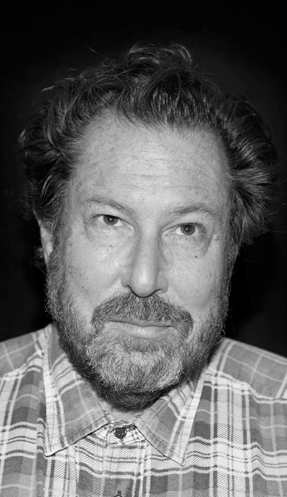
THE ARROGANT, SELF-SATISFIED JULIAN SCHNABEL

From The Talks:

ScreenHunter_01 Jul. 07 14.54 Mr. Schnabel, when does a work of art become important in your opinion? Do you need external confirmation, or is it something explicitly personal?

I don’t think something is important just because an audience likes it. Most people make art and movies as a job and if a lot of people go to see it they make money and that is their sign of success. I am not making judgment here, but their goal is strictly business-oriented. I don’t do this as a business.

So commercial success doesn’t interest you?

Do I think it’s good if people like it? I have to like it. If I think that something is good, it is fine. I mean Gladiator came out when my movie Before Night Falls came out. Gladiator won the Acadamy Award, Russell Crowe won the Acadamy Award. Would I rather be Ridley Scott? No. Do I think Javier Bardem’s performance was better than Russell Crowe’s, although Russell is an excellent actor? Yes. Javier Bardem’s performance was better. Did we win the Oscar? No. Does it matter? No. I mean he was the first Spanish actor to ever be nominated for an Academy Award. What does that say about the Academy? There is a level of chauvinism over there; it’s a club.

Do you think your indifference to the system has actually made you more successful?

Well I can’t just say yes to that, because then I would sound like the guy everybody says I am supposed to be: the arrogant, self-satisfied Schnabel. (Laughs)

More here.

Pakistan’s Army: Divided It Stands

Pervez Hoodbhoy in Economic and Political Weekly:

Pervez_Hoodbhoy Although the army has been extremely reluctant to admit that radicalisation exists within its ranks, sometimes this fact simply cannot be swept under the rug. Last week, the army was forced to investigate Brigadier Ali Khan for his ties to militants of the Hizb ut-Tahrir, a radical organisation that seeks to establish a global caliphate and thinks its mission should begin from nuclear Pakistan. The highest ranking officer so far arrested, Ali Khan, comes from a family with three generations of military service and is said to have a strong professional record. It is said that General Ashfaq Kayani was reluctant to take this step in spite of incontrovertible proof that Khan had militant connections because he feared the backlash. Four army majors are also currently being investigated, but this could be just the tip of an iceberg.

More here.

A Dirty Business

From The New Yorker:

Raja In the fall of 2003, Anil Kumar, a senior executive with the consulting firm McKinsey, and Raj Rajaratnam, the head of a multibillion-dollar hedge fund called Galleon, attended a charity event in Manhattan. They had known each other since the early eighties, when, as recent immigrants, they were classmates at the Wharton School of Business, in Philadelphia. Their friendship, intermittent over the years, was based on self-interest rather than on intimacy.

Kumar, born in Chennai, formerly Madras, India, was fastidious and morose, travelling at least thirty thousand miles a month for work, and seldom socializing. Rajaratnam, a Tamil from Colombo, Sri Lanka, was fleshy and dark-skinned, with a charming gap-toothed smile and a sports fan’s appetite for competition and conquest. Kumar was not among the group whom Rajaratnam took on his private plane to the Super Bowl every year for a weekend of partying. “I’m a consultant at heart,” Kumar liked to say. “I’m a rogue,” Rajaratnam once said. Kumar had the more precise diction and was better educated, but Rajaratnam was one of the world’s new billionaires and therefore a luminary among businessmen from the subcontinent. In an earlier generation of immigrant financiers, Kumar would have been the German Jew, Rajaratnam the Russian. Kumar might have felt some disdain for Rajaratnam, but Rajaratnam’s fortune made him irresistible.

More here.

The vitamin D-lemma

From Nature:

Vit With his skull-and-crossbones bow tie tied tight, Clifford Rosen strides to the podium at the Metropolitan Bone Club, a meeting of researchers and clinicians in New York City concerned with all things skeletal. He begins by bracing himself: “If you want to ask a question or just yell at me, go ahead,” he says. “I'm used to a lot of antagonism, anger, and frustration.”

Rosen is director of clinical and translational research at Maine Medical Center Research Institute in Scarborough and is a respected member of the bone-research community. But his role last year on an expert panel to determine how much calcium and vitamin D people need put him at odds with many of his colleagues. In the past few years, vitamin D has earned a reputation in Western countries for preventing or fighting prostate cancer, cardiovascular disease, multiple sclerosis and about 30 other maladies, leading to advice that most people should be supplementing what the body produces naturally when exposed to sunlight. But in November, the panel, put together by the Institute of Medicine (IOM) — a non-profit group affiliated with the US National Academy of Sciences — issued a report1 that challenged that view. Blood levels of vitamin D need not be as high as many physicians and testing companies had been advocating, it said, and high doses of the vitamin could actually cause harm. Since the report was released, Rosen says he's received about 150 e-mails critical of the panel's decisions. About one-third were downright hateful. “A rehabilitation doctor in Texas threatened to bring me to the board of malpractice to have my licence revoked. People tell me I don't know what I'm doing,” he says. “It has become personal.”

More here.