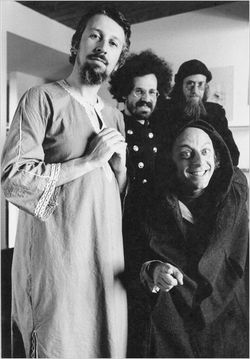
‘How the Hippies Saved Physics’

From The New York Times:

JOHNSON-popup “What the Bleep Do We Know!?,” a spaced-out concoction of quasi physics and neuroscience that appeared several years ago, promised moviegoers that they could hop between parallel universes and leap back and forth in time — if only they cast off their mental filters and experienced reality full blast. Interviews of scientists were crosscut with those of self-proclaimed mystics, and swooping in to explain the physics was Dr. Quantum, a cartoon superhero who joyfully demonstrated concepts like wave-particle duality, extra dimensions and quantum entanglement. Wiggling his eyebrows, the good doctor ominously asked, “Are we far enough down the rabbit hole yet?” All that was missing was Grace Slick wailing in the background with Jorma Kaukonen on ­guitar.

Dr. Quantum was a cartoon rendition of Fred Alan Wolf, who resigned from the physics faculty at San Diego State College in the mid-1970s to become a New Age vaudevillian, combining motivational speaking, quantum weirdness and magic tricks in an act that opened several times for Timothy Leary. By then Wolf was running with the Fundamental Fysiks Group, a Bay Area collective driven by the notion that quantum mechanics, maybe with the help of a little LSD, could be harnessed to convey psychic powers.

More here.

Friday, June 17, 2011

remember the vorticists

Arts_cork2

A century ago, rebellious young artists across Europe banded together in a succession of loudly publicised avant-garde movements. After Expressionism had erupted in Germany, Cubism revolutionised painting in France. Then the Futurists came out of Italy, demanding that art should celebrate the blurred excitement of machine-age dynamism. Rival groups issued manifestos, proclaiming their ability to transform everyone’s vision of the modern era. The years leading up to the first world war were alive with the energy of all these conflicting “-isms,” and in the summer of 1914 a new British movement was announced by a belligerent magazine called BLAST. This publication marked the arrival of Vorticism, and it burst on the world with the impact of a bomb. The thick, black capitals peppering its pages had the force of a loudhailer. The images reproduced in BLAST proved that British art was being revolutionised by a fresh, London-based generation of painters and sculptors dedicated to extreme, urgent renewal. They wanted to sweep away the inhibiting legacy of the “VICTORIAN VAMPIRE,” and now the summer exhibition at Tate Britain intends to celebrate the landmark importance of the Vorticists’ achievement.

more from Richard Cork at Prospect Magazine here.

A Revolution of Equals

1307359341363

In the days immediately following the toppling of President Zine El Abedine Ben Ali on 14 January, Tunis was a city exhilarated by the success of the revolution. Energized protestors kept up pressure on the newly formed interim government. A sit-in outside government offices in the Kasbah led to the ousting of the few remaining politicians associated with the old regime. Trade unions, now emboldened, organized strikes to demand better salaries and working conditions. On Habib Bourguiba Avenue, the Tunisian equivalent of the Champs-Elysées, strangers spontaneously gathered to discuss politics, economics and social issues. Under the tree-lined central promenade, near the sweet-smelling popcorn stalls or sitting at the Paris-style cafés, people from all walks of life were conversing. As I wandered around talking to them, it was clear that all were proud of their achievement and felt they had won back their dignity. They were thrilled to speak freely, and it was truly exciting to see everyone exercise freedom of speech as if it were a newly discovered skill that needed testing and practice. It was, put simply, democracy in action.

more from Lana Asfour at Granta here.

steeped in magic

TLS_Wills_737915a

W. B. Yeats spent much of 1937 in London, and in Sussex, in two separate houses: one belonging to his friend Dorothy Wellesley, and the other to Edith Shackleton Heald, with whom Yeats began his last affair in June. Writing to his wife George at home in Rathfarnham near Dublin in September 1937, he informed her, “A Vision comes out on Oct 7 so you may destroy all proofs etc. I shall send you three of my six copies as you are part author”. It is hard to imagine Rathfarnham flooded with waves of gratitude. It was George’s honeymoon discovery of her talent for automatic writing, beginning as a sly attempt to consolidate her marriage, which set Yeats on the path of his symbolic cosmology, A Vision, and fifteen years’ joint work. She spent the first three years of her marriage from 1917 in regular sessions of automatic writing, followed by bouts of part-conscious “sleep” dictation; the first version of A Vision, published in 1925, went through numerous drafts, and was finally typed by George, only to be followed by a second, completed in 1931 but not published for a further six years.

more from Clair Wills at the TLS here.

Impact Evaluation and the Millennium Villages Experiment in Africa

Michael A. Clemens in the Boston Review:

Clemens_36_3_sauri The Millennium Villages project (MVP) is an ambitious program to break targeted African communities free from extreme poverty and thereby demonstrate how poverty in general can be eradicated. Run by the United Nations Development Programme and Columbia University’s Earth Institute—headed by renowned economist Jeffrey Sachs—the MVP began its pilot phase in a Kenyan village in 2004 and has grown to include numerous rural village clusters in nine other countries. It hopes to scale up its approach across much of Africa, and has plans on other continents as well.

The MVP’s strategy employs an intense, multi-pronged aid package for agriculture, education, health, and infrastructure—with a total cost of about $1.5 million per village cluster spread out over five years. It seeks to disrupt, all at once, the factors that together create the conditions for destitution. The MVP treatment simultaneously deploys a variety of aid-financed interventions, including fertilizer, anti-malaria bed nets, and school meals, among many others. Where a single intervention might leave villagers trapped in poverty by other problems, the MVP asserts that its simultaneous execution of several interventions can break villages out of poverty traps for good.

Although its aims are noble and its leaders well-intentioned, the MVP suffers from a glaring omission: it is not conducting an objective and independent evaluation of its impacts.

More here.

What Is Social Psychology, Anyway?

Steven Pinker in Edge.org:

Showimagebio In his defense of social psychology as it is currently practiced, Timothy Wilson repeats the canard that evolutionary explanations of traits are exercises in “storytelling” which can “explain anything.” He boasts, for example, that he can make up a story in which the redness of blood is an adaptation:

“What if in our very early mammalian history, blood was more brown, but there was a mutation that made it more red, and that turned out to have survival value because if an animals were bleeding, those with red blood would be more likely to notice it, and then they'd lick it. Because licking has healing properties, this conveyed a survival advantage, and so red blood was selected for, and blood became red. Am I right? Or is Steve [Pinker] right, that the color of blood is not an adaptation? Who knows.”

What this shows is that Timothy Wilson can think up a ludicrous evolutionary hypothesis. It does not show that all evolutionary hypotheses are similarly ludicrous. In fact we do know who's right about blood. Chemists tell us that the redness of blood is a necessary physical property of oxygenated hemoglobin, necessary for gas exchange in virtually all vertebrates. This immediately implies that any adaptive hypothesis is otiose. Adaptive hypotheses are needed to explain traits that are improbable given the biologically and physically possible variation in organisms. (This is a basic principle of theoretical biology, most clearly articulated by George Williams in 1966.) The redness of blood is not improbable among mammals; its probability is 1. Moreover, molecular phylogeny has traced the history of hemoglobin hundreds of millions of years, and we know that there was never a stage of mammalian evolution in which oxygenated blood was any other color but red.

Even if, in defiance of biology and common sense, one were to take the wound-licking hypothesis seriously, it would be easy to test it empirically.

More here.

Call Off the Global Drug War

Jimmy Carter in the New York Times:

ScreenHunter_01 Jun. 17 15.43 In an extraordinary new initiative announced earlier this month, the Global Commission on Drug Policy has made some courageous and profoundly important recommendations in a report on how to bring more effective control over the illicit drug trade. The commission includes the former presidents or prime ministers of five countries, a former secretary general of the United Nations, human rights leaders, and business and government leaders, including Richard Branson, George P. Shultz and Paul A. Volcker.

The report describes the total failure of the present global antidrug effort, and in particular America’s “war on drugs,” which was declared 40 years ago today. It notes that the global consumption of opiates has increased 34.5 percent, cocaine 27 percent and cannabis 8.5 percent from 1998 to 2008. Its primary recommendations are to substitute treatment for imprisonment for people who use drugs but do no harm to others, and to concentrate more coordinated international effort on combating violent criminal organizations rather than nonviolent, low-level offenders.

These recommendations are compatible with United States drug policy from three decades ago. In a message to Congress in 1977, I said the country should decriminalize the possession of less than an ounce of marijuana, with a full program of treatment for addicts. I also cautioned against filling our prisons with young people who were no threat to society, and summarized by saying: “Penalties against possession of a drug should not be more damaging to an individual than the use of the drug itself.”

More here.

Tastes Like Disco: A Meal from 1978

From Smithsonian:

Grasshopper-pie-470 This weekend, for my husband’s 33rd birthday, I decided to borrow a fun idea from Sara Bonisteel at the Epi-Log and prepare a dinner of recipes from the year he was born. Bonisteel used the issue of Gourmet magazine from her birth month, but rather than tracking down the June 1978 issue I decided to use recipes from The New York Times. Even before I saw Bonisteel’s post, I had been kicking around the idea of throwing a series of decade-specific dinner parties inspired by The Essential New York Times Cookbook, Amanda Hesser’s excellent and weighty collection, which I received for Christmas last year. It contains recipes from throughout the Gray Lady’s history, along with lots of other fun information like timelines and suggested menus. I didn’t like the sound of any of the 1978 recipes from the cookbook, though, so I went to the newspaper’s searchable online archive. Because I am a few (ahem, seven) years older than my husband, I actually remember 1978 pretty well. My mother was clearly not cooking from the Times—her repertoire of fried tacos, baked cheese spaghetti and sloppy joes was shockingly absent from the archive.

More here.

Friday Poem

Farewell to the Earth

We buried him with a potato in each hand
on New Year’s Day when the ground was hard as luck,
wearing just cotton, his dancing shoes plus
a half bottle of pear cider to stave off the thirst.

In his breast pocket we left a taxi number
and a packet of sunflower seeds; at his feet was
the cricket bat he used to notch up a century
against the Fenstanton eleven.

We dropped in his trowel and a shower of rosettes
then let the lid fall on his willow casket.
The sky was hard as enamel; there was
a callus of frost on the face of the fields.

Dust to dust; but this was no ordinary muck.
The burial plot was by his allotment, where
the water butt brimmed with algae and the shed door
swung and slammed as we shook back the soil.

During the service, my mother asked
the funeral director to leave; take away some hair
and the resemblance was too close; and yet
my father never looked so smart.

I kept expecting him to walk in, his brow
steaming with rain, soil under his fingernails
smelling of hot ashes and compost;
looking for fresh tea in the pot.

by Christopher James
publisher: The Poetry Society (website)
London, © 2009

Beyond Condoms: The Long Quest for a Better Male Contraceptive

From Scientific American:

Beyond-condoms-the-long-q_1 A joke among researchers in the field of male contraception is that a clinically approved alternative to condoms or vasectomy has been five to 10 years away for the past 40 years. The so-close-yet-so-far state of male contraceptive development has persisted in large part because of three serious hurdles: the technical challenges of keeping millions of sperm at bay, the stringent safety standards that a drug intended for long-term use in healthy people must meet, and, ultimately, the question of whether men will use it. Any sex-ed grad can tell you: the only two effective contraceptives for men today are condoms and vasectomy. Condoms have been around for at least 300 years, with early versions made of animal intestines. Today's rubber prophylactics are relatively cheap and widely available, offer bonus protection against sexually transmitted infections, and are 98 percent effective against pregnancy if used properly. On the other hand, surgery to cut the vas deferens (sperm ducts) is nearly foolproof in pregnancy prevention but is usually considered irreversible and tantamount to sterilization. “It's appalling that besides condoms men only have a surgical nonreversible method,” says Regine Sitruk-Ware, a reproductive endocrinologist at the Population Council in New York City.

For decades the promise seemed to lie in a hormonal approach—an analogue to the female birth control pill—that would adjust the hormones controlling sperm production. Inconsistent results among men and side effects associated with long-term testosterone use have, however, led some researchers lately to set their sights elsewhere. Newer, nonhormonal methods target various developmental nodes in the formation of sperm, their motility and their egg-penetrating capabilities. There is also work on a form of reversible vasectomy which involves blocking the vas deferens with a polymer gel that may later be dissolved.

More here.

Thursday, June 16, 2011

the spirit of dfw

Deresiewicz_Spot_Art_ftr

Wallace, ever the seeker, wants to find the situation’s spiritual potential. Now redemption lies not amid the congregation of AA but along the thorny path of solitary asceticism. The story of the contortionist, that victor over the body, makes reference to Catholic stigmatists like Padre Pio and Therese Neumann (who was said to have subsisted on Communion wafers), as well as to a Bengali holy man. On the other side of boredom, says Fogle’s instructor (who seems to be a Jesuit priest), lies “a denomination of joy unequaled by any you men can yet imagine.” The path of corporeal transcendence is represented in The Pale King most fully by a taxman named Drinion. In the manuscript’s second-longest section—Pietsch places it near the end—Drinion listens to the confessional monologue of a fellow agent, the gorgeous Meredith Rand. (Their beauty-and-the-beast relationship recalls that of Gately with Joelle.) Listening, remember, was Wallace’s ethical ideal. Drinion’s concentration is complete, and as Rand talks away, he starts to levitate, like saints and yogis before him. But Drinion achieves his bliss at an enormous price—that, essentially, of having no self. Co-workers consider him “possibly the dullest human being currently alive.” He seems to have no interiority: no feelings, no imagination, no relationships, hardly even a past. “I don’t think I’m really anything,” he tells Rand. “I don’t think I’ve ever had what you mean by sexual attraction.” If perfect Zen emptiness is the only route to happiness, there’s something wrong with Wallace’s vision. He’s willing to try to be a grown-up, but he can’t imagine that there might be anything good about it. Tedium, deadness, drudgery, imprisonment: but no possibility of fulfilling work, or the joys of childrearing, or the increase of powers, or the growth of wisdom—no recompense at all, abundant or otherwise.

more from William Deresiewicz at The Nation here.

lapham as koala

Arcimboldo260x210

In both the periodical and tabloid press these days, the discussion tends to dwell on the bread alone—its scarcity or abundance, its price, provenance, authenticity, presentation, calorie count, social status, political agenda, and carbon footprint. The celebrity guest on camera with Rachael Ray or an Iron Chef, the missing ingredient in the recipes for five-star environmental collapse. Either way, sous vide or sans tout, the preoccupation with food is front-page news, and in line with the current set of talking points, this issue of Lapham’s Quarterly offers various proofs of the proposition that the belly has no ears. No ears but many friends and admirers, who spread out on the following pages a cornucopia of concerns about which I knew little or nothing before setting the table of contents. My ignorance I attribute to a coming of age in the America of the late 1940s, its cows grazing on grass, the citizenry fed by farmers growing unpatented crops. Accustomed to the restrictions imposed on the country’s appetite by the Second World War’s ration books, and raised in a Protestant household that didn’t give much thought to fine dining (one ate to live, one didn’t live to eat), I acquired a laissez-faire attitude toward food that I learn from Michael Pollan resembles that of the Australian koala. The koala contents itself with the eating of eucalyptus leaves, choosing to ignore whatever else shows up in or around its tree.

more from Lewis Lapham at Lapham’s Quarterly here.

theory of malick

Neer-Fig.-01

In short, the idea of Malick as a mystic, swapping philosophical discourse for a mythopoesis in which things “make themselves manifest,” is the symmetrical counterpart to a reductive method that sees him as a purveyor of philosophical profundity in narrative form, a sort of modern-day Voltaire. And here we get to the crux. Although the emerging philosophical criticism has the potential to make good some of the promises (and redeem some of the failures) of High Theory, it can never do so if it simply quarries movies for exemplary narratives susceptible of moral evaluation, or for illustrations of arguments elaborated in canonical texts—still less, if it conflates movies with screenplays.10 If this is hardly news, still Malick’s fate is instructive.11 He may be the most academically-credentialed director in Hollywood history, and has come to function as a “best case” for the film-and-philosophy genre. Yet it is merely tendentious to assume that the director’s pedigree should guarantee the accessibility of his films to academic philosophy; after all, Malick quit the field. Acknowledging that fact entails getting beyond thematics and taking seriously the look and sound of his films—which has proved surprisingly difficult, as Critchley can attest. Conversely, an invocation of mysticism would amount to a cop-out, suggesting the existence of some determinate content that cannot be named—and so justifying the gnawing suspicion of certain critics (like Pauline Kael, David Thomson, and Dave Kehr) that Malick is, in the end, a bullshit artist.

more from Richard Neer at nonsite here.

the catholic mcluhan

Divineinspiration

Critics like Miller are dead accurate on one point: the absolute centrality of Catholicism to McLuhan’s intellectual life. McLuhan was born in Edmonton to a generically Protestant family. His father, a good-natured but unsuccessful businessman, was a Methodist, while his mother, a strong-willed public speaker and actress, was a Baptist. He grew up in Winnipeg and would later claim that much of his personal life was shaped by his horrified reaction to that industrial city, which led him to search for a more humane culture in Europe. In a 1935 letter to his mother explaining his increasing interest in Catholicism, McLuhan noted that “I simply couldn’t believe that men had to live in the mean mechanical joyless rootless fashion that I saw in Winnipeg.” The young McLuhan was a romantic anti-industrialist who came to conclude that Protestantism was to blame for the ills of the modern world. His thinking was much influenced by the Catholic apologist G. K. Chesterton, who advocated “distributist” politics that sought to restore the guild ideals of the Middle Ages as a counterforce to both capitalism and socialism. In the same letter to his mother, McLuhan noted that “I need scarcely indicate that everything that is especially hateful and devilish and inhuman about the conditions and strain of modern industrial society is not only Protestant in origin, but it is their boast(!) to have originated it.”

more from Jeet Heer at The Walrus here.

The Story of the Story of O

Carmela Ciuraru in Guernica:

Ciuraru-575 Not many authors can boast of having written a best-selling pornographic novel, much less one regarded as an erotica classic—but Pauline Réage could. Make that Dominique Aury. No: Anne Desclos.

All three were the same woman, but for years the real name behind the incendiary work was among the best-kept secrets in the literary world. Forty years after the publication of the French novel Histoire d’O, the full truth was finally made public. Even then, some still considered it the most shocking book ever written. When the book came out, its purported author was “Pauline Réage,” widely believed to be a pseudonym. Although shocking for its graphic depictions of sadomasochism, the novel was admired for its reticent, even austere literary style. It went on to achieve worldwide success, selling millions of copies, and has never been out of print. This was no cheap potboiler. There was nothing clumsy, sloppy, or crude about it. Histoire d’O was awarded the distinguished Prix des Deux Magots, was adapted for film, and was translated into more than twenty languages.

Desclos (or, rather, Aury, as she became known in her early thirties) was obsessed with her married lover, Jean Paulhan. She wrote the book to entice him, claim him, and keep him—and she wrote it exclusively for him. It was the ultimate love letter.

Whips and chains and masks! Oh, my. When Histoire d’O appeared in France in the summer of 1954, it was so scandalous that obscenity charges (later dropped) were brought against its mysterious author. Even in the mid-twentieth century, in a European country decidedly less prudish than the United States, the book struck like a meteor.

More here.

Libya not a War for Oil

Juan Cole in Informed Comment:

Juan-cole-headshot The allegation out there in the blogosphere that the United Nations-authorized intervention in Libya was driven by Western oil companies is a non-starter. The argument is that Muammar Qaddafi was considered unreliable by American petroleum concerns, so they pushed to get rid of him. Nothing could be further from the truth. Bloomberg details the big lobbying push by American oil companies on behalf of Qaddafi, to exempt him from civil claims in the US.

The United States in any case did not spearhead the UN intervention. President Obama and Secretary of Defense Robert Gates, along with the Pentagon brass, considered the outbreak of the Libya war very unfortunate and clearly were only dragged into it kicking and screaming by Saudi Arabia, France and Britain. The Western country with the biggest oil stake in Libya, Italy, was very reluctant to join the war. Silvio Berlusconi says that he almost resigned when the war broke out, given his close relationship to Qaddafi. As for the UK, Tony Blair brought the BP CEO to Tripoli in 2007, and BP had struck deals for Libya oil worth billions, which this war can only delay.

Not only is there no reason to think that petroleum companies urged war, the whole argument about UN and NATO motivations is irrelevant and sordid. By now it is clear that Qaddafi planned to crush political dissidents in a massive and brutal way, and some estimates already suggest over 10,000 dead. If UN-authorized intervention could stop that looming massacre, then why does it matter so much what drove David Cameron to authorize it?

More here.

Ex-Spy Alleges Effort to Discredit Juan Cole

James Risen in the New York Times:

ScreenHunter_05 Jun. 16 13.30 A former senior C.I.A. official says that officials in the Bush White House sought damaging personal information on a prominent American critic of the Iraq war in order to discredit him.

Glenn L. Carle, a former Central Intelligence Agency officer who was a top counterterrorism official during the administration of President George W. Bush, said the White House at least twice asked intelligence officials to gather sensitive information on Juan Cole, a University of Michigan professor who writes an influential blog that criticized the war.

In an interview, Mr. Carle said his supervisor at the National Intelligence Council told him in 2005 that White House officials wanted “to get” Professor Cole, and made clear that he wanted Mr. Carle to collect information about him, an effort Mr. Carle rebuffed. Months later, Mr. Carle said, he confronted a C.I.A. official after learning of another attempt to collect information about Professor Cole. Mr. Carle said he contended at the time that such actions would have been unlawful.

More here. Juan Cole responds here.

The Origin of Our Species

From Guardian:

Cave-paintings-at-Lascaux-007 “If there has been no spiritual change of kind / Within our species since Cro-Magnon Man . . .” The poet Louis MacNeice was voicing a commonplace that was accepted by most experts on human evolution until very recently – in fact still is by some. The evolutionary biologist Stephen Jay Gould put it like this: “There's been no biological change in humans in 40,000 or 50,000 years. Everything we call culture and civilisation we've built with the same body and brain.” The Cro-Magnons were the creators of the cave paintings at Lascaux and Altamira – the ice age hunter gatherers whose art astounds us (“We have learned nothing,” said Picasso, after seeing Lascaux). They were modern humans who entered Europe only about 40,000 years ago, and there, despite the hostile ice age environment, created the first artistically sophisticated culture. But that wasn't the end of human evolution. Modern genomics has now shown us that biological evolution actually accelerated from this point on, especially since the beginning of farming 10,000 years ago.

Stringer is most concerned with the period from the emergence of Homo sapiens in Africa, around 195,000 years ago, to their arrival in Europe and the subsequent demise of the Neanderthals (who had left Africa hundreds of thousands of years before). The archaeological record shows Homo sapiens in Africa several times on the verge of a cultural breakthrough, but this is not consolidated until their arrival in Europe. Stringer writes: “It is as though the candle glow of modernity was intermittent, repeatedly flickering on and off again.” The introduction of farming, first in Iraq and Turkey, was the single greatest event in the evolution of Homo sapiens since its emergence. From farming flowed, in an incredibly short time, population growth, craft, art, religion and technology.

More here.