What Can Replace the Dollar?

Pa3808c_thumb3 Barry Eichengreen in Project Syndicate:

For more than a half-century, the US dollar has been not only America’s currency, but the world’s as well. It has been the dominant unit used in cross-border transactions and the principal asset held as reserves by central banks and governments.

But, already before the recent debt-ceiling imbroglio, the dollar had begun to lose its luster. Its share in the identified foreign-exchange reserves of central banks, for example, had fallen to just over 60%, from 70% a decade ago.

The explanation is simple: the United States no longer dominates the world economy to the extent that it did in the past. It makes sense that the international monetary system should follow the global economy in becoming more multipolar. Just as the US now has to share the world stage with other economies, the dollar will have to make room for other international currencies.

In my recent book Exorbitant Privilege: The Rise and Fall of the Dollar, I described a future in which the dollar and the euro would be the dominant global currencies. And, peering ten and more years down the road, I anticipated a potential international role for the Chinese renminbi.

I ruled out a role for Special Drawing Rights (SDRs), the accounting unit issued by the International Monetary Fund. One might think that the SDR, as a basket of four currencies, might be attractive to central banks and governments seeking to hedge their bets. But the process for issuing SDRs is cumbersome, and there are no private markets in which they can be traded.

There was no realistic alternative, I concluded, to a future in which the leading national currencies, the dollar and the euro, still dominated international transactions.

What’s different now is that a pox has been cast on both houses.

Good Germans

Tumblr_lp5y4oTz6Y1qhwx0o Michael Wood on the reissue of Heinrich Böll’s novels, in the LA Review of Books:

Heinrich Böll is not an unknown writer. He won the Nobel Prize in 1972, a major German foundation perpetuates his name, his cottage in Ireland is a retreat for artists. But he is often critically underrated, regarded as a little too pale, too conventionally decent in comparison to his wilder German contemporaries Günter Grass and Uwe Johnson. The Nobel citation went out of its way to say his work was not experimental, and even Salman Rushdie, in an intelligent and sympathetic introduction to The Safety Net (1979), writes of a “too programmatic” quality in the plotting.

None of this is exactly untrue. But this very welcome reissue of these five novels (and other works) allows us to see that it’s not enough. It’s a good moment, too, for thinking about Böll — although the publishers themselves do not explicitly suggest this, “Germany” is no longer simply, as it was for so long, a country with a recent hideous past and no future that wasn’t swallowed up by larger stories of Europe and Russia. Böll is an experimental writer, and his experiments are nonetheless brave because they are quiet. In fact, a certain quietness, a sort of lethal discretion, is his mark. Of the leading figure of Group Portrait with Lady (1971), we are told from the start that “her religious education must have failed or be deemed to have failed, probably to Leni’s advantage.” The switch of perspective could hardly be swifter or subtler: failure becomes success within the space of four words, and both religion and education turn into questionable terms. In the same novel, “certain blemishes” appear on some photographs of young men, but only as regards their clothing, which allows a glimpse of a German army uniform, along with the eagle and the swastika. Leni herself, as a child, is said to look “nice … even in the uniform of a Nazi girls’ organization.” We might think we are hearing the voice of the good German here, a person who knows what a historical blemish is, and when the word “even” is needed. But Böll’s angle is sharper, his impersonation of his compatriots stealthier. He is mimicking all those postwar “good Germans” who now know what a blemish Nazism was, and how it was not nice, but still haven’t learned anything from the change of regime.

From Progress to Catastrophe

Perry Anderson on the historical novel in the LRB:

Within the huge multiverse of prose fiction the historical novel has, almost by definition, been the most consistently political. It is no surprise that it should have occasioned what is still probably the best-known of all works of Marxist literary theory, Lukács’s The Historical Novel, written in Russian exile in the 1930s. Any reflection on the strange career of this form has to begin there, however far it may then wander from him. Built around the work of Walter Scott, Lukács’s theory makes five principal claims. The classical form of the historical novel is an epic depicting a transformation of popular life through a set of representative human types whose lives are reshaped by sweeping social forces. Famous historical figures will feature among the dramatis personae, but their roles in the tale will be oblique or marginal. Narratives will centre instead on middling characters, of no great distinction, whose function is to offer an individual focus for the dramatic collision of opposing extremes between whom they stand, or more often waver. What Scott’s novels then stage is a tragic contest between declining and ascending forms of social life, in a vision of the past that honours the losers but upholds the historical necessity of the winners. The classic historical novel, inaugurated by Waverley, is an affirmation of human progress, in and through the conflicts that divide societies and the individuals within them.

It follows from Lukács’s conception that the historical novel is not a specific or delimited genre or subgenre of the novel tout court. Rather, it is simply a path-breaker or precursor of the great realistic novel of the 19th century. A generation later, Balzac – for example – essentially adapted Scott’s techniques and vision of the world to the present instead of the past, treating the France of the Restoration or the July Monarchy in much the same way that Scott had represented mid-18th-century Scotland or 12th-century England. Balzac’s great successor, for Lukács, was the towering figure of Tolstoy, whose War and Peace represents a peak simultaneously of the historical and of the realist novel in the 19th century. In societies more advanced than Russia, on the other hand, the development of capitalism had by this time pitted a revolutionary working class against a bourgeoisie that no longer believed it bore the future within it, and was intent on crushing any sign of an alternative to its rule.

I Could Show You Memories To Rival Berlin in the Thirties

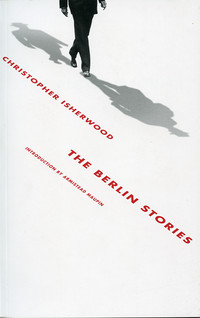
GER19 Matthew Gallaway reviews Christopher Isherwood's The Berlin Stories, in The Millions:

“I am a camera, with its shutter open, quite passive, recording, not thinking.” The year is 1930, and Christopher Isherwood, writing his “Berlin Diary,” is looking out his window at the “dirty plaster frontages” of houses “crammed with the tarnished valuables and second-hand furniture of a bankrupt middle class.” Which depending on your perspective may or may not sound disturbingly familiar 80 years later, as we too confront a society that seems plagued by a kind of decadence and political turmoil that makes the future feel very precarious, to say the least.

Obviously there are big differences between 1930s Berlin and the present state of affairs in say, New York City; in descriptions of Isherwood’s society (not that he ever used the word himself, as far I can tell), “decadence” is generally understood to refer to the let’s just say “adventurous” sexual mores that fell (and pretty much still fall) far outside the mainstream, to the transvestites, prostitutes, and burlesque performers who scraped out an existence in the underbelly of Berlin, whereas today’s brand of decadence seems more aptly to describe the material excesses of an upper class who think nothing of for example spending thousands of dollars on shoes while the rest of the country reels from debt and unemployment. Another difference is that we don’t have Nazis running around terrorizing the city (or at least not yet, lol?), whereas by the time Isherwood was writing, political strife in Berlin had already reached a point where the gangs of (unemployed) thugs who helped bring Hitler to power were regularly beating up (or worse) the Jews and communists who had the misfortune of attracting their attention.

From the Observatory

RV12AUG-BOOKS 10

In 1968, the Argentinian author Julio Cortázar was left astonished by Maharajah Jai Singh II’s astronomical observatories at Jaipur and New Delhi in India. While visiting them he took about 300 photographs of these mammoth structures built early in the 18th century; four years later he returned to the photographs to write the essayistic prose poem, From the Observatory. The book has now been rendered into English for the first time in a stunning translation by the talented Anne McLean, a two-time recipient of the prestigious Independent Foreign Fiction Prize for Translated Literature. From the Observatory brings to mind Friedrich Nietzsche’s declaration that the cosmos is “the primordial poem of mankind”. Nietzsche’s statement reflects the idea that culture is humanity’s “reading” of this primordial poem, as well as that the reality of the cosmos is something we must seek out. Both of these ideas are central to what Cortázar sets out to explore through his churning sentences.

more from Scott Esposito at The National here.

an intelligible vision

ImgCharles Taylor2

The philosopher Charles Taylor is a sadly endangered type: the philosopher-statesman. Born in Montreal in 1931, Taylor studied at McGill and Oxford, where he was a pupil of Isaiah Berlin and G.E.M. Anscombe. In 1961 he returned to his hometown to teach at McGill, and during the next decade he lost four races for the House of Commons, most notably in 1965 to future Prime Minister Pierre Trudeau. By the end of the decade, Taylor was sufficiently well-known as a politico that even his writing two successive books on Hegel could not tarnish his public reputation. Taylor later taught at Oxford, then McGill again, and more recently at Northwestern. Over the years his interests have shifted from analytic philosophy to the concrete political realm; he has made major contributions to the fields of human rights, multiculturalism and communitarianism. Taylor is particularly animated by the problem of Québécois nationalism, which concerns—and perhaps has determined—two of his chief sympathies: liberal democracy and multiculturalism, not just within societies but among them. Those sympathies conflict, of course. On the one hand, Taylor knows that liberal democracies are supposed to treat all people equally; on the other hand, he is sympathetic to his concitoyens’ desire for a French Quebec, an assertion of ethnic chauvinism that mandates legal privileges for one ethnic group and disabilities for another, such as the law prohibiting commercial signs in English.

more from Mark Oppenheimer at The Nation here.

mumford as homer

Atrestband

I grew up looking at Winslow Homer’s paintings and watercolors in Boston’s museums, and occasionally in New York’s Metropolitan Museum of Art; I loved their drama and their seemingly straightforward realism. What I found moving about Homer’s work was that it wasn’t directly about the morality of the Civil War, so much as it sought to recreate the experience of the soldiers. His art rarely read as propaganda. It showed the powerful bonding among men on the front lines, as well as the terror. Homer had experienced it and drawn it. It hit me unexpectedly that I could go to Iraq as an artist. By early 2003, it was already too late to be embedded, so I flew to Kuwait and haunted the fancier hotels until a couple of French journalists offered me a ride to Baghdad in their SUV. Recently, after many trips to Iraq, and with the country’s attention shifting to the worsening situation in Afghanistan, I joined the Marines in Helmand province to continue drawing America’s war zones.

more from Steve Mumford at Harper’s here.

Kashmir’s Raging Rivers

Jonathan Mingle in Slate:

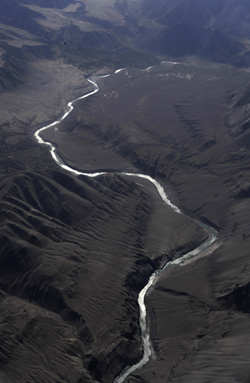
Kashmir Sixty years ago, David Lilienthal published an article in Collier's Weekly that would prove uncannily prescient. Lilienthal, former chairman of the Tennessee Valley Authority and the U.S. Atomic Energy Commission, had just returned from a visit to India and Pakistan and described two fledgling nations on the verge of another war over Kashmir. He made an unlikely suggestion to defuse tensions: The rivals should agree to manage jointly the Indus River and its main tributaries, some of which flowed through the contested region. Water, he claimed, was a hidden driver of South Asia's most dangerous territorial dispute and might also be the key to resolving it. While Lilienthal's vision was never fully realized, his article helped sow the seeds of the Indus Waters Treaty, now widely hailed as one of the most successful international water-sharing agreements.

Lilienthal recognized a truth that remains little discussed but as relevant as ever: The struggle for Kashmir was motivated in large part by Pakistan's desperation to control the rivers that flowed through the region. “The starting point should be … to set to rest Pakistan's fears of deprivation and a return to desert,” he wrote. The treaty would defuse these tensions at a critical point in the young nations' relations, by clearly spelling out how much water each was entitled to use from the rivers that crossed the western border. India and Pakistan signed the IWT in 1960, after protracted negotiations facilitated by the World Bank. Before the partition of British India in 1947, each province had jurisdiction to build dams and other infrastructure for electricity and irrigation on the portions of the rivers that flowed through their land; after partition, a series of patchwork agreements left several key issues, such as whether and how much Pakistan should pay India for water and canal maintenance costs, unresolved. The IWT gave “unrestricted use” of the basin's three western rivers (the Indus, the Jhelum, and the Chenab) to Pakistan and the three eastern rivers (the Ravi, the Beas, and the Sutlej) to India. Today, the treaty governs the use of roughly 55 trillion gallons of water per year, which sustains more than 210 million people in the basin.

More here.

Daily Red Meat Raises Risk for Diabetes

From Scientific American:

Red-meat-diabtetes_1 Sugary soda and other sweet treats are likely not the only foods to blame for the surge in diabetes across the U.S. New research out of Harvard University supports the theory that regular red meat consumption increases the risk of getting type 2 diabetes. An average of just one 85-gram (three-ounce) serving of unprocessed red meat—such as a medium hamburger or a small pork chop—per day increased by 12 percent the chances a person would get type 2 diabetes over the course of a decade or two. And if the meat was processed—such as a hot dog or two slices of bacon—the risk increased to 32 percent, even though serving sizes were smaller.

The new study, published online August 10 in the American Journal of Clinical Nutrition, is not the first to find the link between red meat and diabetes risk. But it is the largest and one of the first to look separately at unprocessed and processed meats. “On a gram-per-gram basis, unprocessed red meat is still better,” says Frank Hu, a professor of nutrition and epidemiology at the Harvard School of Public Health and co-author of the new paper. “But unprocessed red meat is still associated with a significantly increased risk.” More than 8.5 percent of U.S. adults have been diagnosed with diabetes, and in some counties in the so-called “diabetes belt” in the South, the numbers exceed 11.2 percent. The rates are expected to keep climbing in the coming years. Hu suggests that based on the analysis there is indeed a “disease burden that can be attributed to consumption of either processed or unprocessed red meat.”

More here.

Friday Poem

Sapphics Against Anger

Angered, may I be near a glass of water;
May my first impulse be to think of Silence,
Its deities (who are they? do, in fact, they
Exist? etc.).

May I recall what Aristotle says of
The subject: to give vent to rage is not to
Release it but to be increasingly prone
To its incursions.

May I imagine being in the Inferno,
Hearing it asked: “Virgilo mio, who's
That sulking with Achilles there?” and hearing
Virgil say: “Dante,

That fellow, at the slightest provocation
Slammed phone receivers down, and waved his arms like
A madman. What Atilla did to Europe,
What Genghis Khan did

To Asia, that poor dope did to his marriage.”
May I, that is, put learning to good purpose,
Mindful that melancholy is a sin, though
Stylish at present.

Better than rage is the post-dinner quiet,
The sink's warm turbulence, the streaming platters,
The suds rehearsing down the drain in spirals
In the last rinsing.

For what is, after all, the good life save that
Conducted thoughtfully, and what is passion
If not the holiest of powers, sustaining
Only if mastered.

by Timothy Steele
from Sapphics Against Anger, 1986

Thursday, August 11, 2011

Western Secularity

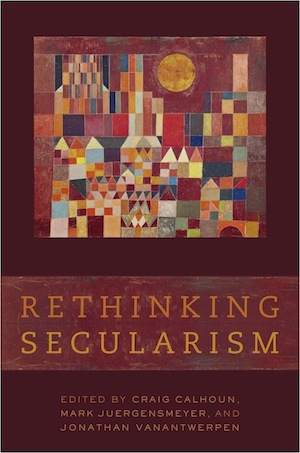
RethinkingSecularism An excerpt from Charles Taylor's piece in Rethinking Secularism, over at The Immanent Frame:

We live in a world in which ideas, institutions, artistic styles, and formulas for production and living circulate among societies and civilizations that are very different in their historical roots and traditional forms. Parliamentary democracy spread outward from England, among other countries, to India; likewise, the practice of nonviolent civil disobedience spread from its origins in the struggle for Indian independence to many other places, including the United States with Martin Luther King Jr. and the civil rights movement, Manila in 1983, and the Velvet and Orange Revolutions of our time.

But these ideas and forms of practice don’t just change place as solid blocks; they are modified, reinterpreted, given new meanings, in each transfer. This can lead to tremendous confusion when we try to follow these shifts and understand them. One such confusion comes from taking a word itself too seriously; the name may be the same, but the reality will often be different.

This is evident in the case of the word “secular.” We think of “secularization” as a selfsame process that can occur anywhere (and, according to some people, is occurring everywhere). And we think of secularist regimes as an option for any country, whether or not they are actually adopted. And certainly, these words crop up everywhere. But do they really mean the same thing in each iteration? Are there not, rather, subtle differences, which can bedevil cross-cultural discussions of these matters?

Is That All There Is? Secularism and its Discontents

110815_r21170_p465 James Wood in The New Yorker:

I have a friend, an analytic philosopher and convinced atheist, who told me that she sometimes wakes in the middle of the night, anxiously turning over a series of ultimate questions: “How can it be that this world is the result of an accidental big bang? How could there be no design, no metaphysical purpose? Can it be that every life—beginning with my own, my husband’s, my child’s, and spreading outward—is cosmically irrelevant?” In the current intellectual climate, atheists are not supposed to have such thoughts. We are locked into our rival certainties—religiosity on one side, secularism on the other—and to confess to weakness on this order is like a registered Democrat wondering if she is really a Republican, or vice versa.

These are theological questions without theological answers, and, if the atheist is not supposed to entertain them, then, for slightly different reasons, neither is the religious believer. Religion assumes that they are not valid questions because it has already answered them; atheism assumes that they are not valid questions because it cannot answer them. But as one gets older, and parents and peers begin to die, and the obituaries in the newspaper are no longer missives from a faraway place but local letters, and one’s own projects seem ever more pointless and ephemeral, such moments of terror and incomprehension seem more frequent and more piercing, and, I find, as likely to arise in the middle of the day as the night. I think of these anxieties as the Virginia Woolf Question, after a passage in that most metaphysical of novels “To the Lighthouse,” when the painter Lily Briscoe is at her easel, mourning her late friend Mrs. Ramsay. Next to her sits the poet, Augustus Carmichael, and suddenly Lily imagines that she and Mr. Carmichael might stand up and demand “an explanation” of life:

For one moment she felt that if they both got up, here, now on the lawn, and demanded an explanation, why was it so short, why was it so inexplicable, said it with violence, as two fully equipped human beings from whom nothing should be hid might speak, then, beauty would roll itself up; the space would fill; those empty flourishes would form into shape; if they shouted loud enough Mrs. Ramsay would return. “Mrs. Ramsay!” she said aloud, “Mrs. Ramsay!” The tears ran down her face.

Why is life so short, why so inexplicable? These are the questions Lily wants answered. More precisely, these are the questions she needs to ask, ironically aware that an answer cannot be had if there is no one to demand it from. We may hope that “nothing should be hid” from us, but certain explanations can only ever be hidden. Just as Mrs. Ramsay has died, and cannot be shouted back to life, so God is dead, and cannot be reimplored into existence. And, as Terrence Malick’s oddly beautiful film “The Tree of Life” reminds us, the answers are still hidden even if we believe in God. Lily Briscoe’s “Why?” is not very different from Job’s “Why, Lord?”

Animal’s Genetic Code Redesigned

_54557832_nematode Roland Pease in the BBC:

Researchers say they have created the first ever animal with artificial information in its genetic code.

The technique, they say, could give biologists “atom-by-atom control” over the molecules in living organisms.

One expert the BBC spoke to agrees, saying the technique would be seized upon by “the entire biology community”.

The work by a Cambridge University team, which used nematode worms, appears in the Journal of the American Chemical Society.

The worms – from the species Caenorhabditis elegans – are 1mm long, with just a thousand cells in their transparent bodies.

What makes the newly created animals different is that their genetic code has been extended to create biological molecules not known in the natural world.

Genes are the DNA blueprints that enable living organisms to construct their biological machinery, protein molecules, out of strings of simpler building blocks called amino acids.

Just 20 amino acids are used in natural living organisms, assembled in different combinations to make the tens of thousands of different proteins needed to sustain life.

The EU: The real sick man of Europe?

Vienna_2011_2_468x115 Therese Kaufmann, Ivan Krastev, Claus Offe, Sonja Puntscher-Riekmann,and Martin M. Simecka in Eurozine:

Therese Kaufmann: Martin Simecka, you once said that the biggest political moment for Slovakia was not 1989 but 1998, referring to a moment in Slovakian political history when the nationalist authoritarian government of Vladimir Meciar fell. You have also said that this political change was the result of a combined effort of many different groups in Slovak society: intellectuals, NGOs, media, politicians and diplomats. What is necessary for political transformation? Can Europe learn something from the Slovakian experience?

Martin Simecka: Sometimes I feel like an expert not on integration but on disintegration. I was part of the movement that brought about the disintegration of the communist empire in 1989; then I was a very sad witness to the disintegration of Czechoslovakia in 1992; and then again of a much happier event, the disintegration of Meciar's authoritarian regime in 1998. What I have learned from all this is that it's all about ideas. The communist system collapsed because it no longer had an idea of its own future. Czechoslovakia dissolved because it didn't believe in its own future. Meciar fell because society believed in ideas that were stronger and more powerful than that of his regime. In 1998 it was not only about getting rid of Meciar, it was also about becoming a part of the European Union. There was a vision for the country.

The current problem with the EU has to do with ideas. The idea of European integration has been driven by the past; by the horrors of WWII, by the Holocaust, by a long history of conflict. Today, the idea of the EU is instead driven by the future – but in a bad sense. If previously it was fear of repeating the past that pushed European integration forward and furthered peace and prosperity, today European policies are driven by fear of the future. We are afraid of increasing migration, of the consequences of the financial crisis. The future is not something that we believe in; we are afraid of it.

Not artist addicts. Not special addicts. Not entitled-to-use addicts.

Winehouse3

To the surprise of no one with the slightest sense of irony, singer Amy Winehouse, who earned a spot on iPods everywhere for saying no, no, no to rehab, died last weekend of an apparent overdose. Earlier this year, two other (less famous) celebrities, alumni of Dr. Drew Pinsky’s “Celebrity Rehab,” also died unsurprisingly from presumed overdoses: Mike Starr and Jeff Conway. Starr, formerly of the band Alice in Chains, had at one point achieved six months clean—an eternity in sobriety; but, then, it’s an insidious thing, this disease. And, lately, so is the response to it. Over on The Huffington Post, Charles Karel Bouley (“KGO Radio and Syndicated Host, Stand Up, Entertainer, Author, Actor, Dog Walker”—who doesn’t blog for HuffPo?) spends many thousands of words pondering the cruelty of the “general public” who “pass judgment on Winehouse, or any of the other host of celebrities that left too soon because of drugs, alcohol, fast cars or a myriad of other ways to die.” Let’s break that down: We, the general public, are chastised for our—un-cited—judgments of Winehouse and those other celebrities who died in, well, myriad other ways. “Those critics are not artists,” he huffs. How perfectly annoying. It’s bad enough that Bouley cannot produce one example of this supposed mass intolerance of fast cars (?!) and the like, but then he has the gall to be callous toward the “general public”—none of whom, apparently, are artists. Talk about passing judgment. “What we really should be asking,” Bouley declares, “is, why artists?”

more from Sacha Z. Scoblic at TNR here.

humanism

PicoUffizi

When we worry about machines replacing human beings, we are focused more on these alien robots than on mimetic replicants. Yet the programming of robots can, as the engineer Cecil Balmont observes, make their proper use obscure and dysfunctional, just because we have no guiding measure of what they should do for us. Neither Lanier nor Balmont are back-to-Nature romantics; they are raising questions of purpose and value in the design of machines, questions they think can only be answered by returning to the human subject. It is exactly the same question technicians in Spinoza’s generation posed about the value of the double concave lens he was a master in fabricating. I have wanted, in sum, to explain in this essay why the label “humanist” is a badge of honor, rather than the name for an exhausted worldview. Humanism’s emphasis on life-narratives, on the enriching experience of difference, and on evaluating tools in terms of human rather than mechanical complexity are all living values—and more, I would say, these are critical measures for judging the state of modern society. Looking back to the origins of these values is not an exercise in nostalgia; it is rather to remind us that we are engaged in a project, still in process, a humanism yet to be realized, of making social experience more open, engaging, and layered.

more from Richard Sennett at The Hedgehog Review here.

What distinguishes humans from animals?

TLS_McDonald_739473a

In 1386, the northern French town of Falaise witnessed an extraordinary trial – extraordinary to the modern mind, at least. A pig, “a sow of three years or thereabouts”, was arrested, held captive, tried in the local court by lawyers and magistrates, found guilty, sentenced, and finally executed for the crime of attacking a child, specifically of having “eaten the face” (mangé le visage) of a swaddled human baby. The infant died; the animal was dragged through the streets and hanged by the town’s “master of high works”, whose receipt for his fee is extant. Apparently the practice of subjecting animals to criminal prosecution, originating in France, spread to neighbouring countries and persisted for centuries, the last recorded case in Europe occurring in 1906. The episode of the homicidal sow is one of the multiple bits of zoographic evidence that informs Stage, Stake, and Scaffold, Andreas Höfele’s sophisticated study of how early modern Europeans conceived of the human being in relation to other species. Recently, Erica Fudge, Laurie Shannon and, more generally, Martha Nussbaum, Cary Wolfe and Giorgio Agamben have endeavoured to reappraise the category of Homo sapiens in different historical eras. Höfele extends their discussion by linking the early modern stage, the bear pit, and the executioner’s arena, thus addressing taxonomic questions such as: what do humans have in common with animals? What distinguishes humans from animals?

more from Russ McDonald at the TLS here.

Harvey Preisler Memorial Symposium: Dr. J. Craig Venter

As many of you know, my sister Azra has established an annual lecture in memory of her late husband Harvey. While attendance is generally by invitation only, once again I thank Azra for generously providing one hundred seats for 3QD readers. If you (and up to three guests) would like to attend the lecture, RSVP by providing your name in the comments area of this post so that you can be added to the guest list. The first 100 people to respond will be able to come. I am happy to say that my wife and I will also be there this year.

The Ninth
HARVEY PREISLER
Memorial Symposium
Saturday, August 13, 2011
9:00 a.m. to 12:00 p.m.

Dr. J. Craig Venter: From Reading to Writing the Genetic Code

Columbia University Medical Center
Myrna L. Daniels Auditorium
Vivian & Seymour Milstein Family Heart Center
173 Fort Washington Avenue
New York, NY 10032

9:00 am: Reception

9:30 am: Welcome of the honored guests and tribute to Harvey Preisler by
Sheherzad Raza Preisler

9:45 am: Introduction of Dr. J. Craig Venter by Azra Raza

10:00 am: Dr. J. Craig Venter

11:00 am: Questions and Discussion

ScreenHunter_01 Jul. 28 10.38 Harvey David Preisler, M.D., Director of Rush Cancer Institute and the Samuel G. Taylor III Professor of Medicine at Rush University, Chicago, died on May 19th 2002. The cause of death was lymphoma. Dr. Preisler grew up in Brooklyn, New York, and obtained his medical degree from the University of Rochester, NY in 1965. He trained in Medicine at New York Hospitals, Cornell Medical Center, and in Medical Oncology at the National Cancer Institute and Columbia Presbyterian Hospital in NYC. He then joined Mount Sinai hospital in NY, and subsequently moved to Roswell Park Cancer Institute in Buffalo, NY to direct the Leukemia Service there for the next 14 years. Dr. Preisler was recruited to Rush University as Director of the Cancer Institute in 1992. At the time of his death, he was the Principal Investigator of a ten million dollar grant from the National Cancer Institute in addition to several other large grants which funded his independent research laboratory with approximately 25 scientists. He published extensively including more than 350 full-length papers in peer reviewed journals, 50 books and/or book chapters and approximately 400 abstracts. He was married to Azra Raza, M.D.

A longer tribute to Harvey by Azra: http://3quarksdaily.blogs.com/3quarksdaily/2006/05/rx_harvey_david.html

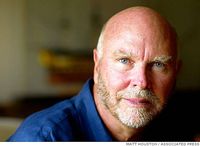
Dd-catchingup11__0497970082 J. Craig Venter is a biologist most known for his contributions, in 2001, of sequencing the first draft human genome and in 2007 for the first complete diploid human genome. In 2010 he and his team announced success in constructing the first synthetic bacterial cell. He is a founder and president of the J. Craig Venter Institute (JCVI) and founder and CEO of the company, Synthetic Genomics Inc (JCVI). His present work focuses on creating synthetic biological organisms and applications of this work, and discovering genetic diversity in the world's oceans. Dr. Venter is a 2008 National Medal of Science recipient and is a member of the National Academy of Sciences. He is the author of A Life Decoded: My Genome: My Life (Viking, 2007).

“A Broken Britain”: England’s novelists and filmmakers saw the riots coming. Why didn’t its politicians?

Tom Rachman in Slate:

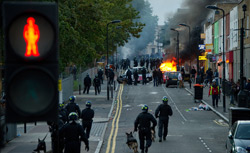
London After days of rioting during which thugs often appeared more confident in the streets than the police trying to stop them, Britain was in a state of shock and trauma at this astonishing loss of control. A lockdown Tuesday night in London involving 10,000 additional police officers appeared to have restored order to the capital, but violence flared in other cities. By Wednesday morning, the authorities had reported a total of 1,335 arrests, including more than 750 in London and 300 in Manchester.

…The political class may have been caught out, but the culture betrayed signs of problems earlier, telegraphing anxieties of the law-abiding citizenry that a brutal underclass might at any moment elbow its way into their homes. Ian McEwan's 2005 novel Saturday tells of a London neurosurgeon who crosses paths with a demented thug, only to have the man invade his life and threaten his family. The book's resolution is rather optimistic, with the surgeon's daughter—forced to strip before the thug—managing to subdue him by reading poetry. Another example of these lurking worries appears in David Abbott's 2010 novel The Upright Piano Player, in which a lonely retired London ad executive is harassed by a violent sociopath, also after an unfortunate chance encounter. A more cathartic resolution came in the 2009 film Harry Brown, in which Michael Caine plays an aging military veteran who served in Northern Ireland but now finds himself in a miserable housing estate ruled by young criminals. Bloodshed ensues and the old man emerges triumphant. While novels and cinema expressed the fears of establishment Britons, pop culture was taking inspiration from the underclass, as in the comedy-drama series Shameless (now remade in a U.S. version), about a dysfunctional family in Manchester.

More here.

‘Amazing’ therapy wipes out leukemia in study

From AP News:

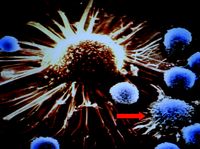
Killers NEW YORK (AP) – Scientists are reporting the first clear success with a new approach for treating leukemia – turning the patients' own blood cells into assassins that hunt and destroy their cancer cells. They've only done it in three patients so far, but the results were striking: Two appear cancer-free up to a year after treatment, and the third patient is improved but still has some cancer. Scientists are already preparing to try the same gene therapy technique for other kinds of cancer. “It worked great. We were surprised it worked as well as it did,” said Dr. Carl June, a gene therapy expert at the University of Pennsylvania. “We're just a year out now. We need to find out how long these remissions last.” He led the study, published Wednesday by two journals, New England Journal of Medicine and Science Translational Medicine. It involved three men with very advanced cases of chronic lymphocytic leukemia, or CLL. The only hope for a cure now is bone marrow or stem cell transplants, which don't always work and carry a high risk of death.

Dr. Kanti Rai, a blood cancer expert at New York's Long Island Jewish Medical Center, could hardly contain his enthusiasm, saying he usually is more reserved in his comments on such reports. “It's an amazing, amazing kind of achievement,” said Rai, who had no role in the research.

More here. (Note: Thanks to Akbi who read the news even before I did!)