
[Thanks to Fawzia Naqvi.]
Category: Recommended Reading
California Girls
Zan Romanoff in The Paris Review:
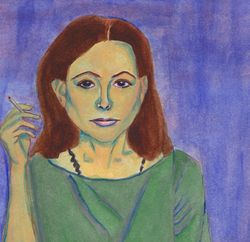
I made plans to leave, applied to colleges anywhere but here and talked about needing to meet people who hadn’t grown up in California. We were a breed apart, I imagined, all of us sun-addled, complacent, with our surfer-inflected drawls. (It took me years to properly recognize my own accent; sometimes I think it gets stronger the longer I stay away, yearning for home, stretching and flattening my vowels: “Oh fer suuure.”) We had grown up in a balmy, flattering climate on land that always threatened disaster. The calm that came from being raised in an unstable paradise was too much for me. I wanted to meet my neurotic people. I wanted to go east and get cold. Of course, no one knows this better than Joan Didion. She loves the state as only its exiles can; she recognizes that California is a land for the stupid and beautiful and she knows that there is still a romance to it that, even if you are not stupid or beautiful, makes you wish to belong.
More here.
A Novel of Grief, Memorials and a Muslim Architect in Post-9/11 America
From The New York Times:

“The Submission” is set not in 2010 but in 2003, and concerns not a mosque but a 9/11 memorial. A jury, assembled by the state’s governor, has spent months reviewing architects’ anonymous submissions for a monument to be built on the site of the tragedy. Finally, a winner is selected: the design is called “The Garden” (in contrast with the other finalist, “The Void”), and its detractors can fault it only for being “too beautiful.” But once the choice is settled and a name attached to the blueprints, the jury discovers, to its alarm, that the architect is a Muslim named Mohammad Khan.
More here.
E-Biographies: the Logical Response to Fifteen Minutes of Fame?
Charles J. Shields in Writing Kurt Vonnegut: A Biographer's Notebook:

It isn’t hard to do. Between 1998-2002, I wrote 20 biographies and histories for young people, each about 20,000 words. I never left my study. All were researched on the Internet. I never interviewed anyone.
But they were solid, fact-filled, and readable (not a single one came back for a revision). I wrote the first biography for youngsters of J. K. Rowling. Martha Stewart: Woman of Achievement was reviewed in the Atlantic (my editor, a catty woman, sent me a tear sheet with “Charles, you’re famous” written at the top).
“Charles J. Shields,” wrote Caitlin Flanagan, “…trots us through the high points of Stewart’s early life and career in short order, making astute observations as to how these various experiences may have shaped her as a businesswoman. Compared with [Christopher] Byron’s fervid ramblings [Martha, Inc., written for adults], this clear analysis is a welcome relief.”
The Martha book, at 112 pages to Byron’s 406, was so popular that it was available only on rental shelves in some public libraries. It’s still in print. I wrote it as a work-for-hire and was paid a flat fee of $3,000, and never received any royalties.
More here.
Saturday Poem
Now I am no longer I, and you are not you.
—Yehuda Amichai
You and I
That old keepsake of yours, the troll-face
doll stares at me from across the room.
I am in its gaze, unable to avoid the wicked grin.
The heating system makes cooling-down noises.
We doze and dream. There is no connection
between the dream and what happens in life.
The drumbeat walk of rain on the roof
keeps a steady rhythm, like afterhours music.
Soon the gale will be everywhere –
it can pass through the eye of a needle
or move heaven nearer to earth.
Once more the quieter sounds strive to be heard:
skinflakes dropping, soapy water dripping
from dresses and shirts. We lie still expecting a pause
in the movement that carries life forward.
by Gerard Smyth
from Daytime Sleeper
publisher: Dedalus, Dublin, 2002
Friday, August 19, 2011
RSA Animate – Smile or Die
The Troubled Life of Nim Chimpsky
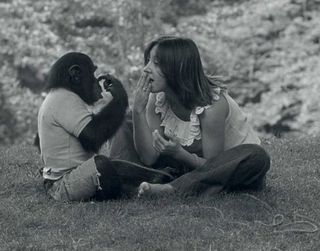
Perhaps Herbert Terrace, professor of psychology at Columbia University, and director of the experiment that is the subject of Project Nim, a new documentary by James Marsh, never read The Little Prince. The sad story of Terrace’s irresponsible treatment of Nim, the chimp he tamed—or more strictly, whose upbringing in a human family he organized—is the guiding thread of this revealing film, which raises important issues about the distinction between humans and animals, about our attitudes toward animals, and about scientific objectivity (or the lack thereof) in behavioral research.
Nim was born in a primate research center in Norman, Oklahoma. His mother, Caroline, was treated as a breeding machine—all her babies were taken from her for use in experiments. She knew the routine well enough to turn her back to humans as soon as her baby was born, presumably hoping that they would not notice him. But how can a chimpanzee hide her baby, when she lives in a bare cage? Nim was taken from her a few days after his birth, to be used in Terrace’s experiment testing whether sign language could be taught to a chimpanzee. (His full name, Nim Chimpsky, was a play on the name of the linguist Noam Chomsky, who had suggested that only humans have the ability to learn language.)
The film, which draws on Elizabeth Hess’s fine book Nim Chimpsky, overplays the novelty and significance of Terrace’s research. It neglects the real pioneers in this field, the psychologist Keith Hayes and his wife Cathy, who in the 1950s tried to raise a chimpanzee called Vicki as a child, to see if she would learn to speak. The attempt failed, but in 1966 another pair of psychologists, Beatrix and Allen Gardner grasped that the failure may simply have been due to the inadequacies of chimpanzee vocal chords for forming words. They therefore brought up an infant chimpanzee, Washoe, in their own home, using American Sign Language to communicate not only with Washoe, but, when Washoe was present, with each other. Washoe learned many signs, using them singly and in combinations that appeared to be sentences. She even invented some of her own terms, like “candy fruit” for watermelon.
Notes from the Egyptian Revolution
A Tale of Two Undergrounds

Ever since reading Jennifer Toth’s The Mole People as a teen, I’ve been intrigued by the metropolitan underground. Cities teem with life, and change happens at a dizzying pace. But what lurks beneath the streets remains a mystery to many—it almost remains a realm lost to time. Yet, to think of this space as stagnant would be foolish: from Paris to New York City, the subterranean has a life and character all of its own. And if you look closely, you’ll find traces of the urban centers on the surface—almost as though these spaces contain seeds of the personalities that thrive above ground.
National Geographic’s Neil Shea did a sweeping tour of the Parisian underground, covering everything from the catacombs to the old quarries to the hand carved party rooms inhabited by cataphiles—”people who love the Paris underground.” There are all sorts of spaces to be found beneath Paris—canals and reservoirs, crypts, bank vaults, wine cellars, quarries—and cataphiles claim them to party, perform, create artwork, do drugs and more. They explore, hook up, educate, and claim these forgotten places. They map them and create records though it seems that these spaces exist on the periphery of the surface world, which seems odd when you consider how much of the metropolis is drawn from the underground.
Society Without Solidarity

In August 2011, smashing up stuff, and stealing it, was what defined the mayhem. In the 1980s, people living in Brixton, Tottenham, Handsworth and Toxteth, in the very places wrecked by the disorders, nevertheless supported the rioters. They recognized that the violence and the destruction were not ends in themselves but part of a necessary challenge to an oppressive system. Today, the fiercest opposition to the rioters comes from those who live in the areas they have trashed. There is real rage in these areas against the orgy of destruction.
Many on the Left, while condemning the riots, argue that they are nevertheless protests against poverty and social exclusion. “Many of the people involved,” the criminologist professor John Pitts suggested, “are likely to have been from low-income, high-unemployment estates, and many, if not most, do not have much of a legitimate future.” Many, such as former London mayor Ken Livingstone, have blamed the riots on the public expenditure cuts introduced by the current Coalition government.
There is little doubt that poverty and joblessness scar large areas of Britain and that the vicious public spending cuts will vastly exacerbate the problem. Tottenham, for instance, where the first riots broke out, is among London's poorest boroughs, with 54 applicants chasing every registered job vacancy. Britain is less equal, in wages, wealth and life chances, than at any time for a century. A map of the London riots matches almost exactly the map of the most deprived areas in London.
And yet, it is difficult to view the rioters simply as members of an “underclass”.
Friday Poem
.
I reel off a small revolution
I reel off a small lovely revolution
I am no longer of land
I am water again
I carry foaming crests on my head
I carry shooting shadows in my head
on my back rests a mermaid
on my back rests the wind
the wind and the mermaid sing
the foaming crests murmur
the shooting shadows fall
I reel off a small revolution
I reel off a small lovely revolution
I am no longer of land
I am water again
I carry foaming crests on my head
I carry shooting shadows in my head
on my back rests a mermaid
on my back rests the wind
the wind and the mermaid sing
the foaming crests murmur
the shooting shadows fall
I reel off a small lovely rustling revolution
and I fall and I murmur and I sing
by Lucebert (Lubertus Jacobus Swaanswijk)
from Verzamelde Gedichten
publisher De Bezige Bij, Amsterdam, 2002
© Translation: 2011, Diane Butterman
ik draai een kleine revolutie af
ik draai een kleine mooie revolutie af
ik ben niet langer van land
ik ben weer water
ik draag schuimende koppen op mijn hoofd
ik draag schietende schimmen in mijn hoofd
op mijn rug rust een zeemeermin
op mijn rug rust de wind
de wind en de zeemeermin zingen
de schuimende koppen ruisen
de schietende schimmen vallen
ik draai een kleine mooie revolutie af
ik ben niet langer van land
ik ben weer water
ik draag schuimende koppen op mijn hoofd
ik draag schietende schimmen in mijn hoofd
op mijn rug rust een zeemeermin
op mijn rug rust de wind
de wind en de zeemeermin zingen
de schuimende koppen ruisen
de schietende schimmen vallen
ik draai een kleine mooie ritselende revolutie af
en ik val en ik ruis en ik zing
van Lucebert
The other George Orwell
From The Telegraph:

Although it’s Orwell’s adopted son Richard, now in his late sixties, who bears his father’s family name, the trio – the offspring of Orwell’s eldest sister Marjorie and her husband Humphrey, a civil servant – are his closest surviving blood relatives. It’s hard not to detect, or possibly project, inherited traits as they chat over coffee: in Morgan’s writerly turn of phrase and spirited determination, in Dakin’s wry, often detached manner, and in the refined, hooded shape of Bestley’s twinkling eyes. It’s incredible to hear first-hand the stories handed on to biographers over the years, especially their experiences on the Scottish west-coast island of Jura, where Orwell lived in frugal isolation and growing ill health with his younger sister Avril while working on Nineteen Eighty-Four. The notorious episode in August 1947, when Orwell’s boat capsized at the Corryvreckan whirlpool, nearly drowning him and Dakin, then 21, Bestley, only 16, and Richard, just three – is relived with much laughter at their uncle’s expense.
More here.
Same-Sex Finch Couples Form Strong Bonds
From Smithsonian:

Researchers raised groups of zebra finches in same-sex groups, all male and all female, and in each group the majority of birds paired up. They interacted frequently and often preened their partners. And they weren’t aggressive to each other as they were to other birds in the group. These are all characteristics found in heterosexual finch couples.
More here.
Thursday, August 18, 2011
Charles Proteus Steinmetz, the Wizard of Schenectady
Gilbert King at Smithsonian:
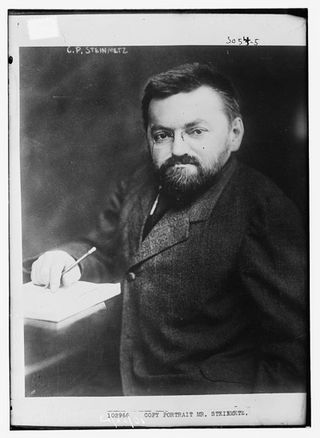
In the early 20th century, Charles Steinmetz could be seen peddling pedaling his bicycle down the streets of Schenectady, New York, in a suit and top hat, or floating down the Mohawk River in a canoe, kneeling over a makeshift desktop, where he passed hours scribbling notes and equations on papers that sometimes blew into the water. With a Blackstone panatela cigar seemingly glued to his lips, Steinmetz cringed as children scurried away upon seeing him—frightened, he believed, by the “queer, gnome-like figure” with the German accent. Such occurrences were all the more painful for Steinmetz, as it was a family and children that he longed for most in his life. But knowing that his deformity was congenital (both his father and grandfather were afflicted with kyphosis, an abnormal curvature of the upper spine), Steinmetz chose not to marry, fearful of passing on his deformity.
Born in 1865 in Breslau, Germany (now Wroclaw, Poland), Carl August Rudolph Steinmetz became a brilliant student of mathematics and chemistry at the University of Breslau, but he was forced to flee the country after the authorities became interested in his involvement with the Socialist Party. He arrived at Ellis Island in 1888 and was nearly turned away because he was a dwarf, but an American friend whom Steinmetz was traveling with convinced immigration officials that the young German Ph.D. was a genius whose presence would someday benefit all of America. In just a few years, Steinmetz would prove his American friend right.
More here.
Who Will Save Libya From Its Western Saviours?
Jean Bricmont and Diana Johnstone in CounterPunch:

On March 17, the UN Security Council adopted Resolution 1973 which gave that particular “coalition of the willing” the green light to start their little war by securing control of Libyan air space, which was subsequently used to bomb whatever NATO chose to bomb. The coalition leaders clearly expected the grateful citizens to take advantage of this vigorous “protection” to overthrow Moammer Gaddafi who allegedly wanted to “kill his own people”. Based on the assumption that Libya was neatly divided between “the people” on one side and the “evil dictator” on the other, this overthrow was expected to occur within days. In Western eyes, Gaddafi was a worse dictator than Tunisia’s Ben Ali or Egypt’s Mubarak, who fell without NATO intervention, so Gaddafi should have fallen that much faster.
Five months later, all the assumptions on which the war was based have proved to be more or less false. Human rights organizations have failed to find evidence of the “crimes against humanity” allegedly ordered by Gaddafi against “his own people”. The recognition of the Transitional National Council (TNC) as the “sole legitimate representative of the Libyan people” by Western governments has gone from premature to grotesque. NATO has entered and exacerbated a civil war that looks like a stalemate.
But however groundless and absurd the war turns out to be, on it goes. And what can stop it?
More here.
Shade Illusion
Augmented communication at the Museum of Modern Art
Our own Morgan Meis in The Smart Set:

In recent decades, the “form follows function” credo has been challenged from all sides. The pure pragmatism of the credo now seems insufficient to the depth and complexity of our relationship to things. A contemporary person's interaction with manufactured things goes beyond the utilitarian. Here's something Paola Antonelli (a senior curator the Museum of Modern Art’s Department of Architecture and Design) wrote in her essay for the new MoMA show about contemporary design, “Talk to Me:” “The bond between people and things has always been filled with powerful and unspoken sentiments going well beyond functional expectations and including attachment, love, possessiveness, jealousy, pride, curiosity, anger, even friendship and partnership — think of the bond between a chef and his knives.” According to Antonelli, it has always been the case that the functionalist approach to design leaves behind the important bond between people and things. Recent developments in technology and design scream out that truth all the more.
More here.
mouse utopia

How do you design a utopia? In 1972, John B. Calhoun detailed the specifications of his Mortality-Inhibiting Environment for Mice: a practical utopia built in the laboratory. Every aspect of Universe 25—as this particular model was called—was pitched to cater for the well-being of its rodent residents and increase their lifespan. The Universe took the form of a tank, 101 inches square, enclosed by walls 54 inches high. The first 37 inches of wall was structured so the mice could climb up, but they were prevented from escaping by 17 inches of bare wall above. Each wall had sixteen vertical mesh tunnels—call them stairwells—soldered to it. Four horizontal corridors opened off each stairwell, each leading to four nesting boxes. That means 256 boxes in total, each capable of housing fifteen mice. There was abundant clean food, water, and nesting material. The Universe was cleaned every four to eight weeks. There were no predators, the temperature was kept at a steady 68°F, and the mice were a disease-free elite selected from the National Institutes of Health’s breeding colony. Heaven. Four breeding pairs of mice were moved in on day one. After 104 days of upheaval as they familiarized themselves with their new world, they started to reproduce. In their fully catered paradise, the population increased exponentially, doubling every fifty-five days. Those were the good times, as the mice feasted on the fruited plain. To its members, the mouse civilization of Universe 25 must have seemed prosperous indeed. But its downfall was already certain—not just stagnation, but total and inevitable destruction.
more from Will Wiles at Cabinet here.
Self Study
Natalie Abbasi in Guernica:
In each image I’ve incorporated myself twice, once as the Iranian and once as the American.

More here.
Computational method predicts new uses for existing medicines
From PhysOrg:

The scientists drew their data from the NIH National Center for Biotechnology Information Gene Expression Omnibus, a publicly available database that contains the results of thousands of genomic studies on a wide range of topics, submitted by researchers across the globe. The resource catalogs changes in gene activity under various conditions, such as in diseased tissues or in response to medications. Butte's group focused on 100 diseases and 164 drugs. They created a computer program to search through the thousands of possible drug-disease combinations to find drugs and diseases whose gene expression patterns essentially cancelled each other out. For example, if a disease increased the activity of certain genes, the program tried to match it with one or more drugs that decreased the activity of those genes. Many of the drug-disease matches were known, and are already in clinical use, supporting the validity of the approach. For example, the analysis correctly predicted that prednisolone could treat Crohn's disease, a condition for which it is a standard therapy.
More here.