Paula Findlen in The Nation:


Paula Findlen in The Nation:
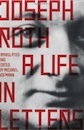
“I can’t give up either humanity or freedom,” Joseph Roth announced in a 1935 letter to fellow Austrian novelist Stefan Zweig. Freedom was the right to fit all his possessions into two suitcases and to live in hotels; to move in a single year from Austria to Germany to France to Russia; to have no address and no bank account. He was married, to a woman committed to a mental asylum, and he had a long-term mistress. But he avoided “cooking smells and ‘family life'”. “I shit on furniture. I hate houses.” He nevertheless felt a duty to support these women, along with their parents and children. Roth was often penniless but he still shared what money he had with eight others. On a wider scale, freedom was the license to spurn friends or nations lacking in humanity. Roth was living in Germany in 1933, but the day that Hitler became chancellor he left and never returned. “What divides me from everyone, without a single exception, who is active in Germany,” he told the more accommodating Zweig, “is precisely what divides a human from an animal”.
more from Lara Feigel at The Guardian here.
What makes a book a gay book, or a writer a gay writer? Walt Whitman, for all his sizzling erotic verses about men, insisted to the end that he was interested only in women. Gore Vidal, who has made no secret of his attraction to men, writes sparingly about gay characters and has asserted that there is no such thing as a homosexual, only homosexual acts. James Baldwin’s novels typically repose on bookstores’ African-American shelves, rather than their gay and lesbian sections — even “Giovanni’s Room,” which centers on a relationship between two white men. Christopher Bram, who calls himself a gay novelist (his “Father of Frankenstein” was the basis of the movie “Gods and Monsters”), assumes the task of herding the gay American male writers who emerged after World War II into a coherent history, beginning with the coded innuendo of Tennessee Williams’s “Glass Menagerie” in 1944 and peaking with Tony Kushner’s luminescent “Angels in America” in 1991. In between, Bram writes, a growing stream of gay-themed novels, plays and poems, some bolder than others, prefigured or hastened sweeping changes in the culture at large. “The gay revolution,” he writes, “began as a literary revolution.”
more from John Leland at the NY Times here.
From NOW:
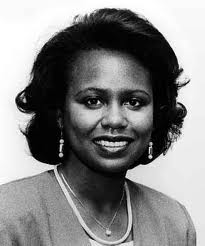
When the nomination moved to the floor of the Senate, it took a sudden and dramatic turn when Anita Hill, a law professor at the University of Oklahoma, came forward with accusations that Clarence Thomas had sexually harassed her. Hill had worked for Thomas years earlier when he was head of the Equal Employment Opportunities Commission. Hill charged that Thomas harassed her with inappropriate discussion of sexual acts and pornographic films after she rebuffed his invitations to date him. A media frenzy quickly arose around Hill's allegations and Thomas's denials. When Thomas testified about Hill's claims before the Senate Judiciary Committee, he called the hearings, “a high-tech lynching for uppity Blacks.” The incident became one person's word against another's. In the end, the Senate voted 52-48 to confirm Clarence Thomas as associate justice of the Supreme Court. To the many people who believed Anita Hill's claims or opposed the Thomas nomination on other grounds, Thomas's appointment was a defeat. Yet, the Anita Hill-Clarence Thomas controversy had other long-term consequences beyond Justice Thomas's life-term on the Supreme Court. Foremost, national awareness about sexual harassment in the workplace heightened considerably. According to Equal Employment Opportunity Commission filings, sexual harassment cases have more than doubled, from 6,127 in 1991 to 15,342 in 1996. Over the same period, awards to victims under federal laws nearly quadrupled, from $7.7 million to $27.8 million. Another repercussion of the Hill-Thomas controversy was the increased involvement of women in politics. The media heralded the 1992 election year as the “Year of the Woman” when a record number of women ran for public office and won. In the U.S. Senate, eleven women ran and five won seats–including one incumbent candidate. In the House of Representatives, twenty-four women won new seats. Many commentators saw this increase as a direct reaction to the Thomas nomination. His appointment dismayed many women, who felt that Anita Hill's allegations were not taken seriously by a Senate that was 98% male.
In the end, the Anita Hill-Clarence Thomas controversy acted as a flash point that illuminated many of the central tensions of life in late twentieth-century America.
More here. (Note: In honor of African American History Month, we will be linking to at least one related post throughout February. The 2012 theme is Black Women in American Culture and History).
Jennifer McDonald in The New York Times:
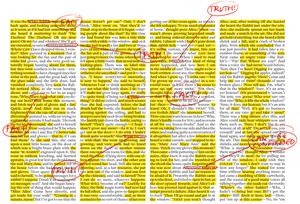
This is so liberating!
Under consideration in this essay is “The Lifespan of a Fact,” which is less a book than a knock-down, drag-out fight between two tenacious combatants, over questions of truth, belief, history, myth, memory and forgetting. In one corner is Jim Fingal, who as an intern for the literary magazine The Believer in 2005 (or it might have been 2003 — sources disagree) signed on for what he must have thought would be a straightforward task: fact-checking a 15-page article. In the other corner is D’Agata, who thought he had made a deal with The Believer to publish not just an article but a work of Art — an essay already rejected by Harper’s Magazine because of “factual inaccuracies” — that would find its way to print unmolested by any challenge to its veracity. “Lifespan” is the scorecard from their bout, a reproduction of their correspondence over the course of five (or was it seven?) years of fact-checking.
More here.
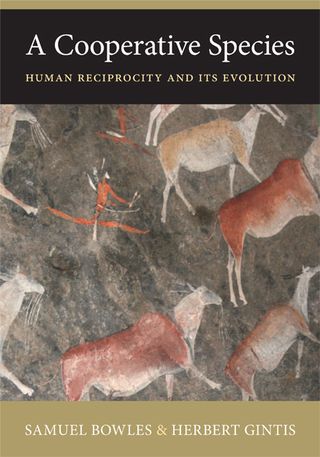
Humans are capable of remarkable feats of cooperation. Warfare is an extreme example: when under attack, hundreds or even millions of people might join forces to provide a mutual defence. In A Cooperative Species, economists Samuel Bowles and Herbert Gintis update their ideas on the evolutionary origins of altruism. Containing new data and analysis, their book is a sustained and detailed argument for how genes and culture have together shaped our ability to cooperate.
Modern hunting and gathering societies offer clues as to how human cooperation evolved. They are typically organized into tribes of a few hundred to a few thousand people. Each tribe is composed of smaller bands of around 75 individuals united by bonds of kinship and friendship. Formalized leadership is often weak, but cooperation is buttressed by social norms and institutions, such as marriage, kinship and property rights. The tribal scale of social organization probably evolved by the late Pleistocene (126,000–11,700 years ago), or perhaps much earlier.
Human societies are diverse and competitive, often violently so. Charles Darwin conjectured in The Descent of Man (John Murray, 1871) that the main evolutionary motor behind human cooperation was intertribal competition, and suggested that cooperation evolved in two stages. In ‘primeval’ times, well before the dawn of recorded history, our ancestors came under selection for cooperative instincts, such as sympathy and group loyalty. In more recent ‘civilized’ times, laws and customs have fostered cooperation on ever larger scales. Darwin contended that the primeval social emotions, more than natural selection, drove the evolution of civilization.
Michael Price takes more critical look in Evolutionary Psychology.

On a frigid winter's morning in 1992, Susan Lindquist, then a biologist at the University of Chicago in Illinois, trudged through the snow to the campus's intellectual-property office to share an unconventional idea for a cancer drug. A protein that she had been working on, Hsp90, guides misfolded proteins into their proper conformation. But it also applies its talents to misfolded mutant proteins in tumour cells, activating them and helping cancer to advance. Lindquist suspected that blocking Hsp90 would thwart the disease. The intellectual-property project manager she met with disagreed, calling Lindquist's idea “ridiculous” because it stemmed from experiments in yeast. His “sneering tone”, she says, left an indelible mark. “It was actually one of the most insulting conversations I've had in my professional life.” It led her to abandon her cancer research on Hsp90 for a decade. Today, more than a dozen drug companies are developing inhibitors of the protein as cancer treatments.
Lindquist seems able to shrug off such injustices, now. Her work over the past 20 years has consistently challenged standard thinking on evolution, inheritance and the humble yeast. She has helped to show how misfolded infectious proteins called prions can override the rules of inheritance in yeast, and how this can be used to model human disease. She has also proposed a mechanism by which organisms can unleash hidden variation and evolve by leaps and bounds. She was the first female director of the prestigious Whitehead Institute for Biomedical Research in Cambridge, Massachusetts, and has received more than a dozen awards and honours in the past five years. In a paper being published this week in Nature, she and her colleagues show that in wild yeast, prions provide tangible advantages, such as survival in harsh conditions and drug resistance.
[H/t: Tom Jacobs]
A nationwide campaign to stem investments in private corrections companies is gathering steam.
Hannah Rappleye in Salon:
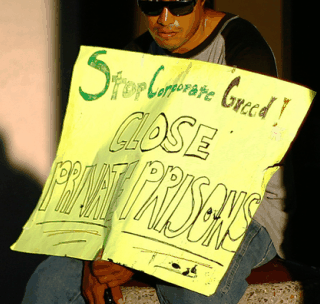
The decision by the largest faith-based pension fund in the United States came in response to concerns expressed last May by the church’s immigration task force and a group of national activists.
“Our board simply felt that it did not want to profit from the business of incarcerating others,” said Colette Nies, managing director of communications for the board.
“Our concern was not with how the companies manage or operate their business, but with the service that the companies offer,” Nies added. “We believe that profiting from incarceration is contrary to church values.”
It was an important success for a slew of activists across the country who are pushing investors and institutions to divest from the private prison industry.
More here.
Sean Carroll in Cosmic Variance:
They do things differently over in Britain. For one thing, their idea of a fun and entertaining night out includes going to listen to a lecture/demonstration on quantum mechanics and the laws of physics. Of course, it helps when the lecture is given by someone as charismatic as Brian Cox, and the front row seats are filled with celebrities. (And yes I know, there are people here in the US who would find that entertaining as well — I’m one of them.) In particular, this snippet about harmonics and QM has gotten a lot of well-deserved play on the intertubes.
More recently, though, another excerpt from this lecture has been passed around, this one about ramifications of the Pauli Exclusion Principle. (Headline at io9: “Brian Cox explains the interconnectedness of the universe, explodes your brain.”)
The problem is that, in this video, the proffered mind-bending consequences of quantum mechanics aren’t actually correct. Some people pointed this out, including Tom Swanson in a somewhat intemperately-worded blog post, to which I pointed in a tweet. Which led to some tiresome sniping on Twitter, which you can dig up if you’re really fascinated. Much more interesting to me is getting the physics right.
One thing should be clear: getting the physics right isn’t easy. For one thing, going from simple quantum problems of a single particle in a textbook to the messy real world is often a complicated and confusing process. For another, the measurement process in quantum mechanics is famously confusing and not completely settled, even among professional physicists.
And finally, when one translates from the relative clarity of the equations to a natural-language description in order to reach a broad audience, it’s always possible to quibble about the best way to translate. It’s completely unfair in these situations to declare a certain popular exposition “wrong” just because it isn’t the way you would have done it, or even because it assumes certain technical details that the presenter did not fully footnote. It’s a popular lecture, not a scholarly tome. In this kind of format, there are two relevant questions: (1) is there an interpretation of what’s being said that matches the informal description onto a correct formal statement within the mathematical formulation of the theory?; and (2) has the formalism been translated in such a way that a non-expert listener will come away with an understanding that is reasonably close to reality? We should be charitable interpreters, in other words.
More here.
From Centennial of Flight:

Coleman was born on January 26, 1892, in Atlanta, Texas, to a large African American family (although some histories incorrectly report 1893 or 1896). She was one of 13 children. Her father was a Native American and her mother an African American. Very early in her childhood, Bessie and her family moved to Waxahachie, Texas, where she grew up picking cotton and doing laundry for customers with her mother. The Coleman family, like most African Americans who lived in the Deep South during the early 20th century, faced many disadvantages and difficulties. Bessie's family dealt with segregation, disenfranchisement, and racial violence. Because of such obstacles, Bessie's father decided to move the family to “Indian Territory” in Oklahoma. He believed they could carve out a much better living for themselves there. Bessie's mother, however, did not want to live on an Indian reservation and decided to remain in Waxahachie. Bessie, and several of her sisters, also stayed in Texas. Bessie was a highly motivated individual. Despite working long hours, she still found time to educate herself by borrowing books from a traveling library. Although she could not attend school very often, Bessie learned enough on her own to graduate from high school. She then went on to study at the Colored Agricultural and Normal University (now Langston University) in Langston, Oklahoma. Nevertheless, because of limited finances, Bessie only attended one semester of college.
More here. (Note: In honor of African American History Month, we will be linking to at least one related post throughout February. The 2012 theme is Black Women in American Culture and History).
Carl Zimmer in Smithsonian:

Our brains need a way to avoid stalemates. Like the decaying dances of honeybees, a coalition starts to get weaker if it doesn’t get a continual supply of signals from the eyes. As a result, it doesn’t get locked early into the wrong choice. Just as honeybees use a quorum, our brain waits until one coalition hits a threshold and then makes a decision. Seeley thinks that this convergence between bees and brains can teach people a lot about how to make decisions in groups. “Living in groups, there’s a wisdom to finding a way for members to make better decisions collectively than as individuals,” he said.
More here.

Like you, we support calls to dismantle the security state and to promote the rule of law. But we do not see that one set of autocratic structures should be replaced by another which claims divine sanction. And while the overthrow of repressive governments was a victory and free elections are, in principle, a step towards democracy, shouldn’t the leader of a prominent human rights organization be supporting popular calls to prevent backlash and safeguard fundamental rights? In other words, rather than advocating strategic support for parties who may use elections to halt the call for continuing change and attack basic rights, shouldn’t you support the voices for both liberty and equality that are arguing that the revolutions must continue?
Throughout your essay, you focus only on the traditional political aspects of the human rights agenda. You say, for instance, that “the Arab upheavals were inspired by a vision of freedom, a desire for a voice in one’s destiny, and a quest for governments that are accountable to the public rather than captured by a ruling elite.” While this is true as far as it goes, it completely leaves out the role that economic and social demands played in the uprisings. You seem able to hear only the voices of the right wing—the Islamist politicians—and not the voices of the people who initiated and sustained these revolutions: the unemployed and the poor of Tunisia, seeking ways to survive; the thousands of Egyptian women who mobilized against the security forces who tore off their clothes and subjected them to the sexual assaults known as “virginity tests.”
From the response:
Western governments should reject this inconsistent and unprincipled approach to democracy. Human Rights Watch called on Western governments to come to terms with the rise of Islamic political parties and press them to respect rights. As rights activists, we are acutely aware of the possible tension between the right to choose one’s leaders and the rights of potentially disfavored groups such as women, gays and lesbians, and religious minorities. Anyone familiar with the history of Iran or Afghanistan knows the serious risks involved. However, in the two Arab Spring nations that have had free and fair elections so far, a solid majority voted for socially conservative political parties in Egypt, and a solid plurality did so in Tunisia. The sole democratic option is to accept the results of those elections and to press the governments that emerge to respect the rights of all rather than to ostracize these governments from the outset.

There was no Santa Claus in the Sarajevo and Bosnia and Herzegovina of my childhood. The white-bearded fat man who assessed the worth of children’s obedience and brought them presents was called Deda Mraz—Grandpa Frost. Having dispatched his proxies to schools and kindergartens in the preceding weeks, he showed up at your home in person (though always unseen) on New Year’s Eve, at midnight or so, just for you. He was non-denominational and non-ideological and delivered presents to all obedient children regardless of their ethnicity or political convictions. The old man was a civic, communal character, someone everyone waited for and was happy to see. He was welcome before the war, even during the war, but, it turns out, not so much after the war.
In December 2008, for instance, Deda Mraz received a punch in his fat gut from Arzija Mahmutović, who at the time was the director of the Children of Sarajevo, the public institution that operates twenty-four kindergartens in the city. Ms. Mahmutović refused to admit Deda Mraz to any of the kindergartens, because she believed (though she backpedaled some after the local and international outcry) that he had no place in Islamic tradition. She had no problem with parents allowing Deda Mraz to deliver presents to the children at some other place, beyond her righteous reach.
Thus was Deda Mraz cast into the pit of Bosnian politics, undergoing public humiliation that has become a kind of seasonal tradition after the war. Soon after the end of the war, for instance, Bosnian then-president Alija Izetbegović denounced the old man as a Communist fabrication. It must have been the blood-red suit that gave it away.

David Graeber’s Debt is, in the most positive sense, rather an old-fashioned book, in its conception and approach if not in its matey and approachable style. It ignores disciplinary boundaries within the human sciences, especially those between economics, history and social studies, in a manner that recalls polymaths like Max Weber or the free-wheeling early years of political economy with figures like Smith and Malthus. In its search for the connecting thread between an astonishing diversity of cultural practices and texts from across time and space, it resembles the early classics of speculative anthropology – not Malinowski but J.G. Frazer. In its ambition to offer an account of the trajectory of the whole of human history, it undoubtedly runs the risk of being confused with the likes of Jared Diamond or Niall Ferguson, but it strikes me rather as in the vein of Arnold Toynbee, not least in the weight of scholarship that underpins this work of imaginative reconstruction. I feel the need to stress again that I don’t offer these comparisons as a criticism.
Above all, the book’s starting position comes straight from nineteenth-century critical historicism: a sense of the importance of the past in shaping the present. Graeber’s evocation of Nietzsche and his provocative fantasies about debt and sacrifice in Chapter 4 seem to be a deliberate nod to this tradition. In Nietzsche’s account of the modern historical sense, humans are understood as being conscious of themselves as beings within time, who tell stories about the past and its relation to the present as a means of making sense of the world. Such stories, whether primitive myths or modern historiography, are never neutral or value-free descriptions of reality, but are shaped by our desires, and in turn – because we inherit and take for granted most such stories, rather than constructing them ourselves – they shape our conceptions and behaviour. Above all – and this is a point emphasised also by Marx (who plays a conspicuously minor role in Graeber’s book) – these stories serve to legitimise the present, to present it as a natural and inevitable state of affairs.
A right thumb, a finger, a tooth. These were the contents of a reliquary acquired several years ago by a collector at an auction in Florence. Little did he know that for centuries the remains had been objects of profane devotion. Last seen in 1905, they had been sliced from the corpse of Galileo, along with another finger and a vertebra, during his highly publicized reburial in the Basilica of Santa Croce in 1737 almost 100 years after his death, and preserved in a slender case fashioned of glass and wood and crowned with a carved bust of the scientist. The reliquary’s new owner consulted Galileo experts about his find, and after the authenticity of its contents had been verified he donated it to the Museo Galileo, which is tucked behind the Uffizi in a quiet piazza overlooking the River Arno. (A dentist asked by the museum to examine the tooth concluded that Galileo suffered from gastric acid reflux and ground his teeth in his sleep.) The rediscovered reliquary is displayed adjacent to a smaller one containing Galileo’s other finger, a prized museum possession since 1927. Nearby are several artifacts of Galileo’s scientific genius: a telescope presented to the Medici and the broken objective lens of the original device with which Galileo sighted Jupiter’s four satellites in 1610.
more from Paula Findlen at The Nation here.
“We develop in multi-cultural and multi-religious societies. To say this is to state the obvious. There is no religiously homogeneous society.” Akeel Bilgrami has invited commentary on his recent working paper about the nature and relevance of secularism in which he advances a central thesis that begins with the conditional phrase, “Should we be living in a religiously plural society.” In this post, I offer a response to his thesis convinced, like Cardinal Jean-Louis Tauran, author of the quotation with which I began, that there is no such thing as a modern religious monoculture. As president of the Pontifical Council for Interreligious Dialogue, the apparatus of the Catholic Church established after Vatican II to serve as the site of engagement with the followers of other religious traditions, Jean-Louis Tauran has something of a professional commitment to pluralism as an ontological category. Tauran gave his 2008 speech on the necessity of cultivating channels of interreligious dialogue at a time when the stock of interreligious dialogue was clearly on the rise. Controversies like those sparked by the Jyllands-Posten cartoons of 2005 and Pope Benedict XVI’s September 2006 lecture on faith and reason, which offended many Muslims by seeming to endorse misleading criticism of Islam, led to a surge in post-9/11 interfaith initiatives. In response to the misunderstandings that informed the Pope’s lecture, 138 global Muslim leaders published “A Common Word Between Us and You” in October 2007, an open letter calling for a common ground of understanding and peace between Muslims and Christians, a period that also saw the launch of Tony Blair’s Faith Foundation and Cardinal Tauran’s initiatives to train clergy for interreligious dialogue in a pluralist world, both in 2008. Global modernity, it is clear, neither presages the necessary rise of a homogeneous consumer culture nor an inevitable decline in the vitality and variety of religious engagement.
more from Justin Neuman at The Immanent Frame here.
IN HER NOVELS AND in her nonfiction essays, Marilynne Robinson’s questions are always roughly the same: Who are we, and where did we come from? The first is a matter of metaphysics, the second of history. At least since the publication of her first collection of essays, The Death of Adam (1998), Robinson has been making it her business to remind us that these questions are not yet settled. We may be descended from apes, but that does not mean that we are essentially apelike. “It has been usual for at least a century and a half to think of human beings as primates,” she writes in her latest collection, When I Was a Child I Read Books, only to add, “I suppress the impulse to say ‘mere primates,’ since I suspect the other members of our great order are undervalued by us in the course of devaluing ourselves.” This is a characteristic Robinson turn—admit the dehumanizing point of your opponent, only to show how deep our humanity goes. When I Was a Child, by far Robinson’s most political work to date, turns her old questions to the problems now directly confronting us. The book is a defense of what she considers the grand traditions of American democracy—generosity, hope, and a radical openness to new experience—waged against a society that seems to believe itself in irreversible decline. At the same time, Robinson registers a profound note of disappointment at feeling, “on the darkest nights, and sometimes in the clear light of day, that we are now losing the ethos that has sustained what is most to be valued in our civilization.”
more from Charles Petersen at Bookforum here.
[H/t: Alan Page]