
Image of unknown woman beaten by Egypt’s military echoes around world

Ahdaf Soueif in The Guardian:

ScreenHunter_06 Dec. 20 16.20The woman is young, and slim, and fair. She lies on her back surrounded by four soldiers, two of whom are dragging her by the arms raised above her head. She's unresisting – maybe she's fainted; we can't tell because we can't see her face. She's wearing blue jeans and trainers. But her top half is bare: we can see her torso, her tummy, her blue bra, her bare delicate arms. Surrounding this top half, forming a kind of black halo around it, is the abaya, the robe she was wearing that has been ripped off and that tells us that she was wearing a hijab.

Six years ago, when popular protests started to hit the streets of Egypt as Hosni Mubarak's gang worked at rigging the 2005 parliamentary elections, the regime hit back – not just with the traditional Central Security conscripts – but with an innovation: militias of strong, trained, thugs. They beat up men, but they grabbed women, tore their clothes off and beat them, groping them at the same time. The idea was to insinuate that females who took part in street protests wanted to be groped.

Women developed deterrent techniques: layers of light clothing, no buttons, drawstring pants double-knotted – and carried right on protesting. Many of the smaller civil initiatives that grew into the protest movement: “We See You”, “Against Corruption”, “The Streets are Ours” were women-led.

But, a symbiotic relationship springs up between behaviours. Mubarak and Omar Suleiman turn Egypt into the US's favourite location for the torture of “terror suspects” and torture becomes endemic in police stations. The regime's thugs molest women as a form of political bullying – and harassment of women in the streets rises to epidemic levels.

More here.

Eating less keeps the brain young

From PhysOrg:

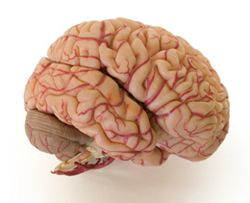
BrainA team of Italian researchers at the Catholic University of Sacred Heart in Rome have discovered that this molecule, called CREB1, is triggered by “caloric restriction” (low caloric diet) in the brain of mice. They found that CREB1 activates many genes linked to longevity and to the proper functioning of the brain. This work was led by Giovambattista Pani, researcher at the Institute of General Pathology, Faculty of Medicine at the Catholic University of Sacred Heart in Rome, directed by Professor Achille Cittadini, in collaboration with Professor Claudio Grassi of the Institute of Human Physiology. The research appears this week in the Proceedings of the National Academy of Sciences (PNAS). “Our hope is to find a way to activate CREB1, for example through new drugs, so to keep the brain young without the need of a strict diet,” Dr Pani said.

Caloric restriction means the animals can only eat up to 70 percent of the food they consume normally, and is a known experimental way to extend life, as seen in many experimental models. Typically, caloric-restricted mice do not become obese and don't develop diabetes; moreover they show greater cognitive performance and memory, are less aggressive. Furthermore they do not develop, if not much later, Alzheimer's disease and with less severe symptoms than in overfed animals.

More here.

the fountain of youth

Lucas_Cranach_d._Ä._00714

Ten or twelve years ago, when I was visiting Berlin, Stan Persky took me to see Cranach the Elder’s painting of the Fountain of Youth at the Gemäldegalerie. It is a medium-sized canvas that depicts, in excruciating detail, a rectangular swimming pool seen in perspective full of happily cavorting men and women. Old people are arriving from the left in carts and wheelbarrows; youths emerge naked from the other side where a series of red tents await them, like those bathing-machines of which Lewis Carroll’s Snark was so inordinately fond. The Cranach painting led Stan and me into a discussion on whether we would like to extend the time of our lives, if such a thing were possible. I said that the foreseeable end did not frighten or worry me; on the contrary, I liked the idea of living with a conclusion in mind, and compared an immortal life to an endless book which, however charming, would end up seeming tiresome. Stan, however, argued that living on, perhaps forever (provided he were free of sickness and infirmities), would be an excellent thing. Life, he said, was so enjoyable that he never wanted it to end.

more from Alberto Manguel at Threepenny Review here.

Genes Play Major Role in Primate Social Behavior

Nicholas Wade in The New York Times:

PrimThe scientists, at the University of Oxford in England, looked at the evolutionary family tree of 217 primate species whose social organization is known. Their findings, published in the journal Nature, challenge some of the leading theories of social behavior, including:

¶ That social structure is shaped by environment — for instance, a species whose food is widely dispersed may need to live in large groups.

¶ That complex societies evolve step by step from simple ones.

¶ And the so-called social brain hypothesis: that intelligence and brain volume increase with group size because individuals must manage more social relationships.

By contrast, the new survey emphasizes the major role of genetics in shaping sociality. Being rooted in genetics, social structure is hard to change, and a species has to operate with whatever social structure it inherits. If social behavior were mostly shaped by ecology, then related species living in different environments should display a variety of social structures. But the Oxford biologists — Susanne Shultz, Christopher Opie and Quentin Atkinson — found the opposite was true: Primate species tended to have the same social structure as their close relatives, regardless of how and where they live.

More here.

Tuesday Poem

“It's when your head's turned inattentively,
just slightly, in belief that inattention comes
to swallow you whole.” —Alain Bischford

Talith

We sleep beneath your grandfather’s talith
Fine lamb’s wool striped black and white
A giant barcode to be scanned by God
The pelt of a fabulous beast.

Little tent, portable temple
It survived Dutch looters and Dublin landlords
To shelter in this Irish night even me
Uncircumcised, and all too often, unwashed.

Your father pinned it to his study wall
A flag without a shield. Eternity’s quilt,
Your grandfather didn’t think he’d need it
When he took the train in Amsterdam.

“And what,” he mocked your father,
“are they going to murder us all?”

by Michael O’Loughlin
from In This Life
publisher: New Island, Dublin, 2011

create new money…

Money_closeup-e1322060471529

Just after the election of 2008, the Nobel laureate liberal economist Paul Krugman made a prophecy: we will not restore prosperity, he warned in The New York Review of Books, “unless we are willing to think clearly about our problems and to follow those thoughts wherever they lead.” But as Krugman’s thoughts drifted back to the maxims of John Maynard Keynes—maxims he called “more relevant than ever”—our thoughts could be turning to the older and in some respects wiser innovations of President Lincoln and the Republican Congress during the Civil War. Here’s the gist of it: using the monetary methods of Lincoln, updated to employ the inflation-fighting tools of the Federal Reserve, we could pay for a faster recovery and a great many worthy projects without higher taxes, without more national debt, and believe it or not, without inflation. How? By letting Congress exercise a little-known power that is used (very quietly indeed) by the Federal Reserve: the power to create new money.

more from Richard Striner at The American Scholar here.

art and the social

The_long_nineties_1

Mocked and ridiculed, the 1980s met a pitiful end at the hands of a generation of artists who considered a market-friendly, object-based art their ideological nemesis, and punished it summarily for its false richness. This is an exaggeration, of course, but ask around in my (Northern European) corner of the world, and I would guess that many of those who were working back then will confirm this picture of a generational showdown. By contrast, faded and forgotten as they may be, ‘the long nineties’ remain unsubverted.1 The symbolic revival of Félix Gonzáles-Torres at the 2011 Istanbul Biennial, for instance, echoed his status as a guiding star of curating and art theory of that decade. However, during the last five years, as the historicization of the ’90s gains momentum, the jury has gradually reconvened. The case being weighed is that of art’s relationship to the social.

more from Lars Bang Larsen at Frieze here.

Hedy Lamarr’s World War II Adventure

John Adams in the New York Times Book Review:

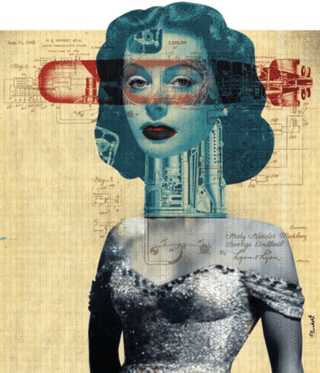
ScreenHunter_04 Dec. 20 10.58That a glamorous movie star whose day job involved hours of makeup calls and dress fittings would spend her off hours designing sophisticated weapons systems is one of the great curiosities of Hollywood history. Lamarr, however, not only possessed a head for abstract spatial relationships, but she also had been in her former life a fly on the wall during meetings and technical discussions between her ­munitions-manufacturer husband and his clients, some of them Nazi officials. Disturbed by news reports of innocents killed at sea by U-boats, she was determined to help defeat the German attacks. And Ant­heil, arguably the most mechanically inclined of all composers, having long before mastered the byzantine mechanisms of pneumatic piano rolls, retained a special genius for “out of the box” problem ­solving.

Over several years the composer and the movie star spent countless hours together drafting and redrafting designs, not only for the torpedo system but also for a “proximity fuse” antiaircraft shell. In reality, their patent was an early version of today’s smart bombs. The device as they made it employed a constantly roving radio signal to guide the torpedo toward its target. Because the signal kept “hopping” from one frequency to another, it would be impossible for the enemy to lock onto. To solve the problems of synchronizing receiver and transmitter, Ant­heil proposed a tiny structure inspired by the workings of a piano roll. This was a feat that years later would be used in everything from cellphone and Bluetooth technology to GPS instruments.

More here.

Hayat Sindi’s career as a scientist began with a fib

…and that’s a good thing. Now the Saudi innovator is doing work that could save millions of lives in the developing world—and launching her own Mideast foundation.

Abigail Pesta in The Daily Beast:

ScreenHunter_02 Dec. 20 10.47Sindi, who dresses in a traditional headscarf but also in trendy heels, relishes the details of making her own way in science. It started with a fib to her family after her first year of college in Saudi Arabia.

Keen to continue her studies abroad, she told her father some good news: She had been accepted at a prestigious university in London. Her traditional Muslim father said it would tarnish the family name for a young woman to live overseas alone. “He told me, ‘Over my dead body,’” Sindi recalls. Still, she persuaded him, and off she went to England.

The truth is, she hadn’t been accepted at any university. When she landed in London as a teenager in 1991, she says, she spoke only Arabic, no English. “My first night there, I went to a youth hostel,” she says. “I was in an attic room. I panicked. I looked at my plane tickets—my father had bought a return ticket. I thought, I’ll go home tomorrow.” Instead she went to an Islamic cultural center and got a translator to help her meet with college officials. “They told me, ‘You’re crazy,’” she says. “I was naive. I thought they would just let me in.”

After a year spent cramming on English and studying to pass the “A-levels,” the U.K.’s college-admission courses, she got herself in to King’s College, where she graduated in 1995 with a degree in pharmacology. She went on to get a Ph.D. in biotechnology from Cambridge in 2001. She says her family didn’t learn about her lie until years later, when they were surprised to hear her mention it in a speech.

More here. [Thanks to Sughra Raza.]

Monday, December 19, 2011

The Winners of the 3QD 2011 Politics & Social Science Prize

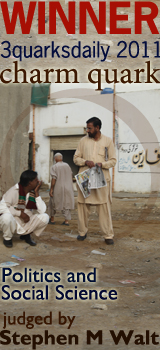
WinnerTop2011 WinnerStrangePol2011 Politics_2011

Stephen M. Walt has picked the winners:

1. Top Quark, $1000: Kenan Malik, Rethinking the Idea of “Christian Europe”
2. Strange Quark, $300: David Graeber, On the Invention of Money
3. Charm Quark, $200: Corey Robin, Revolutionaries of the Right: The Deep Roots of Conservative Radicalism

Here is what Professor Walt had to say about them:

Picking three winners from the nine impressive finalists was not an easy task. In judging the different selections, I looked for writing that combined clarity and verve and made a topic of enduring interest come alive. Did the author help the reader see connections previously unnoticed, or bring into sharp relief a phenomenon that had been forgotten or misunderstood? Did the article advance a novel argument with such force that even skeptical readers might be convinced? That is the essential feature of deep analysis and sharp writing: it forces us to question our prior beliefs and see the world anew. Each of the nine nominees succeeded in considerable measure, but for me, these three stood out.

#1 Top Quark: Kenan Malik, “Rethinking the Idea of 'Christian Europe',” Pandaemonium (August 12, 2011).

Soldiers in today’s culture wars believe “European civilization” rests on a set of unchanging principles that are perennially under siege—from godless communism, secular humanism, and most recently, radical Islam. For many of these zealots, what makes the “West” unique are its Judeo-Christian roots. In this calm and elegantly-written reflection on the past two millenia, Malik shows that Christianity is only one of the many sources of “Western” culture, and that many of the ideas we now think of as “bedrock” values were in fact borrowed from other cultures. This essay is a potent antidote to those who believe a “clash of civilizations” is inevitable—if not already underway—and the moral in Malik’s account could not be clearer. Openness to outside influences has been the true source of European prominence; erecting ramparts against others will impoverish and endanger us all.

#2 Strange Quark: David Graeber: “On the Invention of Money – Notes on Sex, Adventure, Monomaniacal Sociopathy and the True Function of Economics,” naked capitalism.com (September 13, 2011).

Where did money come from? Graeber takes the standard economists' explanation–dating back to Adam Smith–and leaves it (and a few of its defenders) in shards. Instead of simply assuming that money emerged from the process of barter (as economists are wont to do), Graeber marshals an array of anthropological evidence demonstrating that money first arose as a means of account within non-state bureaucracies (such as Sumerian religious temples). It’s a tour de force of sustained argumentation, leavened by incisive writing and deadly flashes of wit, and it tells you a lot about how social science ought to be done (but often isn’t).

#3 Charm Quark: Corey Robin, “Revolutionaries on the Right: the Deep Roots of Conservative Radicalism,” www.coreyrobin.com (September 27, 2011).

Why are today's so-called “conservatives” so enamored of far-reaching social and political transformations, not to mention costly and ill-fated efforts to export “liberty” at the barrel of a gun? Far from being traitors to true conservatism, Robin argues that today's conservative radicals are drawing upon a tradition of discourse dating back to Edmund Burke’s fear that established orders cannot generate the passion and commitment needed to vanquish revolutionary movements. To defeat Jacobinism and its various revolutionary successors, in short, die-hard “conservatives” have to fight fire with fire. And from these deep roots arises a “conservatism” that takes no prisoners and leaves few traditions unscathed. It is the “conservatism” of NSC-68 (which told Cold Warriors not to shrink “from any means, overt or covert, that could frustrate the Kremlin’s design”), of the Patriot Act, and of today’s drone wars and targeted killings. It takes real imagination to help us see Burke afresh, and Robin provides it here.

Congratulations also from 3QD to the winners (I will send the prize money later today or tomorrow–and remember, you must claim the money within one month from today–just send me an email). And feel free to leave your acceptance speech as a comment here! And thanks to everyone who participated. Thanks also, of course, to Stephen M. Walt for doing the final judging.

The three prize logos at the top of this post were designed by me (top and strange) and Sughra Raza (charm). I hope the winners will display them with pride on their own blogs!

Details about the prize here.

Sunday, December 18, 2011

The Revolutionary Shias

Malise Ruthven reviews Shi’ism: A Religion of Protest by Hamid Dabashi in the New York Review of Books:

ScreenHunter_06 Dec. 18 22.06In 2004, anticipating the victory of the Shiite parties in the Iraqi parliamentary elections, King Abdullah of Jordan warned of a “Shiite crescent” stretching from Iran into Iraq, Syria, and Lebanon that would be dominated by Iran with its large majority of Shias and Shiite clerical leadership. The idea was picked up by the Saudi foreign minister, who described the US intervention in Iraq as a “handover of Iraq to Iran” since the US was supporting mainly Shiite groups there after overthrowing Saddam Hussein’s Sunni regime. President Hosni Mubarak of Egypt claimed that Shias residing in Arab countries were more loyal to Iran than to their own governments. In an Op-Ed published in The Washington Post in November 2006, Nawaf Obaid, national security adviser to King Abdullah of Saudi Arabia, reflected on the urgent need to support Iraq’s Sunni minority, which had lost power after centuries of ruling over a Shiite majority comprising more than 65 percent of the Iraqi population.

Shiaphobia is nothing new for Saudi Arabia. The kingdom’s legitimacy derives from the Wahhabi sect of Islam, a Sunni Muslim group that attacked Shiite shrines in Iraq in the nineteenth century, and today systematically discriminates against Shias. We know from WikiLeaks that the US government regards the Saudi monarchy as a “critical financial support base” for al-Qaeda, the Taliban, Lashkar-e-Taiba, and other terrorist groups. As well as attacking American and Indian targets, all these are violently anti-Shiite. We also know that the Saudi king venomously urged his US allies to cut off the “head of the snake” by attacking Shiite Iran.

More here.

Malappuram in Karachi

Shalini Nair in Indian Express:

ScreenHunter_03 Dec. 18 18.36The nondescript apartment looks like an average home in Karachi. It’s the bar of Chandrika herbal soap in the bathroom and the Mathrubhoomi calendar on the wall, ubiquitous to Malayali homes, that betrays the lineage of its occupants. The flat’s octogenarian owner, BM Kutty, came to Karachi from Kerala in search of greener pastures in 1949, a time when Karachi was just a train ride away from Mumbai. Since then, the political activist has spent six decades of his life as a Pakistani national.

Kutty is part of the shrinking community of Malayalis settled in Karachi. Unlike some Muslims of north India who migrated to Pakistan during Partition, the migration of Malayali Muslims had a different context. The first exodus from Kerala to Karachi took place in 1921, the year of the Mappila Revolt, when landless Malabar Muslims (Mappilas) of Malappuram district in north Kerala launched an armed rebellion against the British and upper-caste Hindus. The uprising was brutally crushed after the British proclaimed martial law, and the Karachi chapter of Mappilas was born.

More here.

Working Arrangement

800px-Same-sex_marriage_in_San_Francisco_City_Hall_20080617Justin Smith in Lapham's Quarterly (image from Wikimedia commons):

Whether to denounce it as a step down the path to unspeakable decadence or to exalt it as self-evidently right and just, everyone in public life today has a position on gay marriage. All the presidential candidates in the current electoral cycle have been asked about it, and all have had responses carefully packaged to ingratiate themselves with their constituencies. If the past few years may serve as a guide, it is likely that in the coming elections the subtle middle will be thoroughly excluded, as candidates and voters alike flock to one of two opposite poles: either holding that “marriage is between a man and a woman,” or, on the contrary, that everyone has an equal right to marriage. These are thought-arresting platitudes; they are not articulate positions, nor even the rudiments of arguments for such positions. The greatest problem with both is their brash confidence in the moral abhorrence or necessity of gay marriage, absent any historical or critical interest in the nature of marriage itself.

The rise of gay marriage, I believe, has played an important role in reinforcing naturalism about marriage, and thus in buttressing the conservative cause, at just that moment in history—the decades following the sexual revolution—when the contingency of marriage began to show through and its role as the basic building block of society came to be called into question. Pervading the arguments for marriage equality made by eloquent defenders such as Andrew Sullivan is the idea that gay marriage will not, as the conservatives fear, cause us to lose our moral bearings, so much as it will bring gays into the fold of a single gay-straight community of shared moral values. Over the past fifteen years, the liberal mainstream has begun to move toward this view. But Sullivan is, in the end, a conservative himself, and it is one of the great wonders of the past few decades of public debate that his conservative argument has won over so many who otherwise despise this political orientation. The same people who claim to dislike talk of family values will defend gay marriage on the grounds that it contributes to the strengthening of those values.

Vaclav Havel, 1936-2011

19havel-1324209341879-articleInlineIn the Associated Press, via the NYT:

Mr. Havel left office in 2003, 10 years after Czechoslovakia broke up and a few months before both nations joined the European Union. He was credited with laying the groundwork that brought his Czech Republic into the 27-nation bloc, and was president when it joined NATO in 1999.

Shy and bookish, with wispy mustache and unkempt hair, Mr. Havel came to symbolize the power of the people to peacefully overcome totalitarian rule.

“Truth and love must prevail over lies and hatred,” He famously said. It became his revolutionary motto which he said he strove to live by.

His death reminded me of this exchange in the NYRB. First, Joseph Brodsky:

I’ve decided to write this letter to you because we have something in common: we both are writers. In this line of work, one weighs words more carefully, I believe, than elsewhere before committing them to paper or, for that matter, to the microphone. Even when one finds oneself engaged in a public affair, one tries to do one’s best to avoid catchwords, Latinate expressions, all manner of jargon. In a dialogue, of course, or with two or more interlocutors around, that’s difficult, and may even strike them as pretentiousness. But in a soliloquy or in a monologue it is, I think, attainable, though of course one always tailors one’s diction to one’s audience.

Read more »

Sunday Poem

A Spiritual Experience

“As a chimpanzee – usually an adult male – gets closer,
…….. and the roar of water grows louder
he quickens his pace, his hair bristles
…….. and on reaching the waterfall he stands upright,
dances from foot to foot, dips his hand
…….. in the stream, stamps and splashes in the
shallow rush.
He has been known to pick up and hurl rocks,
…….. climb slender draping vines
and swing like a chasuble out over the flow.
…….. The spray is the incense of his water ceremony.”

by Greg Delanty

Dechronization of Sam Magruder

From Science Forum:

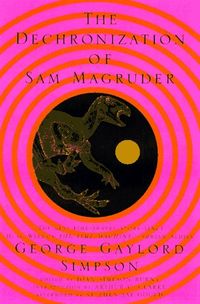
SamTold strongly in the Wellisan tradition, and highly reminiscent of Wells' own The Time Machine, George Gaylord Simpson's The Dechronization of Sam Magruder is probably something that Wells himself would be envious of. Simpson was a very well known evolutionist who helped advance that science considerably during his life. He also apparently was a fan of SF, and in addition to a number of scientific tomes, managed to squeeze in a single SF novelette sometime during his life.

At a party one evening after the year 2162 a number of people gathered, among them the Universal Historian, who told a tale of a chronologist, Magruder, who succeeded in separating himself from the present, and launching himself backwards in time. Present also were a few others, including the Ethnologist, the Pragmatist, the Common Man, and several others, all of whom were referred to generically. The Universal Historian promised them all a fantastic tale, and urged them to return the next week to the next get-together to hear the tale. I told you it was done in a strongly Wellsian style, did I not? Simpson did a magnificent job with the technologies in his story, though the bit on time travel was not with out its problems. Simpson created an odd system where the present and the past were two distinct universes, and to travel between the two required immense amounts of energy. As it happened Magruder, a chronologist, was trying to create a laboratory experiment to learn about the difference between the two universes, and accidentally sent himself eighty million years into the past. After the set up by the Universal Historian Simpson switches to descriptions of seven tablets created by Magruder which had recently been discovered stowed in his cave eighty million years prior. The bulk of the book dealt with two issues: Simpson's survival strategies, and finding answers to all those nagging little questions about dinosaurs that will never be answered by the fossil record.

More here. (Note: As an oncologist, I am the privileged witness to a variety of survival strategies in my cancer patients on a daily basis, and no book of fact or fiction has depicted the utter loneliness and infinite dignity of such a struggle better than this slim work of fiction. I urge everyone to read it.)

Heaven, Texas and the Cosmic Whodunit

A. O. Scott in The New York Times:

Tree…moviegoers eager for rapture can find consolation — to say nothing of awe, amazement and grist for endless argument — in “The Tree of Life,” Terrence Malick’s new film, which contemplates human existence from the standpoint of eternity. Recently showered with temporal glory at the Cannes Film Festival, where it won the Palme d’Or, this movie, Mr. Malick’s fifth feature in 38 years, folds eons of cosmic and terrestrial history into less than two and a half hours. Its most provocative sequences envision the origin of the universe, the development of life on earth (including a few soulful dinosaurs) and then, more concisely and less literally, the end of time, when the dead of all the ages shall rise and walk around on a heavenly beach. At the beginning and the conclusion — alpha and omega — we gaze on a flickering flame that can only represent the creator. Not Mr. Malick (who prefers to remain unseen in public) but the elusive deity whose presence in the world is both the film’s overt subject and the source of its deepest, most anxious mysteries. With disarming sincerity and daunting formal sophistication “The Tree of Life” ponders some of the hardest and most persistent questions, the kind that leave adults speechless when children ask them. In this case a boy, in whispered voice-over, speaks directly to God, whose responses are characteristically oblique, conveyed by the rustling of wind in trees or the play of shadows on a bedroom wall. Where are you? the boy wants to know, and lurking within this question is another: What am I doing here?

Here” in this case is Waco, Tex., in the 1950s, a slice of earthly reality rendered in exquisite detail by the production designer, Jack Fisk, and the cinematographer, Emmanuel Lubezki. Their evident devotion to Mr. Malick’s exacting, idiosyncratic vision — the care with which they help coax his ideas into vivid cinematic reality — is in its way as moving as the images themselves, which flow and sway to equally sublime music. (The score is by Alexandre Desplat. He holds his own in some pretty imposing company, including Couperin, Brahms and Berlioz, part of whose great “Requiem” underpins an ecstatic celestial climax.) The sheer beauty of this film is almost overwhelming, but as with other works of religiously minded art, its aesthetic glories are tethered to a humble and exalted purpose, which is to shine the light of the sacred on secular reality.

More here. (Note: This is an old review, but the movie is playing once again, thanks to being selected as Gotham Awards' Best Feature Film of 2011, and is a must-see on the big screen)