Young zebra finch telomeres serve as a marker for lifespan

From Nature:

BirdProtective caps known as telomeres that help to preserve the integrity of chromosomes can also predict lifespan in young zebra finches (Taeniopygia guttata), researchers have found.

Telomeres are stretches of repetitive DNA sequence that are found at the ends of chromosomes, where they help to maintain cell viability by preventing the fraying of DNA and the fusion of one chromosome to another. The relationship between normal ageing and telomere decline has long been suspected — and even asserted by some companies that measure customers’ telomere length — but the link remains unproven in humans (see 'Spit test offers guide to health').Most studies of longevity and telomere length have relied on only one or two measurements from an individual during their lifespan. But population ecologist Pat Monaghan of the University of Glasgow, UK, and her colleagues found that measuring telomere length periodically over the course of a zebra finch’s life revealed a tight association between length and lifespan — particularly when those measurements were taken when the birds were only 25 days old. The results are reported online this week in Proceedings of the National Academy of Sciences.

More here.

Finishing With No Regrets

Jane Brody in The New York Times:

AdParents undermine children’s self-confidence and self-esteem by punishing them physically or pushing them down paths, both academic and athletic, that they are ill equipped to follow. And myriad prescriptions for antidepressants and anti-anxiety drugs reflect a widespread tendency to sweat the small stuff, a failure to recognize time-honored sources of happiness, and a reliance on material acquisitions that provide only temporary pleasure. Enter an invaluable source of help, if anyone is willing to listen while there is still time to take corrective action. It is a new book called “30 Lessons for Living” (Hudson Street Press) that offers practical advice from more than 1,000 older Americans from different economic, educational and occupational strata who were interviewed as part of the ongoing Cornell Legacy Project. Its author, Karl Pillemer, a professor of human development at the College of Human Ecology at Cornell and a gerontologist at the Weill Cornell Medical College, calls his subjects “the experts,” and their advice is based on what they did right and wrong in their long lives. Many of the interviews can be viewed at legacyproject.human.cornell.edu. Here is a summary of their most salient thoughts.

ON MARRIAGE A satisfying marriage that lasts a lifetime is more likely to result when partners are fundamentally similar and share the same basic values and goals. Although romantic love initially brings most couples together, what keeps them together is an abiding friendship, an ability to communicate, a willingness to give and take, and a commitment to the institution of marriage as well as to each other. An 89-year-old woman who was glad she stayed in her marriage even though her young husband’s behavior was adversely affected by his military service said, “Too many young people now are giving up too early, too soon.”

More here.

Tuesday Poem

The Four Quartets
…..—excerpt from Burnt Norton

At the still point of the turning world. Neither flesh nor fleshless;
Neither from nor towards; at the still point, there the dance is,
But neither arrest nor movement. And do not call it fixity,
Where past and future are gathered. Neither movement from nor towards,
Neither ascent nor decline. Except for the point, the still point,
There would be no dance, and there is only the dance.

by T.S. Eliot

Monday, January 9, 2012

Sunday, January 8, 2012

Happy Birthday, Stephen Hawking

Sean Carroll in Cosmic Variance:
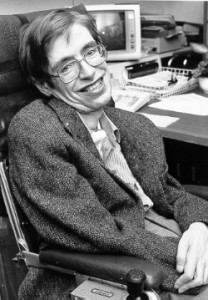
Stephen_Hawking.StarChild-208x300At the end of 1992 I was a finishing grad student, applying for postdocs. One of the places I applied was Cambridge, to Hawking’s group at DAMTP. There is a slight potential barrier for American students to travel to the UK for postdocs, so they like to get out ahead of things and offer jobs early. Unfortunately I was out of my office the day Hawking called to offer me a position. Fortunately, my future-Nobel-Laureate officemate was there, and he took the call. He explained that Stephen Hawking had called to offer me a job — I was thrilled about the offer, but understood “Hawking called” as metaphorical. But no, Brian later convinced me that it actually was Hawking on the other end of the line, which he described as a somewhat surreal experience. Of course after the initial introduction the phone gets handed over to someone else, but still.

Cambridge is one of the world’s best places to do theoretical physics, and I was sorely tempted, but I ended up going to MIT instead. Three years later, I went through the process again, as postdocs typically do. And again Cambridge offered me the job — and again, after a very tough decision, I said no, heading of the the ITP in Santa Barbara instead.

Up to this point I had never actually met Hawking in person, although I had been in the audience for one of his lectures. But every year he visits Caltech and Santa Barbara, so I finally got to be with him in the same place. The first time he visited he brought along a young grad student named Raphael Bousso, who has gone on to do quite well for himself in his own right. As a group of us went to lunch, I mentioned to Raphael that I had never said hi to Stephen in person, so I’d appreciate it if he would introduce us. But, I cautioned, I hope he wasn’t upset with me, because he had offered me a postdoc and I turned it down.

Raphael just laughed and said, “Don’t worry, there’s this one guy who he offered a postdoc to twice, and he turned it down both times!” So I had to explain that this guy was actually me. At which point Raphael ran up to Hawking, exclaiming “Stephen! Stephen, this is the guy — the one who turned down DAMTP for postdocs twice in a row!”

More here.

On Neutrinos and Angels

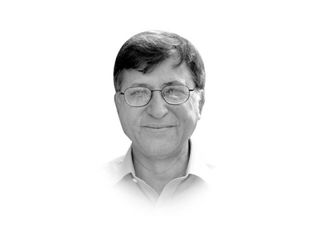
318468-PervezHoodbhoynewagain-1326035518-347-640x480Pervez Hoodbhoy in Tribune (Pakistan):

Speed of light issues have often moved sections of religious people in rather strange ways. Way back in 1973, as a young physics lecturer at Quaid-i-Azam University, I had been fascinated by the calculation done by the head of our department. Seeking the grand synthesis of science and faith, this pious gentleman — who left on his final journey last month — had published calculations that proved Heaven (jannat) was running away from Earth at one centimeter per second less than the speed of light. His reasoning centred around a particular verse of the Holy Quran that states worship on the night of Lailat-ul-Qadr (Night of Revelation) is equivalent to a thousand nights of ordinary worship. Indeed, if you input the factor of 1,000 into Einstein’s famous formula for time dilatation, this yields a number: one centimeter per second less than the speed of light!

These days the internet groans under the weight of claims that the Holy Quran had specified the speed of light 1400 years ago. Dr Mansour Hassab El Naby, said to be a physicist from Egypt, announces that according to his Quranic calculations, this speed is 299,792.5 kilometres per second. He even gives error bars! Another video gives a still more precise figure of 299792.458 km/sec. Given the unrestrained leaps of logic made by the authors, it is not surprising that they all arrive at more or less the same numbers.

Interested readers may also wish to visit an intricately-designed website that has clocked up over 750,000 visitors so far. Chockful of mathematical formulae, diagrams, and pictures, it starts from the premise that “angels are low density creatures” taking orders from a “Preserved Tablet” and says “the speed at which they commute to and from this Tablet turned out to be the known speed of light”. To enhance the visual impact, the website has a Java applet showing a white Caucasian scientist who moves his eyes up, down, and around in wondrous rapture. While doing so he sonorously pronounces — in what sounds like an Australian accent to me — that the extra space-time dimensions demanded by the physics of string theory are exactly those predicted in the Quran. The final conclusion: “Einstein’s theory of General Relativity proves the Quran right”.

So, What is a “Temporal Cloak”, Anyway?

Over at Skulls in the Stars (for Jonathan H and via Zite):

This week, the experimental realization* of a “space-time cloak” or “temporal cloak” by researchers at Cornell University has made national news. This novel device differs from the “invisibility cloaks” discussed previously on this blog in that it hides temporal events, not spatial objects. Loosely speaking, this has also been referred to as a “history editor”. Naturally, the discussion of “cloaking” has again brought out references to “Harry Potter cloaks” and other dramatic imagery; the reality is much more mundane, but still fascinating — and an amazing achievement. Let’s take a look at what was done, what was not done — and why it’s quite cool!

First, let’s get rid of some misconceptions that the terminology naturally brings to mind. The terms “space-time cloak” and “history editor” make it sound like the device is ripping a hole in the fabric of space-time itself — like a time machine equipped with a big eraser! This is definitely not what is happening here! There is no manipulation of time itself, but rather a manipulation of a beam of light to hide something that the light would otherwise detect.

It is difficult to come up with a simple analogy to explain what is really going on, but let us imagine a beam of light as a long moving train of hanging curtains, as illustrated below:

We might imagine that these curtains are at an assembly line and have recently been dyed, and are still wet (I told you, analogies for this phenomenon are tough!). We want to pass objects from one side of the curtains to another, but any attempt to simply push an object between them will mess up the dye and leave a mark.

Walter Benjamin on the 120th Anniversary of his Birth

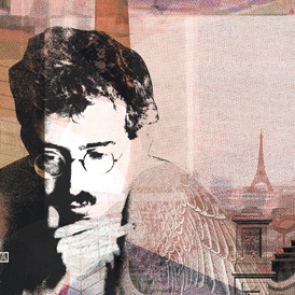
193744519Avner Shapira in Ha'aretz:

If 2012 is the year our world comes to an end, as doomsayers predict, that will provide additional employment for the angel of history, who observes the past and the wreckage of humanity as described by Walter Benjamin in his essay “On the Concept of History.” But if the world and its inhabitants continue to exist, they will be able to observe, next July 15, the 120th anniversary of Benjamin's birth. His influence has only been growing in recent decades, and his writings are increasingly the inspiration for discussion and reconsideration.

The growing corpus of works about Benjamin is about to be augmented with the publication, in January, of a comprehensive study, “Walter Benjamin: A Philosophical Portrait,” by Prof. Eli Friedlander (Harvard University Press ). Friedlander, head of the Philosophy Department at Tel Aviv University, discusses Benjamin's approaches to concepts such as history, mythology, language, beauty and truth. His aim is to tie together the threads of thought spun by the philosopher, who committed suicide in 1940.

Rethinking the Growth Imperative

Pa77c_thumb3Kenneth Rogoff in Project Syndicate:

There is a certain absurdity to the obsession with maximizing long-term average income growth in perpetuity, to the neglect of other risks and considerations. Consider a simple thought experiment. Imagine that per capita national income (or some broader measure of welfare) is set to rise by 1% per year over the next couple of centuries. This is roughly the trend per capita growth rate in the advanced world in recent years. With annual income growth of 1%, a generation born 70 years from now will enjoy roughly double today’s average income. Over two centuries, income will grow eight-fold.

Now suppose that we lived in a much faster-growing economy, with per capita income rising at 2% annually. In that case, per capita income would double after only 35 years, and an eight-fold increase would take only a century.

Finally, ask yourself how much you really care if it takes 100, 200, or even 1,000 years for welfare to increase eight-fold. Wouldn’t it make more sense to worry about the long-term sustainability and durability of global growth? Wouldn’t it make more sense to worry whether conflict or global warming might produce a catastrophe that derails society for centuries or more?

Will Wilkinson in Big Think.

Will We be All Right in the End?

252px-Common_face_of_one_euro_coinDavid Runciman in the LRB:

The recent Brussels summit to save the euro was a strange affair, and not just because of the quixotic behaviour of the British delegation. It was presided over by two politicians who were giving out a very mixed message. Nicolas Sarkozy told the world in the run-up to the meeting that this was the moment of truth not just for the currency but for the future of democracy. Europe only had a few days to save itself: ‘Never has Europe been in so much danger,’ he announced. Get this wrong and ‘there will be no second chance.’ It was salvation or the abyss. Angela Merkel wanted people to know that it was important not to be rushed; any solution would take time. ‘The European crisis will not be solved in one fell swoop,’ she declared. ‘It is a process and this process will take years.’ So which one was it: now or never, or wait and see?

Probably it was both. The two halves of ‘Merkozy’ were simply reflecting the way most of us feel about this crisis. We are in a split mind about it. The whole thing is simultaneously deeply threatening and somehow remote. The worst-case scenarios are so ghastly that it’s almost impossible to fathom what they would mean, but for that reason it’s equally hard to imagine mature democracies deciding to walk off a cliff. This is what gives the crisis its peculiar character. We know we are in trouble but we don’t know how much trouble, because we have an underlying suspicion that we will pull back from the edge, if only we could be clear about where the edge is. Democracies often look like they are in a total pickle, but they always get out of the mess in the end. Don’t they?

The Myth of Japan’s Failure

07japan-img-articleInlineEamonn Fingleton over at the NYT's Sunday Review:

DESPITE some small signs of optimism about the United States economy, unemployment is still high, and the country seems stalled.

Time and again, Americans are told to look to Japan as a warning of what the country might become if the right path is not followed, although there is intense disagreement about what that path might be. Here, for instance, is how the CNN analyst David Gergen has described Japan: “It’s now a very demoralized country and it has really been set back.”

But that presentation of Japan is a myth. By many measures, the Japanese economy has done very well during the so-called lost decades, which started with a stock market crash in January 1990. By some of the most important measures, it has done a lot better than the United States.

Japan has succeeded in delivering an increasingly affluent lifestyle to its people despite the financial crash. In the fullness of time, it is likely that this era will be viewed as an outstanding success story.

How can the reality and the image be so different? And can the United States learn from Japan’s experience?

John Brockman: the man who runs the world’s smartest website

Johan Naughton in The Guardian:

John-brockman-007In cyberspace, Brockman is best known for Edge.org, a site he founded as a continuation of what he describes as “a failed art experiment” by his late friend, performance artist James Lee Byars. Byars believed, Brockman recalls, “that to arrive at a satisfactory plateau of knowledge it was pure folly to go to Widener Library at Harvard and read six million books. Instead, he planned to gather the 100 most brilliant minds in the world in a room, lock them in and have them ask one another the questions they'd been asking themselves. The expected result – in theory – was to be a synthesis of all thought.” But it didn't work out that way. Byars did identify his 100 most brilliant minds and phoned each of them. The result: 70 hung up on him!

Byars died in 1997, but Brockman persisted with his idea, or at any rate with the notion that it might be possible to do something analogous using the internet. And so Edge.org was born as a kind of high-octane online salon with Brockman as its editor and host. He describes it as “a conversation. We look for people whose creative work has expanded our notion of who and what we are. We encourage work on the cutting edge of the culture and the investigation of ideas that have not been generally exposed.”As of now, the roll call of current and deceased members of the Edge salon runs to 660. They include many of the usual suspects (Richard Dawkins, Craig Venter and Stewart Brand, for example, plus Daniel Dennett, Steven Pinker, George Lakoff, Daniel Kahneman, Nassim Nicholas Taleb, Murray Gell-Mann, Nick Humphreycorrect and Richard Thaler, to name just a few.).

More here.

Surprising Science

From Smithsonian:

14 Fun Facts About Elephants

Elephant6) Female elephants live in groups of about 15 animals, all related and led by a matriarch, usually the oldest in the group. She’ll decide where and when they move and rest, day to day and season to season.

7) Male elephants leave the matriarch groups between age 12 and 15. But they aren’t loners—they live in all-male groups. In dry times, these males will form a linear hierarchy that helps them avoid injuries that could result from competing for water.

8) Asian elephants don’t run. Running requires lifting all four feet at once, but elephants filmed in Thailand always kept at least two on the ground at all times.

9) An African elephant can detect seismic signals with sensory cells in its feet and also “hear” these deep-pitched sounds when ground vibrations travel from the animal’s front feet, up its leg and shoulder bones, and into its middle ear. By comparing the timing of signals received by each of its front feet, the elephant can determine the sound’s direction.

10) Like human toddlers, great apes, magpies and dolphins, elephants have passed the mirror test—they recognize themselves in a mirror.

More here.

Sunday Poem

To an Iraqi Infant

do you know
that your mother's nipples
are dry bones?
that her breasts
are bursting
with depleted uranium?

do you know
that the womb's window
overlooks
a confiscated land?

do you know
that your tomorrow
has no tomorrow?
that your blood
is the ink
of new maps?

do you know
that your mother is weaving
the slowness of her moments
into an elegy?
And she is already
mourning you?

don't be shy!
your funeral is over
the tears are dry
everyone's gone

come forward!
it's only a short way
don't be late
your grave is looking
at its watch!

don't be afraid!
We'll arrange your bones
which ever way you want
and leave your skull
like a flower
on top

come forward!
your many friends await
there are more every day
. . .
your ghosts
will play together

come on!
.

by Sinan Antoon
December 2002
Translated from the Iraqi by the poet

Saturday, January 7, 2012

Rethinking “Out of Africa”

Christopher Stringer in Edge:

Stringer630At the moment, I'm looking again at the whole question of a recent African origin for modern humans—the leading idea over the last 20 years. This argues that we had a recent African origin, that we came out of Africa, and that we replaced all of the other human forms that were outside of Africa. But we're having to re-evaluate that now because genetic data suggest that the modern humans who came out of Africa about 60,000 years ago probably interbred with Neanderthals, first of all, and then some of them later on interbred with another group of people called the Denisovans, over in south eastern Asia. If this is so, then we are not purely of recent African origin. We're mostly of recent African origin, but there was contact with these other so-called species. We're having to re-evaluate the Out-of-Africa theory, and we're having to re-evaluate the species concepts we apply, because in one view of thinking, species should be self-contained units. They don't interbreed with other species. However, for me, the whole idea of Neanderthals as a different species is really a recognition of their separate evolutionary history—the fact that we can show that they evolved through time in a particular direction, distinct from modern humans, and they separated maybe 400,000 years ago from our lineage. And morphologically we can distinguish a relatively complete Neanderthal fossil from any recent human.

Bipolar America

From The New York Times:

Kinsley-Noah-popupThomas Frank is the thinking person’s Michael Moore. If Moore, the left-wing filmmaker, had Frank’s Ph.D. (in history from the University of Chicago), he might produce books like this one and Frank’s previous best seller, “What’s the Matter With Kansas?” As you can tell from its ham-fisted title, “Pity the Billionaire” is not the world’s most subtle political critique. But subtlety isn’t everything. Frank’s best moments come when his contempt boils over and his inner grouch is released. This book is Frank’s interpretation of developments since “What’s the Matter With Kansas?” was published eight years ago. Frank’s thesis here is basically that the thesis of the old book has been confirmed. He will not persuade anybody who does not already buy the Tom Frank line. But those who do (as I do, more or less) will enjoy a very good time having their predispositions massaged.

Frank sometimes writes in an arch voice that seemed familiar when I first encountered it but that I couldn’t place. Then I read in his book-jacket bio that he writes for Harper’s Magazine, and I thought, “Zounds, Watson, the man may have Lapham’s Disease.” The symptoms of this malady, named after the longtime editor of Harper’s, Lewis H. Lapham (now of Lapham’s Quarterly), include an elevated, orotund, deeply ironic prose style that, in severe cases, reveals almost nothing about what the topic is or what the author wishes to say about it except for a general sense of superiority to everyone and everything around. Fortunately, Frank’s case is very mild. What he retains is a healthy refusal to be intimidated by charges of “elitism.” He’s not afraid to give his chapters titles like “Mimesis.” (I looked it up. It’s a good joke.) He says of some right-wing nut who enjoyed 15 seconds of YouTube fame that he possessed “an understanding of German history that bordered on complete fantasy.” His message to liberals is: Oh, for heaven’s sake, don’t be so defensive! The other side (Republicans, financiers, business executives, billionaires) has most of the economic — and therefore political — power. Today’s conservatives wield reverse snobbery as a weapon, accusing liberals of sins like living on the East or West Coast. Frank mocks conservatives’ claims that they are victims of an all-powerful liberal establishment. He calls this “tearful weepy-woo.”

More here.

Saturday Poem

Crossing the Loch

Remember how we rowed toward the cottage
on the sickle-shaped bay,
that one night after the pub
loosed us through its swinging doors
and we pushed across the shingle
till water lipped the sides
as though the loch mouthed ‘boat’?

I forget who rowed. Our jokes hushed.
The oars’ splash, creak, and the spill
of the loch reached long into the night.
Out in the race I was scared:
the cold shawl of breeze,
and hunched hills; what the water held
of deadheads, ticking nuclear hulls.

Who rowed, and who kept their peace?
Who hauled salt-air and stars
deep into their lungs, were not reassured;
and who first noticed the loch’s
phosphorescence, so, like a twittering nest
washed from the rushes, an astonished
small boat of saints, we watched water shine
on our fingers and oars,
the magic dart of our bow wave?

It was surely foolhardy, such a broad loch, a tide,
but we live — and even have children
to women and men we had yet to meet
that night we set out, calling our own
the sky and salt-water, wounded hills
dark-starred by blaeberries, the glimmering anklets
we wore in the shallows
as we shipped oars and jumped,
to draw the boat safe, high at the cottage shore.
.

by Kathleen Jamie
from Jizzen
published by Picador, London, 1999

Friday, January 6, 2012

Sir Ben Kingsley: “I love the now, it is all we have”

From The Talks:

ScreenHunter_13 Jan. 07 00.30Mr. Kingsley, what does being a “Sir” mean to you?

It is a hug from England. When I am in New York or California, everyone will come up to me and smile and shake my hand and say, “I love your work,” and that is really gratifying. In England they just look at you quietly – very different. However that seeming total lack of enthusiasm for what you are doing is suddenly balanced by this title. Suddenly the Prime Minister and the Queen say, “Oh, we know you are here.” It is a wonderful balance, a beautiful hug from England.

Colleagues and agents refer to you as “Sir Ben.” Do you want people to call you that?

It became a kind of nickname. It’s like Benji. I think it’s fun.

Is it still fun to be in front of the camera?

Yes, because the moment between “action” and “cut” on a film set is, paradoxically, one of the most private places in the world. In that privacy between me and the camera there is no judgment whatsoever. The only astonishment comes afterwards when I am in the cinema and I watch something and think, “That’s not me,” but I did that.

More here.