the madness of art

Article00

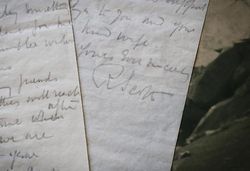
THE USUAL interpretation of the phrase “the madness of art” conjures up an attractive cliché: the writer as a creature possessed, spilling out words in a divine frenzy. This isn’t the normal experience of the practicing fiction writer, the writer who’s found a way to keep going over the long haul, and it isn’t the idea of the artist that James had in mind. Let’s listen again to Dencombe: “Our doubt is our passion and our passion is our task.” I love the fact that he uses the word “passion” and the word “task” in the same sentence—the one so exalted, the other so commonplace. More than this, I love that he equates them. Our passion is our task. To follow the calling of art, to keep faith with it, to continue with your daily labors despite the frustrations, the distractions, and the other varieties of madness that will inevitably beset you—all this requires passion, but it also requires something else, something more down-to-earth. Call it steeliness. Call it persistence. Call it tenacity. Call it resilience. Call it devotion.

more from Brian Morton at Dissent here.

European Turmoil, American Collateral

Eurozone-fears-and-politi-008Robin Wells in The Guardian's Comment is Free:

In the Netherlands, the center-right government of Mark Rutte fell, unable to cobble together a coalition to pass budget cuts required by EU fiscal rules – rules that mandate that eurozone countries run annual deficits no more than 3% of GDP, which would force stringent austerity upon the Dutch to bring down a deficit that is currently projected to be 4.6% of GDP in 2012. Rutte, along with Merkel of Germany, was a hardline advocate of the 3% fiscal discipline rules.

But given that the sober Dutch are in no danger of defaulting on their AAA-rated bonds, why the turmoil and panic? Because, perhaps, the Dutch are indeed sober – and a significant number of them have said “enough”. Having seen the devastation inflicted on the Greek, Irish and Spanish economies by tough austerity measures, many have concluded that the pain is simply not worth it to meet an arbitrary 3% deficit rule.

Moreover, Greece, Ireland and Spain have shown that meeting a deficit number in a depressed economy is akin to chasing a moving target: because budget cuts depress the economy, to achieve a one percentage point of GDP reduction in the deficit requires cutting by more than one percentage point. And when one misses one's target, even more cuts are necessary. Better, then, not to go there at all, reason the Dutch.

When markets contemplate that it's likely that another austerity-skeptic, François Hollande, will win the presidency in France, then the pattern becomes impossible to ignore: the “core” eurozone countries are fragmenting. While it would be foolish to make predictions, what is probable is that Germany's political isolation within the eurozone will deepen, leaving German taxpayers unwilling to continue backstopping the whole system.

Unthinkable as it seems, the logical conclusion is that the eurozone cannot continue to exist, at least in its present form. Markets, which hate unquantifiable uncertainty, are sensing this. We are likely to be in for an extended period of gut-wrenching turbulence.

What are the implications for the US, economically and politically? Direct links between the US and eurozone economies are fairly minor: we don't export that much to them, they don't import that much from us, and US banks have had an extended time to cut their exposure to eurozone risk. Yet the collateral damage could still prove significant.

Our Workhouses: 21st Century Chain Gangs

Chain_gang-460x307Steve Fraser and Joshua Freeman in Salon:

Sweatshop labor is back with a vengeance. It can be found across broad stretches of the American economy and around the world. Penitentiaries have become a niche market for such work. The privatization of prisons in recent years has meant the creation of a small army of workers too coerced and right-less to complain.

Prisoners, whose ranks increasingly consist of those for whom the legitimate economy has found no use, now make up a virtual brigade within the reserve army of the unemployed whose ranks have ballooned along with the U.S. incarceration rate. The Corrections Corporation of America and G4S (formerly Wackenhut), two prison privatizers, sell inmate labor at subminimum wages to Fortune 500 corporations like Chevron, Bank of America, AT&T and IBM.

These companies can, in most states, lease factories in prisons or prisoners to work on the outside. All told, nearly a million prisoners are now making office furniture, working in call centers, fabricating body armor, taking hotel reservations, working in slaughterhouses or manufacturing textiles, shoes and clothing, while getting paid somewhere between 93 cents and $4.73 per day.

Rarely can you find workers so pliable, easy to control, stripped of political rights and subject to martial discipline at the first sign of recalcitrance — unless, that is, you traveled back to the 19th century when convict labor was commonplace nationwide. Indeed, a sentence of “confinement at hard labor” was then the essence of the American penal system. More than that, it was one vital way the United States became a modern industrial capitalist economy — at a moment, eerily like our own, when the mechanisms of capital accumulation were in crisis.

What some historians call “the long Depression” of the 19th century, which lasted from the mid-1870s through the mid-1890s, was marked by frequent panics and slumps, mass bankruptcies, deflation and self-destructive competition among businesses designed to depress costs, especially labor costs. So, too, we are living through a 21st century age of panics and austerity with similar pressures to shrink the social wage.

Convict labor has been and once again is an appealing way for business to address these dilemmas.

Has Physics Made Philosophy and Religion Obsolete?

ChalkBoard01

Ross Andersen interviews Lawrence Krauss (who may be obliquely referring to David Albert's review), in The Atlantic:

Your book argues that physics has definitively demonstrated how something can come from nothing. Do you mean that physics has explained how particles can emerge from so-called empty space, or are you making a deeper claim?

Krauss: I'm making a deeper claim, but at the same time I think you're overstating what I argued. I don't think I argued that physics has definitively shown how something could come from nothing; physics has shown how plausible physical mechanisms might cause this to happen. I try to be intellectually honest in everything that I write, especially about what we know and what we don't know. If you're writing for the public, the one thing you can't do is overstate your claim, because people are going to believe you. They see I'm a physicist and so if I say that protons are little pink elephants, people might believe me. And so I try to be very careful and responsible. We don't know how something can come from nothing, but we do know some plausible ways that it might.

But I am certainly claiming a lot more than just that. That it's possible to create particles from no particles is remarkable—that you can do that with impunity, without violating the conservation of energy and all that, is a remarkable thing. The fact that “nothing,” namely empty space, is unstable is amazing. But I'll be the first to say that empty space as I'm describing it isn't necessarily nothing, although I will add that it was plenty good enough for Augustine and the people who wrote the Bible. For them an eternal empty void was the definition of nothing, and certainly I show that that kind of nothing ain't nothing anymore.

But debating physics with Augustine might not be an interesting thing to do in 2012.

Krauss: It might be more interesting than debating some of the moronic philosophers that have written about my book. Given what we know about quantum gravity, or what we presume about quantum gravity, we know you can create space from where there was no space. And so you've got a situation where there were no particles in space, but also there was no space. That's a lot closer to “nothing.”

But of course then people say that's not “nothing,” because you can create something from it. They ask, justifiably, where the laws come from. And the last part of the book argues that we've been driven to this notion—a notion that I don't like—that the laws of physics themselves could be an environmental accident. On that theory, physics itself becomes an environmental science, and the laws of physics come into being when the universe comes into being. And to me that's the last nail in the coffin for “nothingness.”

Why Do They Hate Us? The War on Women in the Middle East

Sex_elthaway_reuters-stringerMona Eltahawy in Foreign Policy:

Yes, women all over the world have problems; yes, the United States has yet to elect a female president; and yes, women continue to be objectified in many “Western” countries (I live in one of them). That's where the conversation usually ends when you try to discuss why Arab societies hate women.

But let's put aside what the United States does or doesn't do to women. Name me an Arab country, and I'll recite a litany of abuses fueled by a toxic mix of culture and religion that few seem willing or able to disentangle lest they blaspheme or offend. When more than 90 percent of ever-married women in Egypt — including my mother and all but one of her six sisters — have had their genitals cut in the name of modesty, then surely we must all blaspheme. When Egyptian women are subjected to humiliating “virginity tests” merely for speaking out, it's no time for silence. When an article in the Egyptian criminal code says that if a woman has been beaten by her husband “with good intentions” no punitive damages can be obtained, then to hell with political correctness. And what, pray tell, are “good intentions”? They are legally deemed to include any beating that is “not severe” or “directed at the face.” What all this means is that when it comes to the status of women in the Middle East, it's not better than you think. It's much, much worse. Even after these “revolutions,” all is more or less considered well with the world as long as women are covered up, anchored to the home, denied the simple mobility of getting into their own cars, forced to get permission from men to travel, and unable to marry without a male guardian's blessing — or divorce either.

Not a single Arab country ranks in the top 100 in the World Economic Forum's Global Gender Gap Report, putting the region as a whole solidly at the planet's rock bottom. Poor or rich, we all hate our women. Neighbors Saudi Arabia and Yemen, for instance, might be eons apart when it comes to GDP, but only four places separate them on the index, with the kingdom at 131 and Yemen coming in at 135 out of 135 countries. Morocco, often touted for its “progressive” family law (a 2005 report by Western “experts” called it “an example for Muslim countries aiming to integrate into modern society”), ranks 129; according to Morocco's Ministry of Justice, 41,098 girls under age 18 were married there in 2010.

From paralysis to prose

From The Independent:

JessicaJonesbyJDKelleher-smaller-199x3001987 – I was twenty-five years old and holed up in the intensive care unit at the National Neurological Hospital in London, stricken from head to toe with Guillain-Barré Syndrome. Symptoms: total paralysis. Prognosis: uncertain. Guillain Barré Syndrome is a bizarre illness. It attacks the myelin sheath that transmits messages along one’s peripheral nerves. One day my toes went numb. A week later I found myself in hospital, unable to move, breathe or speak. An unscratchable itch on my leg could propel me to the brink of insanity. Dust fell into my eyes and I couldn’t blink or wipe it away. I could not call out for assistance. Upon learning of my perilous condition, my mother had dropped everything, packed a suitcase and flown from Sydney. Now she sat by my bedside for twelve hours a day, every day. Each night mum grabbed a few hours sleep at her friends’ house; Chrissy and Ralph were devotees of an Indian guru by the name of Swamiji. When Swamiji heard of my situation he began to call my mother and tell her of his visions for me. ‘I see yellow,’ spake the guru. The next day mum arrived at the hospital laden with armfuls of daffodils and yellow tulips. She filled all the vases in the room with them. Two days later, Swamiji called again: ‘I see purple.’ Out went the daffodils, replaced by swathes of irises. Mum herself was dressed in a purple silk kimono that she’d borrowed from Chrissy. Then Swamiji made a personal appearance at the ICU, without shoes. Through his flowing grey beard he blew into my chakras. Matron tried to hustle him from the room but Swamiji resisted her. At that point Sister Mary entered the scene.

Sister Mary had been hospitalised for an acute attack of Multiple Sclerosis but was now on the bounce back. She busied herself by ambling from ward to ward with her walking stick, rescuing the souls of fellow patients. Some of those ingrates did not wish to be saved but in me she found a compliant mark. Being fully paralysed I didn’t have much choice in the matter.

More here.

The Spirit of Sisterhood Is in the Air and on the Air

Natalie Angier in The New York Times:

SisWhen first we meet Hannah, the wondrously mopey mid-20s heroine of HBO’s new hit series “Girls,” she seems to have more strikes against her than a bowling alley at Fenway Park. Her parents have cut off her monthly stipend. Her literary-magazine boss refuses to turn her unpaid internship into a real job. Her atonal lover explores his sex fantasies on her awkwardly untitillated body. She lives in New York City. She majored in English. Yet offsetting all those slings and risk factors is a powerful defense system: girlfriends. Hannah has a tight-knit network of three female confederates, one best friend and two sturdy runners-up; and while none of the girl-women can offer much material support, no spare bedroom in a rent-controlled apartment, they are each other’s emotional tourniquets. You, fat? Don’t make me laugh. An unpleasant doctor’s appointment? We’re going too. Lena Dunham, the creator and star of the series, has said that while her titular characters may all date men, female friendship is “the true romance of the show.”

As in urban jungles, so too in jungle jungles. Researchers have lately gathered abundant evidence that female friendship is one of nature’s preferred narrative tools. In animals as diverse as African elephants and barnyard mice, blue monkeys of Kenya and feral horses of New Zealand, affiliative, longlasting and mutually beneficial relationships between females turn out to be the basic unit of social life, the force that not only binds existing groups together but explains why the animals’ ancestors bothered going herd in the first place. Scientists are moving beyond the observational stage — watching as a couple of female monkeys groom each other into a state of hedonic near-liquefaction — to quantifying the benefits of that well-groomed friendship to both picking partners. Researchers have discovered that female chacma baboons with strong sororal bonds have lower levels of stress hormones, live significantly longer and rear a greater number of offspring to independence than do their less socialized peers.

More here.

Monday, April 23, 2012

Sunday, April 22, 2012

Sorry, Kashmir Is Happy

9791.kashmir-1Manu Joseph makes the case that “a historically wounded people are ready to move on,” in Open:

Trauma in Kashmir is like a heritage building—the elite fight to preserve it. ‘Don’t forget,’ is their predominant message, ‘Don’t forget to be traumatised.’ They want the wound of Kashmir to endure because the wound is what indicts India for the many atrocities of its military. This might be a long period of calm, but if the wound vanishes, where is the justice? India simply gets away with all those rapes, murders and disappearances? So nothing disgusts them more than these words: ‘Normalcy returns to Kashmir’; ‘Peace returns to the Valley’; ‘Kashmiris want to move on’.

Yet, all this is true. And for the regular people of Kashmir, who do not have second homes in North America, Europe, Dubai or Delhi, who have no choice but to continue living in Kashmir, this reality is not so disgusting.

Peace is designed to be fragile in Kashmir. Any moment, at the slightest provocation, its youth will be nudged by those who stand to gain from strife to erupt against the Indian Army, or militants may choose to stir things up to bolster the lucrative business of terrorism. But it is hard not to see that this is an extraordinary period of peace. A few days ago, Syed Salahuddin, chief of terrorist organisation Hizbul Mujahideen, confirmed something, which Kashmiris say is common knowledge—that he has withdrawn all his men from Kashmir. According to Jammu and Kashmir’s tourism minister, in 2011 more tourists visited the Valley than in recent memory. It is believed that the figure was over a million. This winter, almost all hotels in Gulmarg, a skiing destination an hour from Srinagar, were fully booked. Zahoor, who is from Srinagar and works in Gulmarg in the winters as a skiing instructor, and who taught me how to ski, says he is enjoying the peace and hordes of Indian tourists and his newfound ability to earn a decent living. Also, in Kashmir, the political stakes in ensuring that the Indian Army does not violate human rights are so high that Kashmiris today have little to complain.

The Force of the Anomaly

GinzburgPerry Anderson on Carlo Ginzburg's Threads and Traces: True False Fictive, in the LRB:

Carlo Ginzburg became famous as a historian for extraordinary discoveries about popular belief, and what was taken by its persecutors to be witchcraft, in the early modern period. The Night Battles and The Cheese and the Worms, each a case-study from the north-east corner of Italy, were followed by a synthesis of Eurasian sweep in Ecstasies. The work that has appeared since is no less challenging, but there has been a significant alteration of its forms, and many of its themes. The books of the first twenty years of his career have been succeeded by essays; by now well over fifty of them, covering a staggering range of figures and topics: Thucydides, Aristotle, Lucian, Quintilian, Origen, St Augustine, Dante, Boccaccio, More, Machiavelli, Montaigne, Hobbes, Bayle, Voltaire, Sterne, Diderot, David, Stendhal, Flaubert, Tolstoy, Warburg, Proust, Kracauer, Picasso and many more, each an extraordinary display of learning. No other living historian approaches the range of this erudition. Every page of Threads and Traces, his latest work to appear in English, offers an illustration of it. Ginzburg, who has a nominalist resistance to epochal labels of any kind, would like to override Fredric Jameson’s dictum that ‘we cannot not periodise,’ but it is impossible to grasp his achievement without recalling that the centre of his work lies in what, protestations notwithstanding, we still call the Renaissance. It is that pivot, on which his writing swings back and forth with complete ease and naturalness from classical antiquity and the church fathers across to the Enlightenment and the long 19th century, that is such a striking feature of this collection, as of its predecessors: Clues, Myths and the Historical Method; Wooden Eyes; History, Rhetoric and Proof; No Island Is an Island.

By definition Renaissance scholarship requires transhumance between ancient and early modern sources, passing across what lies between them. At its highest, the kind of philological mastery it requires can also be seen in the work of the historian with whom Ginzburg can perhaps best be compared, Anthony Grafton, another astonishing comet of learning. The two, each from Jewish families with a political background, one in Turin, the other Manhattan, share a common starting-point in seasons in London at the Warburg Institute, with the influence of Arnaldo Momigliano nearby. There is also an occasional overlap in interests – Panofsky, Jesuits, Bayle, Judaica – and perhaps some similarity in civic sensibility. The most obvious difference is the anthropological cast of Ginzburg’s best-known work, exploring popular rather than elite culture. In the past two decades, however, there has been a convergence of terrain, as Ginzburg has shifted the focus of his writing to intellectual history, where Grafton has always worked.

I.B. Singer, the Last Demon

Ibsinger_041712_620px38Adam Kirsch in Tablet Magazine:

For American Jews, one legacy of the Holocaust is a sense of guilty nostalgia toward the life of our ancestors in Eastern Europe. The nostalgia is natural enough—it is the idealization of an unknown past that is common among American immigrant groups, as Irish or Italian as it is Jewish. What makes the Jewish American experience different is the fact that our “old country” did not continue to evolve and develop after we left it, because it was violently destroyed. We treat our past with kid gloves—see, for instance, Fiddler on the Roof—because we are afraid that if we handle it too roughly it will be shattered beyond repair.

Issac Bashevis Singer had a darker, less-pious take on this overwhelming sense of fragility in “The Last Demon,” a very short tale that can be found in The Collected Stories—his single greatest book, and the one by which he is known to most readers. It takes the form of a monologue by a demon who is the last survivor of the town of Tishevitz, now that the human inhabitants have been killed in the Holocaust. This manifestation of human evil has made supernatural evil irrelevant, obsolete: “Why demons, when man himself is a demon? Why persuade to evil someone who is already convinced?” the demon-narrator asks. He himself has no one left to prey on, and no source of sustenance except an old Yiddish storybook left behind in an abandoned house: “But nevertheless the letters are Jewish. The alphabet they could not squander. I suck on the letters and feed myself. … Yes, as long as a single volume remains, I have something to sustain me.”

The parallel between demon and writer could hardly be clearer: Both are living on language, after the people who spoke the language are gone. But the story also constitutes a complaint about the incongruity of a demon, or a writer, having to take up the task of commemoration and preservation. For Singer, this was a particularly ironic fate, because the whole energy of his fiction is negative—mocking, disputatious, despairing, perverse. These are the characteristic traits of so much modern fiction that it should not be surprising to find them in Singer, a younger contemporary of Mann, Proust, and Kafka. Yet even now, 21 years after his death, there remains something odd, even transgressive, about thinking of Singer as a modernist.

A Quest to Define Hawaii

Theroux-Hawaii-islands-631Paul Theroux in the Smithsonian:

Hawaii seems a robust archipelago, a paradise pinned like a bouquet to the middle of the Pacific, fragrant, sniffable and easy of access. But in 50 years of traveling the world, I have found the inner life of these islands to be difficult to penetrate, partly because this is not one place but many, but most of all because of the fragile and floral way in which it is structured. Yet it is my home, and home is always the impossible subject, multilayered and maddening.

Two thousand miles from any great landmass, Hawaii was once utterly unpeopled. Its insularity was its salvation; and then, in installments, the world washed ashore and its Edenic uniqueness was lost in a process of disenchantment. There was first the discovery of Hawaii by Polynesian voyagers, who brought with them their dogs, their plants, their fables, their cosmology, their hierarchies, their rivalries and their predilection for plucking the feathers of birds; the much later barging in of Europeans and their rats and diseases and junk food; the introduction of the mosquito, which brought avian flu and devastated the native birds; the paving over of Honolulu; the bombing of Pearl Harbor; and many hurricanes and tsunamis. Anything but robust, Hawaii is a stark illustration of Proust’s melancholy observation: “The true paradises are the paradises we have lost.”

I think of a simple native plant, the alula, or cabbage plant, which is found only in Hawaii. In maturity, as an eight-foot specimen, you might mistake it for a tall, pale, skinny creature with a cabbage for a head (“cabbage on a stick” is its common description, Brighamia insignis its proper name). In the 1990s an outcrop of it was found growing on a high cliff on the Na Pali Coast in Kauai by some intrepid botanists. A long-tongued moth, a species of hawk moth, its natural pollinator, had gone extinct, and because of this the plant itself was facing extinction. But some rapelling botanists, dangling from ropes, pollinated it with their dabbling fingers; in time, they collected the seeds and germinated them.

Like most of Hawaii’s plants, an early form of the alula was probably carried to the volcanic rock in the ocean in the Paleozoic era as a seed in the feathers of a migratory bird. But the eons altered it, made it milder, more precious, dependent on a single pollinator. That’s the way with flora on remote islands.

When Manmohan Singh comes to Islamabad

Pervez Hoodbhoy in The Express Tribune:

ScreenHunter_04 Apr. 22 20.26…what should the two sides talk about? Surely, there are many issues but here are the top five on which progress is both necessary and, more importantly, possible.

First, let both countries agree to immediately vacate the killing ice fields of Siachen. This insane war at 22,000 feet has claimed hundreds of lives on both sides; 138 Pakistani soldiers and civilian contractors are still being searched for after a mountain of snow crashed on them last week. Maintaining control over a system of Himalayan glaciers has come at a dreadful cost to human lives and resources, and has also irreversibly polluted a pristinely pure environment. But to what end? There are no minerals in Siachen; not even a blade of grass can grow there. This is just a stupid battle between two monster-sized national egos.

Second, let them talk about water — seriously. But please have the Pakistani side well-prepared for solid technical discussions. This means having real experts with facts at their fingertips. They must know about spillway design, sediment control, DSLs, drawdowns, sluicing, etc. I have seen too many duffers represent our side at Pakistan-India meetings where water inevitably comes up. Their lack of knowledge becomes painfully apparent and the Indians start smirking.

More here.

Monet’s Ultraviolet Eye

Carl Zimmer in Download the Universe:

ScreenHunter_03 Apr. 22 14.21Late in his life, Claude Monet developed cataracts. As his lenses degraded, they blocked parts of the visible spectrum, and the colors he perceived grew muddy. Monet's cataracts left him struggling to paint; he complained to friends that he felt as if he saw everything in a fog. After years of failed treatments, he agreed at age 82 to have the lens of his left eye completely removed. Light could now stream through the opening unimpeded. Monet could now see familiar colors again. And he could also see colors he had never seen before. Monet began to see–and to paint–in ultraviolet.

We can turn light into vision thanks to the pigments in our eyes, which snatch photons and trigger electric signals that travel to our brains. We have three types of pigments tuned to violet, green, and red light. Birds, bees, and many other animals have additional pigments tuned to ultraviolet light. Ultraviolet vision has led to the evolution of ultraviolet color patterns. In some butterfly species, for example, the males and females look identical to the ordinary human eye. In UV light, however, the males sport bright patterns on their wings to attract the females. Many flowers have ultraviolet colors, often using them to get the attention of pollinating bees.

While each kind of pigment responds most strongly to a particular color, it can also respond more weakly to neighboring parts of the spectrum. The violet-tuned pigment, for example,can respond wealy to ultraviolet light, which has a higher frequency. Most of us don't get to experience that response, because our lenses filter out UV rays.

But Monet did.

More here.

THE 2012 TIME 100: Sharmeen Obaid-Chinoy

Angelina Jolie in Time:

ObaidPakistan's first Oscar belongs to a monumental campaign that is changing the legal, social and political fate of survivors of acid-related violence. Sharmeen Obaid-Chinoy's documentary Saving Face brought Pakistan's acid-violence problem to the world stage. Today she is bringing the film's message to towns and villages in Pakistan through an educational-awareness campaign. Her film not only gave her subjects sympathy and understanding but, more important, gave them dignity. The “victims” in Saving Face are some of the strongest, most impressive women you will ever come across. She showed us their scars, and we saw their true beauty.

Obaid-Chinoy, 33, is also shaping the dialogue on Pakistan. Saving Face depicts a Pakistan that is changing — one where ordinary people can stand up and make a difference and where marginalized communities can seek justice. New legislation spearheaded by female parliamentarians will impose stricter sentencing on perpetrators of acid-related violence. This is a huge step forward. Giving voice to those who cannot be heard, Obaid-Chinoy has made over a dozen award-winning films in more than 10 countries. She celebrates the strength and resilience of those fighting against seemingly insurmountable odds — and winning.

I dare anyone to watch this film and not be moved to tears and inspired into action.

Sunday Poem

Pebble

The pebble
is a perfect creature

equal to itself
mindful of its limits

filled exactly
with a pebbly meaning

with a scent that does not remind one of anything
does not frighten anything away does not arouse desire

its ardour and coldness
are just and full of dignity

I feel a heavy remorse
when I hold it in my hand
and its noble body
is permeated by false warmth

–Pebbles cannot be tamed
to the end they will look at us
with a calm and very clear eye
.

Zbigniew Herbert
Translated by Peter Dale Scott and Czeslaw Milosz

The Many Sides Of Hillary Clinton

From Huffington Post:

HILLARY-largeWe came across Sarah Ferguson's “Hillary & I” series a while back, and marveled at the coy and arresting paintings of the Secretary of State. We just never thought of Hillary in that way before. But after “Texts from Hillary” we began to seriously consider the multiple facets of this dynamic woman. And then we saw the Buzzfeed article, where a nude Hillary gazed down upon us from a lonely New York apartment window. Where did this come from? And who would paint such a thing? We had to ask the artist about it. Sarah Ferguson was there to answer our queries.

HP: On “In Belief We Change,” you riff on “Diamonds are a girl's best friend”: “But when mean affairs / are a girl's best friend, / a lass needs a lawyer / and a hard-boiled employer.” How do you see Hillary as embodying Marilyn Monroe?

SF: I’m not sure that I do. In fact the paintings of Hillary as Marilyn embody someone more like Anna Nicole Smith. It’s more of a caricature of femininity. For me the feminine is encoded in form, not cosmetic adornment, so I don’t read high heels, short skirts, makeup, hairstyle etc, as intrinsically feminine at all. It’s just what most women do to mate. But Hillary’s appeal transcends that. I mean when someone says, “Hillary is hot!” they’re responding to something else, something inside her. Maybe it’s her martial energy, her facility with language, her confidence or some combination of those things and her curves. I don’t know, but whatever the thing is about Hillary both men and women respond to it, especially her male counterparts around the globe. They totally dig her. So in that world, she is a modern day Marilyn, hence the rip on “Diamonds are a girls best friend.” Of course in Hillary’s case, political clout trumps diamonds.

More here.

Saturday, April 21, 2012

BFF?: Cell Phone Study Shows Evolving Lifetime Relationships in Men and Women

Bff-cell-phone-call-study_1

Daisy Yuhas in Scientific American:

An analysis of 1.95 billion cell phone calls and 489 million text messages reveal how men and women follow different relationship patterns during their lifetimes. The researchers argue that women's friendships in particular drive the process of finding a mate and supporting the next generation.

The data could also undermine traditional notions about how humans like to organize themselves. “There has been a view in anthropology that the ancestral state for humans is a form of patriarchy, and I'm not sure that that's true,” says University of Oxford anthropologist Robin Dunbar, an author of the study published April 19 by Nature Scientific Reports. (Scientific American is a part of Nature Publishing Group.)

Dunbar and an interdisciplinary team examined cell phone data from a single provider in an undisclosed European country. (Specific locations were kept anonymous to protect cell phone users' identities.) The researchers worked with data gathered over a seven-month timeframe and restricted themselves to studying communications between cell phone users of a known age and sex, making a data set of about 3.2 million subscribers, or about 20 percent of the nation's cell phone users. Working on the assumption that close friends communicate most frequently, the team analyzed the top three friendships of each cell phone user based on the frequency of communication to spot patterns in the average male or female user at various ages.

The researchers expected to find “homophily,” or the tendency for an individual to pick a friend like him or herself. Instead, it seems that romance trumps other forms of friendship: The data revealed that an individual's best friend, particularly in one's 20s and 30s, happens to be someone of the opposite sex and a similar age. In addition, striking differences exist in how men and women communicate with their presumed romantic partner. For one, the man in a woman's life was her very best friend for roughly 15 years, compared with seven years in the case for men. The peak age for partner parlance also differed: 27 years old for women and 32 for men.

After age 50, however, things change. The preference for a romantic partner peters out in both men and women, and toward the oldest age range in the data set, both sexes seek companionship first and foremost.

What a Hollande Victory Would Mean for Merkel

Image-341096-panoV9free-vhzcVeit Medick and Severin Weiland in Spiegel:

As Europe continues to integrate both economically and politically, the outcomes of national elections have grown in importance to reach beyond their own borders. German Chancellor Angela Merkel knows that, and it's why she will travel on Sunday to Paris, where voters will be heading to the polls in the first round of the French presidential elections.

Conservative French President Nicolas Sarkozy is fighting for a second term, but he has a strong opponent. The Socialist candidate, François Hollande, has a good chance of moving into the Élysée Palace. The latest polls show Hollande leading in the first round of voting, as well as in the possible run-off vote on May 6.

For Merkel, this is an election like no other, and one that is even more important to her than many German state elections. Whoever wins in France will help drive European policy by her side. If the victor proves to be Hollande, who differs with Merkel's closely allied partner Sarkozy on many issues, not the least of which involve rescuing of the euro, things could become uncomfortable for her, both in Brussels and at home in Berlin.

The election in France could even alter the political landscape ahead of Germany's upcoming federal election in 2013. The center-left Social Democrats (SPD), who are trailing the chancellor in recent polls, desperately need a boost. If Hollande were to win, it would send a signal that social democracy in Europe, and in Germany, is still a force to be reckoned with. That's how party members see it, at least.