3QD Arts & Literature Prize Finalists 2012

Hello,

Finalist_2012_Art_LitThe editors of 3QD have made their decision. The twenty semifinalists have been winnowed down and wildcards added. Thanks to all the participants. (Details about the prize here.)

Once again, Carla Goller has provided a “trophy” logo that our finalists may choose to display on their own blogs. And if you like our site, please do add us to your blogroll and tell your friends.

So here is the final list that I am sending to Gish Jen who will select the 1st, 2nd, and 3rd prize winners (given here in alphabetical order by blog name):

  1. 3 Quarks Daily: The Last Novel
  2. Guernica: Rape, Revisited
  3. Numéro Cinq: My First Job
  4. Occasional Planet: Navigating the waters of our biased culture
  5. Philip Graham: What Casablanca Can Teach A Writer
  6. Tang Dynasty Times: Leonardo in the Gilded Age
  7. The Best American Poetry: Spend It All
  8. The Millions: Sister Carrie
  9. The Nervous Breakdown: Secret Theatres

We'll announce the three winners on March 19, 2012.

Good luck!

Abbas

P.S. The editors of 3QD will not be making any comments on our deliberations, or the process by which we made our decision, other than to simply say that we picked what we thought were the best six posts out of the semifinalists, and added up to three others that we also liked.

Like it or not, Edith Wharton’s looks and Saul Bellow’s sexual problems do shed light on their work

From Salon:

Wharton_bellow-460x307Just how relevant is an author’s private life to our appreciation or understanding of his or her work? Many would argue that we should disregard it entirely. Others (myself included) might point out that while you can thoroughly enjoy a novel or poem without knowing who wrote it, any deeper grasp requires at least some basic information. It matters that Edna O’Brien is Irish, certainly, and it’s almost impossible to imagine how the writings of Jack Kerouac or Charles Bukowski could be separated from their life stories. This question came up recently in the response to an essay about Edith Wharton that appeared in the New Yorker. The author of the essay, Jonathan Franzen, has been a tennis ball of sorts in recent debates about the relative prestige awarded to male and female novelists: Batted around by the combatants as an example of male privilege, he’s mostly refrained from weighing in with his own views. The Edith Wharton piece has offered that rare chance to assail him for what he has said, rather than what others have said about him.

The premise of Franzen’s essay is that he has sometimes found Wharton “unsympathetic” because of her own privilege — of class and wealth, rather than gender — and her fairly imperious enjoyment of its benefits, but that an assortment of misfit traits, above all her desire to be a writer, ultimately won him over. This inspires a long exploration of the ways that novelists use a character’s desire and pursuit of some goal to kindle sympathy for that character even when he or she is an unpleasant person seeking a shabby prize. (The example he uses is the vulgar Undine Spragg in Wharton’s “The Custom of the Country.”) What most irritates critics of the essay, however, are Franzen’s references to Wharton’s looks: She “did have one potentially redeeming disadvantage,” he writes, “she wasn’t pretty.” Although Franzen means this as a tick in the plus column for Wharton, it has been widely — and most eloquently by Victoria Patterson in the Los Angeles Review of Books — interpreted as “ranking a woman’s beauty before discussing her merits.” Patterson goes on to write, “Do we even have to say that physical beauty is beside the point when discussing the work of a major author? Was Tolstoy pretty? Is Franzen? Wharton’s appearance has no relevance to her work.” Patterson also insists that Wharton wasn’t “preoccupied with her own looks” and that her “appearance wasn’t problematic” in her own milieu.

More here.

Biopsy gives only a snapshot of tumour diversity

From Nature:

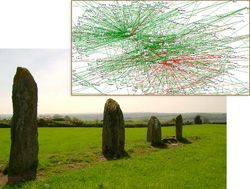
TumorA tumour can be a hotbed of diversity, British scientists have discovered. Just as different types of tumours have distinct genetic mutations, so do separate parts of the same tumour. Findings in a study published in the New England Journal of Medicine1 help to explain why cancer is so difficult to study and treat. A clinician's conclusion about prognosis or the best course of treatment can be contradictory depending on which part of the tumour the biopsy is taken from. “This adds another layer of complexity,” says Charles Swanton from Cancer Research UK’s London Research Institute, who led the study. “It makes flying to the Moon look like a walk in the park.”

As part of a clinical trial, Swanton’s team did a detailed analysis of the tumours of four patients with kidney cancer. They collected samples from several parts of the main tumours at various times during the trial, as well as from the organs to which the cancer had spread. Then every sample was analysed to look at its mutations, patterns of genetic activity, chromosome structure. “We used every possible genomics technique available. Even then we were only scratching the surface,” says Swanton. The team used its results to reconstruct the evolutionary history of each cancer. For example, the first patient’s tumour had split down two lines. One small part had double the usual tally of chromosomes and had seeded all the secondary tumours in the patient’s chest. The other branch had spawned the rest of the primary tumour’s mass. Similar results were seen in the other patients.

More here.

pragmatist dreamer

Vaclav-havel

A philosopher king Havel was not. The Czech presidency did not even entail enough power to make that possible. But if there ever was something like the “king of all dissidents”, Havel was it. No other active head of state has done more than Havel for those who have been politically persecuted – often at considerable political cost. Whether he was calling for more political freedom in Burma (he nominated Aung San Suu Kyi for the Nobel peace prize), supporting human rights activists in Belorussia, Cuba or Ukraine, his voice was heard. His inspirational actions found resonance well beyond the reach of a small country. It is often said that the problem in Russia has been that it does not have its own Havel.[11] It has always had Havel’s support though. One of the very last public interventions that Havel made through his writing was a contribution he wrote for the major Russian opposition newspaper Novaya Gazeta. It was only published after Havel’s death. As the newspaper commented, Havel was “hurrying to tell people something very important. He succeeded – read it.” In the short article, Havel urged his Russian counterparts to continue in their struggle for “basic rights and liberty”; a struggle that can only succeed if more and more people get involved in it. Echoing his argument in the “Power of the powerless”, Havel argued that “the most serious danger for Russia is people’s indifference and apathy”.[12]

more from Stefan Auer at Eurozine here.

beautiful souls

Article00

The horrors of the twentieth century left artists and thinkers preoccupied with the problem of evil. How could Germans herd Jewish families into the gas chambers? How could Serbs turn on their Bosnian neighbors, or Hutus pick up machetes and carry out the bloody work of genocidaires? In Beautiful Souls, Eyal Press takes on a different challenge, more suited to the twenty-first century: He suggests that the true mystery is not what impels ordinary people into the moral abyss, but rather how some people manage to avoid the abyss altogether, by refusing to participate in atrocities. For every horror, there are courageous, conscientious resisters: Germans who hid Jews, Hutus who saved Tutsis, Serbs who saved Muslims. Even the more quotidian forms of evil always generate some resistance: Consider the Enron scandal’s whistle-blowers. But what enables some to resist while most go along? Beautiful Souls, Press writes, is about “nonconformists, about the mystery of what impels people to do something risky . . . when thrust into a morally compromising situation: stop, say no, resist.”

more from Rosa Brooks at Bookforum here.

the fantasies of a madman can seem so lucid

Roussel-448

“Whatever I wrote was surrounded by rays of light,” a young Raymond Roussel told his psychoanalyst, Pierre Janet. “I used to close the curtains, for I was afraid that the shining rays emanating from my pen might escape into the outside world through even the smallest chink; I wanted suddenly to throw back the screen and light up the world.” Roussel was speaking literally, and Janet, who would treat Roussel for years, was taking notes. Though nobody knows for sure, it’s suspected that Roussel first started seeing Janet in the years just before World War I, almost a decade after that first ecstatic experience he described in their early sessions. The manic spell coincided with the editing of La Doublure, a novel in verse that took most of Roussel’s adolescence to complete and that he believed “would illuminate the entire universe” when it was published. When it finally was published in 1897, La Doublure was ignored by critics. The reception to his obsessively detailed and obviously unsalable work ushered in a lifelong series of public disappointments for Roussel, a writer whose work was met—in his own words—with “an almost totally hostile incomprehension.”

more from Alice Gregory at Poetry here.

Wednesday, March 7, 2012

The Acquisitive Gaze and/or Social Network of One’s Own

Henry-james-383x293Two pieces on the latest internet superphenomenon, Pinterest: first, Rob Horning in New Inquiry:

Pinterest has entered the mainstream, as a para-retailing apparatus presumed to appeal mainly to women. The site’s supposed femaleness has occasioned a lot of theorizing, some of which Nathan Jurgenson details in this post, as has its anodyne commerciality. Bon Stewart argues that Pinterest, since it discourages self-promotion and relies entirely on the appropriation of someone else’s creative expression, turns curation into passive consumerism; it allows for the construction and circulation of a bland sanitized “Stepford” identity. In other words, it becomes another tool for enhancing our digital brands at the expense of the possibility of an uncommodified self.

Give that emphasis on passive consumption, it’s not surprising that Pinterest has come to be associated with shopping fantasies. Pinterest’s great technological advance seems to be that it lets users shop for images over the sprawl of the internet, turning it into a endless visual shopping mall in which one never runs out of money. Chris Tackett suggests that sites like Pinterest are actually “anti-consumerist” because they allow people the instant gratification of choosing things without actually having to buy them. “Virtual consumerism means a real world reduction in wasteful consumption,” he writes, and that’s all well and good, though I’m not sure that making window shopping more convenient is in any way “anticonsumerist.” If anything that seems to reinforce the consumerist mentality while overcoming one of its main obstacles — people’s financial inability to perpetually shop. With Pinterest, they can at least simulate that experience, acquiring the images of things and associating them with themselves, appropriating the qualities the goods/images are thought to signify at that given moment. Pinterest allows for the purest expression of the Baudrillardian “passion for the code” that we’ve yet seen.

Second, Amanda Marcotte in The American Prospect:

It doesn’t take long for a blog-loving feminist to find the ugliness of the “ew, girly!” reaction. Women dominate on Pinterest—around 70 percent of users are female—and the site drives more traffic to commercial sites than Google+, YouTube, and LinkedIn combined. Pinterest's popularity means that the male-dominated world of tech blogging has no choice but to pay attention, but they won't go down without a fight. Mean-spirited graphics and blog posts saying that women are an alien species one shouldn’t care to understand proliferated. The sexism prompted bloggers like Tracie Egan Morrissey, Kristy Sammis, and Rebecca Hui to write full-throated defenses of the site. And not despite its girliness, but because of it.

Web Sites Shine Light on Petty Bribery Worldwide

BRIBE-articleLargeStephanie Strom in the NYT:

The cost of claiming a legitimate income tax refund in Hyderabad, India? 10,000 rupees.

The going rate to get a child who has already passed the entrance requirements into high school in Nairobi, Kenya? 20,000 shillings.

The expense of obtaining a driver’s license after having passed the test in Karachi, Pakistan? 3,000 rupees.

Such is the price of what Swati Ramanathan calls “retail corruption,” the sort of nickel-and-dime bribery, as opposed to large-scale graft, that infects everyday life in so many parts of the world.

Ms. Ramanathan and her husband, Ramesh, along with Sridar Iyengar, set out to change all that in August 2010 when they started ipaidabribe.com, a site that collects anonymous reports of bribes paid, bribes requested but not paid and requests that were expected but not forthcoming.

About 80 percent of the more than 400,000 reports to the site tell stories like the ones above of officials and bureaucrats seeking illicit payments to provide routine services or process paperwork and forms.

“I was asked to pay a bribe to get a birth certificate for my daughter,” someone in Bangalore, India, wrote in to the Web site on Feb. 29, recording payment of a 120-rupee bribe in Bangalore. “The guy in charge called it ‘fees’ ” — except there are no fees charged for birth certificates, Ms. Ramanathan said.

Now, similar sites are spreading like kudzu around the globe, vexing petty bureaucrats the world over.

The Inequality Puzzle in U.S. Cities

LargestRichard Florida in The Atlantic:

What lies behind the inequality of American cities? The conventional explanation blames the rise of the globalized, knowledge economy which has eliminated family-supporting factory jobs and cleaved the workforce into high-paying, high-skill and low-paying, low-skill jobs. But, as I wrote in my previous post, wage inequality only explains a very small part of income inequality.

How to explain this apparent discrepancy? What other factors lie behind rising inequality across America's cities?

To answer that question, I reviewed several powerful theories that try to explain persistent economic and social disadvantage across cities.

The first focuses not just on trends in skills and wages, but on shifts in populations. Christopher Berry and Edward Glaeser noted the divergence of human capital levels across cities in 2005. In his book, The Big Sort, Bill Bishop shows how America is becoming increasingly sorted and divided by skill, economic position and political differences. Writing in the magazine, I dubbed this the “means migration.”

A detailed study published by the National Bureau of Economic Research found inequality to be higher in larger cities and metros (which attract more highly skilled people). Size (measured as population) alone accounted for roughly 25 to 35 percent of the total increase in economic inequality across metros over the past three decades, after other key factors were taken into account.

A second calls attention to declining rates of unionization. In The Great U-Turn, economists Bennett Harrison and Barry Bluestone blame the attack on and the decline in unions for undermining wages not just for unionized workers but for reducing the so-called wage floor for workers in the broader economy.

A third focuses on the intersection of race, poverty and economic disadvantage.

Hari Kunzru on ‘Gods Without Men’

KunzruAmitava Kumar talks to the author in The Paris Review:

Hari Kunzru’s latest novel, Gods Without Men, is being released in the U.S. today. Set in the Mojave Desert, the novel is an echo chamber for stories divided across more than two centuries. The clever symmetries that link the stories reveal the bleached bones of American identity—racial mixing, violence, an unending contest over the politics of meaning and faith. This is Kunzru’s fourth novel; his debut, The Impressionist, appeared in 2003 and was followed by Transmission (2004) and My Revolutions (2007). I conducted this interview by e-mail, but I saw Kunzru only a few weeks ago, in late January, at the Jaipur Literature Festival. He had done a public reading from Salman Rushdie’s The Satanic Verses , a book banned in India since its publication more than two decades ago. Rushdie had been scheduled to appear at the festival but, because of threats to his life, decided to stay away. When I last saw Kunzru, it was close to midnight and he was making calls to lawyers overseas. He had been informed that he was facing arrest. The next day, on legal advice, Kunzru left the country.

The first time I read about you, you were described as having “a nonspecifically exotic appearance” that marked you “as a potential native of about half the world’s nations.” How do you usually explain your origins?

I was born in London. Depending on who I’m talking to, and how I feel, I might describe myself simply as a Londoner, British (that one’s only crept in since I came to live in New York—to anyone in the UK, it’s weirdly meaningless), English, the son of an Indian father and an English mother, Kashmiri Pandit, rootless cosmopolitan …

How did Gods Without Men come about?

I got stuck in Los Angeles on 9/11. I’d been in California for a couple months and was supposed to fly home to England the next day, which was not going to happen. I had a weird experience involving trying to give back a little rented Japanese sportscar with Arizona plates, freeways being closed, getting lost and driving round the perimeter of ghostly, closed LAX on the tensest day in modern American history. Then it involved the LAPD and firearms. Only my English accent stopped the fuckers arresting me. It wouldn’t work so well now with cops and immigration people in the Western U.S.—they’ve got English-accented Pakistanis on their radar. Anyhow, I got away unshot and found West Hollywood full of freaked out hipsters telling each other someone was about to fly planes into the Hollywood sign. People were losing their minds.

Sleeping with the Enemy: What happened between the Neanderthals and us?

From The New Yorker:

NeanAt any given moment, Pääbo has at least half a dozen research efforts in progress. When I visited him in May, he had one team analyzing DNA that had been obtained from a forty- or fifty-thousand-year-old finger bone found in Siberia, and another trying to extract DNA from a cache of equally ancient bones from China. A third team was slicing open the brains of mice that had been genetically engineered to produce a human protein. In Pääbo’s mind, at least, these research efforts all hang together. They are attempts to solve a single problem in evolutionary genetics, which might, rather dizzyingly, be posed as: What made us the sort of animal that could create a transgenic mouse?

The question of what defines the human has, of course, been kicking around since Socrates, and probably a lot longer. If it has yet to be satisfactorily resolved, then this, Pääbo suspects, is because it has never been properly framed. “The challenge is to address the questions that are answerable,” he told me. Pääbo’s most ambitious project to date, which he has assembled an international consortium to assist him with, is an attempt to sequence the entire genome of the Neanderthal. The project is about halfway complete and has already yielded some unsettling results, including the news, announced by Pääbo last year, that modern humans, before doing in the Neanderthals, must have interbred with them. Once the Neanderthal genome is complete, scientists will be able to lay it gene by gene—indeed, base by base—against the human, and see where they diverge. At that point, Pääbo believes, an answer to the age-old question will finally be at hand. Neanderthals were very closely related to modern humans—so closely that we shared our prehistoric beds with them—and yet clearly they were not humans. Somewhere among the genetic disparities must lie the mutation or, more probably, mutations that define us. Pääbo already has a team scanning the two genomes, drawing up lists of likely candidates.

More here.

The Art of Waiting

From Orion Magazine:

ArtMy name is called, and a doctor I’ve never met performs a scan of my ovaries. I take notes in a blank book I’ve filled with four-leaf clovers found on my river walks: Two follicles? Three? Chance of success 15–18 percent. On the way out, I steal the journal with the monkey on the cover. Back home, under the canopy of oak and hickory trees, I open the car door and sound rushes in, louder after its absence. Cicada song—thousands and thousands of males contracting their internal membranes so that each might find his mate. In Tennessee it gets so bad that a man calls 911 to complain because he thinks it’s someone operating machinery.

A FEW DAYS LATER, I visit the North Carolina Zoo, where Jamani, the pregnant gorilla, seems unaware of the dozens of extra visitors who have come to see her each day since the announcement of her condition. She shares an enclosure with Acacia, a socially dominant but somewhat petite sixteen-year-old female, and Nkosi, a twenty-year-old, 410-pound male. The breeding of captive lowland gorillas is managed by a Species Survival Plan that aims to ensure genetic diversity among captive members of a species. That means adult female gorillas are given birth control pills—the same kind humans take—until genetic testing recommends them for breeding with a male of the same species. Even after clearance, it can take months or years for captive gorillas to conceive. Some never do. Humans have a long history of imposing various forms of birth control and reproductive technologies on animals, breeding some and sterilizing others. In recent years, we’ve even administered advanced fertility treatments to endangered captive animals like giant pandas and lowland gorillas. These measures, both high- and low-tech, have come to feel as routine as the management of our own reproduction. We feel responsible when we spay and neuter our cats and dogs, proud when our local zoos release photos of baby animals born of luck and science.

More here.

3QD Arts & Literature Prize Semifinalists 2012

Hello,

The voting round of our arts & literature prize (details here) is over. A total of 1,029 votes were cast for the 56 nominees (click here for full list of nominees). Thanks to the nominators and the voters for participating.

Carla Goller has designed a “trophy” logo that our top twenty vote-getters may choose to display on their own blogs. So here they are, in descending order from the most voted-for:

  1. Semifinalist_2012_Art_LitShelf Actualization: Brave New World vs. Nineteen Eighty-Four
  2. Occasional Planet: Navigating the waters of our biased culture
  3. The Nervous Breakdown: Secret Theatres
  4. Tang Dynasty Times: Leonardo in the Gilded Age
  5. 3 Quarks Daily: PINA — a 3D Documentary Film by Wim Wenders
  6. Need to Know on PBS: Excuse me, I'm having a Macbeth moment
  7. 3 Quarks Daily: Adagio in Blues
  8. Sanchari Sur: Scheherazade’s One Thousand and One Arabian Night(mare)s
  9. The Millions: Sister Carrie
  10. 3 Quarks Daily: The Last Novel
  11. Pandaemonium: Antigone Across the Ages
  12. Eyewear: Harlow on Four Zimbabwean Poets
  13. Numéro Cinq: The Formalist Reformation, A Review of Viktor Shklovsky’s Bowstring: On the Dissimilarity of the Similar
  14. Big Think: Will Neuroscience Kill the Novel?
  15. Salon: Whole Foods Was Around the Corner
  16. Kristine Ong Muslim: Bonsai-keeping and the rate of crystal growth
  17. More Quasar: Graham Harman and the Queen of the Blues
  18. Numéro Cinq: My First Job
  19. Rebecca Nemser: Hans Wegner / The Bear Chair
  20. The Millions: Irène Némirovsky, Suite Française, and The Mirador

The editors of 3 Quarks Daily will now pick the top six entries from these, and after possibly adding up to three “wildcard” entries, will send that list of finalists to Gish Jen for final judging. We will post the shortlist of finalists here in the next day or two.

Good luck!

Abbas

Winston’s Hiccup

Borderlines-saudi-blog427

“I think I’ll write a book today,” the writer Georges Simenon was said to tell his wife at breakfast. “Fine,” she would reply, “but what will you do in the afternoon?” Winston Churchill was similarly prolific, and not just in the field of letters [1]. In his later years, he liked to boast that in 1921 he created the British mandate of Trans-Jordan, the first incarnation of what still is the Kingdom of Jordan, “with the stroke of a pen, one Sunday afternoon in Cairo” [2]. Also like Simenon, Churchill wasn’t averse to the odd tipple, and according to some, that Sunday afternoon in Cairo followed a particularly liquid lunch. As a consequence, the then colonial secretary’s [3] penmanship proved a bit unsteady, allegedly producing a particularly erratic borderline. The result is still visible on today’s maps: the curious zigzag of the border between Jordan and Saudi Arabia.

more from Frank Jacobs at The Opinionater here.

laughing at The Great Pu

192_feature_polonsky

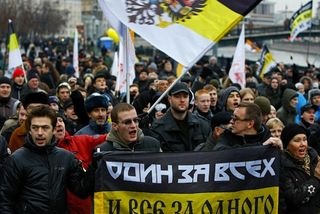
In Russia, poetry can make things happen. In February 2011—two months after the handsome young lawyer Alexei Navalny launched his game-changing anti-corruption website, Rospil.info—a writer, an actor and a theatre producer teamed up on a different kind of internet project, which they called Citizen Poet. Every week, Dmitri Bykov weaves a verse pastiche of a well-known poet out of some event in politics, which Mikhail Yefremov—a prodigious mimic with wickedly twinkling eyes—then delivers in fancy dress. Citizen Poet was an immediate cultural sensation. The first clip was about the farcical second show-trial of Putin’s enemy, the former Yukos oil magnate Mikhail Khodorkovsky. The second was a parody of the Romantic poet Mikhail Lermontov, in which “Vova” (Vladimir Putin) talked to “Dima” (Dmitri Medvedev) about the terrifying possibility of an Arab Spring in Moscow: “We are not in Tunis, not in Cairo/ We are in Russia, like mice in cheese/ and the Arab variant is not for Russia.” In August, after Putin was filmed in diving gear, retrieving two 6th-century BC amphorae from the Black Sea bed, Yefremov, reciting a parody of a poem by Osip Mandelstam, pulled a mini amphora out of a fishtank. Was it coincidence that the Kremlin press spokesman conceded soon afterwards that Putin’s archaeological diving feat had been staged? Citizen Poet made it fashionable to laugh at Putin and Medvedev. The Moscow elite paid high prices to watch Bykov and Yefremov perform in theatres and clubs. While notching up millions of online hits as new clips appeared without fail every Monday morning, Citizen Poet toured the cities of Russia.

more from Rachel Polonsky at Prospect Magazine here.

Wisława Szymborska’s funeral on a snowy day in Kraków

Szymborska-300x226

I missed the news of Wisława Szymborska‘s funeral earlier this month, and only just found this youtube clip of the quiet, secular ceremony that nevertheless attracted more than a thousand people in a Polish winter. According to the Associated Press: Freezing temperatures and falling snow at the Rakowicki Cemetery in the southern city of Kraków, where Szymborska lived, did not discourage the mourners, including Prime Minister Donald Tusk, writers and actors, from attending the ceremony. An urn with Szymborska’s ashes was placed in the family tomb, where her parents and sister are buried, to a recording of Ella Fitzgerald, Szymborska’s favorite singer, singing “Black Coffee.” The poet was a heavy smoker and a lover of black coffee. “In her poems, she left us her ability to notice the ordinary, the tiniest particles of beauty and of the joy of the world,” President Bronisław Komorowski said. “She was a Krakowian by choice,” said Kraków mayor Jacek Majchrowski in the clip below. “The climate agreed with her, so did the people.”

more from Cynthia Haven (and a link to a clip of the ceremony) at The Bookhaven here.

Tuesday, March 6, 2012

Loose Lips

From The Paris Review:

It is perfectly monstrous the way people go about, nowadays, saying things against one behind one’s back that are absolutely and entirely true.

—Oscar Wilde, The Picture of Dorian Gray

GossipSeveral writers have weighed in recently on this age-old human foible that is gossip, with varying levels of success. In The Virtues of Our Vices: A Modest Defense of Gossip, Rudeness, and Other Bad Habits, philosopher Emrys Westacott examines the ethics of several conventionally frowned-upon social transgressions and “moral failings” like rudeness, snobbery, and, of course, gossip. He begins his examination of the subject by posing the big-picture questions: Should we condemn all gossip? If gossip isn’t an “inherently pejorative” act, can it ever be acceptable or even beneficial? Westacott finds compelling ethical justifications for the innocent pleasure so many of us take in slamming our friends and loved ones. Yes, when it’s malicious and untrue, he allows, gossip can ruin reputations and damage lives. But the right kind of gossip—about, say, unwarranted salary discrepancies, or sketchy undisclosed conflicts of interest—can be a force of good. Behind-the-scenes murmurings build relationships, provide emotional catharsis, counteract secrecy, and upend existing power structures, to name just a few benefits. In the end, Westacott concludes, “a willingness to talk about people—which at times will involve gossiping—may be an integral part of the ‘examined life.’”

Another recent book, Joseph Epstein’s Gossip: The Untrivial Pursuit, takes Westacott’s claim that there’s no such thing as “no one else’s business” to new heights—and depths. The extended essay takes as a given that “[o]ther people are the world’s most fascinating subject,” which I for one certainly wouldn’t dispute. From there Epstein veers back and forth between disquisitions on the meaning, importance, and history of gossip to delectable tidbits on everyone from Arthur Miller (who dumped his disabled child in an institution for life!) to Fidel Castro (who did it with Kenneth Tynan’s wife!).

More here.

The Lethal Gene That Emerged in Ancient Palestine and Spread Around the Globe

Jeff Wheelwright in Discover:

JewishgeneThe breast-cancer mutation 185delAG entered the gene pool of Jews some 2,500 years ago, around the time they were exiled to Babylon. Random and unbidden, the mutation appeared on the chromosome of a single person, who is known as the founder. In the same sense that Abraham is said to have founded the Jewish people, scientists call the person at the top of a genetic pyramid a founder. This particular founder was born missing the letters A (for adenine) and G (guanine) from the DNA chain at the 185 site on one copy of his or her BRCA1 gene. BRCA1 is a tumor-suppressor gene; the deletion of the two letters disabled its protective function. But the mutation wasn’t immediately harmful to the founder because he or she had another copy of the gene that worked.

Researchers have no idea who the founder was, but they can deduce from historical evidence when he or she lived. When Jews were permitted to return to Jerusalem after their captivity in Babylon, not all the exiles went home. The ones who stayed behind are the ancestors of Iraqi Jews, whose numbers are today much reduced but who for centuries constituted a venerable center of the faith. In addition to the Jews living in Mesopotamia and Jerusalem, satellite immigrant communities sprang up elsewhere in the Middle East. A decentralization of the gene pool had begun, and the distances between groups acted as barriers to the exchange of DNA, barriers that have persisted into the modern day. When scientists in Israel tested BRCA1 carriers from the dispersed Jewish populations, they discovered that all shared the same basic spelling in the genetic region of 185delAG. But some of the matches between Jewish groups were off by a letter or two, which indicated minor changes since the groups had split. Rolling back the demographic clock, the scientists inferred that its founder must have lived before the groups divided—that is, prior to the Babylonian watershed.

More here.