Laughter

What is laughter? What is laughter?

It is God waking up! O it is God waking up!

It is the sun poking its sweet head out

From behind a cloud

You have been carrying too long,

Veiling your eyes and heart.

It is Light breaking ground for a great Structure

That is your Real body – called Truth.

It is happiness applauding itself and then taking flight

To embrace everyone and everything in this world.

Laughter is the polestar

Held in the sky by our Beloved,

Who eternally says,

“Yes, dear ones, come this way,

Come this way towards Me and Love!

Come with your tender mouths moving

And your beautiful tongues conducting songs

And with your movements – your magic movements

Of hands and feet and glands and cells – Dancing!

Know that to God's Eye,

All movement is a Wondrous Language,

And Music – such exquisite, wild Music!”

O what is laughter, Hafiz?

What is this precious love and laughter

Budding in our hearts?

It is the glorious sound

Of a soul waking up!

by Hafiz
from I Heard God Laughing – Renderings
of Hafiz by Daniel Ladinsky
Is Family Dinner Overrated?

From Ann Meier and Kelly Musick in the NYTimes:

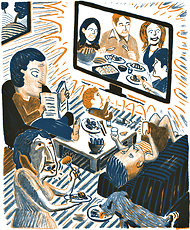
FamilydinnerDozens of studies in the past decade have found that teenagers who regularly eat dinner with their families are healthier, happier, do better in school and engage in fewer risky behaviors than teenagers who don’t regularly eat family dinners. These findings have helped give dinnertime an almost magical aura and have led to no small amount of stress and guilt among busy moms and dads.

But does eating together really make for better-adjusted kids? Or is it just that families that can pull off a regular dinner also tend to have other things (perhaps more money, or more time) that themselves improve child well-being?

More here.

Higgs boson rumours fly as Cern prepares to announce latest results

Alok Jha in The Guardian:

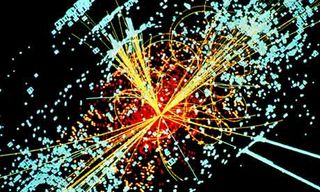
Simulated-collision-of-pr-008As soon as scientists at Cern revealed that they would host a seminar on 4 July to announce the latest results from its two main Large Hadron Collider (LHC) experiments, Atlas and CMS, physicists and bloggers started guessing. Would they announce the long-awaited discovery of the Higgs boson, a find that would be sure to trigger a raft of Nobel prizes and launch a new era of physics?

In December last year, Cern scientists glimpsed something that looked like it might be a Higgs boson in their data, but the results were not conclusive enough to be formally called a discovery. But now hopes are high.

“We now have more than double the data we had last year,” said Sergio Bertolucci, Cern's director for research and computing. “That should be enough to see whether the trends we were seeing in the 2011 data are still there, or whether they've gone away. It's a very exciting time.”

Even if the scientists next week report the signal for a new type of particle, it will take time to convince the scientific community that it is indeed the Higgs boson, or whether it is something else, perhaps something even more exotic that opens the door to new theories of physics.

More here.

The case for a world republic

Tad Daley in Bulletin of the Atomic Scientists:

0804756325Lawrence Wittner's 2009 book, Confronting the Bomb: A Short History of the World Nuclear Disarmament Movement, has an overarching message that will surprise even nuclear policy experts, because Wittner starts with an incontrovertible historical fact almost wholly forgotten today: For several years after Hiroshima, the ultimate aspiration of the disarmament crowd was not just to eliminate nuclear weapons, but to create a federal republic of the world to control them. Though world government did not come to pass, the movement had a vital impact, from the Truman administration's first major nuclear initiatives through the Reagan years. Is democratic federal world government desirable and achievable? If not, is there an alternative world order that might eliminate war and standing militaries from the human condition? These sorts of questions are conspicuous only by their complete absence from the contemporary policy debate.

More here.

The Ultimate Counterfeiter Isn’t a Crook—He’s an Artist

David Wolman in Wired:

Ff_counterfeiter_fOn a bright May afternoon in 2007, a German artist and printmaker named Hans-Jürgen Kuhl took a seat at an outdoor café directly opposite the colossal facade of the Cologne Cathedral. He ordered an espresso and a slice of plum cake, lit a Lucky Strike, and watched for the buyer. She was due any minute. Kuhl, a lanky 65-year-old, had to remind himself that he was in no rush. He’d sold plenty of artwork over the years, but this batch was altogether different. He needed to be patient.

Tourists milled about the platz in front of the cathedral, Germany’s most visited landmark, craning their necks to snap pictures of the impossibly intricate spires jutting toward the heavens. Kuhl knew those spires well. He had grown up in Cologne and painted the majestic cathedral countless times.

On the other side of a low brick wall surrounding the café, Kuhl finally spotted her. Tall, blond, and trim, Susann Falkenthal looked about 30. As was the case during their previous meetings, she wore practical shoes, an unremarkable blouse and pair of pants, and little makeup. Kuhl thought her plain look was something of a contradiction for a businesswoman who drove a black BMW convertible, but no matter.

More here.

Saturday, June 30, 2012

The Perfect Listen

Marc Hirsh on one of his music listening rituals, over at NPR:

FionaappleBut for all the romanticizing of the first time we hear an album or a song, that's almost never the moment of its crucial impact. That's not really how music works, not if it can actually hold up beyond that first listen. Unlike books, movies or plays (and television, to a lesser extent), recorded music is consumed repetitively. It's usually anywhere between the second and fifth listen that fragments that maybe weren't evident on first glance suddenly come at you or your brain makes a connection that could only have been made indirectly. That's when a song start to mean something to you.

Of course, there's something to be said about hearing a song and instantly connecting to it; that experience is just as valid as any, and it's certainly happened to me countless times. But that's precisely an experience, a one-off. The songs that are important to us are more like objects or possessions. They aren't bound by any one moment but instead continue to exist as time trundles ahead.

More here.

Super-Dreams of an Alternate World Order

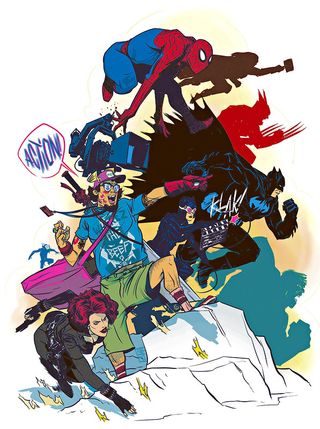
01COMICS2-popup-v2Manohla Dargis and A. O. Scott discuss the meaning of superhero movies, in the NYT:

MANOHLA DARGIS On one level the allure of comic book movies is obvious, because, among other attractions, they tap into deeply rooted national myths, including that of American Eden (Superman’s Smallville); the Western hero (who’s separate from the world and also its savior); and American exceptionalism (that this country is different from all others because of its mission to make “the world safe for democracy,” as Woodrow Wilson and, I believe, Iron Man, both put it). Both Depression babies, Superman and Batman, were initially hard-boiled types, and it’s worth remembering that the DC in DC Comics was for Detective Comics. Since then the suits have largely remained the same even as the figures wearing them have changed with their times. Every age has the superhero it wants, needs or deserves.

Comic book movies are also fun (except when they’re not) and often easy viewing (except when they make your head hurt). They’re also blunt: A guy in a unitard pummels another guy — pow! — and saves the day, the girl and the studio. I like some comic-book movies very much, dislike others. But as a film lover I am frustrated by how the current system of flooding theaters with the same handful of titles limits my choices. (According to boxofficemojo.com “The Avengers” opened on 4,349 screens in the United States and Canada, close to 1 in 10.) The success of these movies also shores up a false market rationale that’s used to justify blockbusters in general: that is, these movies make money, therefore people like them; people like them, therefore these movies are made.

SCOTT And yet these stories do have some appeal, beyond the familiarity of the characters and the relentlessness of the marketing campaigns. As you suggest, they strike mythic, archetypal chords, and cater to a persistent hunger for large-scale, accessible narratives of good and evil.

It’s telling that Hollywood placed a big bet on superheroes at a time when two of its traditional heroic genres — the western and the war movie — were in eclipse, partly because they seemed ideologically out of kilter with the times.

A President Speaks Out on Immigration

WilsonNo doubt you have been disappointed in some of us. Some of us are very disappointing. No doubt you have found that justice in the United States goes only with a pure heart and a right purpose, as it does everywhere else in the world. No doubt what you have found here did not seem touched for you, after all, with the complete beauty of the ideal which you had conceived beforehand. But remember this: If we had grown at all poor in the ideal, you brought some of it with you. … And if some of us have forgotten what America believed in, you, at any rate, imported in your own hearts a renewal of the belief. That is the reason that I, for one, make you welcome. … You dreamed dreams of what America was to be, and I hope you brought the dreams with you. No man that does not see visions will ever realize any high hope or undertake any high enterprise. Just because you brought dreams with you, America is more likely to realize dreams such as you brought. You are enriching us if you came expecting us to be better than we are.

—Woodrow Wilson, to 4,000 newly naturalized citizens, Philadelphia, May 10, 1915

Read the backstory by Patricia O'Toole at The American Scholar.

The Secret History of the Chief Justice’s Obamacare Decision

John Fabian Witt in Balkinization:

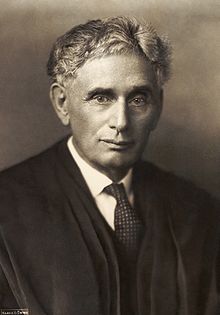
220px-BrandeislThe story begins in 1933, when depression-fueled unemployment rates hit an all-time high of 25 percent. Progressive reformers, including Wisconsin’s influential husband-and-wife reformers Elizabeth and Paul Raushenbush, were desperately casting about for a constitutional basis for national unemployment insurance. Action at the state level was paralyzed because no one state seemed able to adopt an expensive insurance plan without driving employers into neighboring states. But action at the federal level seemed impossible, too, because the conservative Supreme Court seemed unlikely to allow the Congress to enact a comprehensive unemployment system as a regulation of interstate commerce.

That’s where Brandeis comes in. Elizabeth was the justice’s daughter, and when she and her husband visited with him in his summer cottage in Massachusetts, Brandeis suggested a novel solution to the constitutional dilemma: the tax power, he told them, would offer a constitutionally sound footing for the vast social insurance system they were contemplating.

Four years later, Brandeis was a decisive vote in the sharply divided 5-4 decision in Stewart Machine Co. v. Davis, upholding the unemployment insurance provisions of the Social Security Act over the dissent of the four conservative justices, who were known collectively as the “Four Horsemen of the Apocalypse.” Brandeis’s tax theory had become the foundation of the new American social insurance state.

More here. [Photo shows Louis Brandeis.]

another america

01COTTER-COVER-articleLarge-1

In 1934, Thomas Hart Benton, purveyor of muscular scenes of American life, was the country’s most famous painter and one of the very few ever to have his picture on the cover of Time. In 1949, Jackson Pollock, painter of abstract drips and swirls, appeared in a four-page spread in Life teasingly headlined “Is He the Greatest Living Painter in the United States?” Yes or no didn’t really matter: he was the nation’s new art star. What changed in the 15 years that separated the public elevation of these two artists and their radically different art? The world changed, for one thing, moving out of the Great Depression, through World War II, and into a bomb-haunted cold war. America changed from a mighty fortress to an outreaching global imperium. And American art, including Pollock’s, changed from illustrating provincial ­sagas to dramatizing universal myths.

more from Holland Cotter at the NY Times here.

Keep going, going on, call that going, call that on

Erwitt-cat_jpg_470x406_q85

Or again, imagine if the literary folk suddenly tired of it all, realized how unhelpful it all was; if the critics and academics wearied of untangling torment for a living (I see you haven’t got any better, Beckett’s old analyst responded after the author sent him a copy of Watt). Imagine if the publishers—let’s call them the Second Arrow Publishing Corporation—informed all their great authors, all the masters of the mercilessly talkative consciousness, that they are winding up their affairs; they have seen the light, they will no longer publish elaborations of tortured consciousness, lost love, frustrated ambition, however ingenious or witty. Imagine! All the great sufferers saved by Buddhism, declining the second arrow: quietness where there was Roth, serenity where there was McCarthy, well-being where there was David Foster Wallace? Do we want that? I suspect not.

more from Tim Parks at the NYRB here.

biblical liberal

600

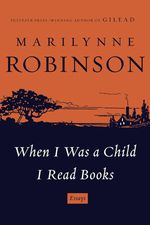
Marilynne Robinson, the Pulitzer-winning novelist, is a confounding writer in today’s political alignment. Her new essay collection, “When I Was a Child I Read Books,” is — despite the sentimentality of its title — fundamentally a leftist political manifesto and lament for America’s loss of faith in government. Yet it grants a central argument of many religious conservatives — that America’s virtues are indeed steeped in biblical thought. “When I Was A Child” is a broadside defense of literature and classical liberalism that demands we include the unfashionable Old Testament as a foundation of both. Through rigorous citation and deep personal reflection, Robinson builds an excellent case. New Atheists like Sam Harris and medieval nostalgists like Rick Santorum would each find occasions for garment-rending in this collection.

More from August Brown at the LA Times here.

Saturday Poem

The Trout

Flat on the bank I parted
Rushes to ease my hands
In the water without a ripple
And tilt them slowly downstream
To where he lay, tendril-light,
In his fluid sensual dream.

Bodiless lord of creation,
I hung briefly above him
Savouring my own absence,
Senses expanding in the slow
Motion, the photographic calm
That grows before action.

As the curve of my hands
Swung under his body
He surged, with visible pleasure.
I was so preternaturally close
I could count every stipple
But still cast no shadow, until

The two palms crossed in a cage
Under the lightly pulsing gills.
Then (entering my own enlarged
Shape, which rode on the water)
I gripped. To this day I can
Taste his terror on my hands.
.

by John Montague
from Collected Poems
The Gallery Press, Oldcastle, 1995

Enjoying Natural Selection on Multiple Levels

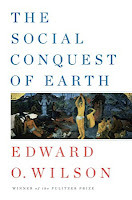
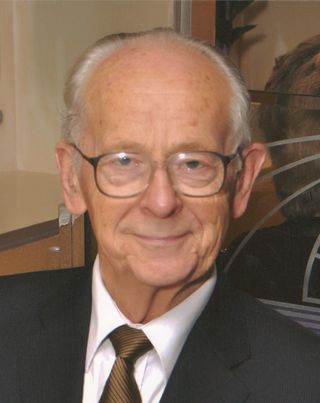
WilsonOver at Rationally Speaking, Leonard Finkelman on the Richard Dawkins-E.O. Wilson debate about levels of natural selection:

The so-called “selfish gene” theory, technically known as gene selection, is an elaboration of work done by W.D. Hamilton and G.C. Williams on a phenomenon known as “kin selection.” Kin selection is predicated on the idea that the impulse I feel to care for my nephew is stronger than the impulse I feel to care for (say) my neighbor’s nephew. I know that my nephew is my sister’s son, and that my sister and I were born of the same parents; I therefore know that he carries 50% of my sister’s genetic alleles, and that there’s a 50% chance that any one of my sister’s alleles is one that I also carry. For any one of my nephew’s alleles, then, there’s a 25% chance that I also carry that allele. If I care for my nephew, then my genes have a one in four chance of helping themselves; if I care for my neighbor’s nephew, the odds are much, much lower. Gene selectionists therefore argue that genes are the individuals who benefit in the process of natural selection. Hence Dawkins’ famous claim that organisms are “gigantic lumbering robots” for carrying genes around: I have an impulse to care for my nephew because it helps (some of) my genes, even though it hurts me as a whole.

In 2010, E.O. Wilson and two collaborators wrote an article in Nature attacking the viability of kin selection. We won’t get into the details of their mathematical argument; the bottom line is that things rarely work out so neatly as “my nephew has half of my sister’s genetic alleles and she has half of mine,” and the complexities ultimately call into question the idea that gene selection can explain altruistic behavior. In his newest book and a recent New York Times “Stone” column (interestingly, a philosophy blog!), Wilson proposes an alternative that he calls “multi-level selection.” His account is so called because Wilson believes that nature sometimes selects genes, sometimes selects organisms, and sometimes selects groups—and that the latter option is the one that explains altruism. It was this claim that prompted Dawkins’ scathing review of Wilson’s book, linked in the first paragraph. Undermining the very foundation of Dawkins’ account of selection probably had something to do with it, too.

Science: A Call for Humility

Portrait.tif_Russell Stannard in The Huffington Post [h/t: Namit Arora]:

[E]ven if the M-theory hypothesis is correct, does it in fact answer the question of “Why is there something rather than nothing?” It would certainly account for the existence of the world. But would it not raise a fresh question: “Where did M-theory come from? What is responsible for its existence?”

This brings us up against what one suspects is a fundamental limitation of the scientific enterprise. The job of science is to describe the world we find ourselves in — what it consists of, and how it operates. But it appears to fall short of explaining why we are presented with this kind of world rather than some other — or why there should be a world at all.

Indeed, there is cause to wonder whether science even gets as far as describing the world. For instance, what is the world made of? One might answer in terms of the electrons, protons, and neutrons that make up atoms. But what are electrons, protons and neutrons? Quantum physics shows how they are observed to behave like waves as they move about. But on reaching their destination and giving up their energy and momentum they behave like tiny particles. But how can something be both a spread out wave with humps and troughs, and at the same time be a tiny localized particle? This is the famous wave/particle paradox. It afflicts everything, including light.

The solution given by the Danish physicist Neils Bohr was that one has to stop trying to explain what something, such as an electron, is. Instead, we are confined to explaining how something behaves in the context of a certain kind of observation being made on it — whether we are observing it moving from one place to another (in which case the language of waves is appropriate), or alternatively observing it interacting on reaching its destination (requiring the language of particles).

Martha Nussbaum and the new religious intolerance

From The Guardian:

Martha-Nussbaum-008There's a popular student story about Martha Nussbaum giving a talk in a small living room of the Episcopal Church's chaplaincy centre on the leafy campus of the University of Chicago. As she was holding forth, a bird flew down the chimney and started to flutter around the room, bashing into the walls and generally panicking, as trapped birds do. The students were immediately busy opening windows and trying to shoo the poor creature to freedom. All their attention was taken up with the bird. But in the midst of all the excitement, Nussbaum didn't break her intellectual stride. She just carried on delivering the lecture as if nothing whatsoever was going on. She emanates detached academic cool – fully in command of herself and her material. From someone who has spent a distinguished academic career emphasising the riskiness and vulnerability of the human condition, all this slightly frosty control comes as something of a surprise.

Why, she once asked in a brilliant essay entitled “Love's Knowledge”, do the gods of the ancient world often fall in love with human beings? Why would they prefer mortals to immortals? It is precisely because human beings are able to fail, she argues, that they are able to manifest so many attractive qualities. Take courage. What place can courage have in the world of immortal gods? How could an immortal god risk everything for another if their own welfare were always guaranteed in advance? And what sort of parent would an immortal parent be to an immortal child? Certainly not one that is up half the night worrying. Risk and vulnerability are intrinsic to being human. And that is what makes us attractive, sometimes heroic.

More here.

The Best of All Possible Worlds

From The New York Times:

Gottlieb-articleLargeRomano was a literary critic with The Philadelphia Inquirer for a quarter of a century and has also been a professor of philosophy. He presumably enjoyed this latter job, because he writes that today’s America is the best place to do philosophy that there has ever been, surpassing even the Athens of those ingenious and polite men Socrates, Plato and Aristotle. In one fit of enthusiastic chauvinism he goes yet further, and announces that it is the “perfectly designed environment” to ply his trade, as if no greater intellectual paradise could be imagined. This news will not provide much comfort to declinists who feel the political and economic hegemony of the United States to be fading fast. But perhaps it will help a little. Let deficits grow, good jobs disappear and China loom — hang it all, America will always have world-beating epistemology and metaphysics up its sleeve. Well, maybe that isn’t quite fair to Romano, because his claim depends on redefining the term “philosophy,” giving it a nebulous meaning that embraces far more than is taught under that name in universities. (More later about this revisionist wordplay.) Also, one part of his case is convincing, and oddly still worth making: America is not nearly so ­dumbed down as its detractors at home like to say.

“Idiot America: How Stupidity Became a Virtue in the Land of the Free,” “Unscientific America: How Scientific Illiteracy Threatens Our Future” and “The Age of American Unreason” are just three of the books from American writers in the past five years that belabor religious fundamentalism, conservative talk shows, scientific illiteracy or the many available flavors of junk food for thought. The fallacy of such books, as Romano argues, is that they take some rotten parts for the largely nutritious whole. It’s not so much that they compare American apples with foreign oranges, but that they fail to acknowledge that the United States is an enormous fruit bowl. Everything is to be found in it, usually in abundance, including a vibrant intellectual life. Rather like that of India — which has over a third of the planet’s illiterate adults but also one of the largest university systems in the world — the intellectual stature of America eludes simple generalizations.

More here.

Friday, June 29, 2012

‘Having It All’? How About: ‘Doing The Best I Can’?

Andrew Cohen weighing in as part of The Atlantic's continuing debate on work-life balance:

Having it allAnne-Marie Slaughter's remarkable article Why Women Still Can't Have It All clearly has meant different things to different people since it was published and posted. To me, first, it is further evidence of what I have come to believe after 46 years on this planet: most women are not just smarter than most men but braver and more aspirational, too. There is the noble, ancient striving to “have it all.” And then there is the earnest and thought-provoking debate, largely between and among women if I am not mistaken, over exactly what that phrase means and whether the quest to achieve it is even worth it.

Men? Please. Such an earnest public conversation on this topic between and among men is impossible to imagine (no matter how hard The Atlantic tries). That's why so many of us diplomatically stayed on the sideline last week. And haven't men as a group largely given up hope of “having it all” anyway? Did we ever have such hope to begin with? I don't remember ever getting a memo on that. Without any statistics to back me up — how typical of a man, right? — I humbly suggest that a great many of us long ago decided in any event to focus upon lesser, more obtainable mottoes, like “doing the best I can” or “hanging in there,” as we try to juggle work, family, and a life.

Read the rest here.

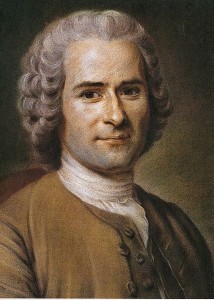
Jean-Jacques Rousseau, On his 300th

Rousseau-214x300I was traveling yesterday, Rousseau's 300th, and did not get a chance to post this piece by Laurie Fendrich in The Chronicle of Higher Ed:

Today, June 28, is Jean-Jacques Rousseau’s 300th birthday. Although it’s hard to imagine philosophers as squalling newborns, in Rousseau’s case, it makes sense. His whole philosophy hinges on the idea that we humans are born good but, along the way of making civilization, we manage to destroy what’s good in ourselves. From the moment the umbilical cord is cut, Rousseau essentially says, we systematically obliterate our real nature, which is one of benevolent beings happily living a simple existence.

But for someone living in any complex society since the Industrial Revolution, Rousseau’s philosophy is not only difficult to believe (aren’t education, exposure to the arts, technological progress inarguably good things?), but inconvenient to practice—even in small instances, such as bringing up his ideas for discussion in a 21st-century college class. None of this has prevented me from loving Rousseau’s complex, contradictory, and exhilaratingly exasperating philosophy ever since first encountering it as a sophomore, in a college course in political philosophy.

Why would a young college student who was just discovering the solitary joys of painting pictures become obsessed with the one and only Enlightenment thinker who ferociously attacked the very value of art (and science as well)? And why would that young college student never manage to break with the almost ubiquitously maligned Rousseau, never manage to put him to the side and forget him? Or, if she was going to stay with him, why couldn’t she have found a way to concentrate on his sweeter side—the side expressed in, for example, his Reveries, where he walks in a “lonely meditation on nature”?