
Enjoying the content on 3QD? Help keep us going by donating now.
Category: Recommended Reading
The debate over Trump’s style of politics obscures his profound indecency
Francis Fukuyama at Persuasion:
 The publication of new interviews with Donald Trump’s longstanding chief of staff John Kelly have been in the news since last week, and the Harris campaign has picked up on Kelly’s use of the word “fascist” to describe his former boss. This has reignited a longstanding debate over whether Trump and his MAGA movement represent the threat of genuine fascism in the United States were he to be re-elected.
This debate misses the point in several respects. Most Americans don’t have a clear definition of “fascist” in their minds, except to know that it means something very bad. But they also know that it’s been an epithet thrown around a lot, especially at Republican candidates. Indeed, as one Republican campaign ad shows, virtually every one of their presidential candidates over recent decades has been described as a fascist by the Democrats.
More here.
Enjoying the content on 3QD? Help keep us going by donating now.
David Katzenstein’s ‘Distant Journeys’
David Katzenstein at Commonweal:
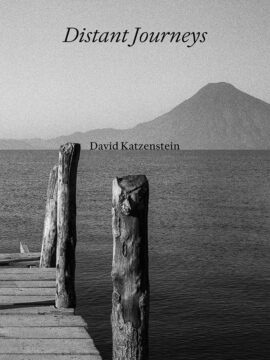 In the brief introduction to Distant Journeys, a new collection of photography assembled from trips undertaken over nearly five decades and across six continents, David Katzenstein tells us that his “passion for discovery” began early. Perhaps it was when he was only three years old, gripping his father’s back as their “frisky gray mare” galloped across a beach in Cuba, or when he visited Norway at age seven and watched a waterfall plunge half a kilometer into the sea below. It’s not surprising that he became a photographer: both memories, distant but visually and metaphorically precise, evoke the shifting perspectives that have defined his work throughout his career.
At first glance, the few images presented here, though taken in places as far-flung as Senegal, India, and Sicily, are neither exotic nor extraordinary. They show people going about their daily lives: milling around in a market, dancing in a sweaty living room, snapping photos at a festival with their phones. But there’s mystery here, too.
more here.
Enjoying the content on 3QD? Help keep us going by donating now.
Friday Poem
Dating in the Apocalypse Bunker
You take the lamp with your last battery
and meet me at the radios, where it’s quiet,
and we can be alone. I like how the light dims
and flickers, the way it plays across the steel.
I like how we can’t see the sand in the air.
You hold my gloved hand in your gloved hand
and we walk the hydroponic halls. I love you
because your eyes are green, because we eat
protein cans and you tell me about birds,
how your dad still has grass in his vault.
And we’re dressed to the nines, in our cleanest
boots, the dust scrubbed from our tanks
until they gleam. Our utility suits are beeping
beneath our helmet read-outs, but no longer
are we clumsy, like those men who fled to Mars.
And we go not to the movies but to the oxygen
chambers, where we crouch low, lean close
to a vent. You shed your gear first, lips dry
and desert-cracked, and we share that same
recycled air, press our mouths against the wall,
breathe so deeply we see stars.
by Kristen Mears
from Palette Poetry
Enjoying the content on 3QD? Help keep us going by donating now.
David Katzenstein: A Photographic Journey of Ritual
Enjoying the content on 3QD? Help keep us going by donating now.
The poetry of revolution
Diane Fieldes in R:
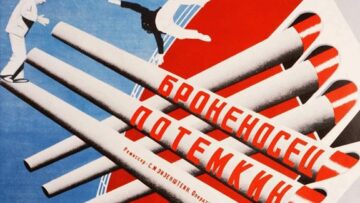 Capitalism thwarts and stunts the creativity of human beings. It robs the mass of the population of control over their own labour, and therefore over production generally. It denies the vast majority of people creative expression in their daily work lives, and this affects all of life. Workers are robbed not just of artistic creativity but even of our potential to be an audience for art. Yet there is a constant struggle to free humanity’s potential. And there have always been troublesome artists and troublesome art. The contradictions of capitalism mean that it is possible, at least to some extent, for artistic expression to develop in opposition to the dominant trajectory of society. Bertolt Brecht’s poem “Motto” makes the point:
In the dark times
Will there also be singing?
Yes, there will also be singing.
About the dark times.
But at high points of struggle, the possibilities of artistic expression expand exponentially. One of the chief aims of socialist revolution, according to the Russian revolutionary Leon Trotsky, is the “awakening of human personality in the masses – who were supposed to possess no personality”.
More here.
Enjoying the content on 3QD? Help keep us going by donating now.
Why the Medical Establishment Often Gets It Wrong
Lola Butcher in Undark Magazine:
 Like many surgeons, Marty Makary used to routinely treat appendicitis by removing the patient’s appendix, a procedure performed nearly 300,000 times a year in the U.S. That changed about a decade ago after he read a research study that found antibiotics may be an effective alternative. Despite subsequent research confirming that appendectomies can often be avoided, Makary estimates only about half of surgeons have accepted the idea. “That means whether or not you go under the knife for appendicitis today in America depends on who’s on call when you walk into the emergency department,” he writes in “Blind Spots: When Medicine Gets It Wrong, and What It Means for Our Health.”
In detailed behind-the-scenes case studies, Makary, a surgeon and public health researcher at Johns Hopkins University, reveals how and why physicians often salute bad science and baseless opinions at the peril of their patients. Among other things, Makary claims, the medical establishment created the opioid epidemic and the peanut allergy epidemic. Tens of thousands of women have died prematurely because of misinterpreted data about the danger of hormone replacement therapy. The U.S. government banned silicone breast implants for 14 years without evidence they caused harm. Physicians’ overuse of antibiotics is likely causing untold suffering. Doctors still tell overweight people to eat low-fat foods, even though low-fat diets are associated with obesity and diabetes.
More here.
Enjoying the content on 3QD? Help keep us going by donating now.
Eat Poop You Cat: The Humanity of GenAI Art
Rachel Ossip at n+1:
 New image-making technologies — whether the printing press, the camera, or satellite imaging — change our perception of the world, which in turn changes our behaviors. The question at hand is: What are these algorithmic images teaching us to see, say, and do?
As of January 2024, GenAI text-to-image tools produced about thirty-four million images per day. This number is still dwarfed by the daily count of digital photographs, but for how long? From here on out, it’s safest to assume that any image you encounter might be generated. What differentiates these images is not their lack of humanity but their intense abundance of it: all the alienated intelligence, historical strata, and linguistic tics embedded and reproduced within them. Each prompter sets off a huge chain of networked collaboration with artists and academics, clickworkers and random internet users, across time and space, engaging in one massive, multicentury, ongoing game of Eat Poop You Cat. Like it or not, we all — whether pre-algorithmic image makers or self-described AI artists — will have to learn to play.
more here.
Enjoying the content on 3QD? Help keep us going by donating now.
Thursday, October 31, 2024
Why Close Reading is An Essential Part of Literary Translation
Damion Searls at Literary Hub:
In my late twenties, when I was interested in maybe becoming a translator but didn’t know how to go about doing such a thing, my mother suggested I try getting in touch with our old neighborhood friend Edie. I had read Dr. Seuss at her apartment on the Upper West Side of Manhattan, later babysat her son. She’s stopped teaching and become a translator, my mother said. What language? I asked. My mother didn’t know, maybe Spanish?
Wait a minute, Edie Grossman was Edith Grossman, legendary translator of García Márquez and soon to be of Cervantes?
I got back in touch, and Edie kindly agreed to let me send her my first translation effort, a short descriptive vignette by Peter Handke. She knew no German, had never read Handke, but took a look. Along with being encouraging about my translation and nicer than it deserved, she gave me some advice: Don’t use “-ing” words if you can help it, she said, they’re weak in English. Don’t say there’s a gleaming in the snow, say there’s a gleam; instead of a cocoon hanging in the trees, say it hung in the trees. She circled three of the “-ing” words in my translation and said that those were all right but I should recast the rest. When I looked back at the German, those three—only those three—had the “-d” verb suffix analogous to “-ing.” The verb I had translated “was hanging” could be “hung”; the noun could be a gleam, not a gleaming.
In telling this story over the years, I’ve found that other translators tend to be less impressed by it than nontranslators. But at the time I was one of those nontranslators, and it gave me an eerie sense of being in the presence of greatness: Grossman knew what she was doing, Handke knew what he was doing, and they could commune with each other right through me.
More here.
Enjoying the content on 3QD? Help keep us going by donating now.
The Case For Small Reactors
Ted Nordhaus and Adam Stein at the Breakthrough Institute:
 If last month’s announcement by Microsoft and Constellation Energy that they planned to restart Three Mile Island was a potent symbol of nuclear energy’s changing fortunes and importance to efforts to decarbonize the US electricity system, this month’s announcements by Google and Amazon likely tell us a lot more about where the US nuclear sector is heading. It is one thing to reopen a recently shuttered nuclear plant like Three Mile Island, quite another to build new reactors. Revitalizing the nuclear sector, such that it might play a major role in meeting US climate ambitions, will require building several hundred new reactors, 200GW worth by 2050 according to Energy Secretary Jennifer Granholm and other Biden administration officials.
Over the last decade, there has been a sometimes quiet, sometimes open debate within the nuclear sector about whether the future of the technology would look much like its past. Would we see predominantly large conventional light water reactors built and operated by regulated monopoly utilities, or does successfully rebooting the sector require different technologies and business models better suited to the range of use cases where nuclear might play a significant role and the changing realities of the US utility sector.
More here.
Enjoying the content on 3QD? Help keep us going by donating now.
This Single Rule Underpins All Of Physics
Enjoying the content on 3QD? Help keep us going by donating now.
A conversation with Wendy Brown on the U.S. presidential election, the exclusions liberal democracy is built on, and why we must aim at more than restoring its mythical former splendor
Wendy Brown & Francis Wade in the Boston Review:
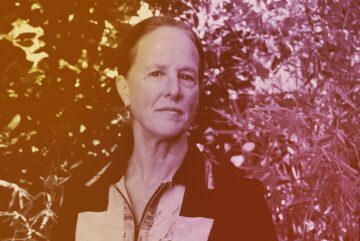 Trump is symptom, not cause, of the “crisis of democracy.” Trump did not turn the nation in a hard-right direction, and if the liberal political establishment doesn’t ask what wind he caught in his sails, it will remain clueless about the wellsprings and fuel of contemporary antidemocratic thinking and practices. It will ignore the cratered prospects and anxiety of the working and middle classes wrought by neoliberalism and financialization; the unconscionable alignment of the Democratic Party with those forces for decades; a scandalously unaccountable and largely bought mainstream media and the challenges of siloed social media; neoliberalism’s direct and indirect assault on democratic principles and practices; degraded and denigrated public education; and mounting anxiety about constitutional democracy’s seeming inability to meet the greatest challenges of our time, especially but not only the climate catastrophe and the devastating global deformations and inequalities emanating from two centuries of Euro-Atlantic empire. Without facing these things, we will not develop democratic prospects for the coming century.
More here.
Enjoying the content on 3QD? Help keep us going by donating now.
Why Didn’t Ancient Philosophers Eat Meat?
Enjoying the content on 3QD? Help keep us going by donating now.
The Essay as Realm
Elisa Gabbert in Georgia Review:
 I think this is important: memories and ideas happen in a place. An essay is a place for ideas; it has to feel like a place. It has to give one the feeling of entering a room.
The architect Christopher Alexander has written that “the experience of entering a building influences the way you feel inside the building.” “If the transition is too abrupt there is no feeling of arrival.” He cites a report called “Fairs, Exhibits, Pavilions, and their Audiences,” in which the authors describe observing people drift in and out of various exhibits, impassive and unengaged. There was one exhibit, however, where visitors had to cross a “huge, deep-pile, bright orange carpet on the way in.” The exhibit itself was no better than the others, they said, but people lingered there because they’d made a journey of sorts to enter. They’d crossed a kind of Willy Wonka or Wizard of Oz threshold, into a different realm. They felt changed.
More here.
Enjoying the content on 3QD? Help keep us going by donating now.
Zombie Fungi Hijack Hosts’ Brains
Hannah Thomasy in The Scientist:
 To the casual observer, the motivations that drive insect behaviors may appear quite simple: An insect might leave the nest to find food, wander around to seek out potential mates, or move into the sun or shade to maintain an optimal body temperature.
But sometimes the drivers of these behaviours are far more complex—and more sinister—than they first appear. In a surprisingly large number of cases, insects are not acting of their own free will in a way that benefits themselves or even their species. Instead, they have become “zombies,” controlled by barely visible fungal puppet masters that direct the insects’ behaviors, steering them into optimal conditions for dispersing infectious spores. While these fungi were described in the scientific literature as early as the mid-1800s, the extent and precision of the behavioral control that they exert on their unfortunate insect hosts—and the mechanisms they use to do so—are only just starting to be appreciated.1
As they begin to explore the complex molecular dialogue between these fungi and their insect hosts, scientists aren’t sure exactly what they will find. So far, the fungal kingdom as a whole has proven to be a rich source of bioactive metabolites; fungal-derived drugs are currently used as antibiotics, immunosuppressants, cholesterol-lowering agents, and migraine therapeutics, so there may be much to discover in these insect-manipulating species.2 “This is a group of fungi that haven’t quite been mined yet, for all the things that they might produce. I’m quite certain that we’ll bump into some interesting stuff,” said Charissa de Bekker, a molecular biologist who studies insect-fungi interactions at Utrecht University. This fascination has spread beyond the scientific community into pop culture, as evidenced by video games and movies like The Last of Us and The Girl with All the Gifts. So, although these fungi cannot literally infect humans, they have certainly extended their mycelia into the hearts of scientists and non-scientists alike.
More here.
Enjoying the content on 3QD? Help keep us going by donating now.
Chiromancy
Betsy Golden Kellem at JSTOR Daily:
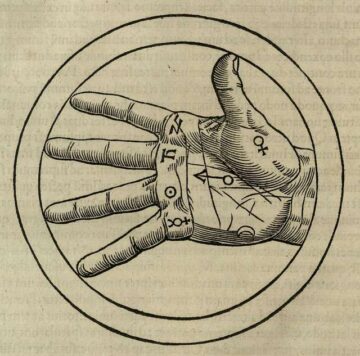 Palm reading, also known as palmistry or chiromancy throughout history, has been far more than a party trick for centuries. Dating back to classical antiquity, the idea that a soothsayer can tell something about a person’s health, disposition, or destiny from the lines on their palm has long fascinated seers and scientists alike.
Classicist Charles S. F. Burnett finds mentions of chiromancy in various ancient texts, including in Aristotle’s writing, but the practice of palm reading seems to have disappeared in the Western world between the classical era and the twelfth century. In an interesting blend of disciplines, records of the practice appear not only in scientific or magical writings but in religious text, too. Readers were advised that certain marks are auspicious.
“When it extends as far as the first finger, he will be a monk,” read a Latin chiromancy manuscript. “This mark is the sign of a parish income (presbyterium)…. This is a sign of someone being elected or freely blessing.”
more here.
Enjoying the content on 3QD? Help keep us going by donating now.
The Decline of the Working Musician
Hua Hsu at The New Yorker:
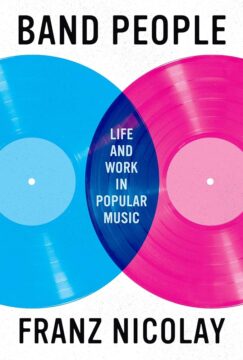 Nicolay makes these gangs sound like a lot of fun, while also demystifying them. Some band people prefer hierarchy and assertive decision-makers; others aspire to a more chaotic kind of democracy. Some envy the star; others feel sorry for him. Jon Rauhouse, a musician who tours with the singer Neko Case, is glad not to be the one that interviewers want to speak with—he’s free to “go to the zoo and pet kangaroos.” Band people are often asked to interpret cryptic directives in the studio. The multi-instrumentalist Joey Burns recalls one singer who, in lieu of instructions, would tell him stories about the music—he might be told to imagine a song they were working on as “a cloud in the shape of an elephant, and it’s trying to squeeze through a keyhole to get into this room.”
Many musicians prefer the “emotional life” of the band to be familial, rather than seeing their bandmates as “a handful of co-workers.” And despite the collective dream that brings artists together, the critic and theorist Simon Frith argues, “the rock profession is based on a highly individualistic, competitive approach to music, an approach rooted in ambition and free enterprise,” which feeds perfectly into a quintessentially American zero-to-hero dream.
more here.
Enjoying the content on 3QD? Help keep us going by donating now.
Thursday Poem
The Keeper of Sheep
—an excerpt
The mystery of things, where is it?
If it exists, why doesn’t it at least appear
To show us that it is a mystery?
What does the river or the tree know of mystery?
And I, who am not more real that they are, what do I know of it?
Whenever I look at things and think what men think about them,
I laugh like a stream as it rushes over a stone.
Because the only hidden meaning of things
Is that they have to hidden meaning at all.
It is stranger than all strangenesses,
Than the dreams of all the poets
And the thoughts of all the philosophers,
That things really are what they seem to be
And there is nothing to understand.
Yes, this is what my senses learned on their own:—
Things have no signification: they have existence.
Things are the only hidden meaning of things.
by Fernando Pessoa
from The Complete Works of Alberto Caeiro
New Directions Paperbooks 2020
Enjoying the content on 3QD? Help keep us going by donating now.
Wednesday, October 30, 2024
Bless You, Toxic Dwarf: An Appreciation of Gary Indiana
Ira Silverberg at Vulture:
 Gary Indiana, who died on October 23 at 74 years old, was a brilliant and scathing critic of contemporary art and literature — and sometimes of those who thought they were his friends. His work at the Village Voice in the mid-to-late 1980s, when Jeff Weinstein edited him to perfect fever pitch, positioned him as the sharpest, most influential, and most feared art critic in New York of the time. It was a role that both defined and ruined him. He relied upon a persona that was about having come from nothing (not entirely the truth), knowing he wasn’t traditionally attractive to most men (he was short, skinny, and if he was ever a twink, those days were long past), was smart and used that to intimidate people, and eschewed money and fame (um, not really).
Not exactly the usual art-world type, he left it and retreated into fiction, where he could work out his issues with characteristically dark humor in ultracontemporary social satires. He was full of contradictions, and his explanations of them were always brilliant and self-focused — plaintive, often exasperated wails from the last bohemian standing about the injustices he faced.
more here.
Enjoying the content on 3QD? Help keep us going by donating now.
Charles Atlas | UNDER THE INFLUENCE
Enjoying the content on 3QD? Help keep us going by donating now.