Shulamith Firestone, 1945-2012

FIRESTONE-obit-popupMargalit Fox's (slightly thin) obit in the NYT:

Shulamith Firestone, a widely quoted feminist writer who published her arresting first book, “The Dialectic of Sex,” at 25, only to withdraw from public life soon afterward, was found dead on Tuesday in her apartment in the East Village neighborhood of Manhattan. She was 67.

Ms. Firestone apparently died of natural causes, her sister Laya Firestone Seghi said.

Subtitled “The Case for Feminist Revolution,” “The Dialectic of Sex” was published by William Morrow & Company in 1970. In it, Ms. Firestone extended Marxist theories of class oppression to offer a radical analysis of the oppression of women, arguing that sexual inequity springs from the onus of childbearing, which devolves on women by pure biological happenstance.

“Just as the end goal of socialist revolution was not only the elimination of the economic class privilege but of the economic class distinction itself,” Ms. Firestone wrote, “so the end goal of feminist revolution must be … not just the elimination of male privilege but of the sex distinction itself: genital differences between human beings would no longer matter culturally.”

In the utopian future Ms. Firestone envisioned, reproduction would be utterly divorced from sex: conception would be accomplished through artificial insemination, with gestation taking place outside the body in an artificial womb. While some critics found her proposals visionary, others deemed them quixotic at best.

Reviewing “The Dialectic of Sex” in The New York Times, John Leonard wrote, “A sharp and often brilliant mind is at work here.” But, he added, “Miss Firestone is preposterous in asserting that ‘men can’t love.’ ”

Friday Poem

“The Trail is Not a Trail”

I drove down the Freeway
And turned off at an exit
And went along a highway
Til it came to a sideroad
Drove up the sideroad
Til it turned to a dirt road
Full of bumps, and stopped.
Walked up a trail
But the trail got rough
and it faded away—
Out in the open,
Everywhere to go.

by Gary Snyder
from Left Out in the Rain
North Point Books

A post-factual age

From New Statesman:

MittWe’re not going to let our campaign be dictated by fact checkers.”…Mitt Romney.

Romney pollster Neil Newhouse admits that his party has given up on telling the truth.

In a related story:

Paul Ryan made his big speech at the Republican National Convention, and ThinkProgress summed it up best: “An energetic, post-factual speech by Ryan.” Time and again, Ryan mislead, misspoke, and made “Demonstrably Misleading Assertions“. If you're interested in the politics of it, he's also been attacked on style – Mother Jones' Kevin Drum recalled Harrison Ford's famous snipe to George Lucas, “you can type this shit, but you sure can't say it” – and doubtless, his “John Galtesque” evocation of the mythical grey, socialist hellhole of Obama's America will win over some. But if Ryan gets away with some of what he said, political discourse in the United States has a lot to answer for. The most egregious of Ryan's statements was an attack on Obama for failing to protect a General Motors plant in his constituency:

A lot of guys I went to high school with worked at that GM plant. Right there at that plant, candidate Obama said: “I believe that if our government is there to support you … this plant will be here for another hundred years.” That’s what he said in 2008.

Well, as it turned out, that plant didn’t last another year. It is locked up and empty to this day. And that’s how it is in so many towns today, where the recovery that was promised is nowhere in sight.

The plant's closure was announced in June 2008, over six months before Obama was inaugurated. Ryan probably knows this, because on 3 June, he issued a statement bemoaning the closure.

More here.

Severe Diet Doesn’t Prolong Life, at Least in Monkeys

Gina Kolata in The New York Times:

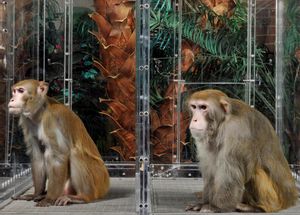
MonkFor 25 years, the rhesus monkeys were kept semi-starved, lean and hungry. The males’ weights were so low they were the equivalent of a 6-foot-tall man who tipped the scales at just 120 to 133 pounds. The hope was that if the monkeys lived longer, healthier lives by eating a lot less, then maybe people, their evolutionary cousins, would, too. Some scientists, anticipating such benefits, began severely restricting their own diets. The results of this major, long-awaited study, which began in 1987, are finally in. But it did not bring the vindication calorie restriction enthusiasts had anticipated. It turns out the skinny monkeys did not live any longer than those kept at more normal weights. Some lab test results improved, but only in monkeys put on the diet when they were old. The causes of death — cancer, heart disease — were the same in both the underfed and the normally fed monkeys.

Lab test results showed lower levels of cholesterol and blood sugar in the male monkeys that started eating 30 percent fewer calories in old age, but not in the females. Males and females that were put on the diet when they were old had lower levels of triglycerides, which are linked to heart disease risk. Monkeys put on the diet when they were young or middle-aged did not get the same benefits, though they had less cancer. But the bottom line was that the monkeys that ate less did not live any longer than those that ate normally.

More here.

Thursday, August 30, 2012

Random! Postmodern Bio Blurbs

Fredericjameson

Daniel Hartley in 3:AM Magazine:

Gone are the golden days when an author’s bio blurb read like an obituary. Date and place of birth, occupation, current abode, names and dates of publications, year of death (if applicable): this was, apparently, all an educated public really needed to know about their writers to be able to ‘place’ their work. And as staid and conventional as that may now seem, there’s a lot to be said for this approach, not the least of which is avoiding bio-blurbs like this: “X lives in New York with her three cats. She makes cookies out of the weirdest things (and they taste REAL GOOD!). Her favourite word is ‘red’ and when it snows she wears sandals.” The only reasonable response to such postmodern narcissism is, firstly, to remind the author that we don’t actually give a damn about his or her personal idiosyncrasies, and, secondly, to ask them to grow up.

That said, it is not only younger writers who fall foul of this idiotic celebration of so-called eccentricity; as well-known a writer as Stephen Fry informs us in the author bio to his Ode Less Travelled (a wonderful book, as it happens) that “[h]is powers grow daily and his disciples are many” and that “his best friends are flowers”. Likewise, Neil Gaiman tells us that he is “a messy-haired white male author trapped in the body of an identical white male author with perhaps even less-tidy hair”, which, as author bios go, is hardly a knock-out. The point here, though, is not to be a killjoy, to declaim like a troubled old soul that the good days are behind us; rather, it is to point out an increasing trend of egoism fused with an insidious celebration of “randomness”.

Indeed, if there is any word in the English language whose current popularity is profoundly and boringly unrandom, it is “random”. Intellectual after intellectual, from Fredric Jameson toDavid Harvey and Terry Eagleton, have shown us that the shifts in the structure of the capitalist mode of production following World War II resulted in a new “cultural logic” which reflected those shifts. The upshot was a rejoicing in the ephemeral, the fleeting, the contingent, the hybrid, the liminal, the accidental, the fragmentary, the part, the border: the random. Randomness and the affirmative cries of “Random!” which accompany it are constitutive aspects of this cultural logic which has been unfurling since the postwar boom. That means that any indulgence in this logic leaves itself open to that once terrifying Enlightenment adjective: “uncritical”.

Four Kinds of Philosophical People

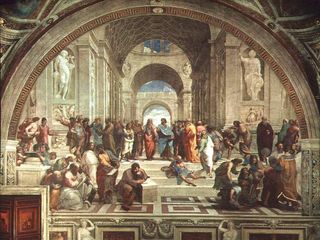
SchoolofAthensBLS Nelson in Talking Philosophy:

In my experience, many skilled philosophers who work in the Anglo-American tradition will tend to have a feverish streak. They will tend to find a research program which conforms with their intuitions (some of which may be treated as “foundational” or givens), and then hold onto that program for dear life. This kind of philosopher will change her mind only on rare occasions, and even then only on minor quibbles that do not threaten her central programme. We might call this kind of philosopher a “programmist” or “anti-skeptic, since the programmist downplays the importance of humility, and is more interested in characterizing herself in terms of the other virtues like philosophical rigour.

You could name a great many philosophers who seem to hold this character. Patricia and Paul Churchland come to mind: both have long held the view that the progress of neuroscience will require the radical reformation of our folk psychological vocabulary. However, when I try to think of a modern exemplar of this tradition, I tend to think of W.V.O. Quine, who held fast to most of his doctrinal commitments throughout his lifetime: his epistemological naturalism and holism, to take two examples. This is just to say that Quine thought that the interesting metaphysical questions were answerable by science. Refutation of the deeper forms of skepticism was not very high on Quine’s agenda; if there is a Cartesian demon, he waits in vain for the naturalist’s attention. The most attractive spin on the programmist’s way of doing things is by saying they have raised philosophy to the level of a craft, if not a science.

—-

“What’s attractive about looking at all philosophers in part suspiciously and in part mockingly is not that we find again and again how innocent they are… but that they are not honest enough in what they do, while, as a group, they make huge, virtuous noises as soon as the problem of truthfulness is touched on, even remotely.”Nietzsche, Beyond Good & Evil

Programmists are common among philosophers today. But if I were to take you into a time machine and introduced you to the elder philosophers, then it would be easy to lose all sense of how the moderns compare with their predecessors. The first philosophers lived in a world where science was young, if not absent altogether; there was no end of mystery to how the universe got on. For many of them, there was no denying that skepticism deserved a place at the table. From what we can tell from what they left behind, many ancient philosophers (save Aristotle and Pythagoras) did not possess the quality that we now think of as analytic rigour. The focus was, instead, of developing the right kind of life, and then — well, living it.

Terry Rudolph on Nature versus Nurture

TerryrudolphTerry Rudolph over at Cosmic Variance:

There has long been a tension between the academic publishing process, which is slow but which is still the method by which we certify research quality, and the ability to instantaneously make one’s research available on a preprint server such as the arxiv, which carries essentially no such certification whatsoever. It is a curious (though purely empirical) observation that the more theoretical and abstract the field the more likely it is that the all-important question of priority – when the research is deemed to have been time-stamped as it were – will be determined by when the paper first appeared on the internet and not when it was first submitted to, or accepted by, a journal. There are no rules about this, it’s simply a matter of community acceptance.

At the high-end of academic publishing, where papers are accepted from extremely diverse scientific communities, prestigious journals need to filter by more than simply the technical quality of the research – they also want high impact papers of such broad and general interest that they will capture attention across ranges of scientific endeavour and often the more general public as well. For this reason it is necessary they exercise considerably more editorial discretion in what they publish.

Topics such as hurdling editors and whether posting one’s paper in preprint form impacts negatively the chances of it being accepted at a high-end journal are therefore grist for the mill of conversation at most conference dinners. In fact the policies at Nature about preprints have evolved considerably over the last 10 years, and officially they now say posting preprints is fine. But is it? And is there more to editorial discretion than the most obvious first hurdle – namely getting the editor to send the paper to referees at all? If you’re a young scientist without experience of publishing in such journals (I am unfortunately only one of the two!) perhaps the following case study will give you some pause for thought.

Last November my co-authors and I bowed to some pressure from colleagues to put our paper, then titledThe quantum state cannot be interpreted statistically, on the arxiv. We had recently already submitted it to Nature because new theorems in the foundations of quantum theory are very rare, and because the quantum state is an object that cuts across physics, chemistry and biology – so it seemed appropriate for a broad readership. Because I had heard stories about the dangers of posting preprints so many times I wrote the editor to verify it really was ok. We were told to go ahead, but not to actively participate in or solicit pre-publication promotion or media coverage; however discussing with our peers, presenting at conferences etc was fine.

Based on the preprint Nature themselves published a somewhat overhyped pop-sci article shortly thereafter; to no avail I asked the journalist concerned to hold off until the status of the paper was known. We tried to stay out of the ensuing fracas – is discussing your paper on blogs a discussion between your peers or public promotion of the work?

Bingo in Utopia

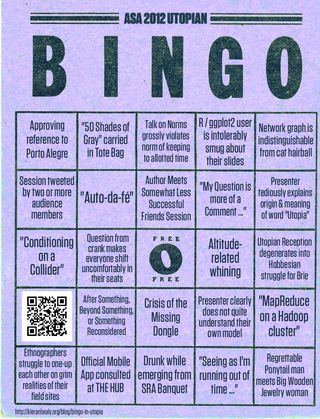
Denver-bingo-card-2012Kieran Healy in Crooked Timber:

Will there be Bingo in Utopia? It is hard to say. The emancipatory potential of bingo as praxishas been criticized from the earliest days of modern social theory. In 1862 Marx was prompted to write the first draft of what became Theories of Surplus Value during very straitened financial circumstances (he had pawned the clothes of his children and his maid, Helene Demuth) brought on mostly by clandestine visits to an East London bingo emporium, where he would play games of “Housey-Housey” while his wife Jenny believed him to be at the British Library conducting research. The game itself was for some time believed to be mentioned by Marx directly in a well-known if difficult section of the Grundrisse:

Capital’s ceaseless striving towards the general form of wealth drives labour beyond the limits of its natural paltriness, and thus creates the material elements for the development of the rich individuality which is as all-sided in its production as in its consumption, and whose labour also therefore appears no longer as labour, but as the full development of bingo itself, in which natural necessity in its direct form has disappeared; because natural need has been replaced by historically produced need.

This passage provoked considerable confusion—and a substantial amount of theoretical debate—amongst the small circle of scholars who had access to it from 1935 onwards.

Following the thaw and wave of rehabilitations during the Khruschev era, however, it transpired that David Riazanov’s original transcription of this passage (with a reading of “activity” and not “bingo”) had been correct. It was altered by an unknown member of theNKVD as part of the effort to falsify evidence establishing the existence of a so-called “United Front of Mensheviks and Mah-Jongg”. The unhappy fate of bingo as an element of emancipatory praxis was sealed by Adorno, who intensely disliked the game (and indeed much else) in all its forms, defending instead what he saw as the more austere but purer pleasures of the tombola.

What a plant knows

Andrea Wills in American Scientist:

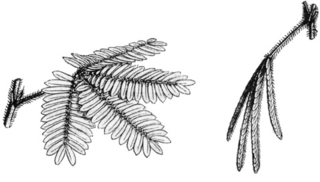
ScreenHunter_01 Aug. 30 13.38In grassy areas along the equator lives a tiny plant, Mimosa pudica, that has the captivating property of closing its leaves in response to touch. Rest a finger on one leaf, and that leaf and its neighbor will fold abruptly toward the stem. Brush your finger along the length of the stem and every pair of leaves will collapse in turn. For everyone who has wondered at Mimosa, the suddenly snapping Venus flytrap or the way a sunflower’s head unerringly turns to follow the sun, Daniel Chamovitz has written the perfect book.

What a Plant Knows: A Field Guide to the Senses examines the parallels and differences between plant senses and human senses by first considering how we interpret sensory inputs and then exploring how plants respond to similar inputs. Each chapter covers one sense—sight, smell, touch and hearing are covered, along with “How a Plant Knows Where It Is” and “What a Plant Remembers”—and each examines a wide taxonomical range of flora and a complementary historical range of experiments. In the book’s introduction, Chamovitz is careful to clarify his intentions in using language that might be considered anthropomorphic to explore the world of plants:

When I explore what a plant sees or smells, I am not claiming that plants have eyes or noses (or a brain that colors all sensory input with emotion). But I believe this terminology will help challenge us to think in new ways about sight, smell, what a plant is, and ultimately what we are.

A plant biologist who has held positions at Columbia and Yale and is now director of the Manna Center for Plant Biosciences at Tel Aviv University, Chamovitz is well qualified to present an archive of research on plant perception. Happily, he also has narrative dexterity: The book is delightful and a fast read.

More here.

A January 26, 1947, contract between Kurt Vonnegut and his pregnant wife, Jane

Kurt Vonnegut excerpted in Harper's Magazine:

Vonnegut100I, Kurt Vonnegut, Jr., that is, do hereby swear that I will be faithful to the commitments hereunder listed:

I. With the agreement that my wife will not nag, heckle, or otherwise disturb me on the subject, I promise to scrub the bathroom and kitchen floors once a week, on a day and hour of my own choosing. Not only that, but I will do a good and thorough job, and by that she means that I will get under the bathtub, behind the toilet, under the sink,under the icebox, into the corners; and I will pick up and put in some other location whatever movable objects happen to be on said floors at the time so as to get under them too, and not just around them. Furthermore, while I am undertaking these tasks I will refrain from indulging in such remarks as “Shit,” “Goddamn sonofabitch,” and similar vulgarities, as such language is nerve-wracking to have around the house when nothing more drastic is taking place than the facing of Necessity. If I do not live up to this agreement, my wife is to feel free to nag, heckle, and otherwise disturb me until I am driven to scrub the floors anyway—no matter how busy I am.

More here.

Thursday Poem

In Magnolia
—for my sons

when i was twenty
five .. we hiked the grass

spare trails that snake
from ocean to Swan Pond .. my

two small crab catchers & me .. we
buried pet turtles at sea
…………… beneath the crooked

footbridge .. sailed stick regattas
in the slim stream in the slow

woods .. bouncing like great
explorers of Kettle Cove & sea

slashed rocks .. listening to each other's
breath .. we trudged home sand fed

by Jim Bell
from Crossing the Bar
Slate Roof, Northfield, MA, 2005

THE LEGITIMATE CHILDREN OF RAPE

From The New Yorker:

Solomon-rape-233Writing in the American Journal of Preventive Medicine, Dr. Felicia H. Stewart and Dr. James Trussell have estimated that there are twenty-five thousand rape-related pregnancies each year in the United States. While these numbers make up only a small part of this country’s annual three million unwanted pregnancies, the numbers are still extremely high. Nonetheless, the relationship between rape and pregnancy has been a topic of highly politicized debate since long before Todd Akin’s comments on “legitimate rape,” Paul Ryan’s bill with its category of “forcible rape,” and Sharron Angle’s suggestion, two years ago, that women pregnant through rape make “a lemon situation into lemonade.” There is a veritable war of statistics about rape and pregnancy, and the confusion is exacerbated by the competing agendas of the pro-choice and anti-abortion movements. It has been argued that fear promotes ovulation, and that women who are raped have a ten-per-cent risk of pregnancy; there are estimates of as little as one per cent. Numbers are also skewed when they are adjusted to include or exclude women not of reproductive age; for sodomy and other forms of rape that cannot cause pregnancy; for rape victims who may be using oral birth control or I.U.D.s; and for women who are raped and become or are pregnant as a result of consensual sex with a husband or partner who is not the rapist, before or after the rape. Women who are being abused on an ongoing basis are particularly likely to conceive in rape. Catherine MacKinnon has written, “Forced pregnancy is familiar, beginning in rape and proceeding through the denial of abortions; this occurred during slavery and still happens to women who cannot afford abortions.”

I have been researching a book, “Far from the Tree,” that deals in part with women raising children conceived in rape, and have therefore met the living reproof to Akin’s remark. Life for these children may be extremely difficult. One of the few groups founded to address this population, Stigma Inc., took as its motto, “Rape survivors are the victims … their children are the forgotten victims.”

More here.

The Accidental History of the @ Symbol

From Smithsonian:

AlpThe symbol’s modern obscurity ended in 1971, when a computer scientist named Ray Tomlinson was facing a vexing problem: how to connect people who programmed computers with one another. At that time, each programmer was typically connected to a particular mainframe machine via a phone connection and a teletype machine—basically a keyboard with a built-in printer. But these computers weren’t connected to one another, a shortcoming the U.S. government sought to overcome when it hired BBN Technologies, the Cambridge, Massachusetts, company Tomlinson worked for, to help develop a network called Arpanet, forerunner of the Internet. Tomlinson’s challenge was how to address a message created by one person and sent through Arpanet to someone at a different computer. The address needed an individual’s name, he reasoned, as well as the name of the computer, which might service many users. And the symbol separating those two address elements could not already be widely used in programs and operating systems, lest computers be confused.

Tomlinson’s eyes fell on @, poised above “P” on his Model 33 teletype. “I was mostly looking for a symbol that wasn’t used much,” he told Smithsonian. “And there weren’t a lot of options—an exclamation point or a comma. I could have used an equal sign, but that wouldn’t have made much sense.” Tomlinson chose @—“probably saving it from going the way of the ‘cent’ sign on computer keyboards,” he says. Using his naming system, he sent himself an e-mail, which traveled from one teletype in his room, through Arpanet, and back to a different teletype in his room. Tomlinson, who still works at BBN, says he doesn’t remember what he wrote in that first e-mail. But that is fitting if, as Marshall McLuhan argued, “The medium is the message.” For with that message, the ancient @, once nearly obsolete, became the symbolic linchpin of a revolution in how humans connect.

More here.

Wednesday, August 29, 2012

A Carefully Crafted F**k You: Nathan Schneider interviews Judith Butler

Nathan Schneider in Guernica:

Guernica: This book, you write, is a response to the policies under the Bush administration. How different would a book about the Obama administration be? Have we learned at all how to expand our circle of grief? Have we adjusted our frames?

ScreenHunter_61 Aug. 29 22.14Judith Butler: The fact is that the war in Afghanistan has escalated under the Obama administration, and though it seems as if there is a firmer policy against torture, and a clear condemnation of torture on the part of the administration, we still are responsible for an extraordinary number of brutal deaths by war. This administration was fully silent during the massacre on Gaza. And Obama himself has agreed not to disclose the full narrative and visual archive on U.S. torture—we have to ask why. I think we have to learn how to separate our impressions of Obama the man as both thoughtful and inspiring from the policies of the Obama administration. Perhaps then we can begin to see that the politics of the administration are very separate from the impression of the man. This is a painful lesson to learn, and I wonder whether the U.S. public and its European allies will actually learn it.

More here.

Despots in the Sand: A Quizzical Memoir

Ihab Hassan in Agni:

10020The Arab Spring, a blast of the hot, Khamsin wind. Spring, I said to myself, how many centuries then did the Arab Winter last? Or was that “Spring” merely an interlude, heralding yet another ice age? But give hope its due. A Tunisian street vendor called Mohamed Bouaziz torched himself and the Middle East blazed.

Look what happened within a few months: the president of Tunisia fled; the president of Egypt sat in an iron cage; the Libyan dictator, dragged from a ditch, died of a bullet fired from his own golden pistol; and the Yemeni has just “resigned” after thirty-three years of misrule. Earlier, the ogre of Iraq had been hanged. And any moment now, the tyrant of Syria, sitting under the sword of Damocles, may find his head in his lap. Interestingly, only the kings of Morocco, Jordan, and Saudi Arabia, though they spurn constitutional monarchies, have been spared.

Take Egypt, where I was born. When the youths of Tahrir Square evicted the latest pharaoh from his palaces by the Nile, I thought: groovy! Then I wondered: is this the land I left seven decades ago? Finally, I saw—saw even before the Muslim Brotherhood swept freely into the Egyptian Parliament, even before other generals continued to hold power with invisible hands—that this Arab Spring would be like no other spring: it would leave the landscape of the Middle East both verdant and sere.

So, what had this dubious season to do with any of us in our addled, interactive world? What, I needed to ask, had it to do particularly with me? Tectonic shifts have tilted many lands a fraction toward democracy. Were these changes relevant to me? Did the Arab Spring touch me deeper than the news of any other day? And what of those jihadists, broken-mirror images of the despots, how did they relate to me, kinsmen in a shadow world?

The answers, I fear, may be subject to the inevitable opacity of introspection. Who can strike clear through the mask? Opacity and, worse, indifference at this stage of my self-exile.

More here. [Thanks to Ahmad Saidullah.]

Palestinian women racers find freedom behind the wheel

From Dawn:

ScreenHunter_59 Aug. 29 21.53With her bright orange pedicure, Michael Kors handbag and skinny jeans, Maysoon Jayyusi hardly looks like a Palestinian speed racer – until she gets behind the wheel.

The minute she starts up her SUV, she’s off – coursing ahead of the rest of the traffic, weaving among bewildered locals in the crowded streets of the West Bank city of Ramallah.

It’s easy to see why the team she heads – the Middle East’s first female speed racing team – has been dubbed the “Speed Sisters”.

The group of six women, Muslims and Christians from their 20s to mid-30s, have battled sceptical parents, the realities of the Israeli occupation and a sometimes disapproving public to become local stars and even the subject of a documentary.

“We feel we are free when we’re doing this,” teammate Mona Ennab, 26, said. “It’s a way to escape everything around us.”

Jayyusi, 36, said her love of speed was born out of frustrating hours stuck in long lines at Israeli checkpoints.

“I feel such depression at the checkpoints, but this speed makes me feel like I’m powerful, it helps me expel my depression,” she told AFP.

More here.

The Reluctant Fundamentalist – review

Peter Bradshaw in The Guardian:

ScreenHunter_58 Aug. 29 17.31The awful inevitability of Kipling's non-meeting of east and west is the subject of this movie by Mira Nair, which begins the 2012 Venice film festival, adapted from the 2007 novel by Mohsen Hamid. It's a sweeping and heartfelt tale of divided loyalties and reversion to type, in a world where the complacent ideas of globalised capitalism were shattered by 9/11.

This is bold and muscular storytelling with a plausible performance from Riz Ahmed in the lead role – though there is something flabby and evasive in the inevitable equivalence it winds up proposing between Islamic fundamentalism and aggressive American capitalism.

Ahmed is Changez, and if ever a character had a significant name, it's this one. He's a charismatic firebrand professor in Lahore, spreading anti-Americanism among his excitable students, under surveillance by the CIA and suspected of having something to do with the recent kidnapping of an expatriate American academic. And yet when Changez starts telling his life story to American journalist Bobby (Liev Schreiber) we see his troubled life unfold in flashback.

More here.

Smoke and mirrors

From Times Higher Education:

Cover_feature_160812'Agnotology', the art of spreading doubt (as pioneered by Big Tobacco), distorts the scepticism of research to obscure the truth. Areas of academic life have been tainted by the practice, but some scholars are fighting back by showing the public how to spot such sleight of hand, reports Matthew Reisz.

Doubt is the lifeblood of the academy. Historians and political scientists try never to take on trust any public statement that cannot be independently verified. Scientists look for every possible alternative factor and explanation before claiming that there is a causal link between A and B. Philosophers have even been known not to take their own existence for granted. An attitude of radical scepticism is essential for most serious research. Yet there is also a point at which such scepticism becomes pathological and irresponsible. Whole industries have an interest in casting doubt on the overwhelming evidence that smoking damages health, that nuclear energy imposes substantial risks, that climate change is taking place and that the pre-credit crunch banking system was a house of cards. Academics who cultivate the art of spreading doubt – what one scholar calls “agnotology” – are often de facto protecting corporate profits and discouraging governments and individuals from taking action. They also give authority to views that would be taken with a large pinch of salt if put forward by journalists, lawyers or public relations firms.Many people writing about academic integrity focus on clear conflicts of interest that can lead to the distortion of research agendas and the risk of corruption.

More here.

Doctors back circumcision

From Nature:

BabyExpectant parents face many anxieties in preparing for a child. For those who have a son, there is an extra complication: deciding whether to keep his foreskin or have it snipped off.

On 27 August, a report by the American Academy of Pediatrics (AAP) concludes for the first time that, overall, boys will be healthier if circumcised1. The report says that although the choice is ultimately up to parents, medical insurance should pay for the procedure. The recommendation, coming from such an influential body, could boost US circumcision rates, which, at 55%, are already higher than much of the developed world (see ‘Cuts by country’). “This time around, we could say that the medical benefits outweigh the risks of the procedure,” says Douglas Diekema, a paediatrician and ethicist at the University of Washington, Seattle, who served on the circumcision task force for the AAP, headquartered in Elk Grove Village, Illinois. The recommendation is also sure to stir up debate. The practice of circumcision cuts deeper than the body, tapping into religious rituals and cultural identities. What is a harmless snip to some signifies mutilation to others. And in the developing world, many see it as an essential life-saving measure. Condoms are more effective at preventing disease, but are not used consistently.

More here.