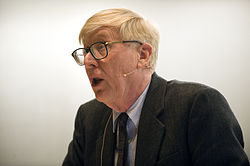
David Byrne: How Do Our Brains Process Music?

David Byrne in Smithsonian Magazine:

ScreenHunter_05 Sep. 18 09.11I listen to music only at very specific times. When I go out to hear it live, most obviously. When I’m cooking or doing the dishes I put on music, and sometimes other people are present. When I’m jogging or cycling to and from work down New York’s West Side Highway bike path, or if I’m in a rented car on the rare occasions I have to drive somewhere, I listen alone. And when I’m writing and recording music, I listen to what I’m working on. But that’s it.

I find music somewhat intrusive in restaurants or bars. Maybe due to my involvement with it, I feel I have to either listen intently or tune it out. Mostly I tune it out; I often don’t even notice if a Talking Heads song is playing in most public places. Sadly, most music then becomes (for me) an annoying sonic layer that just adds to the background noise.

As music becomes less of a thing—a cylinder, a cassette, a disc—and more ephemeral, perhaps we will start to assign an increasing value to live performances again. After years of hoarding LPs and CDs, I have to admit I’m now getting rid of them. I occasionally pop a CD into a player, but I’ve pretty much completely converted to listening to MP3s either on my computer or, gulp, my phone! For me, music is becoming dematerialized, a state that is more truthful to its nature, I suspect. Technology has brought us full circle.

More here.

Monday, September 17, 2012

3QD Philosophy Prize 2012 Finalists

Hello,

Finalist 2012 PhilosophyThe editors of 3QD have made their decision. The twenty semifinalists have been winnowed down to six, and three wildcard entries added. Thanks again to all the participants.

Once again, Carla Goller has provided a “trophy” logo that our finalists may choose to display on their own blogs. And if you like our site, please do add us to your blogroll!

So, here it is, the final list that I am sending to Justin E. H. Smith, who will select the 1st, 2nd, and 3rd prize winners: (in alphabetical order by blog name here)

  1. 3 Quarks Daily: What Kind of Perspectivist is Nietzsche?
  2. Bleeding Heart Libertarians: Recharting the Map of Social and Political Theory: Where is Government? Where is Conservatism?
  3. Experimental Philosophy: Factive Verbs and Protagonist Projection
  4. Meditations Hegeliènnes: Kritik des unreinen Gedankes
  5. Opinionator: The Moral Hazard of Drones
  6. Ratio Juris: Toward a Philosophically Sound & Bioethically Sensitive Definition of Public Health Law
  7. The Immanent Frame: Love's Ladder's God
  8. The Philosopher's Beard: Democracy is not a truth machine
  9. Tomkow: A Few Short Steps to the Gallows

We'll announce the three winners on or around September 24, 2012.

Good luck!

Abbas

P.S. The editors of 3QD will not be making any comments on our deliberations, or the process by which we made our decision, other than to simply say that we picked what we thought were the best posts out of the semifinalists, and added three others which we also liked.

Sunday, September 16, 2012

Can the chick-a-dee call provide lessons about human language?

Todd Freeberg, Jeffrey Lucas, and Indrikis Krams in American Scientist:

201285836449264-2012-09TOCFreebergF1If you live in North America, Europe or Asia near a forest, suburban open woodlands or even an urban city park, chances are you have heard a member of the avian family Paridae—the chickadees, tits and titmice. Birds use calls to communicate with their flockmates, and most parids share a unique call system, the chick-a-dee call. The call has multiple notes that are arranged in diverse ways. The resulting variation is extraordinary: The chick-a-dee call is one of the most complex signaling systems documented in nonhuman animal species.

Much research on the chick-a-dee call has considered Carolina chickadees,Poecile carolinensis, a species common in the southeastern United States. We focus on this species here, but we also compare findings from other parids. We discuss how the production and reception of these calls may be shaped over individual development, and also how ecological and evolutionary processes may affect call use. Finally, we raise some key questions that must be addressed to unravel some of the complexities of this intriguing signaling system. Increased understanding of the processes and pressures affectingchick-a-dee calls might tell us something important about what drives signaling complexity in animals, and it may also help us understand the evolution of that most complex vocal system, human language.

More here.

Noam Chomsky: Why America and Israel Are the Greatest Threats to Peace

Noam Chomsky in AlterNet:

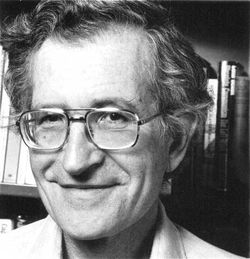
Noamchomsky-11Like its patron, Israel resorts to violence at will. It persists in illegal settlement in occupied territory, some annexed, all in brazen defiance of international law and the U.N. Security Council. It has repeatedly carried out brutal attacks against Lebanon and the imprisoned people of Gaza, killing tens of thousands without credible pretext.

Thirty years ago Israel destroyed an Iraqi nuclear reactor, an act that has recently been praised, avoiding the strong evidence, even from U.S. intelligence, that the bombing did not end Saddam Hussein’s nuclear weapons program but rather initiated it. Bombing of Iran might have the same effect.

Iran too has carried out aggression – but during the past several hundred years, only under the U.S.-backed regime of the shah, when it conquered Arab islands in the Persian Gulf.

Iran engaged in nuclear development programs under the shah, with the strong support of official Washington. The Iranian government is brutal and repressive, as are Washington’s allies in the region. The most important ally, Saudi Arabia, is the most extreme Islamic fundamentalist regime, and spends enormous funds spreading its radical Wahhabist doctrines elsewhere. The gulf dictatorships, also favored U.S. allies, have harshly repressed any popular effort to join the Arab Spring.

More here.

Denise Hamilton on Perfume

The author guides us through the intoxicating world of the perfumer, from ancient Egypt to wartime Paris – and explains what Guerlain meant when he said his fragrances contained a whiff of his mistress's bottom.

Sophie Roell in The Browser:

Why have people been so drawn to perfume down the ages? Is it because of the belief that we can make people desire us if we smell a certain way?

ScreenHunter_11 Sep. 16 19.26Perfume literally means “through the smoke”, from the Latin per fumus. As practised by the ancient Egyptians, perfume was initially religious and ritualistic in nature. It was burned in temples as an offering to the Gods. The resins that made up perfume – rare flower essences, myrrh and frankincense – were very expensive. In the Bible, the three wise men brought gifts of frankincense and myrrh to Jesus. They were on a par with gold. To burn these precious unguents and offer them to the Gods was one of the highest sacrifices and offerings that you could make. Paradoxically, in addition to being a religious offering perfume was also considered an aphrodisiac. There were perfumes made to attract the opposite sex, to make people fall in love with you. So from ancient times perfume has had a dual function.

I think that in ancient times – perhaps when our sense of smell was more important – perfume had a place of higher honour in society. Today, smell is probably the least appreciated and used of all our five senses. Perfume had its heyday in the early 20th century, when big firms like Guerlain, Caron and Chanel were making perfumes that were widely sought after and very expensive.

More here.

Islamist Déjà Vu: The Lessons of 1979

Christian Caryl in the New York Review of Books:

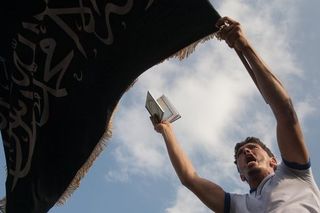
Caryl-mideast-protester_jpg_470x633_q85The year 1979—when Iranian student revolutionaries stormed the US Embassy in Tehran and took dozens of American diplomats hostage, and Muslim radicals in Saudi Arabia, a staunch US ally, brazenly laid siege to the Grand Mosque in Mecca—marked the debut of a new political phenomenon known as “Islamism.” To be sure, the theorists and advocates of political Islam had been around for a while, and there was an extraordinary explosion of Islamic activism around the Muslim world in the 1970s; in some countries there was even talk of a sahwa, an “awakening” of Islamic political consciousness. But few people outside of theummah, the global community of Muslim believers, were paying any attention, and the US was caught flatfooted as Ayatollah Khomeini proceeded to transform his theory of “Islamic government” into reality. “Political Islam” was no longer a theory. It had become an active, practical force in global politics.

Perhaps it’s helpful to recall the events of 1979 as we contemplate the tragic death of US Ambassador to Libya Christopher Stevens and the storming of American diplomatic buildings in Cairo, Sanaa, Tunis, and elsewhere in the Muslim world. (Curiously, that same year was also the last time—until Stevens’ death—that a serving ambassador was killed overseas. The unlucky diplomat in 1979 was Adolph Dubs, killed in a Kabul hotel in a hostage-taking gone wrong.) The events this week appear at least in part to have been set off by an inflammatory anti-Muslim film. But they have been dominated by groups that were little known before the recent Arab uprisings: Salafi Islamists. Once again, a growing political force from within the Islamic world—one of which Westerners were only dimly aware—has dramatically and violently demonstrated its capacity to shape global politics.

More here.

Sunday Poem

All Her Life

I lay down for a nap. But everytime I closed my eyes,
mares' tails passed slowly over the Strait
toward Canada. And the waves. They rolled up on the beach
and then back again. You know I don’t dream.
But last night I dreamt we were watching
a burial at sea. At first I was astonished.
And then filled with regret. But you
touched my arm and said, “No, it's all right.
She was very old, and he'd loved her all her life.”

by Raymond Carver
from Where water Comes Together With Other Water
Vintage Books, 1986

Reluctant Fundamentalist was not directly inspired by 9/11

From Rediff:

ImageMira Nair's latest film, The Reluctant Fundamentalist, is said to be a thriller. Adapted from Mohsin Hamid's international bestseller of the same name, the film set in America and Pakistan is much more, of course, but it does have several edge-of-the-seat scenes. The famed director has described it as her most difficult film in terms of raising money since Salaam Bombay some 30 years ago. The film revolves around a young and ambitious Wall Streeter (the magnetic Riz Ahmad) who returns to Pakistan from America after 9/11 and gets caught in the fundamentalist crossfire. “It is also a film that asks the questions, who am I, and what should I do,” Nair said at a press conference at the Toronto International Film Festival. The event was attended by actors Kate Hudson [ Images ], Riz Ahmad and Kiefer Sutherland. In a crucial scene in the film, Changez (Ahmad) meets a publisher in Istanbul who is forced to sell his firm to an American company. The older man asks Changez if he had heard of 'janissaries'. That was a long time ago, the older man says, when the advancing Turks would take young Christian boys from their parents across Europe, adopt them, convert them and after a few years send them to fight their own people.

Though Changez is not forcibly taken to America — he is, in fact, the son of a poet in Lahore [ Images ] and had gone to American to study and pursue the American dream — the talk about janissaries has a profound influence on him and plays a key role in making him think of going back to Pakistan. Nair recalled how exactly 11 years ago she desperately sought news of her friends in New York during the Toronto film festival for the North American premiere of Monsoon Wedding [ Images ]. And now she was in town to promote her new film which has 9/11 as one of its characters. But she did not get into the project because of its 9/11 connections, she said. “In truth, the film was not directly inspired by 9/11,” she said. Instead, it was a visit to Pakistan that moved her to make a film based on “a brilliant mind-game of a book.” Her father's family had migrated to India [ Images ] from Lahore, she said, adding that she learned a lot about Lahore's culture and literature from him. Kate Hudson plays Changez's lover and Kiefer Sutherland, his boss in a Wall Street firm. Nair did not disclose how much the film cost but it is believed to have been made for about $15 million and was funded by a Doha financing agency. Nair shot much of the film in India and America, a few scenes in Turkey, and plenty of external shots of Lahore. “I am known as a bulldozer and I get a film done in about two years. But this time it took six years to get the script ready, raise the money and shoot the film,” Nair said. “I just knew I had to do it,” she continued, adding that there is “an increasingly sad divide between the East and the West” that makes fresh dialogue necessary.

More here.

Who tolerates anti-American preaching from Muslims?

From Discover:

InterObviously the news over the past week has been filled with the events in the Middle East, and the broader Muslim world, in reaction to an anti-Muslim film. I think the most eloquent commentary is from The Onion (NSFW!!!), No One Murdered Because Of This Image. That being said, there are some serious broader issues here. A friend of mine who lives in India (he is Indian American, though raised for several years in India, so not totally unfamiliar with the culture) has expressed to me his frustration with having to defend American liberalism in a society where American liberalism is an abstraction, rather than concrete. The frustration has to do with the fundamental divergence in basic values. For example, his interlocutors have argued to him (he is a practicing Christian of libertarian political orientation) that if someone committed an act of blasphemy against his faith of course he would react in anger and violence. And yet of course the clause “and” is false, though he is greeted with skepticism when he asserts he wouldn’t react violently. As a matter of fact I can attest to the reality that he wouldn’t react angrily necessarily, because in interactions where I’ve made casually blasphemous comments he’s only rolled his eyes. Just as Americans have a vague, even misleading, understanding of the broader historical forces which engender resentment of American hegemony in the broader world, so many non-Americans lack a proper awareness of the broader historical forces, and cultural reality, of the particular American radicalism and extremism in the domain of free expression.

…Would Americans tolerate anti-American preaching from Muslim clerics in this country? We can explore this with the General Social Survey with the SPKMSLM variable. It asks:

Now consider a Muslim clergyman who preaches hatred of the United States.

If such a person wanted to make a speech in your community preaching hatred of the United States, should he be allowed to speak, or not?

The question was asked in 2008 and 2010. Since the sample sizes are large I’ll limit to non-Hispanic whites first.

More here.

Saturday, September 15, 2012

Ted Hughes on the Universal Inner Child, in a Moving Letter to His Son

PlathhughesnicholasMaria Popova in Brain Pickings:

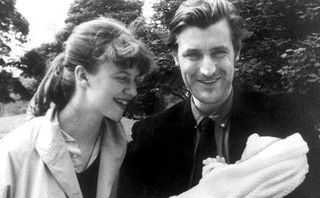
“The analogy between the artist and the child is that both live in a world of their own making,” wrote Anaïs Nin in her diary in 1945. Four decades later, 23 years after Sylvia Plath took her own life at the age of 30, Ted Hughes (1930-1998) wrote to their 24-year-old son, Nicholas. Theletter, found in Letters of Ted Hughes (public library), is superb in its entirety and a worthy addition to history’s finest fatherly advice, but this particular passage speaking to the beautiful vulnerability of our inner child and its longing to be seen, heard, let loose is an absolutley exquisite articulation of the human condition — don’t let the length and density deter you from absorbing it, for once you do, it’ll saturate every cell of your soul.

When I came to Lake Victoria, it was quite obvious to me that in some of the most important ways you are much more mature than I am. . . . But in many other ways obviously you are still childish — how could you not be, you alone among mankind? It’s something people don’t discuss, because it’s something most people are aware of only as a general crisis of sense of inadequacy, or helpless dependence, or pointless loneliness, or a sense of not having a strong enough ego to meet and master inner storms that come from an unexpected angle. But not many people realise that it is, in fact, the suffering of the child inside them. Everybody tries to protect this vulnerable two three four five six seven eight year old inside, and to acquire skills and aptitudes for dealing with the situations that threaten to overwhelm it. So everybody develops a whole armour of secondary self, the artificially constructed being that deals with the outer world, and the crush of circumstances.

Retrieving a History: Responding to Perry Anderson on India

250px-Perry_AndersonAnanya Vajpeyi in Caravan (image from Wikimedia commons):

A RECENT BBC PROGRAM showed Boris Johnson, the mayor of London and author of Johnson’s Life of London: The People who Made the City That Made the World (HarperCollins, 2011), inspecting the gigantic sculpture titled ‘Orbit’ in the company of Lakshmi Mittal, the steel magnate, and Anish Kapoor, the designer of this enormous steel tower built for the London Olympics of 2012. The mayor, with his hefty frame and mop of flaxen hair, and the two Indians who made Orbit as a permanent public artwork for the Olympic Park, all seemed to claim ownership of this work, in one way or another, and thereby to stake a claim in the renewal and refashioning of London as a city as important in the 21st century as it had been in the 19th and 20th centuries. Surely this controversial and ambitious British politician and journalist, belonging to the Conservative Party, could not do what he’s doing without the money and the talent of the two Indian men inspecting the humongous structure alongside him.

The scene of seemingly post-imperial, post-racial and post-modern collaboration and camaraderie reminded me with a jolt of three recent essays on the political history of modern India by the British Marxist and intellectual historian Perry Anderson, in the pages of the London Review of Books. Anderson, a long-time editor of the New Left Review, a professor of history at UCLA and a prolific essayist for the past half-century, has not previously written about India, so these three very long pieces—which together total nearly 50,000 words—may come as something of a surprise to Indian scholars. But even more surprising, for his admirers and readers in India, is his weirdly anachronistic reading of modern Indian history. In pursuit of his effort to render a scathing verdict on the Indian present, he has constructed a malign caricature of the Indian past, beginning with two relentless attacks on Mahatma Gandhi and Jawaharlal Nehru.

In the first two of his three essays, devoted respectively to Gandhi and Nehru, Anderson’s zeal to demolish these idols and, by extension, to discredit the Independence movement, leads him unwittingly to a bombastic rhetorical tone that sounds more like Winston Churchill or the latter-day Tory defenders of the Raj than a preeminent British Marxist.

After declaring that “All countries have fond images of themselves, and big countries, inevitably, have bigger heads than others,” Anderson proceeds through a litany of tendentious claims: that the “idea of India” was a “European and not a local invention”; that the Independence movement did nothing to hasten British withdrawal—and indeed even prolonged the Raj; that the advances of the Japanese Army at the end of World War II in Southeast Asia, rather than any Indian efforts, provided the final blow to British rule in India. Anderson’s Gandhi is an almost unrecognisable figure: a charismatic leader and a “first-class organiser and fundraiser” to be sure, but also a religious zealot, a “stranger” to “real intellectual exchange” whose “homemade” faith was indelibly tinted with an ethos of Hindu supremacy.

A Critic’s Case for Critics Who Are Actually Critical

19riff-articleLargeDwight Garner in the NYT:

In the spring of 1983, Esquire convened what it called a revenge symposium. The editors asked a group of well-known writers to “let go unbridled comments” on their harshest and least favorite critics. The results were spectacular.

Jim Harrison called his detractors “tweed fops” and “snack-food artists.” Roy Blount Jr. declared about Larry McMurtry, who panned one of his books: “I hear he is absurdly, egregiously — especially in a cowboy hat — short.” Erica Jong recalled that Paul Theroux, while reviewing her novel “Fear of Flying,” referred to her as a “mammoth pudenda.” (Actually he was referring to the novel’s main character.) She replied: “Since Mr. Theroux has no personal acquaintance with the organ in question, I cannot help but wonder whether some anxieties about his own anatomy were at the root (as it were) of his review.”

It hurts to be criticized, and there is exhilaration in firing back, sometimes literally. The novelist Richard Ford, after a dismissive review from Alice Hoffman in The New York Times Book Review in 1986, shot bullets through one of her novels and mailed the mutilated thing to her. “My wife shot it first,” he reportedly said. Years later he spat in public upon the novelist Colson Whitehead, who had harshly reviewed another of his books. Afterward Whitehead commented, “This wasn’t the first time some old coot had drooled on me, and it probably won’t be the last.”

Ford is old-school. Most of us, when confronted with painful words, can’t resort to firearms or loogies, as much as we’d enjoy it. Instead we stew. We struggle to be as chipper as the novelist Kingsley Amis, who commented that a bad review could ruin breakfast but should not ruin lunch. It probably helped that Amis drank at lunch.

the sad, extraordinary man

E5cc0a0f-cdb8-400b-8813-d26d6cea700e

Wallace was tormented by one defining question: was the world anything more than a tissue of representations? A hard philosophical sceptic, he felt imprisoned inside his own head, his dark box. “There is this existential loneliness in the real world,” he told Laura Miller, the co-founder of Salon.com, in an interview collected in Conversations with David Foster Wallace. “I don’t know what you’re thinking or what it’s like inside you and you don’t know what it’s like inside me.” It was his belief (more a hope, as it turned out) that “in fiction I think we can leap over that wall itself in a certain way”. But in his life Wallace, who suffered from clinical depression, kept slamming into that wall of separation between the self and the world. He longed to make connections – with other people, with other minds. He longed to understand better, to be free from the tumult and the pain that he felt, every day, without respite.

more from Jason Cowley at the FT here.

After Mandela

600

What a pleasant surprise to encounter a book that actually looks beyond the surface of South Africa’s by now well-known story. We’ve read so many accounts of the miraculous transformation of the hideous apartheid state into the rainbow democracy and, in the nearly two decades since that happened, of the flies in the ointment that have marred the fairy tale. In his many visits to South Africa over the last eight years and the year he spent living there, California journalist Douglas Foster, former editor of Mother Jones, has gained a superb understanding of the complexities of South African society. Though never underestimating the burden laid upon present-day South Africa not just by 45 years of apartheid but by centuries of segregation, he has wisely chosen to concentrate on the chaotic present and immediate past as well as trying to see what a very uncertain future might hold.

more from Martin Rubin at the LA Times here.

depressingly timeless

16ROYTE-articleInline

Carson artfully linked radioactive fallout with the indiscriminate use of pesticides; they were, Souder writes, the “twin fears of the modern age.” The parallels between the chemicals were, to Carson, exact and inescapable: both were invisible, acutely toxic, mutagenic and had effects that could last for generations. Such negative impacts, Carson believed, were the consequence of the “impetuous and heedless pace of man rather than the deliberate pace of nature.” Carson had a knack for encapsulating big ideas and for saying exactly what she meant. Her voice could be clear and plain (“The problem that concerns us here . . . ”) or poetical (she feared “a sterile world ungraced by the curving wing of a bird in flight”). But none of this came easily. Souder paints Carson as an obsessive reviser and a meticulous researcher who was often blocked, she said, by her uneasiness that human beings had acquired the power to reshape the world so profoundly.

more from Elizabeth Royte at the NY Times here.

Saturday Poem

So Little

I said so little.
Days were short.

Short days.
Short nights.
Short years.

I said so little.
I couldn't keep up.

My heart grew weary
From joy,
Despair,
Ardor,
Hope.

The jaws of Leviathan
Were closing upon me.

Naked, I lay on the shores
Of desert islands.

The white whale of the world
Hauled me down to its pit.

And now I don't know
What in all that was real.
.

by Czeslaw Milosz
from The Collected Poems
Ecco Press, NY, 1988