On the State of Indian Fiction in America

Keith Meatto in The Millions:

In the fifth episode of the hit sitcom New Girl, a self-styled stud tries to impress an Indian-American woman by declaring that he loves India. When pressed for details, he stumbles his way through the following catalogue:

I love Slumdog. I love naan. I love pepper. I love Ben Kingsley, the stories of Rudyard Kipling. I have respect for cows, of course. I love the Taj Mahal, Deepak Chopra, anyone named Patel. I love monsoons. I love cobras in baskets…I love mango chutney, really, any type of chutney.

The point is clear: the average American’s knowledge of Indian culture is superficial, stereotypical, and offensive. Nevertheless, the mere existence of the joke — and an Indian-American woman in a leading role on primetime TV — confirms how much Indian culture has permeated American pop culture. This should not be surprising: With a population that increased to 2.8 million from 1.7 million between 2000 and 2010, Indians are one of the fastest growing ethnic groups in America. They may also be one of the fastest growing ethnic groups in literary fiction — in America and the larger Anglophone world.

covercovercoverFiction written in English by authors of Indian descent has been critically acclaimed and commercially successful for decades. Now a new wave of talent has arrived: In 2012, the Indian-American writers Rajesh Parameswaran and Tania Jamespublished their debut short story collections — I Am An Executioner: Love Stories and Aerogrammes, respectively — while British-Indian author Hari Kunzrupublished his fourth novel, Gods Without Men: While it may be too soon for these authors to have achieved the heavyweight status of a Salman Rushdie or Jhumpa Lahiri, their imaginative, provocative, and well-crafted books suggest the continuation of a literary legacy and a move into “post-post-colonial,” “post-ethnic” territory.

How American democracy became the property of a commercial oligarchy

Lewis Lapham at Al Jazeera:

201292610238967734_20The ritual performance of the legend of democracy in the autumn of 2012 promises the conspicuous consumption of $5.8 billion, enough money, thank God, to prove that our flag is still there. Forbidden the use of words apt to depress a Q Score or disturb a Gallup poll, the candidates stand as product placements meant to be seen instead of heard, their quality to be inferred from the cost of their manufacture. The sponsors of the event, generous to a fault but careful to remain anonymous, dress it up with the bursting in air of star-spangled photo ops, abundant assortments of multiflavoured sound bites, and the candidates so well-contrived that they can be played for jokes, presented as game-show contestants, or posed as noble knights-at-arms setting forth on vision quests, enduring the trials by klieg light, until on election night they come to judgment before the throne of cameras by whom and for whom they were produced.

Best of all, at least from the point of view of the commercial oligarchy paying for both the politicians and the press coverage, the issue is never about the why of who owes what to whom, only about the how much and when, or if, the check is in the mail. No loose talk about what is meant by the word democracy or in what ways it refers to the cherished hope of liberty embodied in the history of a courageous people.

The campaigns don't favour the voters with the gratitude and respect owed to their standing as valuable citizens participant in the making of such a thing as a common good. They stay on message with their parsing of democracy as the ancient Greek name for the American Express card, picturing the great, good American place as a Florida resort hotel wherein all present receive the privileges and comforts owed to their status as valued customers, invited to convert the practice of citizenship into the art of shopping, to select wisely from the campaign advertisements, texting A for Yes, B for No.

More here.

It’s All Fun and Games Until Someone 3D-Prints a Gun

Rose Eveleth in Smithsonian Magazine:

Worlds-first-3d-printed-gunEarlier this year, someone took 3D printing to the logical, if extreme, next step: weapons. The 3D printing gun idea has taken off, but Stratasys, the company that makes the printers being used, isn’t exactly happy about it. They want their printers back.

A few months ago, on a gun forum, someone with the username HaveBlue posted pictures of an AR lower that he printed using a Stratasys 3D printer. Eventually he assembled a .22 caliber pistol using that lower. Not only did he print it, he shot it. And it worked. He writes, “No, it did not blow up into a bazillion tiny plastic shards and maim me for life – I am sorry to have disappointed those of you who foretold doom and gloom.”

The plans for that lower are freely available online, and a few months later Cody Wilson, a law student at the University of Texas, formed a group “Defense Distributed” and planned to launch a “Wiki Weapon Project.” The premise was to come up with a design that anyone could download and print. They tried to raise money on IndiGogo, a site for crowd-sourced funding, but the site quickly shut them down and returned the money to their supporters.

But the project has still gained a lot of money from investors.

More here.

A bold economic experiment in France

Alexander Reed Kelly in TruthDig:

Flag300A bold experiment is under way in the world’s fifth-largest economy: As part of a recovery plan aimed at plugging a $48 billion hole in the French budget, leftist President Francois Hollandeannounced last week a 75 percent tax on the personal incomes of anyone earning more than $1.3 million a year, effective for two years beginning in 2013.

The decision has some of the country’s top earners, led in the media by cosmetics tycoon Jean-Paul Agon, suggesting that the new rules will make France inhospitable to commerce, and implying that the impending blow to their bank accounts may compel executives to take their moneymaking activities elsewhere.

“If there is such a new tax rule,” the L’Oreal CEO said in an interview before the figure was confirmed Friday, “it’s going to be very, very difficult to attract talent to work in France, almost impossible.”

Agon’s warning reflects an attitude among the rich that is older than capitalism itself. If you tax us too much, the thinking goes, then the cost of providing the goods and services society requires will become too high. We won’t be able to pay the wages our workers deserve, and our talents for enterprise will find more favorable conditions elsewhere.

More here.

Keatsian ordinariness is protean and unexpected

Perry_10_12

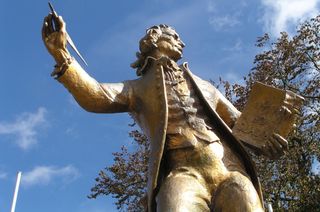
Contemplating the tomb of John Keats for the readers of Irish Monthly, Oscar Wilde swooningly lamented ‘this divine boy’ who was ‘a Priest of Beauty slain before his time’. Critics haven’t spoken that way for a long time, and that’s no bad thing; but Wilde’s sense of a poet doomed and lovely, an aesthetic spirit too good for this life, would prove tenacious despite the changing idioms of the age. Paul de Man, for instance, a high-octane theorist who couldn’t sound less like Wilde, once confidently asserted that when reading Keats ‘we are reading the work of a man whose experience is mainly literary’, a man whose life had been chiefly led within the pure mental spaces of art. Wilde did not invent this legend. Much of its popularity must stem from the early and memorable things said by Shelley, who rapturously elegised an otherworldly spirit in Adonais, and by Byron, who entrenched the myth of vulnerable genius in Don Juan even while he was sending it up: ”Tis strange the mind, that very fiery particle,/Should let itself be snuff’d out by an article.’

more from Seamus Perry at Literary Review here.

hobsbawn the great

Hobsbawm

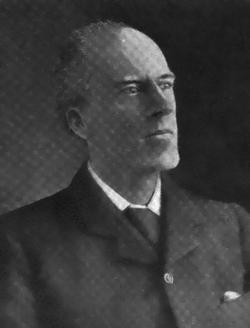
Eric Hobsbawm was one of the greatest historians produced by the twentieth century. Easily. You could slice off any five of the books from his C.V. and he would still be in the running. A thinker of dazzling scope and dizzying erudition, Hobsbawm had few peers and many emulators. He specialized in the nineteenth century but remains a giant in scholarly debates ranging from the seventeenth century to the twentieth. Historians at their most ambitious, he believed, could aspire to explaining “how and why Homo sapiens got from the paleolithic to the nuclear era.” Nobody can claim with even a tattered shred of intellectual honesty the competence to fulfill this project, but Hobsbawm came as close to meeting the challenge as any of us Homo sapiens is likely to. No surprise, then, that his death has precipitated a torrent of deserved tributes, from admirers on the cartoonish Right to comrades on the left, with stops at seemingly every position in between. Celebrations of his intellectual achievements vie with accounts of personal kindness for the admiration of readers. But the rush to memorialize, though understandable, is a poor commemoration for someone whose work at its best was defined by skepticism of dogma and repudiation of sentimentality.

more from Timothy Shenk at Dissent here.

the end of mark strand

Deshpande_37.5_book

T. S. Eliot famously proposed that a poem is no less than a “raid on the inarticulate,” an effort to make what has not yet been said pass into speech. But Strand’s objective is somewhat different, even counter to that. He aims to engage with the inarticulate, to approach it, moving outside of the visible in order, ideally, to inhabit that unknown space. He suggests that the work of the poem could be to bear witness to that which cannot be articulated, even as it calls to us. This effort affords us no end of trouble, however, since poetry is indivisible from its articulation. If the poem is trying to get at nothing, it is always using a something in order to do so. “The Minister of Culture” makes this trouble evident. “Nothing is elsewhere doing what nothing does,” but that expansion of the dark can never occur here: the light of the mind keeps it at a distance. The personification of nothingness in the last sentences also complicates the pursuit of oblivion: nothing becomes a love-object, and therefore loses its insubstantiality.

more from Jay Deshpande at Boston Review here.

Wednesday Poem

I Invent You

I invent you in the garden
I invent that you talk to me
that you call me
and in fact you do talk to me
and sometimes I don't understand
what you say
and I am amazed at you
at your mystery
and I pretend that I understand
so that you won't go away.
Day after day I invent you
and that's my way
of confronting your absence
because if I don't invent you
the joy of my hours
would vanish
and you as well.

by Claribel Alegría
from Sorrow
translation Carolyn Forché
Curbstone Press, 1999

Original Spanish after the jump

Read more »

Did human evolution favor individualists or altruists? Ayn Rand vs. the Pygmies

From Slate:

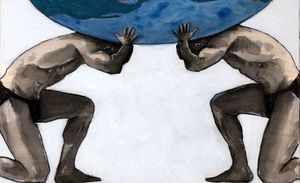
AtlasBlack-and-white colobus monkeys scrambled through the branches of Congo’s Ituri Forest in 1957 as a small band of Mbuti hunters wound cautiously through the undergrowth, joined by anthropologist Colin Turnbull. The Mbuti are pygmies, about 4 feet tall, but they are powerful and tough. Any one of them could take down an elephant with only a short-handled spear. Recent genetic evidence suggests that pygmies have lived in this region for about 60,000 years. But this particular hunt reflected a timeless ethical conflict for our species, and one that has special relevance for contemporary American society. The Mbuti employed long nets of twined liana bark to catch their prey, sometimes stretching the nets for 300 feet. Once the nets were hung, women and children began shouting, yelling, and beating the ground to frighten animals toward the trap. As Turnbull came to understand, Mbuti hunts were collective efforts in which each hunter’s success belonged to everybody else. But one man, a rugged individualist named Cephu, had other ideas. When no one was looking, Cephu slipped away to set up his own net in front of the others. “In this way he caught the first of the animals fleeing from the beaters,” explained Turnbull in his book The Forest People, “but he had not been able to retreat before he was discovered.” Word spread among camp members that Cephu had been trying to steal meat from the tribe, and a consensus quickly developed that he should answer for this crime. At an impromptu trial, Cephu defended himself with arguments for individual initiative and personal responsibility. “He felt he deserved a better place in the line of nets,” Turnbull wrote. “After all, was he not an important man, a chief, in fact, of his own band?” But if that were the case, replied a respected member of the camp, Cephu should leave and never return. The Mbuti have no chiefs, they are a society of equals in which redistribution governs everyone’s livelihood. The rest of the camp sat in silent agreement. Faced with banishment, a punishment nearly equivalent to a death sentence, Cephu relented. “He apologized profusely,” Turnbull wrote, “and said that in any case he would hand over all the meat.” This ended the matter, and members of the group pulled chunks of meat from Cephu’s basket. He clutched his stomach and moaned, begging that he be left with something to eat. The others merely laughed and walked away with their pound of flesh. Like the mythical figure Atlas from Greek antiquity, condemned by vindictive gods to carry the world on his shoulders for all eternity, Cephu was bound to support the tribe whether he chose to or not.

Meanwhile, in the concrete jungle of New York City, another struggle between the individual and the group was unfolding. In October of 1957, Ayn Rand published her dystopian novel Atlas Shrugged, in which a libertarian hero named John Galt condemns his collectivist society because of its failure to support individual rights. “By the grace of reality and the nature of life, man—every man—is an end in himself,” Galt announced, “he exists for his own sake, and the achievement of his own happiness is his highest moral purpose.” Unlike Cephu, Galt had the means to end his societal bondage. By withdrawing his participation and convincing others to do the same, he would stop the motor of the world. Atlas would shrug. “Every living species has a way of survival demanded by its nature,” Galt insisted. “I swear by my life, and my love of it, that I will never live for the sake of another man, nor ask another man to live for mine.” Ayn Rand’s defense of a human nature based on rationality and individual achievement, with capitalism as its natural extension, became the rallying cry for an emerging libertarian stripe in conservative American politics. Paul Ryan cites Atlas Shrugged as forming the basis of his value system and says it was one of the main reasons he chose to enter politics. Other notable admirers include Rush Limbaugh, Alan Greenspan, Clarence Thomas, as well as Congressional Tea Party Caucus members Steve King, Mick Mulvaney, and Allen West.

More here.

Lack of Education Widens Gap in Life Expectancy

From Columbia Magazine:

OldhandsThe MacArthur Research Network on Aging, chaired by Dr. John W. Rowe, has published its latest research showing a widening gap in life expectancy between Americans with higher education and those without a high school diploma. The gap has increased dramatically among whites, with those who lack a high school diploma suffering dramatic declines in life expectancy. The biggest gap, however, persists between college-educated whites and blacks who don't complete high school. The provocative paper was published in the August issue of the journal Health Affairs and was the lead story in today's The New York Times. Dr. Rowe, Professor of Health Policy and Management, and Dr. Linda P. Fried, Mailman School Dean, are co-authors.

The research looked at life expectancy by race, sex, and education and examined trends in disparities from 1990 through 2008. The study cautions that failure to complete high school takes a heavy toll on longevity among all groups, essentially negating the effects of recent healthcare advances and longevity gains. “It's as if Americans with the least education are living in a time warp,” says S. Jay Olshansky, professor of epidemiology at the University of Illinois at Chicago School of Public Health and lead author of the study. “The least educated black men are living in 1954, black women in 1962, white women in 1964, and white men in 1972.”

More here.

Tuesday, October 2, 2012

Why do people love to say that correlation does not imply causation?

Daniel Engber in Slate:

120926_SCI_karlpear.jpg.CROP.article250-mediumDepressed people send more email. They spend more time on Gchat. Researchers at the Missouri University of Science and Technology recently assessed some college students for signs of melancholia then tracked their behavior online. “We identified several features of Internet usage that correlated with depression,” they said. Sad people use IM and file-share. They play video games. They surf the Web in their own, sad way.

Not everyone found the news believable. “Facepalm. Correlation doesn't imply causation,” wrote one unhappy Internet user. “That's pretty much how I read this too… correlation is NOT causation,” agreed a Huffington Post superuser, seemingly distraught. “I was surprised not to find a discussion of correlation vs. causation,” cried someone at Hacker News. “Correlation does not mean causation,” a reader moaned at Slashdot. “There are so many variables here that it isn't funny.”

And thus a deeper correlation was revealed, a link more telling than any that the Missouri team had shown. I mean the affinity between the online commenter and his favorite phrase—the statistical cliché that closes threads and ends debates, the freshman platitude turned final shutdown. “Repeat after me,” a poster types into his window, and then he sighs, and then he types out his sigh, s-i-g-h, into the comment for good measure. Does he have to write it on the blackboard?Correlation does not imply causation. Your hype is busted. Your study debunked. End of conversation. Thank you and good night.

More here.

The deeply disturbing Israel court ruling on Rachel Corrie

Cindy Corrie [Rachel's mother] in The Seattle Times:

The home Rachel and her friends from the International Solidarity Movement defended was eventually demolished with hundreds more in mass-clearing operations to create a buffer along Gaza’s southern border.

Our lawsuit was not a solution, but rather a symptom of a broken system of accountability within Israel and our own U.S. government. Despite a promise from Israel Prime Minister Ariel Sharon for a “thorough, credible, and transparent” investigation and repeated calls from the highest levels of our government for such an investigation to occur, there was no diplomatic resolution. According to the U.S. State Department, its calls “have gone unanswered or ignored.”

Court testimony also confirmed a credible investigation did not occur. Investigators failed to question key military witnesses, including those recording communications; failed to secure the military video, allowing it to be taken for nearly a week by senior commanders with only segments submitted to court; failed to address conflicting soldiers’ testimonies; and ignored damning statements in the military log confirming a “shoot to kill” order and command mentality to continue work in order not to create a precedent with activists.

I had no illusions about the uphill battle we faced in Israeli court, but as I sat with my family in a packed courtroom awaiting the verdict, I held hope that, like so many observing the trial, the judge would see that evidence warranted some criticism of the military’s actions.

The room was filled with human-rights observers, U.S. Embassy officials, family supporters and a throng of media. Judge Oded Gershon surveyed the scene before reading his decision. From the halting tone of my translator and friend, and audible groans around us, I knew it was bad.

He ruled that Rachel was killed as an act of war, which, according to Israeli law, absolves the military of responsibility. He added that she alone was to blame for her own killing and then went on to commend the military police for their professionalism in carrying out such a credible investigation. The courtroom heard the judge parrot the state prosecuting attorneys’ original claims in the case, nearly verbatim.

More here.

The Myths of Muslim Rage

Kenan Malik in Pandaemonium:

Satanic-versesThe Rushdie affair is shrouded in a number of myths that have obscured its real meaning. The first myth is that the confrontation over The Satanic Verses was primarily a religious conflict. It wasn’t. It was first and foremost a political tussle. The novel became a weapon in the struggle by Islamists with each other, with secularists and with the West. The campaign began in India where hardline Islamist groups whipped up anger against Rushdie’s supposed blasphemies to win concessions from politicians nervous about an upcoming general election and fearful of alienating any section of the Muslim community. The book subsequently became an issue in Britain, a weapon in faction fights between various Islamic groups.

Most important was the struggle between Saudi Arabia and Iran for supremacy in the Islamic world. From the 1970s onwards Saudi Arabia had used oil money to fund Salafi organisations and mosques worldwide to cement its position as spokesman for the umma. Then came the Iranian Revolution of 1979 that overthrew the Shah, established an Islamic republic, made Tehran the capital of Muslim radicalism, and Ayatollah Khomeini its spiritual leader, and posed a direct challenge to Riyadh. The battle over Rushdie’s novel became a key part of that conflict between Saudi Arabia and Iran. Saudi Arabia made the initial running, funding the campaign against the novel. The fatwa was an attempt by Iran to wrestle back the initiative. The campaign against The Satanic Verses was not a noble attempt to defend the dignity of Muslims, nor even a theological campaign to protect religious values. It was part of a sordid political battle to promote particular sectarian interests.

The second myth is that most Muslims were offended by the novel. They weren’t.

More here.

And see also this article “Muslim Rage is About Politics, Not Religion” by Hussain Haqqani in Newsweek.

indian summer

290px-IndianSummer

Gradually, the term Indian summer has spread beyond its American origins. First to England, replacing a bevy of poetic names—All Halloween Summer, in Shakespeare’s day; St. Luke’s little summer, St. Martin’s Summer—with that single term. Then to France, capturing the popular imagination with the success of Joe Dassin’s classic homage, “L’été indien.” (Now that I think about it, I likely heard the name in French before I ever did in English; Joe Dassin—himself American born—was always popular in Russia, and I’d hummed the tune many a time before its meaning actually sunk in.) And the Indians and old women aren’t alone. Over the years, many others have laid claim to those days of waning heat. In the southern Slavic countries, it’s known as gypsy summer. I’d like to think that has something to do with the colorful vibrancy of the gypsy music and the sound of guitar strings by the open fire. In Italy, it’s a time of year owned by San Martino, or St. Martin.

more from Maria Konnikova at Paris Review here.

slave castle

Article_raboteau

Of the dozens of trade castles and forts dotting Ghana’s three-hundred-mile coastline, I’d chosen to visit the one in Elmina because it was the most notorious. Being the first permanent European settlement in Africa, it was also the oldest. The Portuguese began construction on São Jorge da Mina in 1482 with stones imported from Portugal. It was designed to defend against attacks from the local people and from other Europeans, but in the seventeenth century it was captured by the Dutch. In the nineteenth century it was purchased by the British. Now it is a World Heritage monument. In the castle’s early days, Europeans didn’t think of themselves as European any more than Africans thought of themselves as African. The Dutch weren’t betraying a European bond when they captured the Portuguese castle, just as the Mandinke weren’t betraying an African bond when they captured Ayuba. Nor, in the castle’s early days, was the castle a slave castle.

more from Emily Raboteau at The Believer here.

Eric Hobsbawm (1917-2012)

Eric-Hobsbawm-010

In the foothills of Hampstead Heath, where Karl Marx and Friedrich Engels used to take their afternoon strolls, stands the home of Eric and Marlene Hobsbawm. To enter the Nassington Road drawing room for a conversation with Hobsbawm was to be transported back to the great ideological struggles of the extreme 20th century. Here was where ideas mattered, history had a purpose, and politics was important. And one could have no more generous, humane, rigorous, and involved a guide than the late Eric Hobsbawm. The breadth of his work and the reach of his intellect was always startling. Right to the end of his days, he stayed up to date with scholarship, never failed to flay an opponent, and continued to write. Afternoon tea with Hobsbawm could range from the achievements of President Lula of Brazil to the limitations of Isaiah Berlin as an historian, the unfortunate collapse of the Communist party in West Bengal to what Ralph Miliband would have made of his boys, David and Ed.

more from Tristram Hunt at The Guardian here.

Tuesday Poem

34. Not What Makes Tao Tick

The Tao flows everywhere
so everything is of it

uncreated

Every thing receives Tao’s work
but it claims nothing for itself

It feeds all worlds
but never enslaves them

The Tao and each thing are merged
—the heart of all things
are filled with Tao’s humility

Each thing comes and goes
from it and to it but
Tao endures

Call it great

But being great is not what makes
Tao tick
……………..…..……which
…………………….. makes it
…………………….. great

from the Tao Te Ching by Lao Tzu
Adaptations by R.Bob

Cinema has changed us all: The birth of alienation

David Thomson in The Independent:

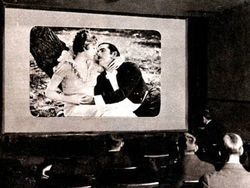
Alienation_freeIn his autobiography, The Words (1964), Jean-Paul Sartre described his discovery of cinema as a child. He would have been 10 years old in 1915 when The Birth of a Nation opened. But he hardly noticed particular films at first. What he saw or felt was something he called “the frenzy on the wall”. That could have been a reaction to the brilliant battle scenes in Griffith's films, but it also covers the still face of Garbo absorbing romantic loss, or the stoic blankness of Buster Keaton baffled by the physical chaos around him. The frenzy was in the whirl with which projected film ran at 16 or 24 frames a second, a passage of time that seethed on the wall – and, paradoxically, the serenity of another reality. That was the inherent madness and the magic in cinema: that we watch the battle but never risk hurt, and spy on Garbo without having her notice us.

At first, the magic was overwhelming: in 1895, the first audiences for the Lumière brothers' films feared that an approaching steam engine was going to come out of the screen and hit them. That gullibility passed off like morning mist, though observing the shower in Psycho (1960) we still seem to feel the impact of the knife. That scene is very frightening, but we know we're not supposed to get up and rescue Janet Leigh. In a similar way, we can watch the surreal imagery of the devastation at Fukushima, or wherever, and whisper to ourselves that it's terrible and tragic, but not happening to us.

More here.