Will Saudi Arabia Ever Change?

Hugh Eakin in the New York Review of Books:

ScreenHunter_110 Jan. 13 20.17Indeed there are few signs that the Saudi monarchy is even contemplating serious reforms. During a recent visit to several parts of the country, I spoke to academics, journalists, members of the Shia minority, and young bloggers, as well as clerics and government officials, and many were outspoken in criticizing the government; one journalist who had worked for official media told me, within minutes of our acquaintance, “I can’t wait for this regime to collapse!” But almost without exception, no one seemed to think that would happen anytime soon. I asked one prominent women’s rights activist why more Saudis weren’t agitating for a full written constitution—a moderate reform that could provide a more rigorous legal frame for continued Al Saud rule and that was discussed publicly during a brief opening after the September 11 attacks. She replied: “No one’s talking about it anymore. All the constitutional monarchists have been jailed.”

Among the many enigmas about the increasingly elderly group of brothers who have ruled Saudi Arabia since 1953—the year in which their father, Abdul Aziz, the country’s modern founder, died—is how they have continually evaded the forces of change. Despite Saudi control of the largest petroleum reserves in the world, decades of rapid population growth have reduced per capita income to a fraction of that of smaller Persian Gulf neighbors. Even the people of Bahrain, a country with little oil that has roiled with unrest since early 2011, are wealthier. Having nearly doubled in twenty years to 28 million, the Saudi population includes over eight million registered foreign residents, many of them manual laborers or domestic workers. Illegal migrants, who enter on Hajj (pilgrimage) visas, or across the porous Yemeni border, may account for two million more.

With three quarters of its own citizens now under the age of thirty, Saudi Arabia faces many of the same social problems as Egypt and Yemen. By some estimates, nearly 40 percent of Saudis between the ages of twenty and twenty-four are unemployed, and quite apart from al-Qaeda, there is a long and troubled history of directionless young men drawn to radicalism. The country suffers from a housing crisis and chronic inflation, there have been recurring bouts of domestic terrorism, and the outskirts of Riyadh and Jeddah are plagued by poverty, drugs, and street violence—problems that are not acknowledged to exist in the Land of the Two Holy Mosques.

More here.
The Science of Why Comment Trolls Suck

Chris Mooney in Mother Jones:

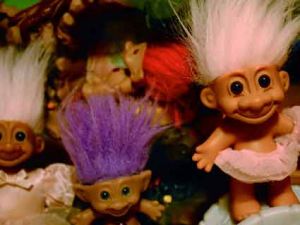
Trolls-masterIn a recent study, a team of researchers from the George Mason University Center for Climate Change Communication and several other institutions employed a survey of 1,183 Americans to get at the negative consequences of vituperative online comments for the public understanding of science. Participants were asked to read a blog post containing a balanced discussion of the risks and benefits of nanotechnology (which is already all around us and supports a $91 billion US industry). The text of the post was the same for all participants, but the tone of the comments varied. Sometimes, they were “civil”—e.g., no name calling or flaming. But sometimes they were more like this: “If you don’t see the benefits of using nanotechnology in these products, you're an idiot.”

The researchers were trying to find out what effect exposure to such rudeness had on public perceptions of nanotech risks. They found that it wasn't a good one. Rather, it polarized the audience: Those who already thought nanorisks were low tended to become more sure of themselves when exposed to name-calling, while those who thought nanorisks are high were more likely to move in their own favored direction. In other words, it appeared that pushing people's emotional buttons, through derogatory comments, made them double down on their preexisting beliefs.

More here.

Happiness is…learning to live with TINA

From Spiked:

The politics of happiness encourages us to accept our lot, breathing life back into the patronising idea that you can be ‘poor but happy’.

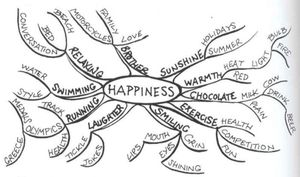
Happiness-mind-map…There are many reasons why happiness, thus conceived, was widely embraced. Most significantly, many implicitly accept Margaret Thatcher’s famous mantra that ‘there is no alternative’ to capitalism (TINA). If we cannot hope to change society in real, material terms, then individual minds and behaviours become some of the few sites open to change. With the political outlook narrowed in this way, ideas like ‘rediscovering happiness’ as the ultimate goal of society can sound radical, utopian even. They also offer a way of bypassing uncertain political identities, connecting with people using the lowest common denominator. After all, who doesn’t want to be happy?

But constructing issues in such broadly agreeable terms makes it difficult to imagine how they might be challenged or opposed. Everyone seemingly agrees that ‘money can’t buy happiness’. The problem with the politics of happiness is that it abstracts this emotion from individual and social experience, and makes it into a flat, measurable policy objective. I have no idea what the future holds, in the same way that no one in 1800, if they had been handed a ‘happiness survey’, would have rated themselves less happy in the expectation of modern innovations like access to electricity. Each generation finds happiness in accordance with the world they take for granted. As a measure of ‘progress’, happiness defaults to an affirmation of the present as the best of all possible worlds.

More here.

Darwin Was Wrong About Dating

Dan Slater in The New York Times:

CoverBUT if evolution didn’t determine human behavior, what did? The most common explanation is the effect of cultural norms. That, for instance, society tends to view promiscuous men as normal and promiscuous women as troubled outliers, or that our “social script” requires men to approach women while the pickier women do the selecting. Over the past decade, sociocultural explanations have gained steam. Take the question of promiscuity. Everyone has always assumed — and early research had shown — that women desired fewer sexual partners over a lifetime than men. But in 2003, two behavioral psychologists, Michele G. Alexander and Terri D. Fisher, published the results of a study that used a “bogus pipeline” — a fake lie detector. When asked about actual sexual partners, rather than just theoretical desires, the participants who were not attached to the fake lie detector displayed typical gender differences. Men reported having had more sexual partners than women. But when participants believed that lies about their sexual history would be revealed by the fake lie detector, gender differences in reported sexual partners vanished. In fact, women reported slightly more sexual partners (a mean of 4.4) than did men (a mean of 4.0).

In 2009, another long-assumed gender difference in mating — that women are choosier than men — also came under siege. In speed dating, as in life, the social norm instructs women to sit in one place, waiting to be approached, while the men rotate tables. But in one study of speed-dating behavior, the evolutionary psychologists Eli J. Finkel and Paul W. Eastwick switched the “rotator” role. The men remained seated and the women rotated. By manipulating this component of the gender script, the researchers discovered that women became less selective — they behaved more like stereotypical men — while men were more selective and behaved more like stereotypical women. The mere act of physically approaching a potential romantic partner, they argued, engendered more favorable assessments of that person.

More here.

Sunday Poem

The Ants

The ants moved into a house
right below ours;
our address did not become theirs:
a sand hill under the floor

The hessian road of the ants
ran from the kitchen cupboards
past the drainpipes, and vice versa
down to their factory shop floors
The stream of workers dressed in
shining black trotted to and fro
in an Asian rhythm

In their footsteps the song of substance
droned, ‘Matter, matter’
– There is nothing but matter
They transported strawberry particles
but dust flecks too and other burdens
to their underground warehouse,
their tinning factory

If I were to fall to pieces
by the kitchen sink,
then they would lift sweet portions of lip;
ant centurions would bear
my no longer functioning eyeball
How the conveyor belt would rattle,
there in the depths

The ants show no mercy
I wouldn’t like to fall down
under the kitchen cupboards
alone with the ants

.
by H.H. ter Balkt
from In de waterwingebieden: gedichten 1953-1999
publisher: De Bezige Bij, Amsterdam, 2000
translation: 2008, Willem Groenewegen

Read more »

Prosecutor as Bully

800px-Aaron_Swartz_2_at_Boston_Wikipedia_Meetup,_2009-08-18_

Larry Lessig has more on Aaron Swartz over at his blog v2 (image from Wikimedia Commons):

The billions of snippets of sadness and bewilderment spinning across the Net confirm who this amazing boy was to all of us. But as I’ve read these aches, there’s one strain I wish we could resist:

Please don’t pathologize this story.

No doubt it is a certain crazy that brings a person as loved as Aaron was loved (and he was surrounded in NY by people who loved him) to do what Aaron did. It angers me that he did what he did. But if we’re going to learn from this, we can’t let slide what brought him here.

First, of course, Aaron brought Aaron here. As I said when I wrote about the case(when obligations required I say something publicly), if what the government alleged was true — and I say “if” because I am not revealing what Aaron said to me then — then what he did was wrong. And if not legally wrong, then at least morally wrong. The causes that Aaron fought for are my causes too. But as much as I respect those who disagree with me about this, these means are not mine.

But all this shows is that if the government proved its case, some punishment was appropriate. So what was that appropriate punishment? Was Aaron a terrorist? Or a cracker trying to profit from stolen goods? Or was this something completely different?

Early on, and to its great credit, JSTOR figured “appropriate” out: They declined to pursue their own action against Aaron, and they asked the government to drop its. MIT, to its great shame, was not as clear, and so the prosecutor had the excuse he needed to continue his war against the “criminal” who we who loved him knew as Aaron.

Here is where we need a better sense of justice, and shame.

Remembering Aaron Swartz

Aaron_Swartz_wmc_img

Aaron Swartz, the activist, programmer and writer, took his own life a couple of days ago. He was the target of a case by the US government, MIT and JSTOR, and was facing possibly decades in prison. (Update: JSTOR was for dropping the case early and had a sense of proportionality, whereas MIT seems to have no such sense. But here is a statement from MIT President L. Rafael Reif indicating that MIT will start an investigation.) Rick Perlstein in The Nation (image via Wikimedia Commons):

I remember a creature who seemed at first almost to be made up of pure data, disembodied—a millionaire, I had to have guessed, given his early success building a company sold to Condé Nast, but one who seemed to live on other people’s couches. (Am I misremebering that someone told me he crashed in his apartment for a while, curling up to sleep under a sink?)

Only slowly, it seems, did he come to learn that he possessed a body. This is my favorite thing he wrote: about the day “I looked up and realized I couldn’t read the street sign. I definitely used to be able to read that sign, but there it was, big and bright and green along the highway, and all I could make out was a blur. I had gone blind.” Legally blind, it turned out; and then when he got contact lenses, he gave us an account of what it felt like to leave Plato’s cave: “I had no idea the world really looked like this, with such infinite clarity. It looks like a modernist photo or a hyperreal film, everything in focus everywhere. Everyone kept saying ‘oh, do you see the leaves now?’ but the first thing I saw was not the leaves but the people. People, individuated, each with brilliant faces and expressions at gaits, the sun streaming down upon them. I couldn’t help but smile. It’s much harder being a misanthrope when you can see people’s faces.”

This man is dead now.

Yes, and not a person of pure data after all. I remember the time, at the height of our friendship, when he announced he was taking a month off from connecting to any computer. I remember him telling me afterward about what it felt like: glorious, radiant, strange, alive, true (he mostly read history books). Dude got to see what it was like outside Plato’s Cave two separate times in his life. How many of us can say that?

More here, here, and here.

Saturday, January 12, 2013

How self-help ate America

Boris Kachka in New York Magazine:

Selfhelp130107_selfhelpbook_560How-to writers are to other writers as frogs are to mammals,” wrote the critic Dwight MacDonald in a 1954 survey of “Howtoism.” “Their books are not born, they are spawned.”

MacDonald began his story by citing a list of 3,500 instructional books. Today, there are at least 45,000 specimens in print of the optimize-everything cult we now call “self-help,” but few of them look anything like those classic step-by-step “howtos,” which MacDonald and his Establishment brethren handled only with bemused disdain. These days, self-help is unembarrassed, out of the bedside drawer and up on the coffee table, wholly transformed from a disreputable publishing category to a category killer, having remade most of nonfiction in its own inspirational image along the way.

Many of the books on Amazon’s current list of “Best Sellers in Self-Help” would have been unrecognizable to MacDonald: Times business reporter Charles Duhigg’s The Power of Habit, a tour of the latest behavioral science; Paulo Coelho’s novel The Alchemist, a fable about an Andalusian shepherd seeking treasure in Egypt; Susan Cain’s Quiet: The Power of Introverts in a World That Can’t Stop Talking, a journalistic paean to reticence; publisher Will Schwalbe’s memoir The End of Your Life Book Club, about reading with his dying mother; and A Child Called “It,” David Pelzer’s recollections of harrowing and vicious child abuse. And these are just the books publishers identify as self-help; other hits are simply labeled “business” or “psychology” or “religion.” “There isn’t even a category officially called ‘self-help,’ ” says William Shinker, publisher of Gotham Books. Shinker discoveredMen Are From Mars, Women Are From Venus and now publishes books on “willpower” and “vulnerability”—“self-help masquerading as ‘big-idea’ books.”

Twenty years ago, when Chicken Soup for the Soul was published, everyone knew where to find it and what it was for. Whatever you thought of self-help—godsend, guilty pleasure, snake oil—the genre was safely contained on one eclectic bookstore shelf. Today, every section of the store (or web page) overflows with instructions, anecdotes, and homilies.

More here.

Milk of Human Kindness Also Found in Bonobos

Sindya N. Bhanoo in the New York Times:

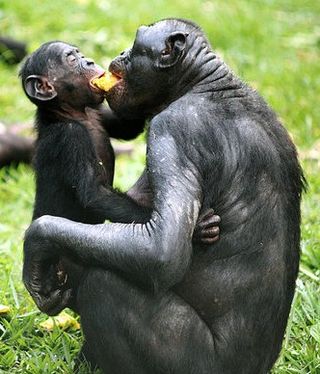
ScreenHunter_108 Jan. 13 14.31Bonobos will happily share their food with a stranger, and even give up their own meal — but only if the stranger offers them social interaction, evolutionary anthropologists at Duke University report in the journal PLoS One. The researchers, Jingzhi Tan and Brian Hare, say their findings may shed light on the origins of altruism in humans.

Along with chimpanzees, bonobos are among the closest primates to humans. Chimpanzees, however, do not display similar behavior toward strangers.

“If you only studied chimps you would think that humans evolved this trait of sharing with strangers later,” Mr. Tan said. “But now, given that bonobos do this, one scenario is that the common ancestor of chimps, humans and bonobos had this trait.”

The subjects were all orphaned bonobos at the Lola ya Bonobo sanctuary in the Democratic Republic of Congo. In one phase of the study, bonobos were given a pile of food, then given the opportunity to release a stranger or a group mate (or both) from other rooms.

The bonobos chose to release strangers and share their food. Not only that, but the just-released bonobo would then release the third.

More here.

‘Singing penis’ sets noise record for water insect

Ella Davies at the BBC:

ScreenHunter_107 Jan. 13 14.22A tiny water boatman is the loudest animal on Earth relative to its body size, a study has revealed.

Scientists from France and Scotland recorded the aquatic animal “singing” at up to 99.2 decibels, the equivalent of listening to a loud orchestra play while sitting in the front row.

The insect makes the sound by rubbing its penis against its abdomen in a process known as “stridulation”.

Researchers say the song is a courtship display performed to attract a mate.

Micronecta scholtzi are freshwater insects measuring just 2mm that are common across Europe.

The team of biologists and engineering experts recorded the insects using specialist underwater microphones.

On average, the songs of M. scholtzi reached 78.9 decibels, comparable to a passing freight train.

More here.

Pakistan: A Bloody Terror to Itself and the West

Tarek Fatah in the Huffington Post:

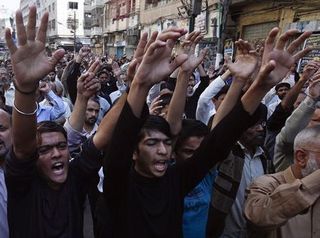
ScreenHunter_106 Jan. 13 14.12The fresh slaughter of the Shia in Pakistan comes in the wake of other events unfolding in Pakistan that seem to suggest its part of an attempt to destabilize the country and thwart parliamentary elections due in a few months.

Clashes with Indian Army on the volatile Kashmir border plus a planned “long-march” by a Tahir-ul-Qadri, Sunni cleric who has arrived from Canada, point to a concerted effort to pave way for the military to step in and take over as an “interim government” to conduct “proper” elections — a tactic used in the past my army commanders.

The Sunni Islamic terrorists of the LeJ, who proudly claimed responsibility for the Thursday night massacre, are a product of the Pakistan Army in its strategy to use non-state actors to create mayhem in India and Afghanistan. No one will be surprised if it turns out the latest slaughter of Shias was merely one act in the larger theatrical play to bring democracy into disrepute and making it palpable to endure another phase of military authoritarianism in Pakistan.

No matter how this play unfolds, the Pakistan created by a Shia Muslim, Mohammed Ali Jinnah, today lies in ruins, being torn apart as vultures gnaw at its carcass. It was near Quetta, Balochistan that MA Jinnah came to die and it is perhaps Balochistan where the country he created will finally unravel into dust.

Had it not been a nuclear power with 200 missiles pointed at India and unknown western interests in the region, we could have shrugged off the failed experiment. But Pakistan today needs to be watched as the single largest source of anti-Western terrorism and the nurturing ground for the ideology of global jihad.

The Shia and Ahmadi Muslims that are being killed, together with Pakistan's beleaguered Hindu minority as well as traumatized Christian community, should be seen as canaries in the mine. In their demise is a warning to the rest of us. A nuclear power is about to collapse.

More here.

The rest is the madness of art

1224328718386_1

Virginia Woolf remarked that Middlemarch was one of the very few novels written for grown-up people. In The Portrait, however, fiction itself grew up. Henry James’s triumph was to discover a way of presenting the processes by which life is actually lived, which is not the way that most novelists before him, even Flaubert, had dared or had the pathfinding skills to follow. As Michael Gorra writes, in that scene in which Isabel sits before the low-burning fire in the Palazzo Roccanera, James “learned to stage consciousness itself”. Henry James’s brother, the philosopher William James, had coined the term “stream of consciousness”, but it was Henry who followed that stream to its source. The novels that came after The Portrait, especially the three great “late” works, The Wings of the Dove, The Ambassadors – James’s own favourite – and The Golden Bowl, take place in a kind of cloud chamber in which are tracked the tiniest particles of his characters’ feelings, motives and desires. As Michael Gorra notes repeatedly, James was forever exploring the gap that lies between what we know and what we admit to knowing. The late novels, Gorra writes, do not simply depict a developing consciousness but “also take sex itself as the focal point of that development”, for sex is the great revealer of what and who we are.

more from John Banville at The Irish Times here.

styron

13BAILEY-articleInline

“I loathe writing with what amounts to a kind of phobia,” he wrote in 1956, “and I suppose that it’s only a sort of perverse masochism that keeps me at it.” Styron, whose prose style straddled a fine line between the florid and the gorgeous, had to work harder than most for his finest effects. Aspiring novelists would do well to consider his suffering over this second novel — “this great bloated overwritten monster,” as he put it, the manuscript of which had grown to 850 pages by 1958 and a year later had retreated, snapping and snarling, to 825. No wonder Styron decided, almost 30 years later, that in his next life he would run a Pontiac dealership. In the meantime, he might be forgiven for doing his utmost to ensure a kindly reception from the critics, and not for nothing did Norman Mailer (whose bitter feud with Styron enlivens these pages) accuse him of having “oiled every literary lever and power” to advance his standing.

more from Blake Bailey at the NY Times here.

pride, prejudice, politics

D7634180-5b87-11e2-9d4c-00144feab49a

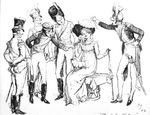
There would be no plot in Pride and Prejudice without the presence of the militia. Lydia’s main source of gossip is news from the Redcoats, whether it be that her uncle has dined with the officers, or the more sinister information that a private has been flogged. The equivalent of the modern Territorial Army in Britain, the militia was essentially the reserves, the Home Guard. Its members frequently incurred a poor reputation for dancing and drinking in the towns where they were quartered. The charming but villainous Wickham in Pride and Prejudice has joined his corps expressly for “the prospect of constant society, and good society”. Austen knew all about it, her favourite brother Henry having joined the Oxfordshire militia in 1793. Just as her sailor brothers, Frank and Charles, were instrumental in shaping the naval background to Mansfield Park (1814) and Persuasion (1817), so Henry’s military associations had a subtle impact on his sister’s literary career.

more from Paula Byrne at the FT here.

Semi-Charmed Life: The twentysomethings are all right

Nathan Heller in The New Yorker:

TwentyRecently, many books have been written about the state of people in their twenties, and the question that tends to crop up in them, explicitly or not, is: Well, whose twenties? Few decades of experience command such dazzled interest (the teen-age years are usually written up in a spirit of damage control; the literature of fiftysomethings is a grim conspectus of temperate gatherings and winded adultery), and yet few comprise such varied kinds of life. Twentysomethings spend their days rearing children, living hand to mouth in Asia, and working sixty-hour weeks on Wall Street. They are moved by dreams of adult happiness, but the form of those dreams is as serendipitous as ripples in a dune of sand. Maybe your life gained its focus in college. Maybe a Wisconsin factory is where the route took shape. Or maybe your idea of adulthood got its polish on a feckless trip to Iceland. Where you start out—rich or poor, rustic or urbane—won’t determine where you end up, perhaps, but it will determine how you get there. The twenties are when we turn what Frank O’Hara called “sharp corners.”

Allowing for a selective, basically narrow frame of reference, then, it’s worth noting that much of what we know about the twentysomething years comes down to selective, basically narrow frames of reference. Able-bodied middle-class Americans in their twenties—the real subject of these books—are impressionable; they’re fickle, too. Confusion triumphs. Is it smart to spend this crucial period building up a stable life: a promising job, a reliable partner, and an admirable assortment of kitchenware? Or is the time best spent sowing one’s wild oats? Can people even have wild oats while carrying smartphones? One morning, you open the newspaper and read that today’s young people are an assiduous, Web-savvy master race trying to steal your job and drive up the price of your housing stock. The next day, they’re reported to be living in your basement, eating all your shredded wheat, and failing to be marginally employed, even at Wendy’s. For young people with the luxury of time and choice, these ambiguities give rise to a particular style of panic.

“F*ck! I’m in My Twenties” (Chronicle), a new cri de coeur by Emma Koenig, is a diary of these fretful years trimmed to postcard size.

More here.

Dacca Dreams

Ali Sethi in The New York Times:

Somewhere in the middle of “Scenes From Early Life,” Philip Hensher’s circuitous new novel of wartime Bangladesh, a lawyer and his wife are arguing over the chilies and tomatoes and mangos that have been left out to dry on their balcony. “My balcony is full of rubbish and detritus,” the lawyer complains. “If there is no pickling and preserving,” says the wife to her daughters, “what does he think we are all going to eat the next time we can’t leave the house? We have no idea how long it will go on for, next time.” She is referring to the soldiers who have begun to stalk the streets outside her house. We are in Dacca circa 1970. It is the capital of East Pakistan, then one of that country’s two wings, long inflamed by political grievance and now on the verge of a violent secession. The West Pakistani military is about to start Operation Searchlight — a euphemism for the massacre of Bengali nationalists. There are roadblocks in the city; soon there will be tanks and air raids. And in one leafy neighborhood, this lawyer and his wife are squabbling over the placement of their chilies.

Hensher doesn’t mean to trivialize such arguments; rather, he gives them pride of place in his narrative. “This is not a history of the struggle for Bangladesh’s independence,” the author writes in the acknowledgments, “but the rendering of a family’s passionately held memories. It does not pretend to be an account of the millions who died in the war and the famines.” So, the lawyer and his wife are the maternal grandparents of Saadi, a character modeled on the author’s own Bangladeshi husband. It is Saadi who is looking back on his childhood in Dacca, Saadi who is recalling the antics of his “immense extended family” and narrating the book to a quietly receptive Westerner, a stand-in for Hensher. For most of the novel, it is Saadi’s subjectivity that will give Hensher his method — the staging of interconnected memories, some more closely bound up with public events than others — to tell a now-personal, now-political story.

The method works best when it reveals the war obliquely, as one of many strands in a personal history.

More here.