
Enjoying the content on 3QD? Help keep us going by donating now.
Category: Recommended Reading
Calvin Tomkins (1925 – 2026) Writer And Art Critic
Enjoying the content on 3QD? Help keep us going by donating now.
Christiane Amanpour Explains The Iran War
Enjoying the content on 3QD? Help keep us going by donating now.
‘I’ve learned first-hand how evil is tolerated’: Colm Tóibín on living in the US under Trump
Colm Toibin in The Guardian:
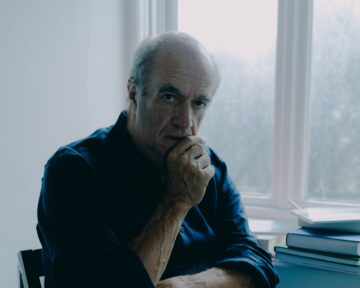 In the early years of this century, I worked for a semester at various American universities in cities where I will not live again. Thus, in a story called Barton Springs, I could conjure up Austin in Texas, and in Five Bridges, the city of San Francisco. In Sleep, I could venture into an apartment I sublet near Columbia University in 2012 and 2013. I could put my hero in my bed. I could have him watch from the same window as I watched from, with a view of the George Washington Bridge. When I take him back to Dublin, I have him spend time in the long living room in Ranelagh that belonged to the feminist writer June Levine and her husband the psychiatrist Ivor Browne. The bar in Barcelona in A Free Man is a place I once knew well. The story The News from Dublin opens in the back room of the house where I was raised, a house that has long been sold. I won’t go back there.
By the time I wrote those stories, those spaces could only be visited in my memory or in my imagination. Other spaces, such as the room where I am now in New York, have not been written about. Not yet. They have not been lost yet. I do not regret them or miss them. They are not part of a world that I can imagine, a world that has somehow been completed and is ready to be framed or entered stealthily, as a ghost might come and haunt a story.
In the future, if I live long enough, I will be able to see this room as though framed, as though completed. It will be part of memory, part of history. I will be able to write about it. This is the room where I learned first‑hand not only what evil is like but how evil is tolerated. What is strange about being in America in the time of Trump is how ordinary it is, how what was unimaginable just over a year ago is suddenly, shockingly no longer a surprise.
More here.
Enjoying the content on 3QD? Help keep us going by donating now.
Sunday Poem
Revolutionary Act
“Every war when it comes, or before it comes,
is represented not as war but as an act of self-defense
against a homicidal maniac…We have now sunk to a depth
at which restatement of the obvious is the first duty of intelligent beings.
If liberty means anything at all, it means the right to tell people
what they do not want to hear. In times of universal deceit,
telling the truth will be a revolutionary act…
“All the war-propaganda,all the screaming and lies and hatred,
comes invariably from those who are not fighting.”
by George Orwell
from Poetic Outlaws, 3/10/26
Enjoying the content on 3QD? Help keep us going by donating now.
Friday, March 20, 2026
The Strange and Spectacular Quest to Define Color–from Azure to Zinc Pink
Kory Stamper at Longreads:
 When I was hired by Merriam-Webster in 1998, it was ostensibly to revise the Big Book, Webster’s Third New International Dictionary, Unabridged. The Third, or W3 as it’s called in the office, was released in 1961 and it made a splash. A dictionary written for the nuclear age, it’s 2,662 pages of six-point type, 10 pounds of knowledge stuffed between two buckram-covered boards, the result of tens of thousands of editorial hours by more than a hundred in-house editors and two hundred outside experts. It’s a nonpareil of twentieth-century American lexicography, notable for its almost scientific, systematic approach to what belongs in a dictionary and how the words inside it should be defined. Every modern American dictionary that you’ve consulted owes something to the Third—even if that something is that the dictionary you’re consulting is not the Third.
I say “ostensibly” because every editor who had been hired at Merriam-Webster since the mid-1970s had been hired to revise the Third, but no work had been undertaken on a full revision of the beast since its publication.
More here.
Enjoying the content on 3QD? Help keep us going by donating now.
John Berger and Susan Sontag in Conversation
Enjoying the content on 3QD? Help keep us going by donating now.
Why Insect Farming Startups Are Going Bankrupt
Kenny Torrella at Undark:
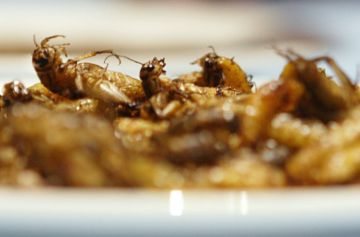 You personally might recoil at the thought of eating fried crickets or roasted mealworms, but many cultures around the world consume insects, either caught from the wild or farmed on a small scale. And while grubs don’t feature prominently in current paleo cookbooks, our paleolithic ancestors most certainly ate plenty of bugs.
But the past decade has shown that even if you build an insect farm, the global market may not come. Of the 20 or so largest insect farming startups, almost a quarter have gone belly up in recent years, including the very largest, Ÿnsect, which ceased operations in December.
All told, shuttered insect farming startups account for almost half of all investment into the industry.
More here.
Enjoying the content on 3QD? Help keep us going by donating now.
AI alignment…to whom?
Enjoying the content on 3QD? Help keep us going by donating now.
How To Read Wuthering Heights
Ellen O’Connell Whittet at Lithub:
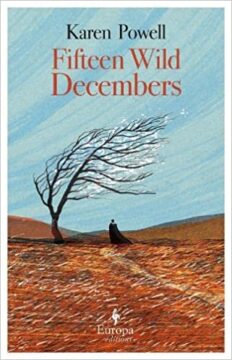 One of the novel’s quietly devastating moments comes when Branwell, in the middle of one of his cycles of resolve, tells Emily he is done with laudanum and alcohol. He is pale and hollow-eyed but composed, eating bread and butter at the kitchen table. Emily looks at him and thinks about the difference between his suffering and the suffering she has witnessed in others—illness that actually corrupts the body, pain that has no switch. His suffering is real, she does not doubt that. But he could, in theory, simply decide to stop. She knows this and also knows, from her own experience of a darkness that once swallowed her at school, that it is not so simple. She thinks of the bottomless black hole she’d poured herself into at Roe Head, and the argument she’s been building against him quietly dissolves. She goes downstairs to fetch her bonnet. She comes back. She keeps showing up.
I have thought about that passage more than any other in the novel, because I recognize that particular arithmetic—the one where you’re trying to assess someone’s suffering against a standard of what they could do differently, and the calculation keeps failing because suffering doesn’t work that way.
more here.
Enjoying the content on 3QD? Help keep us going by donating now.
Mexico’s Forever War on Drugs
Carlos Pérez Ricart at The Ideas Letter:
 Two decades have passed, with operations, clashes, and the arrest of drug lords. And yet the same questions remain. What is the true nature of this conflict? How can we understand a phenomenon that seems to repeat itself over and over? How might it change as the US attempts to assume a new role in the world?
Over the past twenty years, criminal organizations, the Mexican state, and the ways of governing territories ravaged by violence have changed. Mexico’s place in the hemisphere’s illicit flows has also changed. The world has changed. What began in 2006 as a strategy to combat drug-trafficking organizations—Mexico’s own War on Drugs—ended up revealing something much broader: a global network of illegal markets for drugs, money, people, and weapons in which Mexico plays a central role.
To understand this, let’s look at a map.
More here.
Enjoying the content on 3QD? Help keep us going by donating now.
Don Juan’s Reckless Daughter
Richard Skinner at 3:AM Magazine:
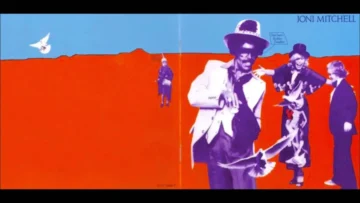 When Don Juan came out, the lyrics were printed on the album sleeve. Included in the lyrics for “Paprika Plains” was a 72-line passage of stream-of-consciousness imagery which was meant to be read while listening to ‘The Medallion’ section of “Paprika Plains”. Drawn from a dream Mitchell had, this lyrical tableau further explored Mitchell’s childhood but, this time, these memories of indigenous Canadian prairie folk were presented as a post-apocalyptic vision.
In interview, Mitchell has stated that “Paprika Plains” was the hardest piece of music she ever worked on. None of Joni’s contemporaries could have produced such a unique and distinctive tone poem as she did with “Paprika Plains”. Not one. The way she held on to her vision and trusted her artistic process is a measure of the heights of her creativity in this period of her life.
And then for something completely different – “Otis and Marlena”, a portrait of an elderly couple vacationing in Miami, observing other holidaymakers from their 10th floor hotel balcony. The song paints such incredible colours of the Floridian city and skies (once again evoked by Larry Carlton’s fine guitar harmonics).
more here.
Enjoying the content on 3QD? Help keep us going by donating now.
Friday Poem
This is Not a Small Voice
This is not a small voice
you hear this is a large
voice coming out of these cities.
This is the voice of LaTanya.
Kadesha. Shaniqua. This
is the voice of Antoine.
Darryl. Shaquille.
Running over waters
navigating the hallways
of our schools spilling out
on the corners of our cities and
no epitaphs spill out of their river mouths.
This is not a small love
you hear this is a large
love, a passion for kissing learning
on its face.
This is a love that crowns the feet with hands
that nourishes, conceives, feels the water sails
mends the children,
folds them inside our history where they
toast more than the flesh
where they suck the bones of the alphabet
and spit out closed vowels.
This is a love colored with iron and lace.
This is a love initialed Black Genius.
This is not a small voice
you hear.
by Sonia Sanchez
from Wounded in the House of a Friend
Enjoying the content on 3QD? Help keep us going by donating now.
In Memoriam: My brilliant friend Sara
Azra Raza in Dawn (April 2022):
 Sara Suleri Goodyear died peacefully at home on Sunday, March 20, 2022 of pulmonary failure. She was 68 years old. She was my friend. Sara disliked being called exotic; except that she was. Hugely so. Dazzling, elegant, glamorous, charmingly imperious, impossibly intelligent. And most of all, fabulously, hilariously, screamingly funny.
As an author, Sara was adored, respected, admired and even worshipped. In 1989, Meatless Days burst on the scene with the same explosive energy that Quratulain Hyder had sparked with her magnum opus, Aag Ka Darya [River of Fire].
…The book didn’t just impress readers, it often had a strange effect on them. Some identified with her experiences at a deeply personal level, almost claiming ownership of them. In 2004, the great Indian filmmaker Shyam Benegal and his wife Nira arrived in town and my friend Anita Patil (actor Smita Patil’s sister) took us out to dinner. We were barely seated when the incredibly sophisticated Nira turned to me: “I was anxious to meet you, Azra. I’ve heard that you personally know the author I admire most, Sara Suleri. I’m dying to know everything you can tell me about her.” Talking about a writer we mutually admired bonded Nira and me. When we compared notes on our favorite Suleri passage, we discovered one about Lahore that we both loved:
“How many times have we driven down from Rawalpindi, fatigue in the marrow of our bones, to cross the full Ravi and then the empty Ravi riverbed, finally to see the great luminous minarets of the mosque rising in our vision like a gasp or a plea?
“Of course, nothing in the city quite lives up to the promise of such a welcome, so that somehow one is always expecting to find Lahore without quite locating it. I used to find it perverse myself, that aura of anticipation, until it occurred to me that the town has built itself upon the structural disappointment at the heart of pomp and circumstances, and since then I have loved to be disappointed by its streets. They wind absentmindedly between centuries, slapping an edifice of crude modernity against a mediaeval gate, forgetting and remembering beauty, in pockets of merciful respite.”
More here.
Enjoying the content on 3QD? Help keep us going by donating now.
The Problem With Promoting ‘Gold Standard Science’
Jonathan Scaccia in Undark Magazine:
 Federal agencies have been branding some of their research and policy work as “gold standard science,” a trend that gained new force after an executive order on the term was issued in May 2025. The phrase now appears in speeches and guidance documents from agencies such as the National Science Foundation and the National Institutes of Health. It shows up in social media posts intended to signal credibility, rigor, and authority. The message is clear: This is science you can trust.
The intention may be to reassure the public, but the framing is misleading. The executive order outlines principles that are broadly consistent with good scientific practice, such as transparency, reproducibility, and peer review. These are not controversial. The problem arises in how those principles are translated into a simplified label that suggests a single hierarchy of evidence.
More here.
Enjoying the content on 3QD? Help keep us going by donating now.
Thursday, March 19, 2026
Amitava Kumar’s Shout-out to the poet Mikko Harvey
Amitava Kumar at his Substack:
There are always deer in my backyard and I try to draw them. In recent days when making those drawings, I have often thought of a poem I read recently by Mikko Harvey.
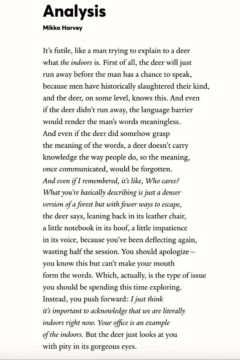
I love the turn midway through the poem, the deer is no longer the dumb animal but the suave and sophisticated analyst. There are other layers. The man or the “you” can’t make his mouth form the words—and that is the type of issue he should spend his time exploring. A profound, mischievous clue that the poet has dropped in the middle of the beautiful mystery that is this poem.
More here.
Enjoying the content on 3QD? Help keep us going by donating now.
I challenged ChatGPT to a writing competition. Could it actually replace me?
Rhik Samadder in The Guardian:
 Every writer I know is in despair at the prospect being replaced by AI. Many of them say they never use it on principle; I know all of them do.
So this week, as part of my AI diary, I’m conducting the forbidden experiment in plain sight. I’m going toe to toe with ChatGPT as a creative writer. Can it truly match me, and might it replace me? Let’s settle this.
We do battle using writing prompts, selected at random from an excellent new guide called A Year of Creative Thinking by Jessica Swale. The first page I flip to has us inventing new words for existing things. It’s very fun. A cheese grater, I decide, could easily be known as a “stinkchizzle”. A very long road would be better as a “slodgepuff”. A fart becomes a “piffsnut”, and a dream an “asterfantastic”. I’m pleased with that one. But how does the machine do?
For cheesegrater it has scritchygrater, which is obviously crap. Very long road? Neverendipath. Bit literal. Trumpelsnort is pretty good, as is slumberwhim. I like nibblink for mouse. For some reason, I could only come up with “pimpsquint”.
I think I’ve got the edge – with a caveat. We’re both doing pastiche. What about more complex writing?
More here.
Enjoying the content on 3QD? Help keep us going by donating now.
The story of the Los Angeles aqueduct
Enjoying the content on 3QD? Help keep us going by donating now.
Antisemitism’s Afterlives
Benjamin Balthaser at the Boston Review:
 The German state has staked redemption for the Shoah on unquestionable support for Israel even as the far-right party Alternative for Deutschland, with an alarming record of antisemitism and Holocaust denial, increases its share of power in the Bundestag. Jews being arrested for insufficient loyalty to a Jewish state stands as a strange emblem of an absurdist present and a menacing echo of a fast-encroaching past.
It is this sense of inversion that historian Mark Mazower’s new book, On Antisemitism: A Word in History, seeks to chronicle and explain. Opening with Victor Klemperer’s account of the way language became “an instrument of power” under the Third Reich, Mazower suggests we are witnessing a similar kind of transformation today: a nationalist and imperialist right in Israel, Europe, and the United States—abetted by timid or overtly complicit liberals—changing the meaning of words not to capture a new reality but to transform it in the service of holding onto and furthering their power. The term “antisemitism,” coined by a far right eager to couch its own Judeophobia in the modern language of scientific racism and later used as a term of condemnation to name that deadly form of bigotry, is now widely associated with hostility to the state of Israel, especially from Arab and Islamic quarters. How did a word originally intended to justify the exercise of state power over a long-persecuted Jewish minority come to serve as a tool for justifying the power of the Jewish state to persecute vulnerable and stateless Palestinians? That is the story Mazower wants to tell: the way the word tracks the history of state power as much as the history of Jews themselves.
More here.
Enjoying the content on 3QD? Help keep us going by donating now.
Sinatra Interrupted Louis Armstrong Being Mocked — What Frank Did Silenced the Entire Room
Enjoying the content on 3QD? Help keep us going by donating now.