
Andrea Branchi at Aeon Magazine:
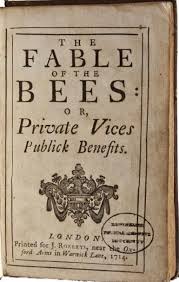 In 1714, and in an enlarged edition in 1723, Mandeville published the prose volume that made him infamous: The Fable of the Bees: Or, Private Vices, Public Benefits. The original poem was reprinted with a series of commentary essays in which Mandeville expanded upon his provocative arguments that human beings are self-interested, governed by their passions rather than their reason, and he offered an explanation of the origin of morality based solely on human sensitivity to praise and fear of shame through a rhapsody of social vignettes. Mandeville confronted his contemporaries with the disturbing fact that passions and habits commonly denounced as vices actually generate the welfare of a society.
The idea that self-interested individuals, driven by their own desires, act independently to realise goods and institutions made The Fable of the Bees one of the chief literary sources of the laissez-faire doctrine. It is central to the economic concept of the market. In 1966, the free-market evangelist Friedrich von Hayek offered an enthusiastic reading of Mandeville that anointed the poet as an early theorist of the harmony of interests in a free market economy, a scheme that Hayek claimed was later expanded on by Adam Smith, reworking Mandeville’s paradox of ‘private vices, public benefits’ into the profoundly influential metaphor of the invisible hand. Today, Mandeville is standardly thought of as an economic thinker.
more here.
Enjoying the content on 3QD? Help keep us going by donating now.