
Creep from Matthijs_Vlot on Vimeo.
Category: Recommended Reading
Close Shave: Asteroid To Buzz Earth Next Week
Nell GreenfieldBoyce at NPR:

Still, some people think this near-miss should serve as a wake-up call.
“It's a warning shot across our bow that we are flying around the solar system in a shooting gallery,” says Ed Lu, a former astronaut and head of the B612 Foundation, a nonprofit dedicated to protecting humanity from asteroids.
The asteroid known as 2012 DA14 was first spotted last year by astronomers in Spain. It's thought to be about 150 feet across and made of rock.
It will whiz past Earth on Feb. 15, going about 5 miles per second. At its closest approach, it will be only about 17,200 miles above the surface of our planet. That's far nearer to us than the moon, and even closer than some weather and communications satellites.
NASA officials say this event is one for the record books — the first time scientists have been able to predict something so big coming so close.
More here. And thanks to our reader “stone” see this cool visualization.
Saturday Poem
A Coat
I made my song a coat
Covered with embroideries
Out of old mythologies
From heel to throat;
But the fools caught it,
Wore it in the world's eyes
As though they'd wrought it.
Song, let them take it,
For there's more enterprise
In walking naked.
by W.B. Yeats
Friday, February 8, 2013
Leonardo da Vinci vs Michelangelo
Michael Kammen in the Los Angeles Review of Books:
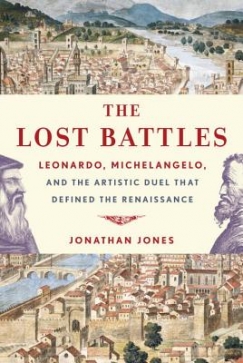
The place is republican Florence; the focal time is 1503 to 1506, with many implications far beyond, when the Medici family, tossed from power late in the 15th century, successfully schemed to regain firm control (they ultimately did in 1530). By then Leonardo had died in France as a self-imposed exile and court painter to the king, and Michelangelo had gone to Rome, first to build a mausoleum for the Pope and later to labor on his masterwork, the ceiling of the Sistine Chapel. Court painter to the Pope and hardly alone, he was one of the architects who figured out the math needed to raise Bramante’s immense dome over St. Peter’s.
Jonathan Jones — a Cantabridgian art critic for The Guardian and contributor to many magazines and newspapers, including the Los Angeles Times — has written a well-argued and well-informed page-turner about the artists and their rivalry that is infinitely accessible for the general reader. It is also little more than half the length of Rona Goffen’s very fine Renaissance Rivals: Michelangelo, Leonardo, Raphael, Titian (2002). Readers intrigued by The Lost Battles, as I am, may choose to follow up with Goffen’s tome. Jones’s is a treatise of political and artistic intrigue, crafted in muscular and arresting prose.
More here.
Small-molecule drug drives cancer cells to suicide
Zoe Cormier in Nature:

The molecule, TIC10, activates the gene for a protein called TRAIL (tumour-necrosis-factor-related apoptosis-inducing ligand), which has long been a target for cancer researchers looking for drugs that would avoid the debilitating effects of conventional therapies.
“TRAIL is a part of our immune system: all of us with functional immune systems use this molecule to keep tumours from forming or spreading, so boosting this will not be as toxic as chemotherapy,” says Wafik El-Deiry, an oncologist at Pennsylvania State University in Hershey and lead author of the study, which is published today in Science Translational Medicine1.
Experiments showed that TIC10 had potent effects against a variety of tumours, including breast, lymphatic, colon and lung cancer. It was especially effective at triggering cell suicide in glioblastoma, a kind of brain tumour that is notoriously difficult to treat2.
More here.
The scientific method for comprehending the world
Suzanne Klingenstein in the Weekly Standard:
A few days later, the 26-year-old Gombrich returned the book with the remark, “I think I could write a better one myself.” Neurath asked him to deliver. Reading in his parents’ library in the morning, studying period documents in the afternoon, and writing at night, Gombrich produced, under great time pressure, what was to be his only book in German: Eine Weltgeschichte von der Urzeit bis zur Gegenwart (1936). The book was an instant success, and has remained in print. With its brevity and intended audience, it mocked the then-ubiquitous, multi-tomed, solid leatherUniversalgeschichten (global histories) designed to give heft to the achievements of the urban bourgeoisie.
Gombrich’s tone was light, his approach literary, his attitude toward his young readers engaging and conversational. What would a 10-year-old in 1935 really have to know about knights and courtly love, or the rebirth of humanism, in order to begin her privileged life in one of Europe’s most cultured cities?
Quite a bit, Gombrich thought: Even children were then expected to know things and to think about them. Gombrich squeezed all of European history, from the cavemen to the end of World War I, into 39 chapters, an appealing number to children because it’s three times the creepy 13. He added chapter 40 only in 1985 when he revised the book for its 50th anniversary. The new chapter covered World War II, and Gombrich ingeniously called it “The Small Part of the History of the World Which I Have Lived Through Myself.”
More here.
Speed Painter
poetry and crazy
Insanity and poetry are old kin. The number of canonical poets who suffered from mental illness is immense: Blake, Holderlin, Pound, Plath, Lowell, Berryman, Hill, to name just a few. The distinction between insanity and genius is typically judged by the extent of an artist's transgressions as well as their social class. The blue-blood can afford his or her illness. A struggling mother or teacher is suffocated by it. And although poets may be granted some leniency, they're hardly alone. Many vocations provide a similar amount of societal absolution, from obsessive-compulsive computer programmers to sociopathic business executives and egomaniacal radio hosts. This special relationship between mental illness and vocation also reveals a significant dilemma about the nature of insanity. Say, for example, that the expression of some mental illnesses fulfills the needs of a profession especially well, and a large number of people with that illness hold it. This could be the coincidence of industry, society, and psychology: a particular job happens to suit those with a given illness, allowing them a productive place in the world. This assumes an atomized world of isolated forces and a certain amount of good luck. On the other hand, it could be that insanity exists as an expression of socioeconomic forces: that the behaviors and cognitive patterns which are judged to be disordered are, in fact, manifestations of economic and social power structures already in place.
more from Daniel Evans Pritchard at The Critical Flame here.
on friendship

Our earliest friendships are coed, then imprecisely homoerotic, as we reach the age at which tribal peoples form cadres of hunter-warriors to protect and feed the clan, then homophobic for the sake of family life, and at last relaxed and coed again. Nevertheless, infatuation changes the equation, the high stakes of intimacy, and the Lord thought it necessary to devote two of his commandments—Thou Shall Not Commit Adultery and, separately, Thou Shall Not Covet Thy Neighbor’s Wife—to the nexus of the sexes. (My strait-laced mother once said only men and women attracted to each other could really be friends.) Perhaps the carnal add-on caused me not to include Nell, Liz, Amy, Brigit, Leonore, Marion, Linda, or Trudy on my initial list of best friends, although they were actually better intrinsically than the males: wholehearted, primal, reproductive— knowing, seeing, giving everything. The buddy system still underpins modern infantry warfare, and young women employ it every day on city playgrounds to keep their children safe. It’s second nature there, as on the veldt. Second nature means reading other people’s thoughts when they are silent, or acting frequently and anonymously on charitable impulses with no quid pro quo.
more from Edward Hoagland at The American Scholar here.
poet-predator-king
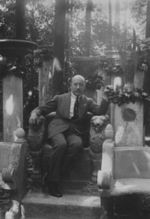
There is no decent way of containing the excesses of Gabriele d'Annunzio's lives. It would astonish his contemporaries to discover that he is now only faintly remembered outside Italy. Even within Italy, though firmly entrenched in the literary canon, he is most commonly recalled with a sort of collective cringe. For once upon a time, in the fervid fin de siècle – for reasons variously literary, political, military and, not least, sexual – he was one of the towering figures of European culture. Think Wilde crossed with Casanova and Savonarola; Byron meets Barnum meets Mussolini – and you would have some of the flavours, but still not quite the essence, of this extraordinary, unstoppable and in many ways quite ridiculous figure. In The Pike, Lucy Hughes-Hallett has taken on the vast and frequently thankless task of trying to capture this strange genius, ten years after the most authoritative literary biography to appear in English thus far, Gabriele d'Annunzio: Defiant Archangel by John Woodhouse.
more from Literary Review here.
‘Bound for Freedom’s light: African Americans and the Civil War’
FromThe Washington Post:
It’s easy to believe that when Abraham Lincoln drafted his second inaugural address in 1865 — writing that if God willed it, the struggle against slavery would continue until “every drop of blood drawn with the lash shall be paid by another drawn with the sword” — he had in mind a famous photograph made two years earlier. The image shows a former slave, known only as “Gordon,” who had escaped bondage in Louisiana to freedom behind Union lines at Baton Rouge. The man appeared seated, with his face and torso turned away from the camera, showing a gruesome and abstract welter of lash marks and lacerations on his back. The photograph was one of the most convulsive images of the 19th century, circulated widely by abolitionists, reproduced and disseminated not just through popular magazines but on visiting cards, small reproductions on card stock that could be purchased and collected in albums. As Frank Goodyear writes in a recently published Smithsonian book, “Photography Changes Everything,” the image not only galvanized antislavery sentiments, but it “also inspired many free blacks in the North to enlist.”
The photograph appears in a small National Portrait Gallery exhibition, “Bound for Freedom’s Light: African Americans and the Civil War,” which, curator Ann Shumard said, is designed “to drive home the point that African Americans weren’t simply passive observers on the sidelines of this conflict.” The show includes photography, engravings, bookplates and drawings, and occupies a niche gallery sandwiched between two larger long-term displays of Civil War material. The modest nature of the display contrasts sharply with the sumptuous oil paintings and traditional sculpture in the main galleries, a visual analog to the complicated way in which African Americans were caught up in the war, yet marginal to its outcome and direction. They fought, and they were fought over, but it was white men who wore the epaulettes, called the shots and ended up being memorialized in full-length, heroic portraits of power.
More here. (Note: At least one daily post throughout February will be devoted to African American History Month)
Cartoonists take science seriously
From MSNBC:
 and video channels worth checking out, including way-cool science comics such as xkcd and Saturday Morning Breakfast Cereal. You'll want to scan the whole list, but you won't want to stop there. It's a good thing the weekend is coming up, because here are another eight science comics to while away the hours with:
Bird and Moon: Rosemary Mosco is a “nature lover with a passion for science communication” — and a flair for cute, colorful graphics that are thoughtful as well. Have you always wondered how to tell a dolphin from a porpoise? Check out the “Animal Cheat Sheet.”
More here.
Friday Poem
Winnowing
Here we go, trying
to separate
the infinite possibilities of life
from the limited circumstances
we prefer.
At the last breath
none of us know
whether it was
the chaff
or the grain
that flew off in the wind.
.
by Simon Ó Faoláin
from Anam Mhadra
publisher: Coiscéim, Dublin, 2008
Thursday, February 7, 2013
Where women warriors will lead
Hugh Gusterson in the Bulletin of the Atomic Scientists:
As a result of Secretary of Defense Leon Panetta's January 24th announcement, within a few years it will be normal to see women leading men into combat, serving on the Joint Chiefs of Staff, and returning to the United States in flag-draped coffins as their tearful husbands comfort their children.
As well as resolving the debate about the role of women in combat, Panetta's announcement will reverberate well beyond war zones. For example, it will have implications for a longstanding tension between antiwar feminists and those I have called “feminist militarists.” In the 1980s, antiwar feminism seemed to have the upper hand. These were the years of women-only peace camps at Greenham Common and Seneca Falls, and an antinuclear movement led largely by women such as Helen Caldicott, Randall Forsberg, Jessie Cocks, and Pam Solo. In a decade in which Carol Gilligan's argument that women reason about right and wrong “in a different voice” held sway in women's studies programs, many feminists took it for granted that militarism was an expression of patriarchy and that feminism was necessarily anti-military. But at the same time a different kind of feminist, typified by Congresswoman Pat Schroeder, was arguing that it was time to smash the glass ceiling in the military and let women fight in combat. While this is a breakthrough in terms of equal opportunity, casting women as fighters signals the eclipse of what had been a powerful ground for critique of the military.
More here.
The Abstract painters blurred the boundary between science and the spiritual
Our own Morgan Meis in The Smart Set:
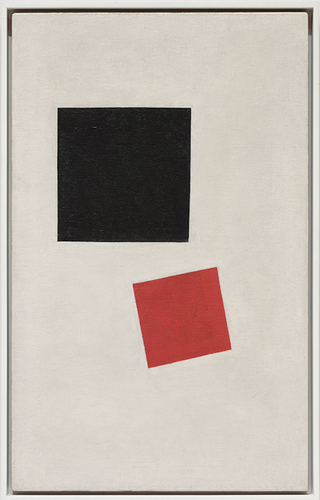
The attempt to answer Kandinsky's question led to a transformation in painting the implications of which are still being felt today. The transformation was Abstraction. Painters, just a few years prior to Kandinsky, happily portrayed human beings and animals and landscapes and historical events. After Kandinsky, pure forms and shapes and colors took over the canvas. This was a shocking and more or less unprecedented development. It took the art world by storm and carried the oft-bewildered public along with it.
More here.
The Real—and Simple—Equation That Killed Wall Street
Chris Arnade in Scientific American:
“If it weren’t for those meddling kids!” That was the punch line for every Scooby Doo episode. It also is the overly simple narrative that many in the media have spun about the last financial crisis. Smart meddling kids armed with math hoodwinked us all.
One article, from the March 2009 Wired magazine, even pinpointed an equation and a mathematician. The article “Recipe for Disaster: The Formula That Killed Wall Street,” accused the Gaussian Copula Function.
It was not the first piece that made this type of argument, but it was the most aggressive. Since then it has been a common theme in the media that mathematics, especially obscure advanced mathematics, is largely responsible for the catastrophe that doomed the world to the last five years of recession and slow growth.
This theme plays on the fallacy that danger always comes from complexity. It’s a fabrication that obscures the real causes, that makes it easier to say, “Hey, it wasn’t my fault, I was blinded by science.”
The reality is much simpler and less sexy. Wall Street killed itself in a time-honored fashion: Cheap money, excessive borrowing, and greed. And yes, there is an equation one can point to and blame. This equation, however, requires nothing more than middle school algebra to understand and is taught to every new Wall Street employee. It is leveraged return.
What is leveraged return? It’s the return on assets using borrowed money.
The equation for the leveraged return, L, is:

Where Y is the return of the asset, R is the cost to borrow money, and N is the “haircut,” or the percentage of money the investor must put down to secure the loan (the down payment).
More here.
Voices United for Mali
“The gods have decreed work for men!”

Hilaire Belloc once wrote that he never burned anything but oak in the huge fireplace of his ancient home in West Sussex. For a while I considered doing the same in the wood stove of my home in the Shenandoah Valley. Oak of several kinds are indeed abundant here. Then practicality intruded. It has a way of doing that. There are in fact a number of eastern hardwoods that have a higher heating value than oak, such as hickory and locust. When upon approaching my home in winter one smells the smoke curling out of the chimney, there are a number of possible suspects: oak (red, black, and white), black locust, red elm, hickory, and less often, cherry or maple. For thirteen years we have heated this house almost exclusively by wood; and I have never purchased a single cord. All the wood that I use is bucked with my chainsaw and hand split with a maul or axe, by me, my family, or my college students. My commitment to purchase neither wood nor hydraulic splitter is at times a sign of contradiction. It has been pointed out to me on numerous occasions how much time I would save with a hydraulic splitter—a ‘splitter’ in common usage. When upon hearing that I heat my house by wood somebody asks, “Surely you have a splitter?” I usually point either to my son or to my arms.
more from John Cuddeback at Front Porch Republic here.
The sound of the blues
IN A MOMENT I will tell you why Kendrick Lamar, a young rapper from Compton, deserves much of the acclaim, and, even more so, the analysis he has received, but first let us deal with the vanguard of black memoirists who came before him and in whose well-forged path he follows. In the summer of 1945, Ralph Ellison wrote a review of Richard Wright’s Black Boy, Wright’s semiautobiographical novel about his tough boyhood in Mississippi. In Ellison’s piece he suggested that Black Boy is shaped more by the blues tradition born from the same hard countryside as Wright than it is by any literary genre or narrative model. Ellison would explain that, “The blues is an impulse to keep the painful details and episodes of a brutal experience alive in one’s aching consciousness, to finger its jagged grain, and to transcend it, not by the consolation of philosophy but by squeezing from it a near-tragic, near-comic lyricism. As a form, the blues is an autobiographical chronicle of personal catastrophe expressed lyrically.”
more from Kaadzi Ghansah at the LA Review of Books here.
Twas brillig, and the slithy toves
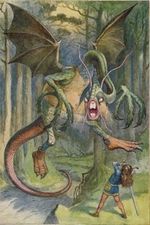
The comedy of the poem is its reproduction of a range of acoustic and rhythmic strategies that the reader immediately recognizes as typical of a certain kind of poetry, but with nonsense words. The suggestion is that all such poetry is driven to a degree by the inertia of style and convention, that the sound is as decisive as the sense in determining what gets said; indeed, when we “run out of sense” the sound trundles on of its own accord. But how could one begin to translate “mome raths outgrabe”? We have no idea what it means. The only strategy would be to find an equally hackneyed poetic form in the translator’s language and play with it in a similar way. Liberated by the fact that many of the words don’t have any precise meaning, the translator should not find this impossible, though whether strictly speaking it is now a translation is another issue.
more from Tim Parks at the NYRB here.