Lunch with Noam Chomsky

304a42fc-8d1b-11e2-aed2-00144feabdc0

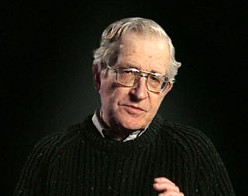
John McDermott talks to Noam Chomsky in the FT:

I am about to ask the professor about Hugo Chávez, who died the night before our lunch, but a waitress arrives and asks for our order. Chomsky chooses the clam chowder, and a salad with pecans, blue cheese, apples and a lot of adjectives. I go for tomato soup and a salmon salad. The professor asks for a cup of coffee and since we are about to discuss the late Venezuelan leader, I ask for a cup, too.

In 2006, Chávez recommended Chomsky’s Hegemony or Survival: America’s Quest for Global Dominance to the UN General Assembly. “It’s a mixed story,” Chomsky says of Chávez’s legacy. He points to reduced poverty and increased literacy. “On the other hand there are plenty of problems,” such as violence and police corruption; he also mentions western hostility – in particular an attempted coup in 2002 supported by the US. America’s behaviour towards Caracas is obviously important in any assessment of Chávez but its appearance is an early signifier of a pattern in a Chomsky conversation: talk for long enough about politics with the professor and the probability of US foreign policy or National Socialism being mentioned approaches one.

I say that he hasn’t referred to Chávez’s human rights record. Some of Chomsky’s critics have accused him of going easy on the faults of autocrats so long as they are enemies of the US. Chomsky denies this vehemently: he spoke out against the consolidation of power by the state broadcaster; he protested the case of María Lourdes Afiuni, a judge who spent more than a year in prison awaiting trial for releasing a government critic. “And I do a million cases like that one.”

Still, Chomsky thinks about how hard to hit his targets. He admits as much as our soups arrive. “Suppose I criticise Iran. What impact does that have? The only impact it has is in fortifying those who want to carry out policies I don’t agree with, like bombing.” He argues that any criticisms about, say, Chávez, will invariably get into the mainstream media, whereas those he makes about the US will go unreported. This unfair treatment is the dissident’s lot, according to Chomsky. Intellectuals like to think of themselves as iconoclasts, he says. “But you take a look through history and it’s the exact opposite. The respected intellectuals are those who conform and serve power interests.”

Saturday, March 16, 2013

Barack, a few travel tips for your upcoming trip to Israel

Amer Zahr in The Civil Arab:

ScreenHunter_140 Mar. 16 16.48Mr. President, I hear you are traveling to Israel next week. As a concerned patriotic American citizen of Palestinian descent, I have some pointers for you.

Now, I assume you’ll be flying into Tel Aviv. Usually, when non-Jews arrive there, especially if they are a little darker-skinned, they are asked to wait in a… let’s call it a “VIP Room.” Incidentally, the room is quite nice. There’s a water cooler, comfortable chairs, and a soda machine. It’s probably the only place in the world where you can be racially profiled and get an ice-cold Coca-Cola all at once.

To avoid the room, I would mention that you are the President of the United States. It might help.

You may get strip-searched. Saying you are an American doesn’t help much here. I’ve tried. I even sang the national anthem last time an Israeli soldier was looking down my pants. Right after I said, “Oh say can you see,” he said, “Not much.”

To escape this embarrassment, I would mention that you are the President of the United States. It might help.

In case they don’t already know, you might not want to tell Israeli security you are half-Muslim. As a fellow half-Muslim, I can tell you they don’t really care about the percentage. Any bit of Muslim freaks them out. And I’m not sure if you heard, but the fans of one of Israel’s soccer teams, Beitar Jerusalem, actually protested when the club signed two Muslim players. When one of them scored in a game last week, hundreds of fans actually walked out of the stadium. One of the fans later stated about the Muslim players, “It’s not racism. They just shouldn’t be here.” Hopefully, they don’t know your middle name is “Hussein.” Maybe they didn’t watch the inauguration.

In any case, I would mention that you are the President of the United States. It might help.

More here. [Thanks to John Ballard.]

Remembering Rachel Corrie

Ten years ago today Rachel Corrie was killed by an Israeli bulldozer. It is still worth having a look at Edward Said's article on the subject, which is also almost ten years old. From CounterPunch:

ScreenHunter_139 Mar. 16 16.21In early May, I was in Seattle lecturing for a few days. While there, I had dinner one night with Rachel Corrie’s parents and sister, who were still reeling from the shock of their daughter’s murder on March 16 in Gaza by an Israeli bulldozer. Mr. Corrie told me that he had himself driven bulldozers, although the one that killed his daughter deliberately because she was trying valiantly to protect a Palestinian home in Rafah from demolition was a 60 ton behemoth especially designed by Caterpillar for house demolitions, a far bigger machine than anything he had ever seen or driven. Two things struck me about my brief visit with the Corries. One was the story they told about their return to the US with their daughter’s body. They had immediately sought out their US Senators, Patty Murray and Mary Cantwell, both Democrats, told them their story and received the expected expressions of shock, outrage, anger and promises of investigations. After both women returned to Washington, the Corries never heard from them again, and the promised investigation simply didn’t materialize. As expected, the Israeli lobby had explained the realities to them, and both women simply begged off. An American citizen willfully murdered by the soldiers of a client state of the US without so much as an official peep or even the de rigeur investigation that had been promised her family.

But the second and far more important aspect of the Rachel Corrie story for me was the young woman’s action itself, heroic and dignified at the same time. Born and brought up in Olympia, a small city 60 miles south of Seattle, she had joined the International Solidarity Movement and gone to Gaza to stand with suffering human beings with whom she had never had any contact before.

More here. [Thanks to Najla Said.]

the great unmentionable

041d48f7-0fc0-4fb7-8db1-47a83447295d

Philip Roth knows he is running out of time. He speaks now of the end – certainly of the end of his writing life. He ought to have won the Nobel Prize long ago, but perhaps his work is simply too American for the august Swedes of the Nobel committee, who have grumbled about the parochialism of the American novel, of how it looks inward rather than out to the rest of the world. That is nonsense, of course. The greatest living American writers – Cormac McCarthy, Don DeLillo and, preeminently, Roth – are universalists who in radiant prose ask, again and again: what does it mean to be human and how should we act in a world that is as mysterious as it is indifferent to our fate? At the end of The Tempest, as he prepares to take his leave, Prospero, a magician of words, hints that “the story of my life” is ending, and now “Every third thought shall be my grave”. Roth has told the story of his life many times and in many different ways, and now he is done.

more from Jason Cowley at the FT here.

auster and coetzee talk sports

17riker-img-articleLarge

For potential pen pals, these two famous writers might seem at first an unlikely pairing. Auster, the younger by seven years, is an enthusiast, or certainly I’ve always thought of him that way: his fascination with coincidences and odd circumstances; his bottomless bag of anecdotes; his championing of out-of-the-way books and films that always end up being very good. Meanwhile Coetzee, the Nobel Prize-winning South African, seems more of a skeptic, a fastidious thinker and uncompromising moralist, who strips away social and political conventions in search of an ethics of essential experience. Yet whatever their differences, real or perceived, what quickly becomes clear in the pages of “Here and Now” is that they have far more in common than not. They both love sports, for example, and the fact that they don’t love precisely the same sports, or love them for precisely the same reasons, is largely why they have so much to say to each other about them. Discussing the nature of sports’ appeal, Auster proposes they are “a kind of performance art.” Coetzee responds that his interest in sports is “ethical rather than aesthetic,” having to do with “the need for heroes that sports satisfy.”

more from Martin Riker at the NY Times here.

the red shoes

Papal-shoes_jpg_470x385_q85

Can it be coincidence that shoemakers like Maurizio Gucci of Florence and Salvatore Ferragamo of Campania and Florence came from places with strong Etruscan connections? A tomb painting from the Etruscan city of Tarquinia, executed perhaps around 530-520 BC, shows several mourners in elegant pointed boots. The people portrayed in this “Tomb of the Augurs” may well have had close connections with Rome, where the ruling dynasts were named Tarquinius, and the tyrant-slayer Brutus, credited with founding the Roman Republic a few years after this tomb was decorated (509 BC), was actually a Tarquinius on his mother’s side. When Roman patricians sported red shoes in subsequent centuries, they were simply carrying on ancestral tradition. With the red shoes went a red-striped robe, again in Phoenician purple—a wide stripe for members of the Senate, a narrower stripe for the second-rank aristocrats known as horsemen, equites. After the coming of Christianity, the tradition of wearing red passed from the Roman Senate to the “Sacred Senate,” the College of Cardinals. Cardinal red, in fact, is Roman senatorial red, derived from Phoenician purple (or a cheaper—but not cheap—substitute called cochineal, made by grinding the shells of beetles).

more from Massimo Gatto at the NYRB here.

Bad girls: A history of unladylike behaviour

From The Independent:

BadDomestic and demure. Neat and sweet. Sugar and spice and all things nice… but what happens when girls go bad? It's a subject that has long fascinated, and titillated, the press, public, and politicians, from whispers over 'fallen women' in the past to drunken 'sluts' slumped in the gutter in 2013. Now a new book, Girl Trouble, by the cultural historian Carol Dyhouse, explores the history of our moral panics over rebel girls, from the late-19th century onwards. Dyhouse found herself “more and more interested in rebel girls, bad girls, the ones who went off the rails. They're not exactly feminist, but they're representing a discontent with what's in front of them. It allows you an insight into the constraints young women have operated under.” And what constraints… from an inability to vote, own property, prevent pregnancy, get a degree, an abortion, or a job, to more ephemeral, societal expectations of decorous behaviour, obedience to men, feminine beauty, and sexual restraint. No wonder nearly every generation had its own modern lasses who stuck their fingers up at societal norms and got stuck into enjoying themselves instead.

…Jump forward to the 1990s for a more recent incidence of moral panic. Once again, it's when girls take on masculine traits that the Establishment gets worried, and in the late Nineties and early Noughties, young women were perceived to be doing just that, matching blokes when it came to drinking lager and behaving raucously. The ladette was born, and she wasn't pretty. During the Seventies and Eighties, much was obviously achieved in the way of equal rights for women and the breaking of gender stereotypes. The Nineties saw the rise of a more pop-y feminism, too, with the gobby, garish 'Girl Power', as espoused by the Spice Girls. Easy to mock today, it did at least promote easy-to-swallow enfranchised concepts, like sticking by your female friends and girls ruling the world. But when young ladies started to behave like lads in the 1990s, many commentators felt this was a flip-side of equality, feminism gone too far. “Girls drinking too much, taking drugs, taking their clothes off, exhibiting loud-mouthed and vulgar behaviour, and creating mayhem in the streets began to dominate newspaper headlines in the 1990s,” writes Dyhouse. Common tropes assigned to these tabloid-filling folk-devils were a slatternly approach to housework and hygiene, the ability to down pints, a resistance to settling down and starting a family, and even a willingness to scrap in the streets on a Saturday night. Celebrity ladettes, such as Sara Cox, Zoe Ball, Charlotte Church and Denise van Outen, were subject to fascinated press scrutiny.

…But she is optimistic that today's young women will soar beyond pornification; for if history has taught us one thing, it's that girls, their bodies and their femininity (or indeed masculinity), is a source of endless, and often over-hyped, concern. Wearing a padded bra, Dyhouse suggests jovially, is not “going to turn someone into a sexual object or rot their brains”.

More here.

The Unwilling Witness

ABDULRAZZAQ AL-SAIEDI in The New York Times:

BridgeWe arrived in Falluja to see people gathered around two burned-out S.U.V.’s. Insurgents had gunned down four Blackwater security contractors who were driving through the city; a mob had set the vehicles ablaze. My reporter’s instincts carried me, almost against my will, through the sea of rioters, to where the bodies of the contractors had been dragged — a bridge over the Euphrates about a half-mile away. Two bodies were on the ground, their jackets still smoking. A boy of about 10 was kicking one of them, yelling, “Pacha, pacha,” the name of an Iraqi dish made from the head of a sheep. It crossed my mind that this child could not be human. Then my attention turned to the bodies swinging mutilated from the bridge. I felt briefly disoriented. Hordes of people glared at me, a stranger in a small, insular city. I pretended to be part of the crowd. “These Americans deserve this destiny!” I yelled. I knew I would be the fifth body if I were exposed as a reporter for a U.S. paper. When I returned to the bureau in Baghdad, I resolved to quit my job with The New York Times. It was too dangerous and too upsetting to witness the seething violence so closely. A few years later, after losing two of my Iraqi colleagues at The Times, both of whom were murdered, I finally did leave, to pursue a graduate degree and get away from a lifetime of war.

I never imagined that on the quiet streets of Cambridge, Mass. — a world away from the chaos of Iraq — I would meet Donna Zovko, the mother of one of the murdered contractors. Zovko had come to attend an event at Harvard; a friend introduced us, knowing that I had been in Falluja just after her son was killed. We met for breakfast in an Au Bon Pain on a rainy Sunday in late winter. The woman sitting across from me was soft-spoken and warm, referring to me as “a young boy” (I was 39) and asking me about my life in Iraq. I learned from Zovko that, as I was standing in that mob in Falluja, she was listening to a radio report of the deaths of four Americans in Iraq. She had e-mailed her son Jerry, telling him to be careful. Two hours later, she learned that he was among the four killed. In the cafe, she became suddenly quiet, and her eyes fixed on mine. “Please tell me what happened to my son,” she pleaded. “Why he died like this.” I started to cry. I didn’t know how to tell her about the terrible scene I witnessed. I replied elusively: “He was killed quickly. He was shot.” My words hung in the air. “Then why was he burned and dragged?” she asked quietly. “Why did they do that?” As she spoke, my thoughts rushed to my own mother. I told Zovko that my brother was executed by Saddam Hussein’s security forces in Abu Ghraib. What if our situations were reversed and Zovko had seen my brother killed? What could she say to my mother to explain how or why it happened? We consoled each other. In that moment, there was no difference between Jerry’s mother and mine. Each had lost her beloved oldest son to a violent, unjust end: Jerry was 32; Sadoon was 36. Zovko told me that she was not angry with the Iraqis who murdered her son. Instead, she empathized with Iraqi mothers who lost children to the American forces.

The American invasion of Iraq took place 10 years ago this month. Even before the invasion, I lived most of my life in war zones, losing friends and relatives with numbing frequency. We thought the trauma of war would be over when Hussein was deposed in 2003, but it extends past the execution of a thug. Ten years ago, I called the Iraq war the right war, but now, I cannot say that I know that such a thing exists.

More here. (Note: Abdulrazzaq Al-Saiedi is a former New York Times reporter and a Nieman fellow at Harvard. He is currently a senior researcher with Physicians for Human Rights.)

No New York: A Jade Anniversary

NoNewYork35LKYGB

Logan K. Young in 3:AM Magazine:

(You mean you don’t own a copy? What are you, sick or something?)”

– Lester Bangs, “A Reasonable Guide to Horrible Noise

May 5-6, 1978. For once, it really did happen so fast. All of it. Rather literally, too. Blink, bat an eye or go take a piss, and you probably missed it. (Those things worth remembering, anyways.) What a bummer. Indeed. If you weren’t there, then you just don’t know. Alas, such is life; you have to seize it while ye may. But even if you were around (and you truly were doing it right) you still don’t remember. (Or at least you shouldn’t.) The ones that claim total recall, well, suffice it to say they’re lying. They have to be. For No Wave was the one, true Blank Generation. Yes. It took Aristotle’s tabula rasa, and with one flailing swipe per Attali, all the rest was noise. Noise being code for negation — a deliberate dithering of all things affirmative — No Wave is then best described not by what it was, but instead by what it wasn’t: no shirt, no shoes, no problem. No fucking future. None at all.

But what’s really in a name? No, seriously? It’s a simple enough inquisition. The line is straight, ‘tis the answer what’s crooked. Ensconced in the void plied by these otherwise nameless, at-risk kids, that inquiry becomes a near tautology. Is the thing now the name? Dunno. Is its name just a thing now? Ibid. So, like Beckett’s L’innommable, perhaps anything longform on No New York is primordially flawed. We shan’t go on; we shall go on. On y va! After all, there’s music, movies and mores left to kill. Still. Janie, get your gun.

To be fair, such existential quandaries didn’t matter to a group like Mars. Meanwhile, a band such as D.N.A. couldn’t be bothered. Likewise, not a single epistemological shit was given by Teenage Jesus & the Jerks. And The Contortions, umm, they were just too cool. Sorry. Basically, they were all looking only for a light. But what we’ve come to call ‘No Wave’ wasn’t anyone’s beacon. That’s for damn sure. A raging burnout in a left-for-dead New York City, nah, it was not built to last the night. Everything about it (the look, the feel, the lifestyle…the savagery) was ephemeral. On purpose, no less.

The Folly of Defunding Social Science

Scott Atran in the Huffington Post:

Scott-Atran-WebWith the so-called sequester geared to cut billions of dollars to domestic programs, military funding, social services, and government-sponsored scientific research — including about a 6 percent reduction for the National Institutes of Health and the National Science Foundation — policymakers and professionals are scrambling to stave off the worst by resetting priorities. One increasingly popular proposal among congressional budget hawks is to directly link federal funding of science to graduate employment data that seriously underestimates the importance and impact of social sciences to the nation at large, in order to effectively justify eliminating social science from the federal research budget. For example, federal legislation introduced by Senators Marco Rubio (R-Fla.), and Ron Wyden (D-Ore.), would require states to match information from unemployment insurance databases with individual student data and publish the results, which would show earnings by program at each institution of higher education. But educators and economists note that measuring return on investment via salary alone is too simplistic: liberal arts majors often start out at lower salaries but make more than their peers in later decades. Even more worrisome, in the guise of practicality, such maneuvers offer up a not-so-veiled attempt to justify eliminating government funding for the social sciences, perilously underestimating their importance and impact to the economy and national welfare.

More here. And Scott's article in Foreign Policy is here.

Resurrecting the Extinct Frog with a Stomach for a Womb

Gastric_brooding_frog

Ed Yong in Not Exactly Rocket Science:

Two years ago, Mike Archer from the University of New South Wales looked down a microscope and saw that a single fertilised frog egg had divided in two. Then, it did it again. And again. Eventually, the egg produced an embryo containing hundreds of cells.

“There were a lot of hi-fives going around the laboratory,” says Archer.

This might seem like an over-reaction. After all, millions of frog eggs divide into embryos every day, as they have done since before dinosaurs walked the earth. But this egg was special. Archer’s team of scientists had loaded it with the DNA of the southern gastric brooding frog—a bizarre creature that has been extinct for almost 30 years.

The fact that it started to grow into an embryo was a big deal. The fact that it never went further was disappointing, but not unexpected. This is cutting-edge science—cloning techniques put to the purpose of resurrection.

Archer’s goal is simple: To bring the extinct gastric brooding frog back from oblivion and, in doing so, provide hope for the hundreds of other frogs that are heading that way. Getting the embryo was a milestone and Archer is buoyantly optimistic that he’ll cross the finish line soon. Lazarus, he says, will rise again.

The Little that Hugo Chávez Got Right

Lansberg-rodriguez_38.2_chavez

Daniel Lansberg-Rodriguez in Boston Review:

There was a time when the world spoke of “Venezuelan Exceptionalism.” For nearly half a century—while Argentina, Bolivia, Brazil, Uruguay, and Paraguay were military dictatorships, the Andean nations were trapped in a carousel of coups d’état, and violent civil insurgency seemed ubiquitous—Venezuela was South America’s only stable and functional democracy. Today that exceptionalism cuts the other way. As Latin America rises, Venezuela is a backwater, starkly divided on social and political grounds and wantonly violent: a world leader in kidnappings, murders, and prison riots. It is a country with a broken heart.

And now, with President Hugo Chávez dead from an unspecified cancer at just 58 years of age, things look bleaker than ever. There were times when I—long an unapologetic opponent of Chávez and his revolution—dreamed that an early death for El Comandante might save Venezuela. No such luck. In his short time in charge, Nicolás Maduro, the successor, has already proven himself to be as erratic as Chávez, a bit meaner, and far more insecure.

Yet I find myself traipsing into the backwoods of my own conviction. What if, in rejecting Chávez, I unwittingly placed myself on the wrong side of history? In the few days since the announcement of his death, I have found myself returning to this question often. Am I simply feeling compassion for a fellow person suffering and dying from terrible illness? Is it empathy for the millions who have responded to Chávez’s death with earnest sadness? Or perhaps, having so often spoken ill of the now dead, I have guilt on my conscience.

Friday, March 15, 2013

Black and Bengali

Shaik_march

Fatima Shaik in In These Times:

The federal census taker comes every 10 years and, for most people in the United States, this has little consequence. But not where I lived, in New Orleans, just outside the historic district of Tremé. There, people talked to each other about whether to lie to the census taker and which lie to tell, and that conversation produced stories about who had disappeared from us and who had stayed, and what was more important: loyalty or money.

That was the mentality in Creole New Orleans from as far back as I can remember—that is, the 1950s—until recently. The lying, the disappearing, the money and lack of it had everything to do with race.

We were part of a mixed-race community of immigrants and Louisiana natives, and there was no place for us in the data tables of the census or in the mind of a black-and-white America. And yet we existed, for generations. Now, in a thoroughly researched new book, Bengali Harlem and the Lost Histories of South Asian America, Vivek Bald traces one vein of our lineage, from a most distant country.

Bald follows Muslim peddlers and, later, ship workers who journeyed from India to the United States at the turn of the 20th century. As local Indian markets for fabrics lost value in the 1880s, Muslim Bengali men began traveling abroad to find customers for “Oriental” wares—silk and cotton, handkerchiefs, bedspreads and tablecloths, and rugs. They found an eager appetite in the United States, where styles from the East were becoming fashionable, furnishing sitting rooms across the nation, from the homes of Northern socialites to New Orleans’ bordellos. Later, in the northeastern United States, Bengali mechanics arrived, often by jumping ship to escape the terrible working conditions in the furnace rooms of British steamers.

All of these men, too dark and foreign to be accepted in the white parts of town, entered segregated communities of color in New York, such as the Harlem of the book’s title, but also Detroit, New Orleans and, later, other large industrial U.S. cities. My grandfather, Shaik Mohamed Musa, a Bengali peddler who arrived in Tremé in 1896, was one of them.

Private Traits and Attributes are Predictable from Digital Records of Human Behavior

PNAS

Michal Kosinski, David Stillwell, and Thore Graepel in the Proceedings of the National Academy of Sciences:

We show that easily accessible digital records of behavior, Facebook Likes, can be used to automatically and accurately predict a range of highly sensitive personal attributes including: sexual orientation, ethnicity, religious and political views, personality traits, intelligence, happiness, use of addictive substances, parental separation, age, and gender. The analysis presented is based on a dataset of over 58,000 volunteers who provided their Facebook Likes,detailed demographic profiles, and the results of several psychometric tests. The proposed model uses dimensionality reduction for preprocessing the Likes data, which are then entered into logistic/linear regression to predict individual psychodemographic profiles from Likes. The model correctly discriminates between homosexual and heterosexual men in 88% of cases, African Americans and Caucasian Americans in 95% of cases, and between Democrat and Republican in 85% of cases. For the personality trait “Openness,” prediction accuracy is close to the test–retest accuracy of a standard personality test. We give examples of associations between attributes and Likes and discuss implications for online personalization and privacy.

manet’s gaze

ID_VS_POLCH_OLYMP_CO_001

It is often said that Manet invented modern painting. He challenged the limits of the canvas frame, distorting perspective and depth, framing scenes as if with the lens of a camera, such that we only get part of the scene, bodies and rooms only partly in view. He also used heavily pronounced brushwork that constantly reminds us we are looking at paint on a canvas. Look at “Portrait of Emilie Ambre as Carmen” (1880), its quick brushstrokes create feathery outlines of body and costume, creating a swirl of color and light. Her face is the most detailed part of the work, the luminous white paint conveying a theatrical light giving the opera’s singer’s face clarity and depth. He also turned his attention away from the academic demands of grand historical scenes and, like the Impressionists whom he kept at a distance, made everyday moments of middle-class Parisian life, of street encounters and Opera lobbies, bar crowds and park strollers legitimate subjects of painting. Such scenes are also quite secular, absent religious or nationalist interests. They direct their gaze at the bourgeoisie’s own individual tastes and desires. And in this way, these paintings are pure theater. They turn the life of the city into painterly scenes, making the casual in own alluring spectacle.

more from James Polchin at The Smart Set here.

francis

15egan-stfrancis-blog427

Though Francis of Assisi is the most popular saint in a long history of tortured bodies and souls, the fact that no pope until Cardinal Jorge Bergoglio would take his name says a lot about the timeless shadow from the 12th century to the 21st. The legacy of the first Francis is almost too much to bear. Today, on the spine of Assisi, where pilgrims jostle with peddlers of all things Francis, you see the extraordinary Giotto frescoes inside the basilica, a narrative of the saint’s life. That such a magnificent structure was built over the bones (interred beneath the floor of the lower church) of a man who often slept without a roof over his head is a testament to how a powerful movement can be co-opted. But another legacy, far removed from marbled ostentation, can be found in the Franciscan priests who try to follow the example of their founder. When my young nephew was murdered by gunfire a few years ago, it was soothing that a man in the brown robes, sandals and roped belt of the Franciscan order conducted the most humane of funeral masses.

more from Timothy Egan at The New York Times here.

I low mine ear incline

TaftImagePS

In his 1915 Book of Wonders, popular science writer Rudolph Bodmer suggested that the association followed from the symbolic power of shells: “The sounds we hear when we hold a sea shell to the ear are not really the sound of the sea waves. We have come to imagine that they are because they sound like the waves of the sea, and knowledge that the shell originally came from the sea helps us to this conclusion very easily.”2 But the likeness, he urged, had a technical explanation—though one in which similitude still figured. Both sea and seashell sounds were generated by waves: “The sounds we hear in the sea shell are really air waves”—waves, that is, of concentrated, resonant noise from the listener’s surroundings. That explanation sought to supplant superstition with science, trading sublime enchantment for fascinating fact. The account in Bodmer’s book rested on a century of empirical and theoretical investigation in which sound had come to be understood as vibration, and not, as earlier, more numinously, on the model of music or voice, exampling what Jonathan Sterne names as a “shift from models of sound reproduction based on imitations of the mouth to models based on imitations of the ear.”

more from Stefan Helmreich at Cabinet here.

Friday Poem

In The Loop

I heard from people after the shootings. People
I knew well or barely or not at all. Largely
the same message: how horrible it was, how little
there was to say about how horrible it was.
People wrote, called, mostly e-mailed
because they know I teach at Virginia Tech,
to say, there’s nothing to say. Eventually
I answered these messages: there’s nothing
to say back except of course there’s nothing
to say, thank you for your willingness
to say it. Because this was about nothing.
A boy who felt that he was nothing,
who erased and entered that erasure, and guns
that are good for nothing, and talk of guns
that is good for nothing, and spring
that is good for flowers, and Jesus for some,
and scotch for others, and “and” for me
in this poem, “and” that is good
for sewing the minutes together, which otherwise
go about going away, bereft of us and us
of them. Like a scarf left on a train and nothing
like a scarf left on a train. As if the train,
empty of everything but a scarf, still opens
its doors at every stop, because this
is what a train does, this is what a man does
with his hand on a lever, because otherwise,
why the lever, why the hand, and then it was over,
and then it had just begun.
.

by Bob Hicok
from Poetry, Vol. 195, No. 5, February
publisher: Poetry, Chicago, 2010

Sex and the arab world

From The Telegraph:

ArabAt the height of the anti-Mubarak protests in Tahrir Square in 2011, a young man held up a sign reading, “I want to get married.” It may not sound like the most urgent political demand, but it does prove that sex gets everywhere. Shereen El Feki’s book on sex in the Arabic-speaking world is frequently eye-popping, with its tales of female cross-dressers wearing football kit beneath their black robes, prostitutes catering to rich lesbian Saudis in five-star hotels, or pimps arranging short-lived “summer marriages” between poor teenage girls and elderly men. The stories lend the book an anecdotal air and may draw criticism that El Feki has cherry-picked the most lurid cases. The truth, however, is that the stories emphasise just how bewildering the issue of sex has become across the Middle East. The mix of national laws, local customs and religious edicts bring nothing but confusion, made all the more extreme because global media have opened up a public space that has never existed before. In politics, business and art, no one has any clue what the future holds. When it comes to sex, there’s not much clarity.

Take homosexuality. An array of public decency laws allow the police to target gay men and close down the places they meet, but there are no specific laws against homosexuality in Egypt. However, when El Feki points this out to a retired police chief, he insists she is wrong. There are laws, and he acted on them throughout his career. In a country where the law is whatever a policeman imagines, the need for reform is urgent. Demands for sexual freedom were not a significant feature of the protests in Tahrir Square, however. El Feki is told by an activist that talk of sexual freedom would offend the rural villagers who have joined them. El Feki is dubious: she believes the revolutionaries are guilty of self-censorship, fearing any suggestion of licentiousness would enable the puritanical Muslim Brotherhood to outflank them. The Brotherhood was notably absent from the streets of Cairo until late in the revolution, when their fearsome organisational skills brought victory in the presidential election. Nineteenth-century Europeans regarded the Arabic-speaking world as an alien erotic landscape. El Feki quotes Flaubert, who records his dalliances with prostitutes along the length of the Nile. The Frenchman was one of thousands of writers and artists who recorded their impressions of a region that only opened to Western travellers after 1830.

More here.