Can Beirut Be Paris Again?

Michael J. Totten in City Journal:

BeirutBefore it became the poster child for urban disaster areas in the mid-1970s, Beirut was called the Paris of the Middle East. With its French Mandate architecture, its world-class cuisine, its fashionable and liberated women, its multitude of churches on the Christian side of town, and its thousand-year-old ties to France, it fit the part. Then civil war broke out in 1975 and tore city and country to pieces. More than 100,000 people were killed during a period when Lebanon’s population was under 4 million. The war sucked in powers from the Middle East and beyond—the Palestine Liberation Organization, Israel, Iran, France, the Soviet Union, the United States—but no country inflicted more damage than Syria, ruled by the Assad family’s Arab Socialist Baath Party. Today, the shoe is on the other foot. Syria, not Lebanon, is suffering the horrors of civil war. With Syria’s Bashar al-Assad possibly on his way out—or at least too busy to export mayhem to his neighbors—will Beirut have the chance to regain its lost glory?

…In fact, much of the city may be doing that. In the name of postwar progress, many of Beirut’s most beautiful buildings and even entire streets are being demolished and replaced with high-rises. Some of the towers, like those along the city’s new waterfront, are outstanding architecturally; others are generic blocks, little more than vertical placeholders, that are replacing some of the most charming urban vistas in the Middle East.

…Beirut sometimes looks like what you’d get if you put Paris, Miami, and Baghdad into a blender and pressed PUREE. Gleaming glass skyscrapers rise above French-style villas adjacent to bullet-pocked walls and mortar-shattered towers. Hip entrepreneurs set up luxury boutiques next to crumbling modern-day ruins. A Ferrari showroom sits across the street from a parking lot that was recently a rubble field. Beirut’s fabulous cuisine never went away; neither did its high-end shopping districts, cafés, nightclubs, and bars. But English has eclipsed French as the second-most-spoken language. None of the new construction looks even the slightest bit French.

More here.

Thursday Poem

Stoning

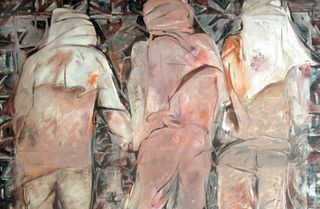
They say under these womens’ chador walk children and restaurants
They say all the skin and passages are moonlight and marble . . .
They do their mock laughter
if the chador is blown away they would take the ‘disaster’ to be stoned
onto the gravediggers of justice

….. Hey! The cry of the creeking carts . . .

Meaning, if there were no boundaries
no desire should be tempted to advance?
But if someone was left under the stones . . .

….. buried alive . . .
….. a woman . . .
.
.
by Maryam Hooleh
from Cursed Booth
publisher: Baran, Stockholm, 2000

ranslation: Abol Froushan

Engineered bacterium hunts down pathogens

From Nature:

EcoliIn the war against infection, medicine needs a hero. Meet the bioengineered bacterium that can hunt down pathogens and destroy them with a powerful one–two punch. Synthetic biologist Matthew Chang at Nanyang Technological University in Singapore has armed Escherichia coli bacteria with a ‘seek and kill’ system that targets cells of Pseudomonas aeruginosa, an invasive bacterium that causes pneumonia and other illnesses1. In preliminary tests with infected mice, the modified bacterium left a trail of dead P. aeruginosa in its wake. Chang and his team had previously developed an E. coli that could brew up an antibacterial peptide called pyocin, and then explode to release its deadly cargo whenever it detected a chemical signal emitted by its prey2. Now the bioengineered vigilante is back — and it is tougher than ever. The researchers inserted genes into E. coli to make a killing peptide called microcin S (MccS). This is smaller than pyocin, so the E. coli can secrete it, rather than delivering the payload in a single suicidal burst. That means that fewer of the modified bacteria are required to treat an infection. The team then loaded the engineered bacterium with genes to make a nuclease called DNase I. This efficiently slices through the protective biofilm that envelops P. aeruginosa colonies by breaking down the nucleic acids that help to hold the biofilm together. The researchers programmed their E. coli so that it cunningly keeps its powder dry until it is close to its mark. It can detect a P. aeruginosa messenger molecule used for a process called quorum sensing, by which the invader assesses its own population density. Each E. coli generates a protein that latches on to a quorum-sensing molecule, forming a complex that activates its weapons systems. That complex also controls E. coli’s movement, so that the bacterium swims towards higher concentrations of a quorum-sensing molecule — a process called chemotaxis. As it homes in on its quarry, the E. coli ramps up its ammunition production. “That’s the real gem of this work,” says William Bentley, a synthetic biologist at the University of Maryland in College Park. “I think it’s really innovative.” Some of these tactics have been used individually in other bioengineered bacteria, but “putting it all together is totally new”, says Bentley. The assassin is unveiled this week in ACS Synthetic Biology1. Chang fed his microscopic mercenaries to mice infected with P. aeruginosa, then collected faecal samples a few hours later. He found that the animals had fewer pathogens than those given ordinary E. coli. and appeared to suffer no ill effects from the treatment. “It’s quite promising,” says Chang.

But can such engineered bacteria ever be used in humans? “I believe so,” says Chang. Most conventional antibiotic treatments kill bacteria indiscriminately, taking out both pathogenic microbes and beneficial bacteria in the gut, for example. By contrast, Chang’s E. coli offers the possibility of a surgical strike. Chang also suggests that the bacterium could be given to people at high risk of pathogenic infection. The E. coli would lie dormant in the gut, and activate only once its enemy makes an appearance. “Of course there are regulatory hurdles: these are genetically modified organisms,” says Chang. “But eventually, if we can demonstrate that it is safe and effective, I really envision that this could be used in humans.” Bentley and his collaborators have used a similar approach to make bacteria that seek out cancer cells, and deliver a burst of chemicals when they arrive2.

More here.

Wednesday, September 11, 2013

What Putin Has to Say to Americans About Syria

Vladimir V. Putin in the New York Times:

ScreenHunter_316 Sep. 12 10.53Recent events surrounding Syria have prompted me to speak directly to the American people and their political leaders. It is important to do so at a time of insufficient communication between our societies.

Relations between us have passed through different stages. We stood against each other during the cold war. But we were also allies once, and defeated the Nazis together. The universal international organization — the United Nations — was then established to prevent such devastation from ever happening again.

The United Nations’ founders understood that decisions affecting war and peace should happen only by consensus, and with America’s consent the veto by Security Council permanent members was enshrined in the United Nations Charter. The profound wisdom of this has underpinned the stability of international relations for decades.

No one wants the United Nations to suffer the fate of the League of Nations, which collapsed because it lacked real leverage. This is possible if influential countries bypass the United Nations and take military action without Security Council authorization.

More here.

September 11 secrets: The amazing life — and death — of an Internet pioneer on Flight 11

A plane that struck the Trade Center carried one of the Web's geniuses, who may have been the day's first casualty.

Molly Knight Raskin in Salon:

ScreenHunter_315 Sep. 12 10.49Despite the fact that the markets were no longer betting on Akamai, company executives chose Las Vegas for their 2001 sales kickoff. To mark the official launch of EdgeSuite, they flew several dozen employees and advisors out to Sin City for a few days at the Mandalay Bay Hotel & Casino.

As VP of sales, John Sconyers said that, despite the market downturn, the mood was celebratory. Akamai had a new service, and with it the promise of new customers. They were in Vegas, and for a time, they felt like big winners. “We were just pinching ourselves,” Sconyers recalled. “It was an unbelievable experience.”

Employees, customers and members of the company’s board were put up in swank suites and handed substantial wads of cash to gamble. Ironically, it was the only time Dwight Gibbs of the Motley Fool recalled any sort of dispute with founder Danny Lewin, who insisted that Gibbs, a member of the company’s customer advisory board, stay in an upscale suite. “I said I didn’t like the optics . . . Danny would hear none of it,” Gibbs explained. “It was a mild kerfuffle, and eventually Danny won. I should have given in immediately. It would have saved us both a lot of time.”

The featured event of the sales kickoff was a speech by Lewin, the mathematical genius who had created a set of algorithms to foster a faster, better Internet, who announced the official launch of EdgeSuite with much fanfare. Notwithstanding the reality of the plunging markets, he was ebullient and optimistic. “Isn’t EdgeSuite a crappy name?” he asked, pausing for a laugh. “Luckily, we use it to our advantage. Microsoft also told me EdgeSuite was a crappy name, but they said we also have a crappy name so [they] respect companies with crappy names. So we should keep it even though it sucks.”

More here.

The Man Who Would Build a Computer the Size of the Entire Internet

Cade Metz in Wired:

ScreenHunter_314 Sep. 12 10.45Inside the massive data centers that drive things like Google Search and Gmail and Google Maps, you’ll find tens of thousands of machines — each small enough to hold in your arms — but thanks to anew breed of software that spans this sea of servers, the entire data center operates like a single system, one giant computer that runs any application the company throws at it.

A Google application like Gmail doesn’t run on a particular server or even a select group of servers. It runs on the data center, grabbing computing power from any machine than can spare it. Google calls this “warehouse-scale computing,” and for some, it’s an idea so large, they have trouble wrapping their heads around it.

Solomon Hykes isn’t one of them. He aims for something even bigger. With a new open-source software project known as Docker, he wants to build a computer the size of the internet.

More here.

hoagland goes north

Malignelake

June 9 The mountains look dramatic and incisive today. No sun, but a high ceiling, almost windless. I climbed in the Opal Hills, so-called, to the basin under the top ridge. Snow occasionally to my knees in drifts, otherwise gone. Saw some old black bear tracks on the path—hind foot the size of one of my hands. Very still today, woods quite empty, panorama on top, the lake green and white. I’m enjoying being alone, although thinking about New York literary politics, and the Kennedys, of course. Saw the tracks of a coyote and heard a short bark. Rubbed shoulders with some Maligne mosquitoes. Am glad to know I can climb to the places I climbed 16 years ago, when I was 19. My reactions are quieter and smudgier, though, and the park is developing like Yellowstone. If a person has just been married, like me, he kicks himself if his new wife isn’t constantly in the front of his mind, when, as a matter of fact, it wouldn’t be natural for her to be. The symbiosis comes with time. As it is, I think of how pretty Marion was in the three dresses she wore during the weekend of my sister’s wedding.

more from Edward Hoagland in The American Scholar here.

the great dismisser

F-r-leavis

I once met F.R. Leavis – or almost. It was in October 1977, in a house in Bulstrode Gardens in Cambridge. I had arrived with a group of fellow students for an introductory meeting with our medieval supervisor, Mrs Helena Shire, a formidable Scottish lady of confident views and startling formality. As she ushered us into her sitting room we realised that it already had an occupant. A small, gaunt, elderly man in a jacket and open-necked shirt stood in the French window. I think I remember a look of something like panic on his face as the gaggle of 19-year-olds approached. After a brief hesitation he turned and exited rapidly through the glass doors into the garden. I watched as he walked away from the house, squeezed through a gap in the fence into the next-door garden and disappeared. ‘Ladies and gentlemen,’ Mrs Shire said, ‘do you know who that was?’ She paused, more for dramatic effect than in any expectation of an answer. ‘That,’ she said, ‘was F.R. Leavis.’ She lingered on the two initials. No one said anything, but it was obvious that the name was meaningless to most of us. It was another example of someone who was famous in Cambridge but otherwise unknown. He was evidently Mrs Shire’s next-door neighbour.

more from John Mullan at the LRB here.

lawrence

Cover00

Indeed, Lawrence would never have imagined that a foreign power might invade an Arab country with so little knowledge of it. His own affection for the Arabs went so far that he committed treason in an attempt to save them. In 1917, France and Britain desperately wanted to take Aqaba from the Turks; the port would assure them dominance of the northern Arabian coastline, as well as easier supply lines to Egypt. Faisal, the leader of the Arab revolt tenuously allied with the British, needed Aqaba as a launching point for the Arab rebellion in Syria. Lawrence thought the invasion would be a Gallipoli-like disaster—and foresaw a still darker outcome for this adventure. Once Aqaba was conquered, he predicted, the Allied forces would block the Arabs from moving northward on their march to create a greater Arab nation, a maneuver that would establish France and Britain as the dominant military forces in the Middle East. Lawrence had read the Sykes-Picot accord; when both the Arabs and the French made claim to Syria, there was no question who would win. “So long as that treaty stood,” Anderson writes, “British betrayal of the Arab cause in deference to its French ally was virtually preordained.” Lawrence advised Faisal to avoid Aqaba entirely, and find an alternative path into Syria to lead his uprising. More astoundingly, he told Faisal the details of Sykes-Picot, thereby committing “a consummate act of treason.”

more from Suzy Hansen at Bookforum here.

Wednesday Poem

The Self-playing Instrument of Water
.
It is the story of the falling rain
To turn into a leaf and fall again

It is the secret of a summer shower
To steal the light and hide it in a flower

And every flower a tiny tributary
That from the ground flows green and momentary

Is one of water’s wishes and this tale
Hangs in a seed head smaller than my thumbnail

If only I a passerby could pass
As clear as water through a plume of grass

To find the sunlight hidden at the tip
Turning to seed a kind of lifting raindrip

Then I might know like water how to balance
The weight of hope against the light of patience

Water which is so raw so earthy-strong
And lurks in cast iron tanks and leaks along

Drawn under gravity towards my tongue
To cool and fill the pipe-work of this song

Which is the story of the falling rain
That rises to the light and falls again
.

by Alice Oswald
Poetry International, 2013

Enter A World Of Cupcake Sledding And Broccoli Lawns

From NPR:

CupLots of us play with our food. But for photographer Christopher Boffoli, it's become a full-time career. Boffoli rose to fame a couple of years ago. You may have seen some of his photographs — amusing dioramas featuring miniature plastic figurines in dramatic settings crafted from food — when they went viral back in 2011. More than 200 such images — at least half of which, Boffoli says, have not been previously published — are collected in a new book, Big Appetites. Boffoli's scenarios, and especially his captions, evoke New Yorker cartoons — many are dark and humorous. “I love the idea of taking something whimsical that people expect to be fun and turning on the fulcrum of their expectations to something more disturbing,” Boffoli tells The Salt.

More here.

Who did you hear, me or your lying eyes?

From KurzweilAI:

What did you hear?

“For the first time, we were able to link the auditory signal in the brain to what a person said they heard when what they actually heard was something different. We found vision is influencing the hearing part of the brain to change your perception of reality — and you can’t turn off the illusion,” says the new study’s first author, Elliot Smith, a bioengineering and neuroscience graduate student at the University of Utah. “People think there is this tight coupling between physical phenomena in the world around us and what we experience subjectively, and that is not the case.”

The McGurk effect

The brain considers both sight and sound when processing speech. However, if the two are slightly different, visual cues dominate sound. This phenomenon is named the McGurk effect for Scottish cognitive psychologist Harry McGurk, who pioneered studies on the link between hearing and vision in speech perception in the 1970s. The McGurk effect has been observed for decades. However, its origin has been elusive. In the new study in the open-access journal PLOS ONE, the University of Utah team pinpointed the source of the McGurk effect by recording and analyzing brain signals in the temporal cortex, the region of the brain that typically processes sound. The researchers recorded electrical signals from the brain surfaces of four epileptic adult volunteers who were undergoing surgery to treat their epilepsy. These four test subjects were then asked to watch and listen to videos focused on a person’s mouth as they said the syllables “ba,” “va,” “ga” and “tha.” Depending on which of three different videos were being watched, the patients had one of three possible experiences as they watched the syllables being mouthed:

— The motion of the mouth matched the sound. For example, the video showed “ba” and the audio sound also was “ba,” so the patients saw and heard “ba.”

— The motion of the mouth obviously did not match the corresponding sound, like a badly dubbed movie. For example, the video showed “ga” but the audio was “tha,” so the patients perceived this disconnect and correctly heard “tha.”

— The motion of the mouth only was mismatched slightly with the corresponding sound. For example, the video showed “ba” but the audio was “va,” and patients heard “ba” even though the sound really was “va.” This demonstrates the McGurk effect — vision overriding hearing.

More here.

9/11: The Falling Man

Do you remember this photograph? In the United States, people have taken pains to banish it from the record of September 11, 2001. The story behind it, though, and the search for the man pictured in it, are our most intimate connection to the horror of that day.

Tom Junod in Esquire:

Fallingman-lgIn the picture, he departs from this earth like an arrow. Although he has not chosen his fate, he appears to have, in his last instants of life, embraced it. If he were not falling, he might very well be flying. He appears relaxed, hurtling through the air. He appears comfortable in the grip of unimaginable motion. He does not appear intimidated by gravity's divine suction or by what awaits him. His arms are by his side, only slightly outriggered. His left leg is bent at the knee, almost casually. His white shirt, or jacket, or frock, is billowing free of his black pants. His black high-tops are still on his feet. In all the other pictures, the people who did what he did — who jumped — appear to be struggling against horrific discrepancies of scale. They are made puny by the backdrop of the towers, which loom like colossi, and then by the event itself. Some of them are shirtless; their shoes fly off as they flail and fall; they look confused, as though trying to swim down the side of a mountain. The man in the picture, by contrast, is perfectly vertical, and so is in accord with the lines of the buildings behind him. He splits them, bisects them: Everything to the left of him in the picture is the North Tower; everything to the right, the South. Though oblivious to the geometric balance he has achieved, he is the essential element in the creation of a new flag, a banner composed entirely of steel bars shining in the sun. Some people who look at the picture see stoicism, willpower, a portrait of resignation; others see something else — something discordant and therefore terrible: freedom. There is something almost rebellious in the man's posture, as though once faced with the inevitability of death, he decided to get on with it; as though he were a missile, a spear, bent on attaining his own end. He is, fifteen seconds past 9:41 a.m. EST, the moment the picture is taken, in the clutches of pure physics, accelerating at a rate of thirty-two feet per second squared. He will soon be traveling at upwards of 150 miles per hour, and he is upside down. In the picture, he is frozen; in his life outside the frame, he drops and keeps dropping until he disappears.

More here.

Tuesday, September 10, 2013

Happiness. Kannada. That’s all.

Shankar-nag-by-d-c-nagesh_1

In 2011, Darshan Thoogudeep, a Kannadiga actor commonly known by his first name, starred as Raja, an auto-rickshaw driver, in a Kannada film titled Sarathi. The film was released on 30 September, the death anniversary of Shankar Nagarkatte (better known as Shankar Nag), a legendary figure in Kannada cinema who acted in over 80 films and directed ten (along with two television serials, including Malgudi Days, adapted from RK Narayan’s work). Darshan’s film, which even included an animated dance-sequence featuring Nag, was widely viewed as a tribute to the late star, who, in 1980, had also essayed the role of an autorickshaw driver in the film Auto Raja, directed by Vijay. Auto Raja was an inter-class love story, with Nag playing an urban working-class auto driver and the leading actress Gayathri the daughter of a wealthy estate owner, and Nag’s love interest. According to the critic MK Raghavendra, the film attempted to “build a community around the urban working class”, represented by Bangalore’s autorickshaw drivers. It was a super-hit, making Nag a rage with auto-rickshaw drivers across Bangalore.

more from Sharanya at Caravan here.

Wong Kar-wai’s Subtle Battles

Directors_wallpapers__wong_kar_wai_by_runn089-d4j7x0e

Wong Kar-wai’s The Grandmaster was released last Friday. Each of Wong’s previous masterpieces has evoked a kind of romantic longing. Chungking Express, for example, opens with a woman in a blond wig and a trench coat walking through the stalls of Chungking Mansions in Hong Kong. It’s a place where you can buy electronics and food, and it is crowded at night. The woman takes an elevator up to what looks like it might be a tailor shop, though it’s too dark to tell. We follow her down a hallway, and abruptly she turns and looks directly into the camera, the way a beautiful woman would turn to look at a man who was following her too closely. She walks a bit further, into a room with a man in an undershirt sitting on a top bunk, and the title screen comes up. Then, over scenes of white clouds against the blue sky, behind silhouettes of industrial equipment, a young man says in voiceover, “Every day we brush past so many people. People we may never meet or people who may become close friends. I’m a cop, number 223. My name’s He Qiwu.” Now he is chasing someone through Chungking. He brushes past a mannequin wearing a blond wig like the woman’s.

more from Amie Barrodale at Harper’s here.

Syria and the Rules of War

1378748279syrianbombs

In the summer of 1925, a large revolt broke out in the French Syrian Mandate, a territory administered by France in conjunction with the League of Nations after the collapse of the Ottoman Empire at the end of the First World War. The uprising began with the Druze in the semi-autonomous region of southern Syria, Jabal al-Druze. But given the unpopularity of French rule, it spread quickly throughout Syria and Lebanon and across sectarian lines. To their international humiliation, the French proved incapable of slowing its expansion, as major uprisings broke out in the cities of Hama and Homs (both centers of the civil war today). In October 1925, as fighting raged in and around Damascus, the French army responded with brutal force: burning villages suspected of harboring insurgents, publicly parading the corpses of slain Syrian fighters, and indiscriminately shelling civilian areas in Damascus and its outskirts, which resulted in the deaths of over 1,000 civilians. The opposition was finally defeated in the summer of 1927. But the 1925 bombardment of Damascus sparked an international controversy: did the direct targeting of civilian areas in and around Damascus violate the laws of war as they had been established in the late nineteenth and early twentieth centuries?

more from James R. Martin at Dissent here.

Haruki Murakami emerges as favourite for Nobel prize for literature

Liz Bury in The Guardian:

ScreenHunter_312 Sep. 10 13.59After years of hovering in the wings, this could be Haruki Murakami's year to clinch the Nobel prize for literature – at least if you go by the odds offered by Ladbrokes on the Japanese author, who is 3-1 favourite.

Other favoured contenders include US author Joyce Carol Oates (6-1), Hungarian writer Peter Nádas (7-1), South Korean poet Ko Un (10-1), and Alice Munro, the short story writer from Canada (12-1).

Piecing together the odds is a question of informed guesswork, since the nominations and cogitations of the members of the Nobel Committee for Literature are kept under wraps by the Swedish Academy, which only reveals the conversations of the judicial huddle 50 years after the decision is made.

Sixth favourite is Syrian poet Adonis, 14-1, who was tipped to win in 2011 following the Arab spring uprisings but lost out to another poet, Sweden'sTomas Tranströmer, the second favourite.

Murakami has been considered a frontrunner for the past 10 years. His emergence as favourite this time round comes as his latest novel – the title of which translates as Colourless Tsukuru Tazaki and His Years of Pilgrimage – is being translated into English ahead of publication in 2014.

More here.

Tuesday Poem

Another Place

Another place, another life, another book,
we go on without a return ticket, on the trail
of the vanished song, the elusive lines unlocking
a whole library of meaning, our lives shelved
in comprehensive order, for us who will arrive
clothed in dust and dusk, to sit at the appointed desks
and pore over the pages, search out the thread
stringing together all arrivals and departures
which our hands will tell, over and over,
as if in prayer, as if in peace.

by Kim Cheng Boey
from Another Place

Singapore Times

Martin Manley’s bequest: reconsider the stigma of suicide

Today is World Suicide Prevention Day. Here's Tauriq Moosa in The Guardian:

Tombstone-006By being more open about what leads people to suicide, by not treating suicidal thoughts as automatic signs of insanity, we might actually reduce the number of suicides.

People don't merely want biological life, after all, they want quality life. Who wants to continue living if it means endless, incurable suffering and debilitation? Perhaps a few do, but why should their standard be applied to all?

As research indicates, by reducing social stigma, more effort can go into suicide prevention, not least because we're more likely to donate to a cause if we are not repulsed by the subject. People won't feel ashamed for having suicidal thoughts when they're treated as people, instead of pariahs. This could translate into lives saved.

Furthermore, some countries and certain American states have recognised assisted suicide as a medical option. Certain conditions must be met, of course: an incurable disease, the full consent of a “capable” patient, and other carefully circumscribed parameters. Against those who cry that legalised euthanasia will lead to abuse, murder and so on, there are years of evidence to the contrary, as io9 contributor George Dvorsky points out.

There is plenty of empirical evidence for saying that suicide is a good indicator of mental health problems, but that should be different from arguing that suicide is, by definition, a sign of insanity.

More here.