Thursday Poem

The Leveret

This is your first night in Carrigskeewaun.
The Owennadornaun is so full of rain
You arrived in Paddy Morrison’s tractor,
A bumpy approach in your father’s arms
To the cottage where, all of one year ago,
You were conceived, a fire-seed in the hearth.
Did you hear the wind in the fluffy chimney?
Do you hear the wind tonight, and the rain
And a shore bird calling from the mussel reefs?
Tomorrow I’ll introduce you to the sea,
Little hoplite. Have you been missing it?
I’ll park your chariot by the otters’ rock
And carry you over seaweed to the sea.
There’s a tufted duck on David’s lake
With her sootfall of hatchlings, pompoms
A day old and already learning to dive.
We may meet the stoat near the erratic
Boulder, a shrew in his mouth, or the merlin
Meadow-pipit-hunting. But don’t be afraid.
The leveret breakfasts under the fuchsia
Every morning, and we shall be watching.
I have picked wild flowers for you, scabious
And centaury in a jam-jar of water
That will bend and magnify the daylight.
This is your first night in Carrigskeewaun.
.

by Michael Longley
from Poetry International
why W H Auden still matters

Alexander McCall Smith in New Statesman:

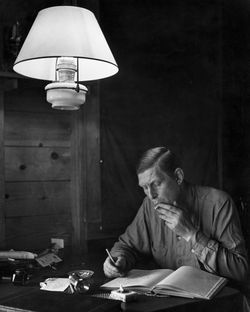
AudenWhen I started to write novels set in Edinburgh, the characters in these books – unsurprisingly, perhaps – began to show an interest in Auden. In particular, Isabel Dalhousie, the central character in my Sunday Philosophy Club series, thought about Auden rather a lot – and quoted him, too. A couple of years after the first of these novels was published, I received a letter from his literary executor, Edward Mendelson, who is a professor of English at Columbia University in New York. Unlike those writers who appoint coevals to look after their work, with the result that their executors either predecease them or do not last much longer, Auden made the wise move of appointing a young man to watch over his literary legacy. Mendelson was then a junior academic at Yale – and this gave him the opportunity to devote much of a long and distinguished career to producing commentary on Auden’s writing. It transpired that he was a reader of my Botswana novels and he wrote to me to tell me that, in his opinion, Auden and Mma Ramotswe would have agreed on practically every subject. However, what particularly pleased him, he said, was the attachment my other fictional characters had to the poet. The letter led to a friendship. I then wrote Professor Mendelson into an Isabel Dalhousie novel, creating a scene in which he comes to Edinburgh to deliver a public lecture on the sense of neurotic guilt in Auden’s verse. A year later, we translated fiction into reality by bringing Mendelson to Edinburgh to deliver before a real audience the lecture that he had previously given to a group of fictional characters. Such is the interest in Auden that almost 400 people came to hear him speak.
That is not bad for a poet who died 40 years ago this month. What explains the continuing appeal of his work? The language he used probably goes some way towards it. Auden had an ear for the rhythmic possibilities of English – at one time or another he used virtually every metre available to a poet writing in English. It is the syllabic verse, though, that he consistently used for so many of his later poems that has the strongest and most consistent appeal. It appears effortless – rather like the steady flow of a clever lecture – but it is really very skilfully constructed and has an extraordinary capacity to resonate with the reader. Yes, we think. This is exactly how it is. This is true.
More here.

Parasite makes mice lose fear of cats permanently

Eliot Barford in Nature:

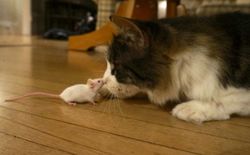
CatA parasite that infects up to one-third of people around the world may have the ability to permanently alter a specific brain function in mice, according to a study published in PLoS ONE today1. Toxoplasma gondii is known to remove rodents’ innate fear of cats. The new research shows that even months after infection, when parasites are no longer detectable, the effect remains. This raises the possibility that the microbe causes a permanent structural change in the brain. The microbe is a single-celled pathogen that infects most types of mammal and bird, causing a disease called toxoplasmosis. But its effects on rodents are unique; most flee cat odour, but infected ones are mildly attracted to it. This is thought to be an evolutionary adaptation to help the parasite complete its life cycle: Toxoplasma can sexually reproduce only in the cat gut, and for it to get there, the pathogen's rodent host must be eaten.

In humans, studies have linked Toxoplasma infection with behavioural changes and schizophrenia. One work found an increased risk of traffic accidents in people infected with the parasite2; another found changes in responses to cat odour3. People with schizophrenia are more likely than the general population to have been infected with Toxoplasma, and medications used to treat schizophrenia may work in part by inhibiting the pathogen's replication. Schizophrenia is thought to involve excess activity of the neurotransmitter dopamine in the brain. This has bolstered one possible explanation for Toxoplasma’s behavioural effect: the parasite establishes persistent infections by means of microscopic cysts that grow slowly in brain cells. It can increase those cells’ production of dopamine, which could significantly alter their function. Most other suggested mechanisms also rely on the presence of cysts.

More here.

A Jewel at the Heart of Quantum Physics

Natalie Wolchover in Quanta:

Amplutihedron_spanPhysicists have discovered a jewel-like geometric object that dramatically simplifies calculations of particle interactions and challenges the notion that space and time are fundamental components of reality.

“This is completely new and very much simpler than anything that has been done before,” said Andrew Hodges, a mathematical physicist at Oxford University who has been following the work.

The revelation that particle interactions, the most basic events in nature, may be consequences of geometry significantly advances a decades-long effort to reformulate quantum field theory, the body of laws describing elementary particles and their interactions. Interactions that were previously calculated with mathematical formulas thousands of terms long can now be described by computing the volume of the corresponding jewel-like “amplituhedron,” which yields an equivalent one-term expression.

“The degree of efficiency is mind-boggling,” said Jacob Bourjaily, a theoretical physicist at Harvard University and one of the researchers who developed the new idea. “You can easily do, on paper, computations that were infeasible even with a computer before.”

The new geometric version of quantum field theory could also facilitate the search for a theory of quantum gravity that would seamlessly connect the large- and small-scale pictures of the universe. Attempts thus far to incorporate gravity into the laws of physics at the quantum scale have run up against nonsensical infinities and deep paradoxes. The amplituhedron, or a similar geometric object, could help by removing two deeply rooted principles of physics: locality and unitarity.

More here.

Wednesday, September 18, 2013

Tariq Ali: Wishing for the Syrian civil war to be a revolution doesn’t make it so

Tariq Ali in Guernica:

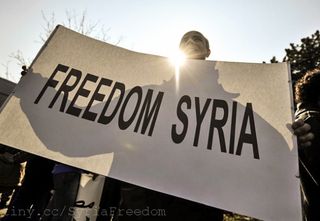
6962095179_076a97e063_z-600x415Ever since the beginning of the Arab Spring there has been much talk of revolutions. Not from me. I’ve argued against the position that mass uprisings on their own constitute a revolution, i.e., a transfer of power from one social class (or even a layer) to another that leads to fundamental change. The actual size of the crowd is not a determinant—members of a crowd become a revolution only when they have, in their majority, a clear set of social and political aims. If they do not, they will always be outflanked by those who do, or by the state that will recapture lost ground very rapidly.

Egypt is the clearest example in recent years. No organs of autonomous power ever emerged. The Muslim Brotherhood, a conservative social force, one that belatedly joined the struggle to overthrow Mubarak, emerged as the strongest political player in the conflict and, as such, won the elections that followed. The Brotherhood’s factionalism, stupidity, and a desire to reassure both Washington and the local security apparatuses that it would be business as usual led it to make several strategic and tactical errors from its own point of view. New mass mobilizations erupted, even larger than those that had led to the toppling of Mubarak. Once again they were devoid of politics, seeing the army as their savior and, in many cases, applauding the military’s brutality against the Muslim Brothers. The result was obvious. The ancient régime is back in charge with mass support. If the original was not a revolution, the latter is hardly a counter-revolution. Simply the military reasserting its role in politics. It was they who decided to dump Mubarak and Morsi. Who will dump them? Another mass mobilization? I doubt it very much. Social movements incapable of developing an independent politics are fated to disappear.

More here.

The Storytellers: 150 years after the death of Jacob Grimm, here’s what really happened with that princess and the pesky frog

Our own Morgan Meis in The Smart Set:

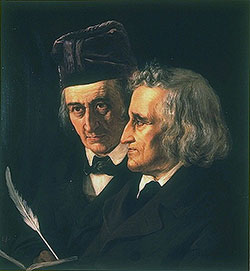
ID_IC_MEIS_GRIMM_AP_001If the Brothers Grimm were not trying to tell charming bedtime stories, what were they trying to do? Why are the original versions of their stories so often violent and disturbing? The first answer to these questions is that the Brothers Grimm were simply being true to the stories as they existed in the early 19th century. The Brothers saw themselves as faithful recorders of a living German tradition. They wanted to preserve these stories in their true and exact form. The second answer is this: The violence of the folktales is part of their power. The Brothers Grimm understood this fact. They wanted to tap into that power. They thought that the tales would revitalize a German people fallen on hard times. But we leap ahead of ourselves.

The story of the Brothers Grimm begins in a small town, Henau, in what is now the western part of Germany. But Germany was not yet a country in 1785, the year when little Jacob Ludwig Carl Grimm was born. Germany was a disorganized collection of principalities and fiefdoms. And Germans were still recovering from the Thirty Years’ War, which had wreaked much havoc in the middle of the 17th century. It is impossible to explain the Thirty Years War briefly or clearly. Let’s just say that the War left many regions of Germany devastated, depopulated, divided and unstable. It was a condition that would continue through the 18th century.

In the early 19th century, just when it seemed that Germans might be coming out of their funk, Napoleon came along. Young Jacob and Wilhelm Grimm were to see their region turned into a French satellite state in 1806. At the time of the initial publication ofGrimm’s Fairy Tales, the Brothers Grimm were living under a kind of military occupation.

More here.

Why Rachel Wetzsteon is her generation’s best love poet

Xwetzsteon-rachel.jpg.pagespeed.ic.hnVdh4WtIzAdam Kirsch at Poetry Magazine:

The type of writer who falls prey to the “not quite,” who thinks deeply about it and makes it a major theme of her work, tends to be at the same time sentimental and ironic. The sentiment comes from her longing for the ordinary, for un-self-conscious emotion and experience; her irony comes from her secret feeling of superiority to that kind of simplicity. (Mann, again, is the classic example of this kind of artist—Tonio Kröger says just about everything there is to say on the subject.) For of course, if you were to offer the artist the chance to stop writing and start living, she would never take it; she is too deeply defined by her own distance from life to dare to close it.

Rachel Wetzsteon, who died in 2009 at the age of 42, was her generation’s best poet of the “not quite.” During her tragically brief career, Wetzsteon earned her share of the small honors that are in the poetry world’s gift: her debut collection, The Other Stars (1994), was chosen for the National Poetry Series by John Hollander; she won prizes, and was the poetry editor of the New Republic (where I was proud to be her colleague). But she had produced only three books of poetry before she died—a fourth, Silver Roses, came out posthumously—and she had not yet reached the level of seniority or acclaim where her work was much reviewed.

more here.

King Krule’s lineage

130923_r23977_p465Sasha Frere-Jones at The New Yorker:

Last week, Marshall played the Bowery Ballroom with his current band, made up of bass, guitar, and drums. He emerged in a suit jacket that looked three sizes too big, as most clothing does on him, and carrying a Fender Telecaster guitar. When playing it, he looked slightly hemmed in, as if he sensed that the band might be getting too close to a familiar entity. When he put down the guitar and just sang, gripping the microphone and doubling over as he yelled, the sound came into focus. He introduced each of the musicians in the band, as if it were a genuine jazz ensemble, but that’s not what has drawn people to King Krule. Though Marshall sounds as if he had stumbled into a recording studio by accident (and confesses that he likes many of his demos better than the final studio versions), he manages to be a confirmed, dedicated romantic. His voice curls around his lyrics as if he were disgusted with everything, but the words fight his delivery. In “Borderline,” which features one of his loveliest choruses over a swift series of chord changes, he sang, “And the soul chokes to cause the tide to enforce divide—this whole devotion has morphed in time. I’ll escort her mind to solve my crimes, reach slow motion to con the mind.”

more here.

in Gaudí’s great cathedral

Sagrada-familia-large

Casey N. Cep at The Paris Review:

Gaudí wanted the interior of Sagrada Família to look like a forest. The columns of the nave stretch like tree trunks from the floor to the ceiling, branching to support the heavy weight of the ceiling, but also sprawling, reaching like tendrils for the sky. The church is beautiful because of its continual incompletion, its revelation that human construction is not so unlike natural construction: you plant a sapling as a child, then years later it is still growing into something taller, something more; your grandparents planted daffodils that decades later you see still returning every spring; you sit reading the newspaper on a bench in a park that your father tells you was once under water, the river having receded miles from its ancient reaches.

Cathedrals reveal human construction for what it is. In “The Cathedral,” Rainer Maria Rilke wrote “Their birth and rise, / as our own life’s too great proximity / will mount beyond our vision and our sense / of other happenings.” The poet disdains the possibility that cathedrals eclipse their makers: “as though that were history, / piled up in their immeasurable masses / in petrifaction safe from circumstance.” Life, Rilke argued, was on the streets beneath the cathedral’s spires, while death was “in those towers that, full of resignation, / ceased all at once from climbing.”

more here.

The New Deal We Didn’t Know

Lemann_1-092613_jpg_470x634_q85

Nicholas Lemann reviews Ira Katznelson's Fear Itself: The New Deal and the Origins of Our Time, in the NYRB:

The New Deal, the apogee of liberal political power in American history and a story with a relatively happy ending—the Great Depression vanquished, World War II won—has usually had its history presented, except by conservatives who disapprove of the expansion of central government and taxation in the 1930s and 1940s, as an uplifting, inspiring one. That is not how Ira Katznelson presents it. There is only one very brief personal note in his long, scholarly book—a snip of memory about having to wear military-style dogtags and practice responses to a nuclear attack as a schoolchild in the early 1950s—but all of Fear Itself is suffused with the same sense of pure terror during the Roosevelt and Truman years as, say, Philip Roth’s The Plot Against America. It’s easy to forget not just how dangerous the situation was, at home and abroad, during the New Deal, but how palpable were outcomes far worse than what we got.

Another difference between Fear Itself and most of the familiar histories of the New Deal is that Katznelson thinks like a political scientist. That means that, although he defines the period presidentially, as the twenty years when Franklin Roosevelt and Harry Truman were in the White House, Roosevelt and Truman themselves are spectral presences. They are not the primary determiners of the course of government, and Katznelson has no interest in their personal qualities or their methods of leadership. Instead his focus is on Congress and government agencies, and more broadly on political systems, voting, and interest groups. This gives Fear Itself the feeling of a fresh look at a familiar story; what Katznelson loses in ignoring the inherent force of the hero narrative, he gains in being able to make an argument that largely ignores the presidency.

The argument bears laying out in some detail. Katznelson begins, usefully, by placing the New Deal in a global setting: the severity of the Great Depression presented an existential threat to liberal democracy everywhere, both as an ideal and as a reality. In response to the same economic crisis that confronted the United States, Germany turned to National Socialism, Italy to Fascism, and the Soviet Union already had a form of communism that no liberals except willfully blind ones could believe in. During Roosevelt’s first term, these alternate systems were on the verge of imposing themselves by force on many other countries.

It was not at all clear that democracy would survive here.

More here.

Pakistan in perpetual tension

From The Hindu:

JeffChristophe Jaffrelot is a Senior Research Fellow at CERI-Sciences Po/CNRS, Paris, Visiting Professor at the King's India Institute (London) and Global Scholar at Princeton University. In this exclusive interview with The Hindu’s Vaiju Naravane he discusses his new book to be published in India under the title The Pakistan Paradox.

In what sense is your book, published in France this week by Fayard under the title Le Syndrome Pakistanais, an essay or a pamphlet, and what is the thesis or the central point of the book?

The book argues that Pakistan is facing three contradictions since 1947 — and even, sometimes, since its very project emerged during the Raj. Primarily, there is the tension between a unitary notion of the Muslim nation state that is Pakistan and the diversity of the country in ethno-linguistic terms. This tension was there before Partition and it has remained after Partition with at least three provinces that never reconciled themselves fully with the Pakistani project: Bengal — Bengalis went in 1971, and the Baluchistan, which has been repeatedly on the warpath vis-à-vis the centre, and the Pashtuns, who have a very peculiar trajectory. There's been a demand for Pashtunistan, even a kind of irredentism with the Afghan Pashtuns for years, but the Pashtun trajectory has been more complicated since sections of the Pashtun elite — especially among the military — have rallied around the Pakistani project.

More here.

Bacteria and Termites Team Up

From Science:

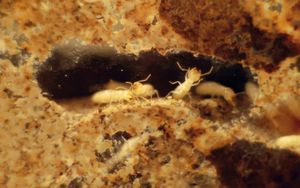
TermThe Formosan subterranean termite (Coptotermes formosanus) is native to southern China, but the aggressive little chompers have set up huge destructive colonies worldwide, including in the southeastern United States and Hawaii. They build the inner structure of their underground nests with a blend of chewed-up wood that used to be your house with their own excrement. In a study published in the Proceedings of the Royal Society B, researchers in Florida studied that recipe, called carton material (in photo above), and found a good purpose for the poop: It hosts protective bacteria, which can fight a termite-killing fungus.

More here.

Wednesday Poem

Magritte
.
I am a man in a black bowler hat,
showing my back to the world.
If I turn, an apple blocks my face.

My first glimpse of art was in a churchyard,
so close it is to death.
I listened to the silence of that place.

Sometimes, laid out, she elevates behind me
as I walk the towpath.
Stiff-necked, I do not look around.

My art has no laws of gravity,
but a woman’s chestnut hair falls to the ground
and bowler-hatted men are falling rain.

I have seen boulders floating in the sky,
and every day a cloud comes in my door.
Baguettes, instead of clouds, go drifting by.

In woods, between the horse’s head and rider,
a vista slips, slim as the trunk of a tree.
What’s visible hides what’s also visible.

The sea is one with what is not the sea.
.
by Ciaran O'Driscoll
from Surreal Man
Pighog Press, Brighton, 2006

Tuesday, September 17, 2013

The American Jewish Cocoon

Peter Beinart in the New York Review of Books:

Beinart_1-092613_jpg_470x685_q85Speak to American Jews long enough about Israel and you begin to notice something. The conversation may begin with Israel, but it rarely ends there. It usually ends with “them.”

Express concern about Israeli subsidies for West Bank settlements and you’ll be told that the settlements don’t matter because “they” won’t accept Israel within any borders. Cite the recent warning by former Shin Bet head Yuval Diskin that “over the past 10–15 years Israel has become more and more racist” and you’ll be told that whatever Israel’s imperfections, it is “they” who teach their children to hate and kill. Mention that former prime minister Ehud Olmert has called Mahmoud Abbas a partner for peace and you’ll be told that what “they” say in Arabic is different from what they say in English.

This spring I watched the documentary The Gatekeepers—in which six former heads of Shin Bet sharply criticize Israeli policy in the West Bank—with a mostly Jewish audience in New York. Afterward a man acknowledged that it was an interesting film. Then he asked why “they” don’t criticize their side like Israelis do.

I used to try, clumsily, to answer the assertions about Palestinians that so often consume the American Jewish conversation about Israel. But increasingly I give a terser reply: “Ask them.” That usually ends the conversation because in mainstream American Jewish circles, asking Palestinians to respond to the endless assertions that American Jews make about them is extremely rare.

More here.

Is There a Word for That?

Ralph Keyes in The American Scholar:

ScreenHunter_329 Sep. 18 09.22Soon after they arrived in America, British settlers got busy with an important task: reinventing their language. This called for repurposing old words and coining new ones. Colonists called the plump, smelly rodents they encountered in swamps muske rats. Other forms of wildlife were named katydids, bobcats, catfish, and whippoorwills. To these settlers, sleigh improved on sledge, and the help reflected their values better than servants. “The new circumstances under which we are placed,” observed Thomas Jefferson, “call for new words, new phrases, and for the transfer of old words to new objects.”

“Necessity,” he concluded, “obliges us to neologize.” According to the Oxford English Dictionary, Jefferson is the first person known to have used the termneologize, in an 1813 letter. It is one of 110 words whose earliest use the OED credits to him. Others include indescribable, pedicure, and electioneer.

Once they caught wind of all the new words being coined across the Atlantic, self-appointed guardians of the King’s English were rather cross. When Jefferson used the new word belittle in his 1781 book Notes on the State of Virginia, a British critic exclaimed, “It may be an elegant [word] in Virginia, and even perfectly intelligible; but for our part, all we can do is to guess at its meaning. For shame, Mr. Jefferson!” Undaunted, the third president proceeded to coin Anglophobia.

More here.

Miss America, Meet India’s ‘Dark’ Side

Tunku Varadarajan in The Daily Beast:

MissAmericaA woman of Indian origin, Nina Davuluri of New York, is the new Miss America. In the first wave of news about her winning this arguably outdated concourse, there was an almighty collision between two American cultural strains. The first celebrated her ascent to tiarahood, seeing hers as a triumph of diversity and assimilation (values that have not always marched in lockstep in this land). The Girl Next Door can be a dark-skinned daughter of immigrants from Andhra Pradesh, a state in the southeast of India whose inhabitants speak Telugu, 13th in the list of the most-spoken languages worldwide. Take a bow, America. (Compare this country with mostly dark-skinned Brazil, which has had not a single nonwhite Miss Brazil.)

The second cultural strain revealed itself in a torrent of abuse on Twitter and other forums. Some disenchanted Americans gave vent to a racial displeasure over this incomprehensibly exotic Miss America. “And the Arab wins Miss America. Classic,” someone tweeted. (Dude, the Arab won Miss America in 2010. She’s called Rima Fakih.) The most frequent complaint was of the “This is America, not India” variety. The critics of Davuluri’s selection were, one can be sure, the kind of people who wouldn’t want our young Indian beauty queen as a neighbor, let alone as Miss America, so their views need not detain us.

More here.

Overpopulation Is Not the Problem

Erle C. Ellis in the New York Times:

0914OPEDstreeter-articleInlineMany scientists believe that by transforming the earth’s natural landscapes, we are undermining the very life support systems that sustain us. Like bacteria in a petri dish, our exploding numbers are reaching the limits of a finite planet, with dire consequences. Disaster looms as humans exceed the earth’s natural carrying capacity. Clearly, this could not be sustainable.

This is nonsense. Even today, I hear some of my scientific colleagues repeat these and similar claims — often unchallenged. And once, I too believed them. Yet these claims demonstrate a profound misunderstanding of the ecology of human systems. The conditions that sustain humanity are not natural and never have been. Since prehistory, human populations have used technologies and engineered ecosystems to sustain populations well beyond the capabilities of unaltered “natural” ecosystems.

The evidence from archaeology is clear. Our predecessors in the genus Homo used social hunting strategies and tools of stone and fire to extract more sustenance from landscapes than would otherwise be possible.

More here.

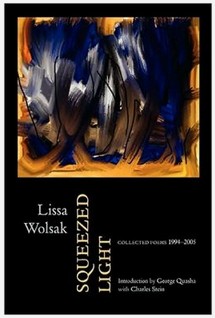
Preface to Lissa Wolsak

Henry Gould in The Critical Flame:

ScreenHunter_328 Sep. 17 16.45Lissa Wolsak is a major American poet, living in Vancouver; Squeezed Light is a comprehensive gathering of her published work, which includes seven poem-sequences, a prose piece titled “An Heuristic Prolusion”, an interview, and an extended introduction by George Quasha (with Charles Stein).

“Major” is a weighty word, not to be trifled with; yet I feel confident in this case. It has become a commonplace to note that American poetry is various, fractured, “balkanized”—but if we think of the distinctive American stream in English writing, we must reckon with a single, branching river. That is, we are dealing on the one hand with the brilliant, idiosyncratic, metaphysically-ambitious, transcendental Emerson, Whitman, Dickinson—and on the other with a darker channel: the melancholic, skeptical, ironic “power of blackness” (Harry Levin’s term) represented primarily by Poe and Melville. Lissa Wolsak floats her boat where both streams merge. She is an heir to their astringent, challenging, and problematic greatness.

put me on the dune
oval
sloping
this is,
she, made, undertaken…

T.S. Eliot once famously wrote, “poetry in our civilization, as it exists today, must be difficult.” In this regard, Lissa Wolsak demands the reader Walt Whitman required: an athlete—alert, engaged, willing to wrestle both angels and devils in order to grasp the poem.

More here. [Thanks to Daniel Pritchard.]