more on the “undergraduate atheists”

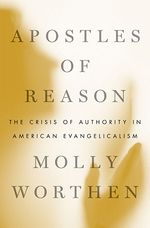
140103_SBR_APOSTLES_COVER.jpg.CROP.original-originalMichael Robbins at Slate:

The “undergraduate atheists,” as the philosopher Mark Johnston dubbed them inSaving God, have been definitively refuted by Hart, Terry Eagleton, Marilynne Robinson, Johnston himself, and others. As intellectual bloodbaths go, it’s been entertaining—like watching Jon Stewart skewer Glenn Beck. But of course Richard Dawkins is merely a symptom. I have encountered atheists who seem not only to have never met an intelligent, educated believer, but to doubt that such a creature could exist.

Such unbelievers seem to me to have missed something quite fundamental about the nature of being, as it appears to the human animal, something that the major theistic traditions attempt to address with rather more nuance and generosity than contemporary updates to logical positivism can muster. You don’t, obviously, have to believe in God to feel humbled and bewildered before what Heidegger called “the question of the meaning of Being.” (Indeed, I often think the notion of “belief” is more trouble than it’s worth.) But you do have to acknowledge that there is a question, “the major question that revolves around you,” as John Ashbery puts it: “your being here.” And you have to recognize that it concerns something outside the scope of the natural sciences.

more here.

secret to writing a best-selling novel? avoid cliches and excessive use of verbs

Mathew Sparkes in The Telegraph:

BookScientists have developed an algorithm which can analyse a book and predict with 84 per cent accuracy whether or not it will be a commercial success. A technique called statistical stylometry, which mathematically examines the use of words and grammar, was found to be “surprisingly effective” in determining how popular a book would be. The group of computer scientists from Stony Brook University in New York said that a range of factors determine whether or not a book will enjoy success, including “interestingness”, novelty, style of writing, and how engaging the storyline is, but admit that external factors such as luck can also play a role.

By downloading classic books from the Project Gutenberg archive they were able to analyse texts with their algorithm and compare its predictions to historical information on the success of the work. Everything from science fiction to classic literature and poetry was included. It was found that the predictions matched the actual popularity of the book 84 per cent of the time. They found several trends that were often found in successful books, including heavy use of conjunctions such as “and” and “but” and large numbers of nouns and adjectives. Less successful work tended to include more verbs and adverbs and relied on words that explicitly describe actions and emotions such as “wanted”, “took” or “promised”, while more successful books favoured verbs that describe thought processes such as “recognised” or “remembered”. To find “less successful” books for their tests, the researchers scoured Amazon for low-ranking books in terms of sales. They also included Dan Brown’s The Lost Symbol, despite its commercial success, because of “negative critiques if had attracted from media”.

More here.

“Unnatural killer cells” zap circulating tumor cells in the bloodstream

From KurzweialAI:

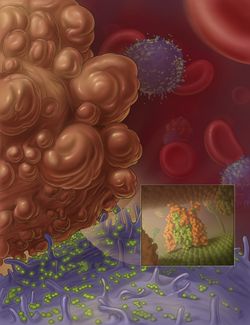
Nanoscale_liposomes_trailCornell biomedical engineers have discovered a new way to destroy metastasizing cancer cells traveling through the bloodstream by hitching cancer-killing proteins along for a ride on life-saving white blood cells. “These circulating cancer cells are doomed,” said Michael King, Cornell professor of biomedical engineering and the study’s senior author. “About 90 percent of cancer deaths are related to metastases, but now we’ve found a way to dispatch an army of killer white blood cells that cause apoptosis — the cancer cell’s own death — obliterating them from the bloodstream. “When surrounded by these guys, it becomes nearly impossible for the cancer cell to escape.” Metastasis is the spread of a cancer cells to other parts of the body. Surgery and radiation are effective at treating primary tumors, but difficulty in detecting metastatic cancer cells has made treatment of the spreading cancers problematic, say the scientists.

King and his colleagues injected human blood samples, and later mice, with two proteins: E-selectin (ES, an adhesive) and TRAIL (Tumor Necrosis Factor Related Apoptosis-Inducing Ligand). The TRAIL protein joined with the E-selectin protein was able to stick to leukocytes (white blood cells) abundant in the bloodstream. When a cancer cell comes into contact with TRAIL, which is nearly unavoidable in the frenzied flow of blood, the cancer cell essentially kills itself.

More here.

Thursday Poem

Not Fade Away

Half of the Beatles have fallen
and half are yet to fall.
Keith Moon has set. Hank Williams
hasn’t answered yet.

Children sing for Alex Chilton.
Whitney Houston’s left the Hilton.
Hendrix, Guru, Bonham, Janis.
They have a tendency to vanish.

Bolan, Bell, and Boon by car.
How I wonder where they are.
Hell is now Jeff Hanneman’s.
Adam Yauch and three Ramones.

[This space held in reserve
for Zimmerman and Osterberg,
for Bruce and Neil and Keith,
that sere and yellow leaf.]

Johnny Cash and Waylon Jennings,
Stinson, Sterling, Otis Redding.
Johnny Thunders and Joe Strummer,
Ronnie Dio, Donna Summer.

Randy Rhoads and Kurt Cobain,
Patsy Cline and Ronnie Lane.
Poly Styrene, Teena Marie.
Timor mortis conturbat me.

by Michael Robbins
From: Poetry, Vol. 203, No. 4, January, 2014

Wednesday, January 8, 2014

Roth Unbound: A Writer and his Books

Ian Thomson in the Financial Times:

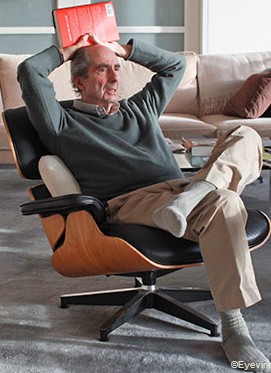
ScreenHunter_487 Jan. 08 18.21Philip Roth, the last of the Great American Novelists, was born in 1933 in New Jersey. His parents, Herman and Bess Roth, were “Americans from day one”, Roth recalled, yet they retained something of their forebears’ Polish-Galician and Russian- Jewish identity. Philip and his older brother, Sandy, were provided with Hebrew instruction and went to synagogue for the most important festivals. Roth as an adult may have regarded his Jewishness as an “irrelevance”, yet he was unavoidably shaped by it, and by the experience of being Jewish in America. His scabrous novel of sexual yearning and death, Sabbath’s Theater (1995), is suffused with a memory of the pogroms and derision inflicted on Jews in the Russian Pale in the 19th century.

In Roth Unbound, a smoothly readable hybrid of biography and criticism, Claudia Roth Pierpont (no relation) considers Roth’s awkward relationship with the American Jewish establishment. His first book of stories, Goodbye, Columbus, published in 1959, brought accusations of Jewish self-hatred and even anti-Semitism. “What is being done to silence this man?” a New York rabbi demanded to know of the 26-year-old New Jersey author. Roth’s third and most famous early novel, Portnoy’s Complaint (1969), told of the sexually repressed Alexander Portnoy and the recreational use he makes of (among other things) raw liver. “When had so much dirty Jewish laundry ever been displayed before so many Gentiles?” Pierpont asks. Roth was now not merely famous, but notorious.

More here.

The Mathematical Reality of Reality: An Interview with Cosmologist Max Tegmark

Lex Berko in Motherboard:

ScreenHunter_486 Jan. 08 17.57Max Tegmark has a theory about reality. According to Max, who is a cosmologist and professor of physics at MIT, all that exists, all this familiar stuff—that ergonomic chair you are sitting on, your body and your brain, even the space surrounding you— is math and we are merely “self-aware parts of a giant mathematical object.”

It’s a heady concept, but what does it even mean? In his new book Our Mathematical Universe, Max calls this idea the Mathematical Universe Hypothesis, wherein the universe is envisaged as a mathematical structure. A mathematical structure is “an abstract set of entities with relations between them,” expounds Max in his book, and these relations do not just describe all that is, but actually are all that is.

Reading Our Mathematical Universe, which is part mind-bending scientific treatise and part autobiography, is no casual jaunt. While the book offers a lot to readers, it also asks a lot in return. When I had the opportunity to chat with Max just before the holidays, I felt obligated to preface our conversation with the fact that although I had read the entirety of the book, I experienced difficulties in understanding chunks of it. To him, this presented no problem at all.

“You have to remember, Lex, that if you don’t feel you understand 100 percent about our Universe, nobody else does either!”

Fortunately for me, and anyone else interested in the possible realities of reality, Max is open to having his brain probed, which is what I hoped to achieve in our conversation.

More here.

How America became a torturing regime in the ‘war on terror’

Lisa Hajjar in Dawn:

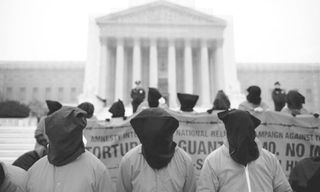
52cd101c9950dOn the television programme ‘Meet the Press’ on September 16, 2001, five days after the 9/11 terrorist attacks, vice president Dick Cheney said: “We’ll have to work … the dark side, if you will. We’ve got to spend time in the shadows in the intelligence world. A lot of what needs to be done here will have to be done quietly, without any discussion, using sources and methods that are available to our intelligence agencies — if we are going to be successful.” The following day, president George W. Bush signed a memorandum of understanding granting the CIA authority to establish a secret detention and interrogation operation overseas.

By December 2001, Pentagon officials were exploring how to “reverse engineer” SERE (survival, evasion, resistance, extraction) techniques that had been developed during the Cold War to train US soldiers to withstand torture in case they were captured by regimes that don’t adhere to the Geneva Conventions. The Clinton-era rendition programme of sending detainees captured abroad to foreign states for trial was revamped as “extraordinary rendition” to permit the CIA to kidnap people from anywhere in the world and disappear them into secret prisons, euphemised as “black sites,” where they could be held as “ghost detainees” — i.e., with no record of their identities or whereabouts and no access to monitors from the International Committee of the Red Cross (ICRC) — or transferred extra-legally to other states for interrogation.

Cheney and other officials in the Bush administration devised a “new paradigm” according to which the president, as commander-in-chief, has unfettered powers to wage war. On November 13, 2001, president Bush issued a military order declaring that captured terror suspects were “unlawful combatants,” a heretofore non-existent category conceived to place such prisoners outside of the law. Anyone taken into US custody could be designated an unlawful combatant by presidential fiat rather than on the basis of any status review by a tribunal, and could be held incommunicado indefinitely.

More here.

the importance of paper

Xquill-statue-448.jpg.pagespeed.ic.EQ3rTpv_pGAli Pechman at Poetry Magazine:

For thousands of years writing surfaces such as papyrus, animal skins, and stone had been alternately celebrated and eschewed for the advancements they provided to memory, but none had been as utilitarian as paper. Basbanes, “a self-confessed bibliophile,” gives a number of dates for paper’s first appearance: fragments have been found from as far back as 150 A.D. in China, although the first identifiable printed book appeared there in 868 A.D. Use quickly spread from China to the Middle East and eventually to medieval Europe, where paper mills proliferated. Usefulness, Basbanes argues, is paper’s defining merit: in 20,000 different iterations, it can be handled and physically present in the face of an increasingly abstract world. Basbanes quotes from A Midsummer Night’s Dream:

The poet’s eye, in a fine frenzy rolling,
Doth glance from heaven to earth, from earth to heaven;
And as imagination bodies forth
The forms of things unknown, the poet’s pen
Turns them to shapes, and gives to airy nothing
A local habitation and a name.

Even in its most poetic forms, paper’s role in our world is a way to put “airy nothings” onto solid objects.

Sansom, on the other hand, describes paper not just as a useful thing but an inherent part of us. “In Japanese there’s a phrase, yokogami-yaburi, which means to tear paper sideways against its grain—idiomatically, it means ‘perversity’ or ‘pig-headedness.’ By ignoring paper, we are perverse; we go against the grain.”

more here.

Joaquim Câmara Ferreira: Guerrillero-Gentleman

Fraenkel_aguerillero-gentleman_img_0Carlos Fraenkel at The Nation:

“Gentleman” is not the first epithet that comes to mind when one thinks of Latin American revolutionaries, from Simón Bolívar to Fidel Castro. Yet that’s how relatives, friends and political companions describe my grandfather, Joaquim Câmara Ferreira. With Carlos Marighella and Carlos Lamarca, he was a leading figure of the armed resistance against the military dictatorship that ruled Brazil from 1964 to 1985. He is best known as the political strategist in the most spectacular act of Brazil’s guerrilla movement: the kidnapping in September 1969 of the American ambassador, Burke Elbrick, who after being held for three days was set free in exchange for fifteen political prisoners. That operation secured my grandfather a spot on the state’s list of top enemies. My uncle recalls an evening playing billiards in a bar: “Suddenly a friend asked me, ‘Isn’t that your father?’ When I looked up, I saw his photo on a poster of ‘Wanted Terrorists’ next to the counter.” A year later, the regime would hunt him down, torture and kill him.

A guerrillero-gentleman? Many who knew him still grapple with this seeming paradox. They remember my grandfather as an affable, tolerant and unassuming person. For decades, he was a leader of Brazil’s Communist Party, responsible in particular for its press operations (primarily newspapers). Why, in his mid-50s, did he decide to exchange the pen for the pistol? The transition wasn’t easy. “Starting military training at my age!” he said, self-mockingly, to a friend in Cuba, where Brazilians from the rebel group he helped found prepared for guerrilla warfare. But he showed up for shooting class every day.

more here.

leopardi meets andrew jackson

ID_POPKI_ZIBAL_CO_001Nathaniel Popkin at The Smart Set:

I spent much of November reading the Zibaldone (which translates loosely asmiscellany); the translation is both lush and firm and, given the range of languages Leopardi employs, is itself one the great literary endeavors of our time. Often, while reading, I would find myself thinking about American politics, particularly the regular rhetorical convulsions about federalism and states’ rights, localism and uniformity, systems and the individual, and government power and personal responsibility that framed the Bank War and infects discourse today. The Zibaldone, indeed, put these lines of ideology in a new light, even as Leopardi gives barely a thought to the American experience as a potential setting for the revival of primordial ways. Notably, Leopardi’s compelling vision, situated as it is in ancient Greece, matches the Jacksonian ideal far more neatly than that of Jackson’s Grecophile enemy Nicholas Biddle.

Not at all unlike Jackson, Leopardi finds modernity fundamentally bankrupt, for it deals in abstraction instead of face-to-face reality (and reality’s cousin illusion), and its language of reason corrupting of human experience. Reason, says Leopardi, distances us from nature and instinct, the only true teachers of mankind, and abstraction leads to tyranny. “We have no choice in this pitiful century of reason and enlightenment,” he wrote in one of the earliest entries, in 1820,

but to flee from ourselves and see how the ancients, who were still children, spoke, and how they saw and depicted the sanctity of nature with eyes that were neither malicious nor prying but innocent and utterly pure.

more here.

7 Medical Advances to Watch in 2014

From Smithsonian:

BacteriaGut reactions: Another area of research showing a lot of promise has to do with our guts, specifically all the bacteria residing there. Among the more recent findings: That there may be a direct physiological connection between the mix of microbes in our digestive tract and how our brain functions, and that that mix can also be a factor in whether a person is thin or obese. Expect more focus this year on how gut bacteria affect not just gastrointestinal diseases, such as ulcerative colitis and Crohn’s disease, but also cancer and allergies. In fact, a study just published in the Proceedings of the National Academy of Sciences determined that when dust from houses in which dogs lived was introduced into the gut bacteria of mice, the lab animals were less likely to develop symptoms of asthma.

Take that, cancer!: The War on Cancer has been going on a long time, with its share of false hopes, but a growing number of experts suggest that the fight may have turned a corner with a treatment known as cancer immunotherapy. Last month, for instance, Science magazine named it the “Breakthrough of the Year.” So what exactly is cancer immunotherapy? Put simply, it is using drugs that spur the body’s immune system to battle tumor cells directly. The reason this doesn’t happen naturally, as researchers discovered a few years ago, is that tumor cells are able to wrap themselves in a protective shield. But new drugs are being tested that have been able to empower the immune system to break through that protection and allow the body to do its job in fighting cancer cells on its own. The number of cases where immunotherapy has been tested is still relatively small, but the results have been encouraging. And, as Jennifer Couzin-Frankel wrote in Science, “Immunotherapy marks an entirely different way of treating cancer—by targeting the immune system, not the tumor itself.”

More here.

What to expect in 2014: Nature takes a look at what is in store for science in the new year.

Richard Van Noorden in Nature:

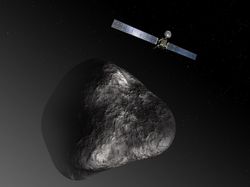
CometSpace probes: The European Space Agency’s Rosetta spacecraft could become the first mission to land a probe on a comet. If all goes well, it will land on comet Churyumov–Gerasimenko in November. Mars will also be a busy place: India’s orbiter mission should arrive at the planet in September, about the same time as NASA’s MAVEN probe. And NASA’s Curiosity rover should finally make it to its mission goal, the slopes of the 5.5-kilometre-high Aeolis Mons, where it will look for evidence of water. Back on Earth, NASA hopes to launch an orbiter to monitor atmospheric carbon dioxide.

Neural feats: Neurobiologist Miguel Nicolelis at Duke University in Durham, North Carolina, has developed a brain-controlled exoskeleton that he expects will enable a person with a spinal-cord injury to kick the first ball at the 2014 football World Cup in Brazil. Meanwhile, attempts are being made in people with paralysis to reconnect their brains directly to paralysed areas, rather than to robotic arms or exoskeletons. In basic research, neuroscientists are excited about money from big US and European brain initiatives, such as Europe’s Human Brain Project.

Novel drugs: In the pharmaceutical industry, all eyes are on trial results from two competing antibody treatments that harness patients’ immune systems to fight cancer. The drugs, nivolumab and lambrolizumab, work by blocking proteins that prevent a person’s T cells from attacking tumours. In early tests, the drugs evoked a better level of response in patients than ipilimumab, a similar therapy that was launched in 2011 to treat advanced melanoma.

More here.

Wednesday Poem

Are You There

Are you here?
I don’t know, Unnamed, I don’t know.
Look at me.
Look at me.
When you like.
When I die.
When it shines.
When my body is extinguished.
When I breathe.
When I go.
I didn’t write like this yet.
I don’t know what will happen.
I see stars.
Does it spin round?
I don’t know what spins round.
Can one hear?
I’m out of the cup.
I eat bran.
You found the cap.
I put on pajamas.
Everything goes into me.
I glued myself.
I write slowly.
You are, what I see.
When I’ll breathe, I’ll die.
The reward is terrible.
I have everything.
There’re lumberjacks.
The hour came.
There’re apricots.
I hear touches.
There’s a lock.
They said.
They danced.
Give me your cap.
I breathed.
I fell asleep.
You were fast.
I was late.
I have painted.

by Tomaž Šalamun
from Ko vdre senca/When the Shadows Breaks In/Lorsque l’ombre force
publisher: Litterae Slovenicae, Ljubljana, 2010
translation: 2010, Michael Thomas Taren and Tomaž Šalamun

Tuesday, January 7, 2014

Does Immigration Mean ‘France Is Over’?

Justin E. H. Smith in the New York Times:

ScreenHunter_485 Jan. 07 17.10It is difficult to go more than a day in France without hearing someone express the conviction that the greatest problem in the country is its ethnic minorities, that the presence of immigrants compromises the identity of France itself. This conviction is typically expressed without any acknowledgment of the country’s historical responsibility as a colonial power for the presence of former colonial subjects in metropolitan France, nor with any willingness to recognize that France will be ethnically diverse from here on out, and that it’s the responsibility of the French as much as of the immigrants to make this work.

In the past year I have witnessed incessant stop-and-frisk of young black men in the Gare du Nord; in contrast with New York, here in Paris this practice is scarcely debated. I was told by a taxi driver as we passed through a black neighborhood: “I hope you got your shots. You don’t need to go to Africa anymore to get a tropical disease.” On numerous occasions, French strangers have offered up the observation to me, in reference to ethnic minorities going about their lives in the capital: “This is no longer France. France is over.” There is a constant, droning presupposition in virtually all social interactions that a clear and meaningful division can be made between the people who make up the real France and the impostors.

More here.

How Dale Carnegie’s self-help movement is now more about entitlement than enlightenment

Tom Jokinen in The Globe and Mail:

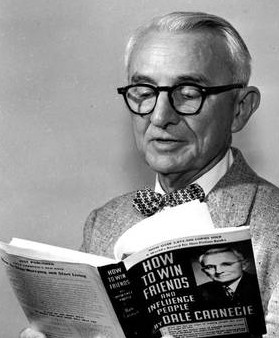
ScreenHunter_484 Jan. 07 15.55Want to change your life, your career, your outlook this year? Plenty of successful go-getters say they owe their go-getterness to Dale Carnegie’s bestseller How To Win Friends And Influence People: Warren Buffett, Lee Iacocca, Charles Manson. In 1957, Manson took a Carnegie self-improvement course while doing time in a California prison for car theft. “Virtually every word in the Carnegie publications resonated with Charlie,” writes Jeff Guinn in Manson: The Life and Times of Charles Manson. “For the first time in his life he was considered an outstanding pupil.” Carnegie’s advice was simple: make the other fellow feel important and he’ll follow you anywhere. Manson took it to heart, and from this homespun, self-improvement philosophy, the Manson Family was born 10 years later. There are still Family members in prison who are denied parole, year after year, because they still think of Charlie as a great man. The lesson? Don’t be so quick to dismiss Dale Carnegie as corn-pone pop psychology: This stuff works.

And sells. Considered the stem cell of the self-help publishing line, How To Win Friends… has sold over 30 million copies since its first printing in 1936 – more than Gone With The Wind and The Very Hungry Caterpillar.Carnegie’s skill was in adapting early-20th-century academic psychology, from Alfred Adler to William James, into cracker-barrel idiom: “Become genuinely interested in other people.” “Smile.” “Remember that a person’s name is, to that person, the sweetest and most important sound in any language.” An off-the-rack hit, the book would redefine the American promise of the “pursuit of happiness,” as Steven Watts writes in his new biography Self-Help Messiah: Dale Carnegie and Success in Modern America, a straight-up, warm-hearted account of the life of an unlikely American role model. It would also, according to Watts, launch a therapeutic industry that leads directly from Carnegie to Oprah, Dr. Phil, the Landmark seminars, and conference hall roomfuls of unhappy people standing on chairs and hollering about their neglectful parents. How did that happen? How did Dale Carnegie, who urged people to be nice to each other, spawn a pseudo-religion of narcissism?

More here.

HARDING, KERRIGAN: SPECTACLES OF FEMALE POWER AND PAIN

Article_marshallSarah Marshall at The Believer:

First, the facts: on January 6, 1994, Nancy Kerrigan left the ice after a public practice session in Detroit’s Cobo Arena, where she was to compete in the US Figure Skating Championships the following day. “I was walking toward the locker rooms, away from the ice,” she said later, “and someone was running behind me. I started to turn, and all I could see was this guy swinging something… I don’t know what it was.” The man had been aiming for her left knee, but missed, instead hitting her on the lower thigh. Later, in an exclusive interview with Jane Pauley, Nancy put a brave face on the assault, reassuring Americans that she knew how lucky she was, because if the man had actually hit her knee she would undoubtedly have been unable to skate at the Olympics. She had to feel thankful, she said in a moment of good-natured wit, for his poor aim. By then, however, it didn’t really matter what she had to say. To the public, her injury had already been transformed into a gangland kneecapping, while the assailant’s weapon, revealed soon after the assault to have been a collapsible police baton, was routinely characterized as everything but—a crowbar, a wrench, a lead pipe—in an ongoing public game of Clue. Nancy, meanwhile, would be remembered not for anything she was doing now, but for the way she had acted immediately following the assault. There was room for only one image of Nancy in the public’s memory, and it had already been chosen.

more here.

Maps and Monsters

Balena-orchas-2_jpg_600x650_q85Marina Warner at the New York Review of Books:

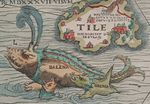
If animals are not only bons à manger but also bons à penser (good to eat, good to think with), according to the celebrated dictum of Claude Lévi-Strauss, then monsters, while perhaps less inviting to the palate, make even better food for thought. Themselves the direct and fanciful products of attempts to understand phenomena, they appear in a wonderful variety of forms on the maps drawn up by medieval and Renaissance cartographers, as Joseph Nigg and Chet van Duzer show in two resplendently illustrated and thoughtful recent studies. Scylla and Charybdis, sea serpents and pristers offer a range of explanations for natural phenomena, such as whirlpools and reefs; indeed the abundant stories that Homer and Ovid tell draw up a wonderful narrative geography as much as a mythical history.

Yet in many ways maps and monsters would appear antithetical: maps are about measurement and evidence; they attempt to document a real world out there in an objective way with empirical tools tested over time; by contrast, monsters are fantasies, mostly sparked by terrors, but sometimes born of desiring curiosity, too.

more here.

Move over, Kerouac! “Grand Theft Auto” is the American Dream narrative now

Ryan Leas in The Atlantic:

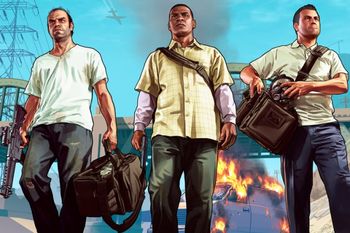
GtaAin’t the American Dream grand? Michael, one of three playable characters in “Grand Theft Auto V,” yells this periodically during firefights, typically when you’re rampaging against cops. In a nutshell, that context is all you need to understand the wicked smirk specific to the GTA franchise’s exaggerated vision of America. It’s always hard to pin down exactly what the ultra-successful series is. “GTA” is equal parts incisively clever and on the nose. It pushes boundaries with some of the most mature content in mainstream video games while channeling that content toward juvenile ends, tapping into latent teenage dreams of anarchy. The games acerbically critique American consumerism while also offering a world in which driving up on a sidewalk and running down civilians is cause for laughing out loud.

Throughout, one thing has been consistent. In its continual mining of classic American crime dramas, from “The Godfather” to “Scarface” to “Heat,” the GTA franchise automatically inherits that tradition’s outlaw take on undying American Dream tropes. The upward mobility, the rags to riches, all with a pistol in one hand and a bag of money in the other. Through its knowing recalibration of this traditional structure, “GTA” would like to position itself as subversive. And, no doubt, its vision of America has always been an amusingly satirical one, that proclamation of “Ain’t the American Dream grand?” delivered with a healthy amount of sarcasm. But it’s also fantasy fulfillment. As much as this newest iteration of “GTA” skewers American culture, it also captures how the GTA franchise as a whole plays into a more contemporary tradition — a new, digital American frontier in which to play out our inherited myth over and over. One that urges us to press “Start” once more, but on the pretense of what is, ultimately, a batch of false promises.

Read more here.