Political Hatred in Argentina: An Interview with Uki Goñi

Jessica Sequeira in the Boston Review:

ScreenHunter_497 Feb. 18 17.03Two days before I met with Uki Goñi, his analysis of president Cristina Fernández de Kirchner and the crisis in Argentina was the top article on the Guardian website. Goñi is a correspondent for British newspapers, covering events in Argentina, but his professional experiences before this are enough for a number of lives. He arrived in the city in his early twenties and began work as a journalist at the Buenos Aires Herald, an English language daily and the city’s only newspaper reporting on missing people during the dictatorship. Over the next decade he focused on his band Los Helicópteros, and then wrote three books: El Infiltrado. La verdadera historia de Alfredo Astiz, on the activities of the ESMA, an illegal detention center during the country's National Reorganization Process (1976-1983) responsible for disappearances, tortures, and illegal executions; Perón y los Alemanes, on Perón's involvement with Nazi spies in the country; and The Real Odessa, on Nazi criminals' escapes to Argentina.

Jessica Sequeira: Why did you come to Buenos Aires?

Uki Goñi: My life story is way complicated. I was born in the States, where I lived until I was fourteen, then my family moved to Ireland, where I lived until I was twenty-one, then I came here. But my family background is Argentine and my parents were Argentine. I wanted to stay in Ireland very much. Very much. But there was tremendous family pressure on me to come here. I am an Argentine citizen, and when I turned twenty-one—no, eighteen—the military service was still obligatory, so I had to come for that. I tried staying on in Ireland, enrolling at Trinity College. But basically I ran out of money, and they wouldn’t give me a scholarship because they said my father was an ambassador and I didn’t need it. I couldn’t really work because I wasn’t Irish either; I could be there as a student but I couldn’t work. I had like 300 pounds or something, that was all.

More here.

Algebra-cadabra! Here’s a classic magic trick, and the mathematical secret behind it

Alex Bellos in The Guardian:

Playing-cards-007Irishman Colm Mulcahy is a legendary cardsmith in the mathe-magical community, and his lovely new book Mathematical Card Magic is jammed with entertaining and thought-provoking tricks.

Here's one that's in the book.

The good thing about this trick is that you need an attractive assistant, which is one of the best things about being a magician.

Okay, the assistant doesn't need to be attractive. But I like to aim high, and will assume that she is for the remainder of this post.

The trick was invented by William Fitch Cheney Jr, a US mathematics professor, in 1951. It was originally called Telephone Stud since it could be done over the phone. Mulcahy calls it Fitch Cheney's Five-Card Twist.

First the magician leaves the room, leaving the attractive assistant with the audience. She gives a full deck of cards to an audience member, and asks him or her to shuffle it and then to choose any five cards.

The assistant takes the cards, looks at them, places one face down, and places the four others face up and side by side.

The magician is allowed back in. He glances at the table and – abracadabra – names the hidden card. The audience gasps in awe, since there was no way he knew which cards had been chosen.

So how did he do it?

More here. [Thanks to Jennifer Oullette.]

The Loving v. Virginia Case in Historical Perspective

From BlackPast.org:

Mildred Loving always insisted she was no civil rights pioneer, but Loving. v. Virginia, the 1967 Supreme Court case that bears her name, established the legal right to interracial marriage across the United States. In memory of Mildred Loving, who died on May 2, 2008, University of Oregon historian Peggy Pascoe, author of the new book, What Comes Naturally: Miscegenation Law and the Making of Race in America , discusses the many meanings of Loving v. Virginia.
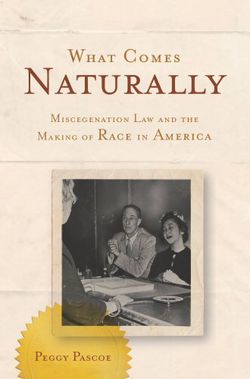
BookWhen Richard Loving and Mildred Jeter decided to get married in June 1958, laws banning interracial marriage had been in effect for nearly three centuries. The colonies of Maryland, Virginia, and Massachusetts had banned intermarriage in 1664, 1691, and 1705. After the American Revolution, states passed similar laws. During the Civil War, interracial marriage acquired a new name–“miscegenation”-and miscegenation laws became the foundation for the system of racial segregation in railroads, schools, parks, and cemeteries that prevailed into the 1960s. When this regime was at its height, 30 states banned interracial marriage, many of them prohibiting whites from marrying Chinese, Japanese, Filipinos, and American Indians as well as blacks. Judges justified these laws by insisting that interracial marriage was somehow “unnatural,” a claim that became so pervasive that by 1958, 94 percent of Americans told pollsters they opposed interracial marriage. Richard Loving and Mildred Jeter had grown up in Central Point, Virginia, a town so tiny that whites, blacks, and Indians had been mixing as far back as anyone could remember. Richard was the son of a “white” truck driver who worked for a well-off “Negro” farmer. Mildred, who said she was “part negro and part Indian,” fit into the catch-all category of “colored.” The labels “white” and “colored” carried enough weight that Richard and Mildred attended different schools and churches. Still, they knew each other even before they met at a local dance and started dating. When Richard was 24 and Mildred was 18, they decided to get married.

Richard knew they had no hope of getting a license in Virginia, so the pair traveled toWashington, D.C. to get married, returning with a marriage certificate that they framed and placed on a wall of the home they shared with Mildred's parents. Most of their Central Point neighbors paid little attention to the marriage, but someone told the Caroline County sheriff, who vowed to put a stop to it. The newlyweds had lived together for a little more than a month when they were awakened in the middle of the night by the sheriff and his deputies, who walked through the unlocked door of the house and right into the Lovings' bedroom to arrest them.

More here. (Note: One post throughout February will be dedicated to Black History Month.)

Phantom Melodies Yield Real Clues to Brain’s Workings

Carl Zimmer in The New York Times:

Zimmer-master675In 2011, a 66-year-old retired math teacher walked into a London neurological clinic hoping to get some answers. A few years earlier, she explained to the doctors, she had heard someone playing a piano outside her house. But then she realized there was no piano. The phantom piano played longer and longer melodies, like passages from Rachmaninov’s Piano Concerto number 2 in C minor, her doctors recount in a recent study in the journal Cortex. By the time the woman — to whom the doctors refer only by her first name, Sylvia — came to the clinic, the music had become her nearly constant companion. Sylvia hoped the doctors could explain to her what was going on.

…For their experiment, Sylvia put on earphones and sat with her head in a scanner that detects the magnetic field produced by the brain. On the day of the study, she was hearing selections from Gilbert and Sullivan’s “H.M.S. Pinafore.” Every few minutes the scientists would switch to Bach for 30 seconds, to tamp down the hallucination. When the real music stopped, Sylvia pressed numbers on a keyboard to rate the strength of her hallucinations while the scanner recorded her brain activity. Dr. Kumar and his colleagues later pored over the data. They compared Sylvia’s brain activity when the hallucinations were strongest with when they were at their weakest. They found that a few regions consistently produced stronger brain waves when the hallucinations were louder. It turned out that they are regions that we all use when we listen to music. One region becomes active when we perceive pitch, for example. Another region becomes active when we recall a piece of music. Dr. Kumar argues that these results support a theory developed by Karl Friston of the Wellcome Trust Center for Neuroimaging. (Dr. Friston is a co-author of the new study.) Dr. Friston has proposed that our brains are prediction-generating machines. Our brains, Dr. Friston argues, generate predictions about what is going to happen next, using past experiences as a guide. When we hear a sound, for example — particularly music — our brains guess at what it is and predict what it will sound like in the next instant. If the prediction is wrong — if we mistook a teakettle for an opera singer — our brains quickly recognize that we are hearing something else and make a new prediction to minimize the error.

More here. (Note: Could this explain deja vu?)

Monday, February 17, 2014

Synesthesia is Not a Reason for Good Design

by Caitlin Gianniny

ScreenHunter_493 Feb. 17 09.13Contributing to the growing buzz around synesthesia, the third episode of HBO’s new series True Detective revealed that Matthew Mcconaughey’s character is a synesthete. Bloomberg Businessweek joined the ranks last month as well publishing an article titled The Mind's Eye: Synesthesia Has Business Benefits by Caroline Winter, discussing how synesthesia can be an asset in the workplace as a tool for cross-sensory design and creativity. As someone with synesthesia I applaud the positive public reception of it as legitimate and not only “non-harmful” but potentially beneficial for those who experience it as fellow synesthete Maureen Seaberg does. Unfortunately, however, the article overgeneralizes findings in research in relation to creativity and the universality of synesthetic experiences.

Due to the higher prevalence of synesthesia amongst people working in the arts (Vladimir Nabokov, David Hockney and Pharrell Williams, to name a few), the question as to whether synaesthesia may predispose individuals to be creative has been raised by synesthetes and researchers alike. Winter highlights “enhancing creativity and innovation” as a “professionally beneficial side effect” of some types of synesthesia, citing a 2004 study from the University of California at San Diego in which synesthetes scored twice as high as controls on Torrance Tests of Creative Thinking.

However, a 2008 study conducted by Jamie Ward et al. at the University of Sussex that explicitly examined links between synesthesia, art and creativity concluded that while synesthetes outperformed controls on some measures of creativity these findings do not translate into the cognitive flexibility necessary for creativity per se. “The cardinal feature of creativity is to think beyond the boundaries of existing associative knowledge” and “there is no convincing evidence that synaesthetes are more capable of doing this than other individuals.” Ward et al. suggest that the atypical experience of synaesthesia may bias synesthetes “towards the creative arts” and that this “artistic bias” is confused with creativity.

Read more »

Sunday, February 16, 2014

A Conservative Who Was Right About Occupy

400000000000001198560_s4-197x300

Nathan Schneider in Waging Non-Violence:

In the heady early days of Occupy Wall Street, there was a lot of talk about whether this thing was really a movement or something else, something presumably less worthy of attention. In an early Room for Debate discussion at The New York Times, for instance, the eminent social movement scholar Stephen Zunes stressed that “protests are not a movement”; I insisted, in the same discussion, on calling Occupy an “occupation-turned-movement.” To me, the evidence was this: Occupy was confounding the normal political spectrum. It wasn’t just people aligned with what are normally called the left or right, but an assemblage of people who reflected the inadequacy of the right-and-left spectrum for reflecting people’s longings — libertarians and anarchists, socialists and liberals, veterans and peaceniks, conservatives and utopians.

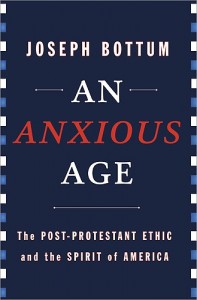
Over time, a more familiar leftist activist culture came to dominate the movement; at right about that time (with the help of coordinated repression) it started losing steam. But I’m reminded of that early movement moment by the release of Joseph Bottum’s new book, An Anxious Age: The Post-Protestant Ethic and the Spirit of America. I once met Bottum around his dinner table when he was editor of First Things, an organ of religious neoconservatism; he’s also a writer for The Weekly Standard and an avid science fiction reader. He explains in an interview on the book’s Amazon page (which Paul Elie points to at Everything That Rises):

In some ways, An Anxious Age really began when I was sent out to report on the protestors at Occupy Wall Street — and couldn’t finish the assignment. I could feel a spiritual anxiety about modern civilization radiating from nearly all of them, but I could find no easy way to explain it.

Now, two years later, this book is my answer: Not just those protestors, but nearly everyone today is driven by supernatural concerns, however much or little they realize it. Radicals and traditionalists, liberals and conservatives — together with politicians, artists, environmentalists, followers of food fads, and the chattering classes of television commentators: America is filled with people frantically seeking confirmation of their own essential goodness. We are a nation of individuals desperate to stand on the side of morality—anxious to know that we are righteous and dwell in the light.

More here.

The Vampire Squid Strikes Again: The Mega Banks’ Most Devious Scam Yet

Matt Taibbi in Rolling Stone:

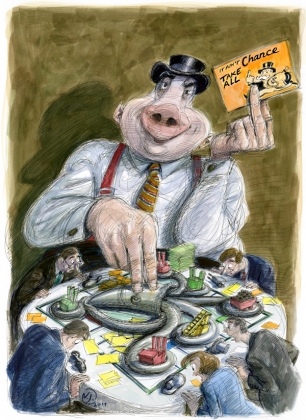
Taibbi-x600-1392149148Call it the loophole that destroyed the world. It's 1999, the tail end of the Clinton years. While the rest of America obsesses over Monica Lewinsky, Columbine and Mark McGwire's biceps, Congress is feverishly crafting what could yet prove to be one of the most transformative laws in the history of our economy – a law that would make possible a broader concentration of financial and industrial power than we've seen in more than a century.

But the crazy thing is, nobody at the time quite knew it. Most observers on the Hill thought the Financial Services Modernization Act of 1999 – also known as the Gramm-Leach-Bliley Act – was just the latest and boldest in a long line of deregulatory handouts to Wall Street that had begun in the Reagan years.

Wall Street had spent much of that era arguing that America's banks needed to become bigger and badder, in order to compete globally with the German and Japanese-style financial giants, which were supposedly about to swallow up all the world's banking business. So through legislative lackeys like red-faced Republican deregulatory enthusiast Phil Gramm, bank lobbyists were pushing a new law designed to wipe out 60-plus years of bedrock financial regulation. The key was repealing – or “modifying,” as bill proponents put it – the famed Glass-Steagall Act separating bankers and brokers, which had been passed in 1933 to prevent conflicts of interest within the finance sector that had led to the Great Depression. Now, commercial banks would be allowed to merge with investment banks and insurance companies, creating financial megafirms potentially far more powerful than had ever existed in America.

More here.

Why Writers Are the Worst Procrastinators

Megan McArdle in The Atlantic:

ScreenHunter_492 Feb. 16 15.15I once asked a talented and fairly famous colleague how he managed to regularly produce such highly regarded 8,000 word features. “Well,” he said, “first, I put it off for two or three weeks. Then I sit down to write. That’s when I get up and go clean the garage. After that, I go upstairs, and then I come back downstairs and complain to my wife for a couple of hours. Finally, but only after a couple more days have passed and I’m really freaking out about missing my deadline, I ultimately sit down and write.”

Over the years, I developed a theory about why writers are such procrastinators: We were too good in English class. This sounds crazy, but hear me out.

Most writers were the kids who easily, almost automatically, got A's in English class. (There are exceptions, but they often also seem to be exceptions to the general writerly habit of putting off writing as long as possible.) At an early age, when grammar school teachers were struggling to inculcate the lesson that effort was the main key to success in school, these future scribblers gave the obvious lie to this assertion. Where others read haltingly, they were plowing two grades ahead in the reading workbooks. These are the kids who turned in a completed YA novel for their fifth-grade project. It isn’t that they never failed, but at a very early age, they didn’t have to fail much; their natural talents kept them at the head of the class.

More here.

BMJ Article on Breast Cancer Screening Effectiveness Incredibly Flawed and Misleading

A few days ago, Zujaja posted this article on 3QD, calling into question the value of mammograms. Here is a reply from the American College of Radiology:

ScreenHunter_491 Feb. 16 15.09According to the American College of Radiology and Society of Breast Imaging, the recent breast cancer screening article (Miller et al) published in the British Medical Journal (BMJ) (1) is an incredibly misleading analysis based on the deeply flawed and widely discredited Canadian National Breast Screening Study (CNBSS). The results of this BMJ study, and others resulting from the CNBSS trial, should not be used to create breast cancer screening policy as this would place a great many women at increased risk of dying unnecessarily from breast cancer.

Experts called on to review the CNBSS confirmed that the mammography quality was poor (2). The trial used second hand mammography machines, which were not state of the art at the time of the trial. The images were compromised by “scatter,” which makes the images cloudy and cancers harder to see since they did not employ grids for much of the trial. Grids remove the scatter and make it easier to see cancers. Also, technologists were not taught proper positioning. As such, many women were not properly positioned in the machines, resulting in missed cancers. And the CNBSS radiologists had no specific training in mammographic interpretation. The CNBSS own reference physicist stated that “…in my work as reference physicist to the NBSS, [I] identified many concerns regarding the quality of mammography carried out in some of the NBSS screening centers. That quality [in the NBSS] was far below state of the art, even for that time (early 1980s).”(3)

In this latest BMJ paper, only 32 percent of cancers were detected by mammography alone. This extremely low number is consistent with poor quality mammography. At least two-thirds of the cancers should be detected by mammography alone (4).

More here. [Thanks to Sughra Raza.]

Robot navvies may be just around the corner

From The Economist:

TermiteIn a paper just published in Science, a group at Harvard, led by Justin Werfel, describes termite-inspired robots that can build things by combining magnetic bricks of a standard size. All their human controller has to do is program them with a few appropriate rules and leave them to get on with it.

Robot construction teams are not, in themselves, new. Researchers at the University of Pennsylvania have already demonstrated a system which uses remotely controlled flying robots to build things. What makes Dr Werfel’s approach different is that instead of having a controlling force, in the form of a computer program, sitting at the centre telling everything else what to do (as was the case in Pennsylvania), control is distributed throughout the system’s components, which cannot communicate with each other. The robots, which are little wheeled contraptions, do not need to see the bigger picture.

In the case of termites, the bigger picture is provided by natural selection, which has, over the millennia, refined the rules that individual termites obey. In the case of Dr Werfel’s robots, a human designer specifies the desired outcome and, with the help of a program developed by the team, generates the rules that will lead to its construction, with which each robot is then programmed. All that remains is to place a foundation brick to show the robots where to start building.

More here.

Raags to Riches: Globalism and Vernacular in Contemporary Pakistani Rap

Hamzah Saif in Chapati Mystery:

AdilRap’s transition from the poetry of marginalized African American communities to the mega-hits circulating in mainstream America today draws fierce debate. Consumerism and commodification are frequently found guilty of eviscerating a once-radical movement with the market’s golden handcuffs, swapping its class politics for “mere spectacle.” In contrast, Western popular and academic assessments of rap’s journey beyond American borders, particularly in the “Muslim world,” are markedly inattentive to this commercialism. Instead, this rap evokes a virtually unanimous nostalgia. There, 1986 Los Angeles is found alive in 2013 Lebanon, and New York’s Public Enemy and L.A.’s N.W.A are discovered rhyming through Beirut’s Rayess Bek and Tehran’s Yas. So prevalent is this penchant for locating the dissent lost in American rap in “over there” rap that the Washington D.C.-based think-tank, Middle East Institute, finds Iran’s Ayatollahs battling a reanimated Tupac, and Wall Street Journal has rappers soundtracking revolt from Egypt to Iran. The anachronism of finding 1980’s Ice Cube in contemporary Islamabad can be plausible only if one abundantly ignores the realities of contemporary rap. In a landscape where middle class white purchasers have dictated the contours of the genre’s production since at least 1992, it is particularly absurd to impose upon non-American “Muslim” rappers the romantic notion that their rap is protest. Imagining a resurrection of resistance in “over there” rap shortchanges the breadth of the non-American musical movements. Instead, they are much more productively seen as artists in the peripheral markets of globalized rap. Such a lens appropriately situates the rappers, and accords their work the creativity and artistry it deserves.

Far from culturally-appropriate replicas of bygone American rappers, Middle East and South Asia rappers are creators of an entirely new art, vastly expanding the frontiers of the genre. “It may not have started in our communities, but just like cricket”, says Islamabadi rapper Xpolymer Dar (Muhammad Dar), “we have made rap our own.” Indeed, in Dar’s country of Pakistan, where rap is a growing underground music genre, the ‘80s American rhymes for race and class justice are judged to have little resonance with Pakistani realities. Instead, it is the stylings of hyper-commercialized contemporary artists such as Eminem and 50 Cent that find ears, and have provided the launching pad for contemporary Pakistani rappers.

More here.

“Global Whitemanism”: The capitalist economy and dark dreams of the slaveholding South

Michael Bernath in Harvard Magazine:

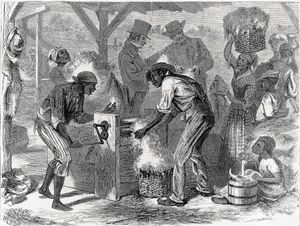
BlackThis is a dark book about a dark subject. Walter Johnson burst onto the historical scene with the 1999 publication of his influential Soul by Soul, which positioned the slave market as the central institution of the antebellum South, shaping not only the southern economy, but also white self-conceptions and black lives. With chilling efficiency, the book unpacked the practical and psychological difficulties in commodifying what should not be commodified. Johnson sought to reduce slavery to its basic equation—“a person with a price”—and to show how this omnipresent calculation permeated and undergirded every aspect of southern life. In River of Dark Dreams, Johnson deals with some of the same themes, but the Winthrop professor of history and professor of African and African American studies expands them outward in every direction. The new book, too, is rooted in an equation, or rather a conversion—“lashes into labor into bales into dollars into pounds sterling”—one that governed the lives of planters and slaves, shaped the land, development, and society of the Cotton Kingdom, and drove a global economy extending to banks in London and mills in Lancashire. The book is not simply the history of a region (the antebellum Mississippi Valley) or a work of political economy (what Johnson terms “slave racial capitalism”), though it is certainly both of these things. In a larger sense, it is the history of a mentality out of which would emerge a vision of global empire premised upon the commodification of cotton and the human beings forced to tend it.

…Throughout, Johnson seeks to stress the human and environmental resistance that always conditioned white ambitions, and to remind us that on the ground, “The Cotton Kingdom was built out of sun, water, and soil; animal energy, human labor, and mother wit; grain, flesh, and cotton; pain, hunger, and fatigue; blood, milk, semen, and shit.”

More here. (Note: One post throughout February will be dedicated to Black History Month.)

Sunday Poem

Lu Yu (AD 1125-1209)

On the day of Lu Yu's last sickness
a thin coffin was ready,
and two quilts to cover him,
and the gravediggers paid
their work done.
Then he started to write another poem
a short time before death,
about drinking wine again in the village —
He was working on the poem when they buried him,
so that half a line protruded from the earth
in wind and weather's hearing —
With sunlight touching the first young syllables,
the last ones flowering from a dark coffin:
“marketplace the in/drink more One”
The first three words above ground
the last ones wine in the Red Dust.
Near the village of Shanyang
in Chekiang Province…
.

by Al Purdy
from Beyond Remembering-The Collected Poems of Al Purdy. 2000

Saturday, February 15, 2014

Under the Spell of Yoga

William Dalrymple in the New York Review of Books:

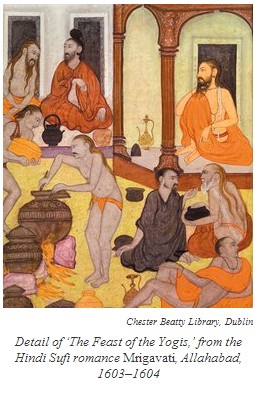
ScreenHunter_490 Feb. 15 14.43Around 1600, a dramatic shift took place in Mughal art. The Mughal emperors of India were the most powerful monarchs of their day—at the beginning of the seventeenth century, they ruled over a hundred million subjects, five times the number administered by their only rivals, the Ottomans. Much of the painting that took place in the ateliers of the first Mughal emperors was effectively dynastic propaganda, and gloried in the Mughals’ pomp and prestige. Illustrated copies were produced of the diaries of Babur, the conqueror who first brought the Muslim dynasty of the Mughal emperors to India in 1526, as well as exquisite paintings illustrating every significant episode in the biography of his grandson, Akbar.

Then, quite suddenly, at this moment of imperial climax, a young Hindu khanazad (or “palace-born”) prodigy named Govardhan began painting images of a sort that had never been seen before in Mughal art. They were not pictures of battles or court receptions. Instead they were closely observed portraits of holy men performing yogic asanas or exercises that aimed to focus the mind and achieve spiritual liberation and transcendence. The results of Govardhan’s experiments in painting—along with a superbly curated selection of several hundred other images from the history of yoga—were recently on view in “Yoga: The Art of Transformation,”a remarkable exhibition at the Freer and Sackler galleries in Washington, D.C., which will travel next to San Francisco and Cleveland.

More here.