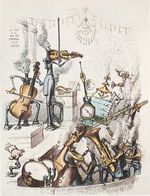
everything is an algorithm

Algorithms_WEB1Tom Whipple at More Intelligent Life:

Algorithms decide what we are recommended on Amazon, what films we are offered on Netflix. Sometimes, newspapers warn us of their creeping, insidious influence; they are the mysterious sciencey bit of the internet that makes us feel websites are stalking us—the software that looks at the e-mail you receive and tells the Facebook page you look at that, say, Pizza Hut should be the ad it shows you. Some of those newspaper warnings themselves come from algorithms. Crude programs already trawl news pages, summarise the results, and produce their own article, by-lined, in the case of Forbes magazine, “By Narrative Science”.

Others produce their own genuine news. On February 1st, the Los Angeles Times website ran an article that began “A shallow magnitude 3.2 earthquake was reported Friday morning.” The piece was written at a time when quite possibly every reporter was asleep. But it was grammatical, coherent, and did what any human reporter writing a formulaic article about a small earthquake would do: it went to the US Geological Survey website, put the relevant numbers in a boilerplate article, and hit send. In this case, however, the donkey work was done by an algorithm.

more here.

An overdue study of the “experimental” novelist Ann Quin

159229391Juliet Jacques at The New Statesman:
Too little has been written about Brightonian novelist Ann Quin since her death in August 1973. Most of what has been has highlighted the striking opening sentence of her first novel, Berg, originally published by John Calder in 1964 and later reissued by Dalkey Archive Press:
A man called Berg, who changed his name to Greb, came to a seaside town intending to kill his father …’
Robert Buckeye’s Re: Quin, also published by Dalkey and described as an “unabashedly personal and partisan critical biography” of “one of the best and most neglected” British “experimental” writers of the 1960s, breaks with convention by opening with a quote from contemporary author-artistStewart Home about “The body of a dead princess” serving “as a metaphor for literature”. Buckeye then moves onto a Malcolm X speech from 1964, using it to illustrate his point that radical times need radical culture, before placing Quin into a post-war avant-garde with William S. Burroughs, Alexander Trocchi, B. S. Johnson and others.
more here.

the money and art problem

Schwabsky_survivingthemoment_ba_imgBarry Schwabsky at The Nation:

The price of things is crowding out their value. When it comes to art, the belief that the price of a work is its sole worth constitutes the peculiar accord between the hedge-fund millionaires driving prices into the stratosphere and the would-be revolutionaries who fantasize about the collapse of the art-market bubble and the whole hideous economic system of which it is a prominent sideshow. Is it even remotely possible to see the exhibition hanging in the Guggenheim Museum right now—paintings, drawings and photographs by the American artist Christopher Wool—as art instead of dollar signs, now that one of Wool’s paintings (not included in the exhibition, which is on view through January 22) has sold at auction for $26.5 million, just a year after another sold for what then seemed an already outlandish $7.7 million? According to a recent article in The Art Newspaper, speculation on Wool’s art over the past few years indicates that it “‘has become a parking lot for money,’ says one high-profile European curator. Like the market for Jean-Michel Basquiat, Wool’s market is in danger of being controlled by a small, powerful group of players, he [adds].”

“Parking one’s money” is apparently an everyday concept among those who have too much of it; a recent New York Times article headlined “Record Prices Mask a Tepid Market for Fine Art” quoted a market expert who accounted for the popularity of contemporary art among hedge-fund managers this way: “They can hang anything they want in their Manhattan co-ops or in Aspen and nobody can say that’s ugly because contemporary art has not been subjected to sustained critical appraisal. There are no markers of good or bad taste that have yet been laid down. It’s a safe place to park your money.”

more here.

America’s Secret History of Atomic Accidents

Gregory D. Koblenz in Foreign Affairs:

Fat_Man_Assembled_Tinian_1945_0Between 1950 and 1980, the United States experienced a reported 32 “broken arrows,” the military’s term for accidents involving nuclear weapons. The last of these occurred in September 1980, at a U.S. Air Force base in Damascus, Arkansas. It started when a young technician performing routine maintenance on a Titan II missile housed in an underground silo dropped a socket wrench. The wrench punctured the missile’s fuel tank. As the highly toxic and flammable fuel leaked from the missile, officers and airmen scrambled to diagnose the problem and fix it. Their efforts ultimately failed, and eight hours after the fuel tank ruptured, it exploded with tremendous force. The detonation of the missile’s liquid fuel was powerful enough to throw the silo’s 740-ton blast door more than 200 yards and send a fireball hundreds of feet into the night sky. The missile’s nine-megaton thermo­nuclear warhead — the most powerful ever deployed by the United States — was found, relatively intact, in a ditch 200 yards away from the silo.

The Damascus accident epitomizes the hidden risk of what the sociologist Charles Perrow has dubbed “normal accidents,” or mishaps that become virtually inevitable once a system grows so complex that seemingly trivial miscues can cause chain reactions with catastrophic results. As the journalist Eric Schlosser explains in his new book, Command and Control, “The Titan II explosion at Damascus was a normal accident, set in motion by a trivial event (the dropped socket) and caused by a tightly coupled, interactive system.” That system, he writes, was so overly complex that technicians in the control room could not determine what was happening inside the silo. And basic human negligence had only made things worse: “Warnings had been ignored, unnecessary risks taken, sloppy work done.”

More here.

Epistemology, Democracy, and the dynamic duo of 3 Quarks Daily

From 3:AM Magazine:

Aikin_Talisse222-1024x501Robert B. Talisse (on the right of the picture) and Scott F. Aikin (on the left of the picture) are the dynamic duo of 3Quarksdaily, thinking about the social nature and political significance of argument, about the two things the word ‘argument’ captures, about the straw man fallacy, about misfiring sound arguments, about the intimate connection between epistemology and democracy, about the nature of democracy, pragmatism and Rawls, about Dewey, Elizabeth Anderson and Pierce, about ‘pluralism’ as a halo term, about the truth orientation of our cognitive life, about Nietzsche’s challenge, about being fearless about the fear of regress, about the use of tone, about the need for political arguers and the dangers of cognitive insulation, about when to revise ones beliefs, about civility in argument and about why their new book is keyed to all contemporary democracies. Epistemocracy doubled!

3:AM: What made you become philosophers?

Scott Aikin: I was a Classics major at Washington University in St. Louis, and I was very lucky to have the patient instruction of Merritt Sale, George Pepe, and Carl Conrad there. We would have class discussion about some line from Seneca or Plato, and I’d get hung up on some philosophical issue. I originally thought it was because my ancient languages weren’t good enough, but it became clear that disagreements about virtue or knowledge aren’t solved by dictionaries, but by doing some philosophical work. You had to think about what virtue and knowledge really are. It was like my mind caught fire – I was eighteen years old and could dispute with the greats on what was good and true. Authority with these matters came with having reason on your side, not any status or anything like that. It was exhilarating, and that anti-authoritarian appeal of philosophical work still enlivens me.

Robert Talisse: I grew up in northeastern New Jersey, and I took a class in Philosophy in my senior year in high school. The class was a survey of the great philosophers’ ideas, paying nearly no mind to the arguments they devised. I liked that class, but it left me with the impression that Philosophy was a dead discipline, something that had ended in the 19th Century. So, when I entered William Paterson College (it was not yet a university then), I was not aware that it was possible to major in Philosophy. I spent my first semester as an Economics major, but once I discovered that there was a Philosophy major, I switched immediately. At the time William Paterson was a small commuter school filled with Business majors, yet somehow there was a critical mass of really serious Philosophy students, all of whom eventually earned PhDs, and many of whom are now professional philosophers. In any case, I quickly learned there that Philosophy is about challenging those (including oneself) who claim to know. Like Aikin, I latched on to the anti-authoritarianism of it all. And I soon realized that the impression of Philosophy that I got from my high school class – that it had died as a discipline – was exactly wrong. Philosophy is one of the few disciplines that is not dead. I eventually found myself with a PhD in Philosophy from CUNY and a job at Vanderbilt as a philosopher. To be honest, I’m not really sure how it all happened.

More here.

When Minority Students Attend Elite Private Schools

Judith Ohikuare in The Atlantic:

Cd1cf41e3Dalton is a prestigious, decades-old, K-12 prep school on New York City’s Upper East Side that filters its students into the best universities in the country. In 2010, Forbes reported that 31 percent of its students matriculated into MIT, Stanford, or an Ivy League institution. Former students include Anderson Cooper, Claire Danes, and Ralph Lauren’s daughter Dylan. Even imaginary peoplemake sure their families are present for parent-teacher conferences. For years, however, Dalton was largely inaccessible to minority and lower-income students. Maintaining its reputation as a top-tier place of learning did not require administrators to extend invitations to those groups.

When Idris Brewster and his friend Seun Summers entered kindergarten at Dalton in the late 1990s, they were one of the few students of color in their class. Idris and Seun’s parents believed that getting into Dalton was the first step to a life filled with accomplishments.

“Students that came out of independent schools were well-prepared on the level of networking, internships, job and school opportunities—you name it—and we were offered great financial-aid incentives,” Michèle Stephenson, Idris's mother, told me. “We thought this intensive, intellectually stimulating institution would open doors for Idris and take him anywhere he wanted to go.”

Fourteen years later, Idris's parents have released American Promise, a documentary that records the boys' personal and academic experiences from kindergarten through senior year of high school. The film reveals a hard truth about being a student of color at an elite school: Simply being admitted doesn't guarantee a smooth or successful educational journey.

More here. [Thanks to Anjuli Raza Kolb.]

In the Human Brain, Size Really Isn’t Everything

Carl Zimmer in The New York Times:

ZimmerThere are many things that make humans a unique species, but a couple stand out. One is our mind, the other our brain. The human mind can carry out cognitive tasks that other animals cannot, like using language, envisioning the distant future and inferring what other people are thinking. The human brain is exceptional, too. At three pounds, it is gigantic relative to our body size. Our closest living relatives, chimpanzees, have brains that are only a third as big.

Scientists have long suspected that our big brain and powerful mind are intimately connected. Starting about three million years ago, fossils of our ancient relatives record a huge increase in brain size. Once that cranial growth was underway, our forerunners started leaving behind signs of increasingly sophisticated minds, like stone tools and cave paintings. But scientists have long struggled to understand how a simple increase in size could lead to the evolution of those faculties. Now, two Harvard neuroscientists, Randy L. Buckner and Fenna M. Krienen, have offered a powerful yet simple explanation. In our smaller-brained ancestors, the researchers argue, neurons were tightly tethered in a relatively simple pattern of connections. When our ancestors’ brains expanded, those tethers ripped apart, enabling our neurons to form new circuits. Dr. Buckner and Dr. Krienen call their idea the tether hypothesis, and present it in a paper in the December issue of the journal Trends in Cognitive Sciences.

More here.

The Genius in All of Us

From The Genius in All of Us: New Insights into Genetics, Talent and IQ by David Shenk via delancyplace:

MozartGenius. The popular conception of genius is that it is an inborn gift, yet an increasingly large body of research suggests the opposite — that genius is always the product of sustained effort. A case in point — Mozart: “Standing above all other giftedness legends, of course, [is] that of the mystifying boy genius Wolfgang Amadeus Mozart, alleged to be an instant master performer at age three and a brilliant composer at age five. His breathtaking musical gifts were said to have sprouted from nowhere, and his own father promoted him as the 'miracle which God let be born in Salzburg.' “The reality about Mozart turns out to be far more interesting and far less mysterious. His early achievements — while very impressive, to be sure — actually make good sense considering his extraordinary upbringing. And his later undeniable genius turns out to be a wonderful advertisement for the power of process. Mozart was bathed in music from well before his birth, and his childhood was quite unlike any other. His father, Leopold Mozart, was an intensely ambitious Austrian musician, composer, and teacher who had gained wide acclaim with the publication of the instruction book … Treatise on the Fundamental Principles of Violin Playing. For a while, Leopold had dreamed of being a great composer himself. But on becoming a father, he began to shift his ambitions away from his own unsatisfying career and onto his children — perhaps, in part, because his career had already hit a ceiling: he was vice-kapellmeister (assistant music director); the top spot would be unavailable for the foreseeable future. “Uniquely situated, and desperate to make some sort of lasting mark on music, Leopold began his family musical enterprise even before Wolfgang's birth, focusing first on his daughter Nannerl. Leopold's elaborate teaching method derived in part from the Italian instructor Giuseppe Tartini and included highly nuanced techniques …

“Then came Wolfgang. Four and a half years younger than his sister, the tiny boy got everything Nannerl got — only much earlier and even more intensively. Literally from his infancy, he was the classic younger sibling soaking up his big sister's singular passion. As soon as he was able, he sat beside her at the harpsichord and mimicked notes that she played. Wolfgang's first pings and plucks were just that. But with a fast-developing ear, deep curiosity and a tidal wave of family know-how, he was able to click into an accelerated process of development. “As Wolfgang became fascinated with playing music, his father became fascinated with his toddler son's fascination — and was soon instructing him with an intensity that far eclipsed his efforts with Nannerl. Not only did Leopold openly give preferred attention to Wolfgang over his daughter; he also made a career-altering decision to more or less shrug off his official duties in order to build an even more promising career for his son.

…The tiny Mozart dazzled royalty and was at the time unusual for his early abilities. But today many young children exposed to Suzuki and other rigorous musical programs play as well as the young Mozart did — and some play even better. Inside the world of these intensive, child-centered programs, such achievements are now straightforwardly regarded by parents and teachers for what they are: the combined consequence of early exposure, exceptional instruction, constant practice, family nurturance, and a child's intense will to learn.

More here.

Tuesday Poem

Let Me Make This Perfectly Clear

Let me make this perfectly clear.
I have never written anything because it is a Poem.
This is a mistake you always make about me,
A dangerous mistake. I promise you
I am not writing this because it is a Poem.

You suspect this is a posture or an act
I am sorry to tell you it is not an act.

You actually think I care if this
Poem gets off the ground or not. Well
I don't care if this poem gets off the ground or not
And neither should you.
All I have ever cared about
And all you should ever care about
Is what happens when you lift your eyes from this page.

Do not think for one minute it is the Poem that matters.
Is is not the Poem that matters.
You can shove the Poem.
What matters is what is out there in the large dark
and in the long light,
Breathing.
.

.

by Gwendolyn MacEwen
from Afterworlds
McClelland & Stewart, 1987

Monday, December 30, 2014

Perceptions

Simon-beck-05

Simon Beck. #5.

“Using an orienteering compass, measuring tape and a pair of snowshoes, 54-year-old Simon Beck turns the hills and frozen lakes around Les Arcs into geometrically-perfect immaculate masterpieces. His intricate prints are huge, often spanning the equivalent size of six football fields, but while you’d be tempted to think Beck needs at least several days to complete just one of these patterns, he really only needs about 10 hours, on average.”

More here, here, and here.

Thanks to Walter Johnston.

Sunday, December 29, 2013

An Open Letter to the Makers of The Wolf of Wall Street, and the Wolf Himself

Cristina McDowell in LA Weekly:

ScreenHunter_476 Dec. 29 16.29I hate to be the bearer of bad news, dear Kings of Hollywood, but you have been conned.

Let me introduce myself. My name is Christina McDowell, formerly Christina Prousalis. I am the daughter of Tom Prousalis, a man the Washington Post described as “just some guy on trial for penny-stock fraud.” (I had to change my name after my father stole my identity and then threatened to steal it again, but I'll get to that part later.) I was eighteen and a freshman in college when my father and his attorneys forced me to attend his trial at New York City's federal courthouse so that he “looked good” for the jury — the consummate family man.

And you, Jordan Belfort, Wall Street's self-described Wolf: You remember my father, right? You were chosen to be the government's star witness in testifying against him. You had pleaded guilty to money laundering and securities fraud (it was the least you could do) and become a government witness in two dozen cases involving your former business associate, but my father's attorneys blocked your testimony because had you testified it would have revealed more than a half-dozen other corrupt stock offerings too. And, well, that would have been a disaster. It would have just been too many liars, and too many schemes for the jurors, attorneys or the judge to follow.

But the records shows you and my father were in cahoots together with MVSI Inc. of Vienna, e-Net Inc. of Germantown, Md., Octagon Corp. of Arlington, Va., and Czech Industries Inc. of Washington, D.C., and so on — a list of seemingly innocuous, legitimate companies that stretches on. I'll spare you. Nobody cares. None of these companies actually existed, yet all of them were taken public by the one and only Wolf of Wall Street and his firm Stratton Oakmont Inc in order to defraud unwitting investors and enrich yourselves.

More here.

Richard Dawkins’ Hate Mail

Rowan Hooper in Slate:

ScreenHunter_475 Dec. 29 16.13Rowan Hooper: You have just published part one of your memoir. Is it intended as a humanizing exercise, to show you're not a mean, nasty baddie?

Richard Dawkins: I don't know how many people think I'm mean. I'm certainly not and I didn't consciously set out to do any image-cleaning or anything. I like to think it's an honest portrayal of how I really am. And I hope it is human, yes.

RH: Nevertheless, there's a gulf between the real you and the caricature Richard Dawkins. How has that come about?

RD: I have two theories which are not mutually exclusive. One is the religion business. People really, really hate their religion being criticized. It's as though you've said they had an ugly face, they seem to identify personally with it. There is a historical attitude that religion is off-limits to criticism.

Also, some people find clarity threatening. They like muddle, confusion, obscurity. So when somebody does no more than speak clearly it sounds threatening.

RH: You definitely polarize people. How do you feel about the hate mail you get?

RD: I did a film that's on YouTube of me reading hate mail with a woman playing the cello in the background. Sweet strains to contrast with this awful, “you fucking wanker Dawkins” and so on. Making comedy of it is a pretty good way of absorbing it.

More here.

Wine-tasting: It’s Junk Science

Woman-tasting-red-wine-009

David Derbyshire in The Guardian:

[…D]rawing on his background in statistics, [Robert] Hodgson approached the organisers of the California State Fair wine competition, the oldest contest of its kind in North America, and proposed an experiment for their annual June tasting sessions.

Each panel of four judges would be presented with their usual “flight” of samples to sniff, sip and slurp. But some wines would be presented to the panel three times, poured from the same bottle each time. The results would be compiled and analysed to see whether wine testing really is scientific.

The first experiment took place in 2005. The last was in Sacramento earlier this month. Hodgson's findings have stunned the wine industry. Over the years he has shown again and again that even trained, professional palates are terrible at judging wine.

“The results are disturbing,” says Hodgson from the Fieldbrook Wineryin Humboldt County, described by its owner as a rural paradise. “Only about 10% of judges are consistent and those judges who were consistent one year were ordinary the next year.

“Chance has a great deal to do with the awards that wines win.”

These judges are not amateurs either. They read like a who's who of the American wine industry from winemakers, sommeliers, critics and buyers to wine consultants and academics. In Hodgson's tests, judges rated wines on a scale running from 50 to 100. In practice, most wines scored in the 70s, 80s and low 90s.

Results from the first four years of the experiment, published in theJournal of Wine Economics, showed a typical judge's scores varied by plus or minus four points over the three blind tastings. A wine deemed to be a good 90 would be rated as an acceptable 86 by the same judge minutes later and then an excellent 94.

More here.

Trotsky in China

1e5df6aad4c8bac689c8e0dabc0baed5c8ef6fd1

Chen Tian in News China:

Trotsky’s Views was openly published in China in 1980, two years after the country embarked on its ongoing experiment with Reform and Opening-up, and 40 years after Leon Trotsky, who remains one of the world’s most contentious political thinkers, was assassinated.

Its predecessor was Excerpts of Trotsky’s Reactionary Views, compiled by the Central Compilation and Translation Bureau and printed by the People’s Press, as one of the “Gray Cover” books issued to a limited number of Party cadres in 1964.

Gray Cover books were classified into three categories. Category C included books by such European socialist thinkers as Alexandre Millerand of France and Otto Bauer of Austria who attempted revisions to perceived orthodox Marxism. These were generally available to Party functionaries, though banned from public sale. Category B covered more controversial works by figures such as Eduard Bernstein and Karl Kautsky, both revisionist leaders of the Second International, and were restricted to higher-level cadres.

Category A covered books published for the exclusive consumption of ranking officials above the ministerial level, and Excerpts of Trotsky’s Reactionary Views fell under this category. The name Leon Trotsky, as it had within the Soviet Union, became synonymous with revisionism in the official ideology of the Communist Party of China (CPC), which, modified by the unique political theories of Mao Zedong, based its core ideology on a Stalinist interpretation of Marxism-Leninism. During Party purges of the 1930s and 40s, branded “Trotskyites” within the Party ranks were purged in their hundreds.

More here.

Sunday Poem

A Barred Owl

The warping night air having brought the boom
Of an owls voice into her darkened room,
We tell the wakened child that all she heard
Was an odd question from a forest bird,
Asking of us, if rightly listened to,
“Who cooks for you?” and then “Who cooks for you?”

Words, which can make our terrors bravely clear,
Can also thus domesticate a fear,
And send a small child back to sleep at night
Not listening for the sound of stealthy flight
Or dream of some small thing in a claw
Borne up to some dark branch and eaten raw.

by Richard Wilbur
from Collected Poems, 1943 – 2004