3QD Arts & Literature Prize Semifinalists 2014

The voting round of our politics and social science prize (details here) is over. Thanks to the nominators and the voters for participating.

So here they are, the top 20, in descending order from the most voted-for:

  1. Art_Literature 160 semifinalist 2014View from Elephant Hills: Trophies 101: a year of books and bookstores
  2. The Millions: The Fictional Lives of High School Teachers
  3. 3 Quarks Daily: On Reading Emerson as a Fourteen-Year-Old Girl
  4. Medium: The Death of the Urdu Script
  5. 3 Quarks Daily: European Crime Fiction – Mini Reviews
  6. 3 Quarks Daily: San Francisco and the Storm of Progress
  7. Gilded Birds: Michael Rosen
  8. 3 Quarks Daily: Mental Illness, the Identity Thief
  9. Gilded Birds: Kwame Anthony Appiah
  10. 3 Quarks Daily: Industrial Township-ness or How I learnt to be Bourgeois
  11. Paris Review: Drinking in the Golden Age
  12. 3 Quarks Daily: Haiku and Landays in Science
  13. 3 Quarks Daily: Digging Up Bones or, The Labyrinths beneath Our Feet
  14. Los Angeles Review of Books: How Auden Was Modified in the Guts of the Living
  15. Northeast Review: Mofussil Junction
  16. The Nation: Breaking the Cycle of Anger
  17. Writing Without Paper: Metastatic ~ A Cento (Poem)
  18. 3:AM Magazine: Honest work: an experimental review of an experimental translation
  19. 3 Quarks Daily: The Short Bus *
  20. n + 1: Everywhere and Nowhere *
  21. New Savanna: What's Photography About Anyhow? *

* There is a three-way tie for last place, hence there are 21 entries.

The editors of 3 Quarks Daily will now pick the top six entries from these, and after possibly adding up to three “wildcard” entries, will send that list of finalists to Mohsin Hamid for final judging. We will post the shortlist of finalists here on this coming Monday, June 16, 2014.

Chew On This Fantastic New Fossil

Jane Hu in Slate:

FishOnce upon a time, weird fish ruled the world. The oceans teemed with primitive vertebrates that lacked eyes, ears, and even fins. Fish ate by sucking up water and debris from the ocean floor, filtering out the goodies, and then releasing the rest through their gills. Once fish evolved jaws, they began to chomp on more complex plants and animals. Scientists announced today in Nature that Metaspriggina, a primitive fish that lived roughly 505 million years ago, played a key role in the origin of jaws.

Like other fish, Metaspriggina had bones called gill arches to support its gills. But while more primitive fish had seven individual gill arches, scientists found that Metaspriggina had seven pairs of gill arches. This fish did not have full-fledged jaws, but its gill arches, with paired separate bones rather than continuous single bones, were “a staging post in the evolutionary story of vertebrates,” says paleontologist Simon Conway Morris, the study’s lead author. Morris and his co-author, Jean-Bernard Caron, propose that the pair of gill arches closest to the head evolved into the upper and lower jaw bones.Paleontologists have long predicted such a creature, but Metaspriggina is the first fossil evidence that supports the prediction. “Everyone said it should have existed, but it’s never been found,” Morris said. “It looks remarkably like the hypothetical animal that we’d talked about.”

More here.

The Surprising Power of Stories That Are Shorter Than Short Stories

Joe Fassler in The Atlantic:

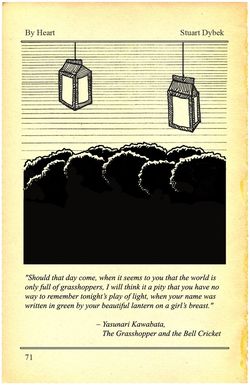
Lead_large_tmpLast week, Stuart Dybek, one of America’s living masters of the short story, published two new, and very different collections. The nine pieces in Paper Lantern: Love Stories are fairly conventional—they’re stories with drawn characters, and clear conflicts, that reach a certain length. Ecstatic Cahoots: Fifty Short Stories is more focused on the evocative power of language itself—as the strange, musical pairing of words in its title suggests. In offerings that range in length from two lines to nearly 10 pages, from narrative to wholly impressionistic, Dybek uses fragments, koans, and brief lyric flights to capture whole worlds in miniature. In our conversation for this series, Dybek discussed the troubled label “flash fiction” (which was also the topic, and title, of Nathanael Rich’s review in this month’s Atlantic magazine), a form without a solid definition.

Stuart Dybek: It goes way back. From high school on, I wrote these strange, varied, and very short prose pieces that didn’t seem to fit into any established genre. I didn’t have any literary pretensions about what I was doing—it was just one way I liked to work. I thought I was writing stories, but I learned quickly that I’d taken on a form without an easy category. At the time, you could only publish very short prose works, something editors uniformly regarded as “prose poems,” in poetry magazines. So I sent my stuff out that way—because there was no other outlet for it—even though, deep down, I felt I was fudging.

More here.

Thursday Poem

Bolshevescent

You stand far from the crowd, adjacent to power.
You consider the edge as well as the frame.
You consider beauty, depth of field, lighting
to understand the field, the crowd.
Late into the day, the atmosphere explodes
and revolution, well, revolution is everything.
You begin to see for the first time
everything is just like the last thing
only its opposite and only for a moment.
When a revolution completes its orbit
the objects return only different
for having stayed the same throughout.
To continue is not what you imagined.
But what you imagined was to change
and so you have and so has the crowd.

by Peter Gizzi
from The Outernationale
publisher: Wesleyan, Middletown, CT, 2007

Wednesday, June 11, 2014

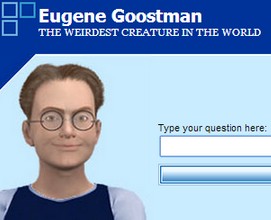
Response by Ray Kurzweil to the announcement of chatbot Eugene Goostman passing the Turing test

From Kurtweil's blog:

ScreenHunter_680 Jun. 12 08.24Two days ago, on June 8, 2014, the University of Reading announced that a computer program “has passed the Turing test for the first time.”

University of Reading Professor Kevin Warwick described it this way:

“Some will claim that the test has already been passed. The words ‘Turing test’ have been applied to similar competitions around the world. However, this event involved more simultaneous comparison tests than ever before, was independently verified and, crucially, the conversations were unrestricted. A true Turing test does not set the questions or topics prior to the conversations. We are therefore proud to declare that Alan Turing’s test was passed for the first time on Saturday.” — Kevin Warwick, PhD

I have had a long-term wager with Mitch Kapor in which I predicted that a computer program would pass the Turing test by 2029 and he predicted that this would not happen, see links below.

This was the first long-term wager on the “Long Now” website. The bet called for $20,000 to be donated from us to the charity of the winner’s choice.

As a result, messages have been streaming in from around the world congratulating me for having won the bet.

However, I think this is premature. I am disappointed that Professor Warwick, with whom I agree on many things, would make this statement. There are several problems that I describe below, including a transcript of a conversation that I had with Eugene Goostman, the chatbot in question.

More here.

The Search for a Science of the Mind

Gray_06_14John Gray at Literary Review:

Headhunters is a mind-opening exploration of the lives, careers and ideas of four leading figures who believed themselves pioneers in a new branch of knowledge: the anthropologist and psychiatrist William Rivers (1864-1922), Rivers's pupil the physician and psychologist Charles Myers (1873-1946), the anatomist Grafton Elliot Smith (1871-1937) and the social psychologist William McDougall (1871-1938). The origins of this arrestingly original and beautifully written book are themselves an interesting story. They go back to 1963, when as a teenager Shephard read Siegfried Sassoon's Sherston's Progress, in which Rivers appears as the doctor who treated Sassoon for shell shock. Reinforced by studies of the traumas experienced by servicemen as a result of the Vietnam War, Shephard's concern with the psychological aftermath of warfare led to an interest in military psychiatry, which eventually resulted in his writing War of Nerves (2000). All of the thinkers examined here, Shephard discovered, were involved in one way or another in the treatment of psychologically damaged soldiers. Rivers's pupil Myers coined the term 'shell shock' when serving in the army in France; McDougall – another pupil of Rivers – had written an account of the patients whom he had treated back in England; while Elliot Smith had published a wartime polemic on shell shock.

Shephard writes that he has 'tried to give some idea of how science actually works: the passions, the irrational flashes, the moments of insight – the big ideas that work and the big ideas that are plain wrong'. He does this, in part, by giving us a flavour of the personalities of his four protagonists.

more here.

GETTING “MACBETH” RIGHT

Macbeth-als-580Hilton Als at The New Yorker:

W. H. Auden, in his very honest 1947 essay about “Macbeth,” said that it is “difficult to say anything particularly new or revealing about” the play. And I would agree, given the lengths that many directors go to to make the piece “new,” including building sets like Oram’s. At first, the spooky and delightful weird sisters—Shakespeare’s poetry always extended beautifully to the supernatural—feel like the “new” thing here, given their arresting choreography. But pretty soon that’s dropped, and we’re in the same old “Macbeth” territory of war and conquest and all those crimes against God eventually smiting the hubris of man.

Still, Richard Coyle’s depiction of MacDuff, the lord who commits regicide at the end of the play, is original; he finds substance and emotional conflict in a role that is generally passed over in favor of all those vengeful ghosts. So doing, Coyle brings an enlivening spirit to a piece that many directors, including Ashford and Branagh, try to claim as their own by layering it with ideas about culture, about history, about marriage, which have less to do with reality than with their failure to even approach what Shakespeare was able to achieve through his imagination: dramatic truth, the freedom of the born storyteller.

more here.

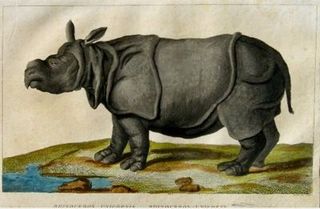
The Rhinoceros of Versailles

Justin E. H. Smith in his blog:

6a00d83453bcda69e201a3fd1a6d13970b-400wiIn a corner of the Paris Jardin des Plantes, tucked between the greenhouses and the cultivated rows of bright dahlias of this vast park on the Left Bank of the Seine, we find La Ménagerie, as it is still called, home to over 1100 animals of various sizes, lineages, and provenances: panthers, wallabies, pheasants. It is held to be one of the oldest zoos in the world, having been established in 1793 by Jacques-Henri Bernardin de Saint Pierre from the transplanted remnants of the former royal menagerie at Versailles.

The Ménagerie has been immortalized in innumerable works of French literature and cinema, from the satirical fiction of Honoré de Balzac to Chris Marker’s 1962 masterpiece, La Jetée (later the inspiration for the Bruce Willis vehicle, 12 Monkeys). Balzac, in a curious novella of 1841 entitled A Guide for Animals Looking to Move Up in the World, relates the schemes of a man named Adam Marmus, the not-so-proud owner of a humble donkey. He conceives a plot to paint his donkey with stripes, like those familiar specimens in novelty photos from Tijuana, but white on black rather than black on white. As a peculiar new variety of zebra, the donkey will be the hit of the menagerie, and will bring his owner fame and fortune.

More here.

Ruska: Leading the Creative Self

Marko Ahtisaari in his blog:

6a00d834536e6c69e200e54ffd6ea58833-150wiRuska is the Finish word for the turning of the leaves in the fall. “Ruska occurs,” writes designer and pamphleteer Dan Hill, “when birch, larch and rowan trees explode into russet tones of richly saturated purples, reds, yellows and oranges, before shivering off their leaves for winter. It's an extraordinary vivid and life-affirming cycle.” Ruska is an apt metaphor for replenishment and renewal, of both organizations and the individual. And while there is so much talk these days about leading others, leading change or changing the world, I'd like to address something more close to home, changing oneself.

How do you lead the creative self? How do you create the physical, cognitive and social conditions for creative work? I'm not talking about the designing itself (of which there is much to say) but rather enabling the everyday conditions to make creative breakthroughs as we've done and you’ll continue to do in the studio.

I want to share with you some of the simple techniques I've used to stay creative, sane and productive. To be clear, I don't mean to be didactic. It's not as if I've figured it all out. I've barely figured anything out. This said, most everything I have learned about leading myself has been by modeling other people I respect. So I offer these thoughts as models and patterns, for you to consider, prototype, or tweak in your own everyday. I’ll do this under three broad headings: your week, your energy and your habits.

More here.

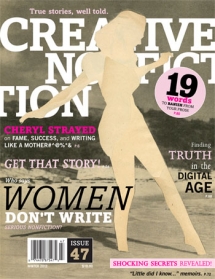
How to Write Like a Mother#^@%*&

Elissa Bassist & Cheryl Strayed in Creative Nonfiction:

47_Cover_Final4-1In August 2010, a young writer named Elissa Bassist moved from San Francisco to Brooklyn to start working on an MFA in creative nonfiction. After living in New York for just two weeks, she wrote a letter to The Rumpus’s popular online advice columnist “Sugar,” expressing her frustrations about her writing: “I write about my lady life experiences, and that usually comes out as unfiltered emotion, unrequited love, and eventual discussion of my vagina as metaphor. … I am sick with panic that I cannot—will not—override my limitations, insecurities, jealousies, and ineptitude, to write well, with intelligence and heart and lengthiness.” She asked, finally, “How does a woman get up and become the writer she wishes she’d be?”

Sugar—who last February revealed herself to be Cheryl Strayed, author of the bestselling memoir Wild—replied: “Writing is hard for every last one of us—straight white men included. Coal mining is harder. Do you think miners stand around all day talking about how hard it is to mine for coal? They do not. They simply dig. You need to do the same. … So write, Elissa Bassist. Not like a girl. Not like a boy. Write like a motherfucker.”

The quote—“Write Like a Motherfucker”—has been emblazoned on a T-shirt and a coffee mug; the letter also appears in Tiny Beautiful Things, Strayed’s bestselling collection of Sugar columns, published last summer by Vintage.

Over the past two years, Bassist says, she has taken every word of Sugar’s/Cheryl’s advice to heart—and she’s not alone.

More here.

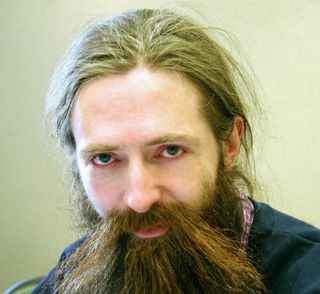
Aubrey de Grey Interview

From In-Sight:

Dr-aubrey-de-grey1. How was your youth? How did you come to this point?

Pretty normal, but rather short on social life: I had no brothers or sisters (or indeed any family other than my mother), and I wasn’t particularly outgoing until I was about 15. I was always reasonably high-achieving academically and I immersed myself in that. When I discovered programming, and found I was fairly good at it, I decided to study computer science, and pretty quickly I decided to pursue a career in artificial intelligence research because I felt it was where I could make the most humanitarian difference to the world. At around 30, I started to realise that aging was a criminally neglected problem and that, maybe, I could make even more of a difference there. So I switched fields.

2. Where did you acquire your education? What education do you currently pursue?

I went to school at Harrow, a top UK boarding school, and then university at Cambridge. These days my education comes from my colleagues, via their papers and my interactions at conferences.

More here.

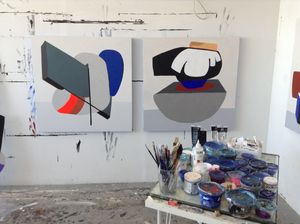
Signs and Wonders: In the Studio with Hayal Pozanti

Joseph Akel in The Paris Review:

Photo-may-20-11-20-59-am-1024x764My first encounter with artist Hayal Pozanti was the lucky happenstance of a predetermined seating arrangement: she was placed across the table from me at a dinner celebrating Jessica Silverman Gallery, which represents Pozanti on West Coast. We spent the evening in deep discussion on the finer points of photographic theory and discovered a shared interest in the writings of Freidrich Kittler. Agreeing to stay in touch, I found myself in New York for Frieze Art Fair and decided to pay a visit to Pozanti’s studio in Queens. She was born in Istanbul in 1983 and moved to New York in 2009. In a small partitioned space with views looking over the East River toward midtown Manhattan, we talked about her current body of work, which will be exhibited later this year at the Prospect New Orleans biennial and at the Parisian iteration of the Foire Internationale d’Art Contemporain.

With my recent paintings, I’ve been thinking a lot about Ken Price, Philip Guston, and Allan McCollum. And, of course, I always come back to Giorgio Morandi—I think about him regularly. I find that a common ground for all of these artists was the ability to create, through figurative abstraction, a world parallel to the one we live in. As a Turkish immigrant who has moved from place to place, who speaks several languages, I’m intrigued by the possibility of creating a universal language to unite my cross-cultural experiences. When I think back to my childhood in Istanbul—even during my time as a young professional there—I was always concerned with the question of acceptance and with the idea of unifying people. My early paintings were very figural—I was looking at Turkish miniatures and thinking about the Abrahamic religions I was in contact with daily. While getting my M.F.A at Yale and studying with Peter Halley, my practice was based on images that I would collect from the Internet. I was really engrossed in that culture of image collecting, collaging. But I realized that I couldn’t propose something new by appropriating things. I wanted to step away from the computer, because I was spending so much time in front of the screen, sitting there staring at something with dozens of tabs open.

More here.

Study suggests social identification can mitigate danger felt by people in dense crowds

From Phy.Org:

MeccaA pair of researchers has found that if people in a large crowd identify socially with other members, they tend to feel safe, even as the density goes up. Hani Alnabulsia and John Drury of the University of Sussex, and Umm Al-Qura University respectively conducted a survey of people attending the annual Hajj in Mecca in 2012 regarding their feelings of safety, and also counted members in the crowd to establish density—they've published their results in Proceedings of the National Academy of Sciences. Crowds can be dangerous places, examples of what can happen appear regularly in the news—from trampling to suffocation to violence, masses of people often spell trouble. For these reasons, many people find themselves feeling scared when in a crowd—particularly when suddenly noticing that their fate is no longer in their own hands. But, as Alnabulsia and Drury note in their paper, that may not always be the case.

One of the danger elements in crowds is perception of fear. If the people in the crowd are afraid something bad is going to happen, they might take actions that wind up causing it to happen. In this new study, the research duo sought to find out if it might be possible in some instances, to feel perfectly safe, despite being in the midst of a horde of other people. To find out, they spoke to 1,194 pilgrims at the Hajj in Mecca in 2012, site of one the largest annual gatherings of people in the world—attendance is close to three million people each year. The researchers also noted crowd density as it applied to those being queried about their feelings regarding their safety—they found at times it approached 8 people per square meter, which is of course, quite packed.

More here.

Tuesday, June 10, 2014

That Computer Actually Got an F on the Turing Test

Turing-getty-660x480

Adam Mann in Wired (Alan M Turing and colleagues working on the Ferranti Mark I Computer in 1951. Photo: SSPL/Getty Images):

Over the weekend, a group of programmers claimed they built a program that passed the famous Turing Test, in which a computer tries to trick judges into believing that it is a human. According to news reports,this is a historic accomplishment. But is it really? And what does it mean for artificial intelligence?

The Turing Test has long been held as a landmark in machine learning. Its creator, British computer scientist Alan Turing, thought it would represent a point when computers would have brains nearly as capable as our own. But the value of the Turing Test in modern day computer science is questionable. And the actual accomplishments of the test-winning chatbot are not all that impressive.

The Turing Test 2014 competition was organized to mark the 60th anniversary of Turing’s death and included several celebrity judges, including actor Robert Llewellyn of the British sci-fi sitcom Red Dwarf. The winner was a program named Eugene Goostman, which managed to convince 10 out of 30 judges that it was a real boy. Goostman is the work of computer engineering team led by Russian Vladimir Veselov and Ukrainian Eugene Demchenko.

The program had a few built-in advantages, such as the fact that he was claimed to be a 13-year-old non-native English speaker from Ukraine. It also only tricked the judges about 30 percent of the time (an F minus, or so). For many artificial intelligence experts, this is less than exciting.

More here.

Twenty-Five Years After Tiananmen

Tienanmen-square

Andrew J. Nathan and Hua Ze in The New Republic:

It is unlikely that anyone outside of China who watched the massacre of peaceful protestors in Beijing’s Tiananmen Square on live TV 25 years ago will ever forget the events of that horrible day.

The Chinese regime argues that the shooting of unarmed pro-democracy demonstrators laid the groundwork for political stability and China’s miraculous economic growth. Yet the continuous intensification of repression since then tells another story. Most recently, in early May, the regime “disappeared” a dozen rights activists merely for meeting in a private apartment to commemorate June 4, 1989 and formally detained one of them, human rights lawyer Pu Zhiqiang, for “picking quarrels and provoking trouble.”

This was just the latest in a series of harsh repressions. Five years ago, Tiananmen activist and Nobel Peace Prize winner Liu Xiaobo was handed an eleven-year prison sentence for advocating civil rights and constitutionalism. Earlier this year, human rights activist Xu Zhiyong was sentenced to four years in prison for opposing corruption and abuse of power. The National Endowment for Democracy, with which we are both affiliated, honored Liu and Xu on May 29 in the U.S. Congress in an effort to raise awareness of their cases in advance of the Tiananmen anniversary—and through their cases, to bring awareness to the estimated 4,800 political prisoners in Chinese jails and camps.

The need to sustain and progressively intensify repression is a sign that the June 4 crackdown did not solve China’s problems; it exacerbated them.

More here.

The Return of Karl Polanyi

1402280576polanyi_sketch_william_townsend666

Margaret Somers and Fred Block in Dissent [Karl Polanyi teaching at the Workers' Educational Association, c. 1939. Sketch by William Townsend.]:

Karl Polanyi’s ideas took form in Vienna in the 1920s in direct opposition to the free-market orthodoxy of Ludwig von Mises, the contemporaneous avatar of market fundamentalism. Both thinkers were deeply influenced by the “Vienna experiment,” the post–First World War period of democratic, worker-led municipal socialism. While Polanyi saw in the experiment the very best that socialism had to offer, it motivated von Mises’s lifelong effort to prove that socialism and “planning” were economically disastrous and morally corrupt.

Von Mises had little success in the short term, and most thinkers on the left simply dismissed him as a reactionary apologist for big business. But a half century later, his more famous student—Friedrich von Hayek—became the inspiration for both Margaret Thatcher and Ronald Reagan, as market fundamentalism and neoliberalism became the ruling ideas of our time. Fortunately, Karl Polanyi did take von Mises’s ideas seriously. In fact, The Great Transformation is an analysis of the enormously destructive and seductive nature of the market fundamentalist worldview that has been so influential over the last three decades.

Right from the start of the book, Polanyi attacks market liberalism for what he calls its “stark Utopia.” Conservatives had long deployed the “utopianism” epithet to discredit movements of the left, but Polanyi was determined to turn the tables by showing that the vision of a global self-regulating market system was the real utopian fantasy. Polanyi’s central argument is that a self-regulating economic system is a completely imaginary construction; as such, it is completely impossible to achieve or maintain. Just as Marx and Engels had talked of the “withering away of the state,” so market liberals and libertarians imagine a world in which the realm of politics would diminish dramatically. At the same time, Polanyi recognizes why this vision of stateless autonomous market governance is so seductive. Because politics is tainted by a history of coercion, the idea that most of the important questions would be resolved through the allegedly impartial and objective mechanism of choice-driven, free-market competition has great appeal.

Polanyi’s critique is that the appeal has no basis in reality. Government action is not some kind of “interference” in the autonomous sphere of economic activity; there simply is no economy without government. It is not just that society depends on roads, schools, a justice system, and other public goods that only government can provide. It is that all of the key inputs into the economy—land, labor, and money—are only created and sustained through continuous government action.

More here.

So Much Arctic Ice has Melted that We Need a New Atlas

Gwynn Guilford in Quartz:

It used to be wars, Communism and colonialism that kept atlas illustrators on their toes. These days, though, their biggest headache is global warming.

For instance, when the National Geographic Atlas of the World is published this coming September, its renderings of the ice that caps the Arctic will be starkly different from those in the last edition, published in 2010, reports National Geographic. That reflects a disquieting long-term trend of around 12% Arctic ice loss per decade since the late 1970s—a pace that’s picked up since 2007. This comparison from the US National Snow and Ice Data Center, although not the one used by National Geographic, should give a sense of how much skimpier that Arctic ice cover has gotten:

But drawing Arctic ice isn’t as uncontroversial as you might think. A few years ago, the Times Atlas mistakenly suggested that the Greenland ice sheet had shrunk by 15% since 1999, which it later retracted. Even choices made by the National Geographic atlas geographers have elicited criticism.

First is the issue of which years to compare. Arctic ice trends vary wildly by year. The atlas geographers’ use of data from 2012—a freakishly low year—risks misleading readers, as Walt Meier, a scientists at NASA’s Cryospheric Sciences Lab, told NatGeo.

Then there’s the matter of which ice to illustrate.

Every winter, cold temperatures seal the Arctic under a sheet of ice. By late summer, though, the sun’s warmth has melted millions of square kilometers of that ice.

More here.

Deep Control, Death and Co

Newsimage

Richard Marshall interviews John Martin Fischer [Photo: Stefan Klatt]:

3:AM: Most people hold themselves and others morally responsible. and you think we need a philosophical foundation for this. Others might say that its just biology, or culture, or education or psychological biases or a supernatural element underwritten by a deity that makes us do this and that there’s not space for a philosophical foundation. How do you think we should answer this mix of challenges?

JMF: In some ways it can be helpful to have an explanation of our responsibility practices. Perhaps in the end they are just “brute” or unexplained by deeper philosophical ideas, but I think it can be fruitful at least to explore ways in which our responsibility practices can be explained by simpler, more basic ideas (where these are distinctively philosophical ideas). If we have such an explanation, we can (perhaps, at least) answer certain moral responsibility skeptics, and we might be able to provide answers to questions about moral responsibility in “hard cases”, such as psychopathy and other disordered agents. After all, our actual responsibility practices can (and should) be called into question, and they don’t in themselves answer questions about certain contentious or difficult cases. Can a severely depressed individual be deemed morally responsible? An individual suffering from Alzheimer’s Disease? How about an individual with unusual or atypical brain structures (suggestive of a higher probability of violent behavior)?

Similarly, I think it is desirable to have a way of engaging more productively with the moral responsibility skeptics. That is, we want to take their worries very seriously, and seek to address them as much as possible on their own terms. This is perhaps a way in which I differ from the approach taken by Peter Strawson (although we both think that moral responsibility should be sequestered from certain metaphysical issues). I believe in a moderate sequestration of metaphysics, whereas Peter Strawson argues for a more extreme sequestration of metaphysics. Here (as elsewhere) I prefer the path of moderation.

More here.

The Guillotine: Second Time as Meme

6a00d83453bcda69e201a73dd46105970d-400wi

Justin Smith over at his website:

I knew another of my periodic retreats from the public expression of political opinions had arrived when, contacted by a certain French media outlet for my views on the recent electoral victories of the Front National, I muttered something about how I've been busy writing about animals recently, and then quoted Kropotkin to the effect that the animals, unlike us, seem to get by just fine without holding elections at all.

The name I've just invoked should serve as a guide to the sort of 'deviations' I am about to express, relative to what is increasingly a party-line view among young metropolitan leftists and their hangers-on in fashion and lifestyle.

Well, it's hard to really talk about 'views' in the age of memes. Surely you've seen it by now: the ironized, memified representation of the guillotine, often accompanied by slogans announcing that this is the fate awaiting the CEOs of Goldman Sachs, that 'the French knew how to deal with the 1%', etc. Likely the most iconic representation of that execution device in the past few years is the one presented on the cover of the Spring, 2013, issue of Jacobin Magazine, showing it as the 'Giljotin': an IKEA-bought, home-assembled, mass-produced piece of furniture.

I am not an admirer of the original Jacobins, and for this reason I cannot support any media venture that derives its name from that movement. The magazine has on occasion shown itself to be a lucid defender of truth and justice, as for example in a recent defense of serious social-scientific critique of capitalism, against the frivolous academic-blogger culture's displacement of our attention to the all-pervasiveness of gender, and that same culture's vain dream of fixing the associated problems by compelling everyone, pretty much, to just watch their language, and to make regular public performances of preparedness for privilege-checking, of 'radical humility'. “Give me a card-carrying brocialist over one of these oily 'allies' any day” is surely among the most refreshingly exasperated pleas from the left I've read in a long, long time.

But still, shame on Jacobin for helping to turn a murder weapon into an icon of urban radical fashion. I understand that from a certain point of view it is the same desire for 'realness' that motivates them both to publish lovely screeds against silly liberal moralizing and dead-end identity-mongering, on the one hand, and on the other hand to insist that what they are really pushing for is revolution, and that revolution means heads are going to roll, etc. But in truth I strongly suspect that most educated urban twenty-somethings who flirt with the symbol do so in the secret hope and expectation that it is never in fact going to come to that, that they will never be called on to pull the lever on a Goldman Sachs CEO, or on the small child of a Goldman Sachs CEO (nipping inheritance structures in the bud), or on a former comrade now accused of harboring too many deviations.

More here.