Saturday Poem

Hvar/Glagoli

a man enters the vineyard,
sits and weeps at the edge of the island,
where God no longer awaits the stars
to reveal himself to the sea,
the woman rises and jumps into the sea,
One and the Other are silent

I now know that nothing could have
happened: a jump is a jump,
the sea merely the sea, a lone star
just God who doesn’t want to be
questioned about this thing
at all
.

by Miroslav Mićanović
from: Zib
publisher: Meandar, Zagreb, 1998
translation: 2011, Stipe Grgas
Hvar
Glagoli

Read more »

Friday, April 11, 2014

Why We’re in a New Gilded Age

Krugman_1-050814_jpg_250x1434_q85

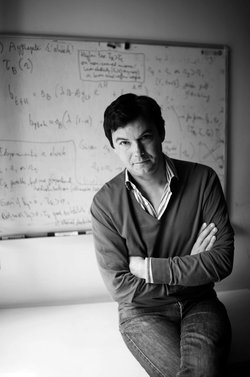
Paul Krugman in the NYRB (photo by Emmanuelle Marchadour):

Piketty throws down the intellectual gauntlet right away, with his book’s very title:Capital in the Twenty-First Century. Are economists still allowed to talk like that?

It’s not just the obvious allusion to Marx that makes this title so startling. By invoking capital right from the beginning, Piketty breaks ranks with most modern discussions of inequality, and hearkens back to an older tradition.

The general presumption of most inequality researchers has been that earned income, usually salaries, is where all the action is, and that income from capital is neither important nor interesting. Piketty shows, however, that even today income from capital, not earnings, predominates at the top of the income distribution. He also shows that in the past—during Europe’s Belle Époque and, to a lesser extent, America’s Gilded Age—unequal ownership of assets, not unequal pay, was the prime driver of income disparities. And he argues that we’re on our way back to that kind of society. Nor is this casual speculation on his part. For all that Capital in the Twenty-First Century is a work of principled empiricism, it is very much driven by a theoretical frame that attempts to unify discussion of economic growth and the distribution of both income and wealth. Basically, Piketty sees economic history as the story of a race between capital accumulation and other factors driving growth, mainly population growth and technological progress.

To be sure, this is a race that can have no permanent victor: over the very long run, the stock of capital and total income must grow at roughly the same rate. But one side or the other can pull ahead for decades at a time. On the eve of World War I, Europe had accumulated capital worth six or seven times national income. Over the next four decades, however, a combination of physical destruction and the diversion of savings into war efforts cut that ratio in half. Capital accumulation resumed after World War II, but this was a period of spectacular economic growth—the Trente Glorieuses, or “Glorious Thirty” years; so the ratio of capital to income remained low. Since the 1970s, however, slowing growth has meant a rising capital ratio, so capital and wealth have been trending steadily back toward Belle Époque levels. And this accumulation of capital, says Piketty, will eventually recreate Belle Époque–style inequality unless opposed by progressive taxation.

Why? It’s all about r versus g—the rate of return on capital versus the rate of economic growth.

More here.

How the CIA Turned Doctor Zhivago into a Propaganda Weapon Against the Soviet Union

Colin Marhsall in Open Culture:

Humanity has long pondered the relative might of the pen and the sword. While one time-worn aphorism does grant the advantage to the pen, most of us have entertained doubts: the sword, metaphorically or literally, seems to have won out across an awfully wide swath of history. Still, the pen has scored some impressive victories, some even in living memory. Take, for example, the CIA’s recently revealed use of Boris Pasternak’s novel Doctor Zhivago as a propaganda weapon. Repressed in Pasternak’s native Russia, the book first appeared in Italy in 1957. The following year, the British suggested to America’s Central Intelligence Agency that the book stood a decent chance of winning hearts and minds behind the Iron Curtain — if, of course, they could get a few copies in there. A CIA memo sent across its own Soviet Russia Division subsequently pronounced Doctor Zhivago as possessed of ”great propaganda value, not only for its intrinsic message and thought-provoking nature, but also for the circumstances of its publication. We have the opportunity to make Soviet citizens wonder what is wrong with their government, when a fine literary work by the man acknowledged to be the greatest living Russian writer is not even available in his own country in his own language for his own people to read.”

More here.

The Banker, the Visitor, His Wife and Her Lover

13KUMAR-master180

Amitava Kumar reviews Zia Haider Rahman's ‘In the Light of What We Know’ (photo by Katherine Rose):

In diverse genres, but primarily in fiction, writers from India and (especially after the attacks of Sept. 11) from Pakistan and Bangladesh, as well as Sri Lanka and Nepal, have released work that is riveting, often formally inventive and certainly relevant. Mohsin Hamid, Kiran Desai, Arundhati Roy, Suketu Mehta, Sonali Deraniyagala, Mohammed Hanif, Monica Ali, Samrat Upadhyay, Nadeem Aslam, Rahul Bhattacharya, Siddhartha Mukherjee — these are only some of the glittering names to glide into view alongside older, bigger planetary bodies like Salman Rushdie, Michael Ondaatje, Vikram Seth and Anita Desai.

“In the Light of What We Know” is a debut novel whose author has worked as an investment banker on Wall Street. Like its protagonist, Zafar, Zia Haider Rahman was born in rural Bangladesh and educated at Oxford and other places before following a career as a trader and lawyer. The novel’s narrator is a Pakistani-­American friend of Zafar’s from his days at the university, a rogue banker in London who has taken a fall after making a lot of money for his firm from mortgage-backed securities. The narrator’s task is to listen as Zafar tells his story after showing up at the door early one morning in 2008, disheveled and apparently destitute.

Zafar’s narration shifts registers — “this fluctuation from crystal clarity of exposition to a barely restrained fury” — and folds into lengthy but fascinating digressions. Like the narrator of W. G. Sebald’s “The Rings of Saturn,” whose erudite riffing on anything from herrings to the execution of Roger Casement allowed him to make melancholic observations about the horrors of history, the Zafar of Rahman’s strange and brilliant novel is at ease drawing sharp lessons from subjects as varied as derivatives trading and the role of metaphor in determining the fate of pigeons.

More here.

kate bush returns

Penm01_3608_09Ian Penman at The London Review of Books:

Kate is perceived to be more ‘one of us’ than other pop/rock figures, one of the extended family. There’s a feeling that she’s ‘stayed the same’, that success ‘hasn’t spoiled her’. She’s someone you might have known at sixth-form college, or at your Saturday job (the artier kind, obviously: knick-knack stall at the local market); but definitely a scream down the pub, with her packet of Silk Cut and pint of proper scrumpy. At the same time, people are drawn to her peacock’s-tail otherness, the slightly recherché taste for odd bods like Ouspensky, Gurdjieff and Wilhelm Reich. She has the soul of a Manic Pixie Dream Girl, but the robust mien of Mrs Thatcher at a 1980s cabinet meeting. Obviously, no one maintains a position somewhere near the top of the music biz for three and a half decades by being entirely nice and floppy and whichever-way-the-wind-blows. From the off, she was the beneficiary of her parents’ middle-class smarts. A precociously dreamy, sky-eyed teen daughter, she was wisely shepherded. Family and management were merged, became one and the same: Kate Inc., a well-tended cottage industry. Her decision, after 1979’s one exhausting and ill-fated outing, not to tour again, removed yet another plank from the algae-hued drawbridge over the moat. (Consider a few tropes from Aerial: fond dreams of invisibility; pained bafflement at Elvis’s trashy reclusion; the self-imposed exile of Charles Foster Kane; and Joan of Arc, ‘beautiful in her armour …’) Ever since, she has lived a life in many ways more like a writer’s than a modern pop star’s: pop’s own J.K. Rowling. (With her Roman Catholic background and taste for bittersweet mysticism, other names suggest themselves here too: Muriel Spark, Penelope Fitzgerald, Angela Carter, Fay Weldon.)

more here.

can the transition to a more modest way of living be accomplished peaceably?

TLS_Benthall_450521hJonathan Benthall at the Times Literary Supplement:

In Pauperland: Poverty and the poor in Britain, Jeremy Seabrook makes an eloquent case that wealth, which now commands “many of the rites and observances formerly associated with religion”, is founded on an ideology of limitless desires fuelling limitless economic growth. These desires spur the poor as well as the rich. In earlier times, attempts were made by the comfortably off to curb the desires of poor people, and their profligacy was frowned on. But high consumption by the poor is now encouraged as a source of commercial profit. Bombarded with incitements to spend, the poor no longer aim at securing a modest sufficiency, but tend to become caricatures of the rich. Poor people in Britain are attracted by the occult, reincarnation, astrology, ghosts, vampires and monsters, and by “haunted skinny models and images of brooding machismo, who live in ostentatious kitsch and bling, a degraded version of aristocratic grandeur”.

Driving home the argument that all wealth, not merely that displayed conspicuously, has been accumulated on the backs of poor people, Seabrook extends his purview from Britain to the whole world: “there is scarcely anything in daily consumption, a child’s toy, a garment, a tropical fruit, a piece of jewellery, uncontaminated by the suffering of people whose existence is unknown to us”.

more here.

Her Dagestan: Taus Makhacheva

Stephanie Ball in AsiaPacificArt:

ArtIn Taus Makhacheva’s three-minute video Walk (2010), a jagged cliff zigzags across the frame producing a line of perspective. Three points demarcate the division between the ocher earth and a brilliant blue sky, and a figure in black comes into view walking at a steady pace, bisecting the landscape. This same dark figure features in another work, Endeavour (2010), which was filmed on the same day. In this piece, the performing body throws its weight against a boulder that has been hanging over the Dagestani village of Tsada for centuries. It is a romantic, existentialist work, executed with precision by an artist with a steady eye on her native country and the changes that have been taking place there over the past decade. Yet, beyond Dagestan’s literal highs and lows—its mountains, plateaus and crevasses—Makhacheva’s examinations also look at the very structure of Caucasian society. In both aforementioned works, she draws upon a compositional trope long associated with the Caucasus region—the lone figure in the mountains, representative of humanity’s coexistence with the forces of nature. But, despite the focus on landscape in much of her work, Makhacheva explains that her videos hint more at “the way we don’t relate to the landscape anymore.” And this is where Makhacheva’s subtle agitation lies. As an artist whose intentions are to illuminate things we often overlook, her aim is to uncover the historical, cultural and, above all, personal layers that constitute the world around her.

That Makhacheva’s grandfather was Rasul Gamzatov, the most famous poet of Dagestan and son of Gamzat Tsadasa, the eminent Soviet Avar poet, has inevitably had an impact on her work. Also feeding into her practice is her dual Russian-Dagestani identity and her Western education. Makhacheva graduated with a BA in Fine Art from Goldsmiths College in 2007 and studied at Moscow’s Institute of Contemporary Arts in 2009. Recently, she completed her Master’s degree at the Royal College of Art, London. This background has no doubt inspired an approach that attempts to reconcile the contemporary with the nostalgic, the local with the global. “I do have this romantic notion that I have to work with my context, geographical or cultural,” she admits.

More here.

James Lovelock reflects on Gaia’s legacy

Philip Ball in Nature:

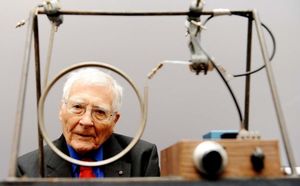
LovelockA new exhibition at the Science Museum in London features the personal archives of one of the most influential modern scientists; James Lovelock. ‘Unlocking Lovelock: Scientist, Inventor, Maverick’ tells the story of the British scientist's work in medicine, environmental science and planetary science, and displays documents ranging from childhood stories, doodle-strewn lab notebooks and patents to letters from dignitaries such as former UK prime minister (and chemist) Margaret Thatcher. Also included are several of Lovelock’s inventions, such as the electron-capture detector that enabled the measuring of ozone-destroying chlorofluorocarbons in the atmosphere in the 1970s. Lovelock, born in 1919, is best known for the ‘Gaia hypothesis’, which proposes that the Earth functions as a self-regulating system, similar to a living organism. The idea sparked controversy when Lovelock and microbiologist Lynn Margulis proposed it in the 1970s, but environmental and Earth scientists now accept many of its basic principles. In 2006, his book The Revenge of Gaia predicted disastrous effects from climate change within just a few decades, writing that “only a handful of the teeming billions now alive will survive”.

Is climate change going to be less extreme than you previously thought?

The Revenge of Gaia was over the top, but we were all so taken in by the perfect correlation between temperature and CO2 in the ice-core analyses [from the ice-sheets of Greenland and Antarctica, studied since the 1980s]. You could draw a straight line relating temperature and CO2, and it was such a temptation for everyone to say, “Well, with CO2 rising we can say in such and such a year it will be this hot.” It was a mistake we all made. We shouldn’t have forgotten that the system has a lot of inertia and we’re not going to shift it very quickly. The thing we’ve all forgotten is the heat storage of the ocean — it’s a thousand times greater than the atmosphere and the surface. You can’t change that very rapidly. But being an independent scientist, it is much easier to say you made a mistake than if you are a government department or an employee or anything like that.

More here.

Friday Poem

We remember the rabbit when we see the duck, but we cannot
experience both at the same time.
…………………… —E.H. Gombrich, Art and Illusion
.

Duck/Rabbit

What do you remember? When I looked at

his streaky glasses, I wanted

to leave him. And before that? He stole those

cherries for me at midnight. We were walking

in the rain and I loved him.

And before that? I saw him coming

toward me that time at the picnic,

edgy, foreign.
But you loved him? He sat in his room with

the shades drawn, brooding. But you

loved him? He gave me

a photo of himself at sixteen, diving

from the pier. It was summer. His arms

outstretched. And before that?

His mother was combing his soft curls

with her fingers and crying. Crying.
Is that what he said? He put on the straw hat

and raced me to the barn. What did he

tell you? Here's the dried rose, brown

as tobacco. Here's the letter that I tore

and pasted. The book of blank pages

with the velvet cover. But do you still
love him? When I rub the nap

backwards, the colors lift,

bristle. What do you mean?

Sometimes, when I'm all alone,

I find myself stroking it.

by Chana Bloch
from The Past Keeps Changing
Sheep Meadow Press, 1992

Thursday, April 10, 2014

‘No Palestinian Has Ever Written Poetry Quite Like This Before’

From Arabic Literature:

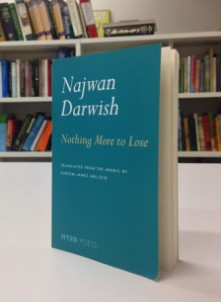
ScreenHunter_589 Apr. 10 16.12Before I ever met Najwan Darwish, I’d imagined him in an impassioned frustration, throwing handfuls of promotional fliers in the air:

That was at the 2011 Palestine Festival of Literature. Two years later, when I was invited to tag along with PalFest, I rode in Darwish’s patient car and expected to hear him read his poetry in Nablus.

In that, I was disappointed. Later, I heard Darwish tell the story of why he didn’t appear onstage in Nablus, where he’d been expected to read just before Basel Zayed and Turab played music inspired by his poems.

Darwish didn’t get to see the crowd of two hundred-odd people singing along with his poetry. But he made it to the following night’s event in Ramallah and, after several false starts, he finally explained: He’d waited at a checkpoint for forty-odd minutes before being turned away. A soldier didn’t want to let him through, and Darwish felt he didn’t have time to wait for some higher-up to arrive and sort it out. So he drove off in search of an alternate checkpoint. But he got lost. He couldn’t find Nablus on his GPS, he couldn’t find signs pointing to the city and — perhaps even more telling — walls blocked his view of possible landmarks.

He ended up near Tel Aviv, where he got stuck in traffic, and continued driving around for a while longer before, in frustration, he gave up and went home.

More here.

The Miracle of Analogy

Joseph-Nicephore-view-from-the-window-at-le-gras-600x417Kaja Silverman at nonsite:

We have grown accustomed to thinking of the camera as an aggressive device: an instrument for shooting, capturing and representing the world. Since most cameras require an operator, and it is usually a human hand that picks up the apparatus, points it in a particular direction, makes the necessary technical adjustments and clicks the camera button, we often transfer this power to our look. The standardization of this account of photography marked the beginning of a new chapter in the history of modern metaphysics—the history that began with the cogito, that seeks to establish man as the “relational center” of all that is, and whose “fundamental event” is “the conquest of the world as a picture.”1 It did so by fixing a problem that had emerged in the previous chapter: the problem posed by human perception. In order to replace the sky and earth with his mental representations, Descartes had to “call away all of [his] senses” and “efface even from [his] thoughts all of the images of corporeal things.”2 His camera-wielding successor could picture the world—or so he claimed—without closing his eyes.

When we challenge this account of photography, it is usually by appealing to the medium’s indexicality. Since an analogue photograph is the luminous trace of what was in front of the camera at the moment it was made, we argue, it attests to its referent’s reality, just as a footprint attests to the reality of the foot that formed it.

more here.

W. G. Sebald’s unsystematic search

Cover00Damion Searls at Bookforum:

When we read Sebald fifteen or so years ago, his combination of historical acknowledgment and cultural engagement seemed definitive, but rereading him recently, I was surprised to feel the work out of date in some ways. I thought he had captured what it meant to be alive in our time, but our time has moved on: to put it bluntly, gone online. His method was one of drawing connections—“Since then I have slowly learned to grasp how everything is connected across space and time,” he remarks in A Place in the Country—but that is not something one learns slowly anymore. Here in Internet world, finding connections is the work of a nanosecond. The last two pages of Rings of Saturn catalogue various occurrences on the day Sebald finished writing, and it used to read as a deeply moving web of connections across time, moving because it tracked Sebald’s mind making those connections. Now it almost seems like a second-rate Wikipedia entry, /April-13-Events.

On the other hand, Sebald never just found connections or followed links; he made them, made them new. Sebald’s work is not encyclopedic, because it lacks any drive for totality or pretense of completeness—he follows whim, goes wherever things take him.

more here.

Vegetarian cookbooks for carnivores

140414_r24857_p233Jane Kramer at The New Yorker:

I’m not a vegetarian. I would describe myself as a cautious carnivore. The “cautious” dates from a trip to Texas in the mid-seventies, for a book that introduced me to the pitiable state of industrial feedlot cattle, crammed into pens to be fattened on quasi-chemical feed laced with antibiotics and hormones, to say nothing of the frantic baying of ranch yearlings driven through chutes to be branded and cut by cowhands, their testicles fed to the foreman’s dogs. Not much later, I was in Europe watching the tubal force-feeding of French ducks and geese, for foie gras. But the truth is that I worried much more about myself than about those animals. What drugs and diseases was I ingesting when I ate their meat? For that matter, what waste was I consuming with fish bred and raised in the dirty waters of industrial fish farms? Today, I buy organic meat and chicken and milk and eggs, and the fishmonger at Citarella knows me as the woman who calls and says, “I don’t want it if it’s not wild.” (You can’t win this one, given the size of the dragnet fleets now depleting nearly every marine habitat on the planet.)

That said, I am unlikely ever to give up my applewood breakfast bacon, or the smoked salmon on my bagels, or the prosciutto that’s always in my fridge.

more here.

the power of CRISPR: Replacing a defective gene with a correct sequence to treat genetic disorders

From KurzweilAI:

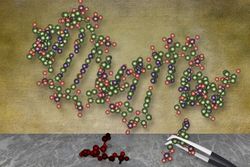
CrispUsing a new gene-editing system based on bacterial proteins, MIT researchers have cured mice of a rare liver disorder caused by a single genetic mutation. The findings, described in the March 30 issue of Nature Biotechnology, offer the first evidence that this gene-editing technique, known as CRISPR, can reverse disease symptoms in living animals. CRISPR, which offers an easy way to snip out mutated DNA and replace it with the correct sequence, holds potential for treating many genetic disorders, according to the research team. “What’s exciting about this approach is that we can actually correct a defective gene in a living adult animal,” says Daniel Anderson, the Samuel A. Goldblith Associate Professor of Chemical Engineering at MIT, a member of the Koch Institute for Integrative Cancer Research, and the senior author of the paper.

The recently developed CRISPR system relies on cellular machinery that bacteria normally use to defend themselves from viral infection. Researchers have copied this cellular system to create new gene-editing complexes, which include a DNA-cutting enzyme called Cas9 bound to a short RNA guide strand. The strand is programmed to bind to a specific genome sequence, telling Cas9 where to make its cut. At the same time, the researchers also deliver a DNA template strand. When the cell repairs the damage produced by Cas9, it copies from the template, introducing new genetic material into the genome. Scientists envision that this kind of genome editing could one day help treat diseases such as hemophilia, Huntington’s disease, and others that are caused by single mutations.

More here.

Thursday Poem

Astronomy Lesson

The two boys lean out on the railing

of the front porch, looking up.
Behind them they can hear their mother
in one room watching “Name That Tune,”
their father in another watching
a Walter Cronkite Special, the TVs
turned up high and higher till they
each can’t hear the other’s show.
The older boy is saying that no matter
how many stars you counted there were
always more stars beyond them
and beyond the stars black space
going on forever in all directions,
so that even if you flew up
millions and millions of years
you’d be no closer to the end
of it than they were now
here on the porch on Tuesday night
in the middle of summer.
The younger boy can think somehow
only of his mother’s closet,
how he likes to crawl in back
behind the heavy drapery
of shirts, nightgowns and dresses,
into the sheer black where
no matter how close he holds
his hand up to his face
there’s no hand ever, no
face to hold it to.

Read more »

What plaster casts from Pompeii tell us about death…and life

Morgan Meis in The Smart Set:

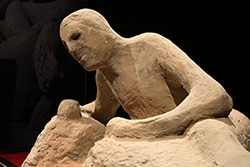
ID_IC_MEIS_POMPE_AP_001Sometime during the late summer, or perhaps the early fall, of the year 79 C.E., Mount Vesuvius erupted near Naples. The result was instant death for the people, plants, and animals in the Roman town of Pompeii, which is about five miles from Mount Vesuvius. A Volcanologist named Giuseppe Mastrolorenzo recently (2010) published a definitive study of death in Pompeii. The living things, he concluded, died from the intense heat of the volcanic blast. Basically, they were flash fried. In one of the multiple pyroclastic surges produced by the eruption, “temperatures outdoors — and indoors,” wrote Mastrolorenza, “rose up to 570°F and more, enough to kill hundreds of people in a fraction of a second.”

The ash and the volcanic mud came a little later. Pompeii was buried under this ash and volcanic matter, preserving the town in the instant in which it had been flash fried. The world then gradually forgot about Pompeii. It had been wiped from the face of the earth. Then, at the end of the 16th century, Pompeii began to resurface. The accidents of weather, of rain and flood and earthquake and further volcanic eruptions brought bits of the city back into the light of day. It took many years for people to realize that what was down there was Pompeii. It wasn’t until the mid-18th century that excavation of the city was begun in earnest. The excavation has been going on ever since. There are still objects and structures being discovered.

In the 1860s, something else incredible happened at Pompeii. A man named Giuseppe Fiorelli was named director of excavations at the site. Ingrid D. Rowland writes about Fiorelli in her new book, From Pompeii: The Afterlife of a Roman Town (Harvard University Press, 2014). Fiorelli, Rowland writes, “was one of the first archeologists to excavate stratigraphically, that is, by removing layers of earth from the top down.” With this method of archeology, Fiorelli and his team began to notice “oddly shaped bubbles” in the layers of ash. Fiorelli came up with an ingenious idea. He shot liquid plaster down into those bubbles. When the plaster hardened, the shapes could be dug out from the earth and ash. The bubbles, it turned out, were the molds created in the ash from the objects and physical bodies (people, animals) that had been covered in the ash after the eruption, and which had then decomposed. The bubbles didn’t collapse, since the ash had hardened over the centuries. As Rowland puts it, “the organic remains of the town survived as hollow voids within the pumice.”

More here.

Wednesday, April 9, 2014

Rich People Rule!

183654828

Larry Bartels in The Washington Post (via Andrew Sullivan):

Everyone thinks they know that money is important in American politics. But howimportant? The Supreme Court’s Gilded Age reasoning in McCutcheon v. FEC has inspired a flurry of commentary regarding the potential corrosive influence of campaign contributions; but that commentary largely ignores the broader question of how economic power shapes American politics and policy. For decades, most political scientists have sidestepped that question, because it has not seemed amenable to rigorous (meaning quantitative) scientific investigation. Qualitative studies of the political role of economic elites have mostly been relegated to the margins of the field. But now, political scientists are belatedly turning more systematic attention to the political impact of wealth, and their findings should reshape how we think about American democracy.

A forthcoming article in Perspectives on Politics by (my former colleague) Martin Gilens and (my sometime collaborator) Benjamin Page marks a notable step in that process. Drawing on the same extensive evidence employed by Gilens in his landmark book “Affluence and Influence,” Gilens and Page analyze 1,779 policy outcomes over a period of more than 20 years. They conclude that “economic elites and organized groups representing business interests have substantial independent impacts on U.S. government policy, while mass-based interest groups and average citizens have little or no independent influence.”

Average citizens have “little or no independent influence” on the policy-making process? This must be an overstatement of Gilens’s and Page’s findings, no?

More here.

The Mathematical World

EGGS

James Franklin in Aeon:

To the question: ‘Is mathematics about something?’ there are two answers: ‘Yes’ and ‘No’. Both are profoundly unsatisfying.

The ‘No’ answer, whose champions are known as nominalists, says that mathematics is just a language. On this view, it is just a way of talking about other things, or a collection of logical trivialities (as Singer claims), or a formal manipulation of symbols according to rules. However you cut it, it is not really about anything. Those whose encounter with mathematics at school was less than happy (‘Minus times minus equals plus/The reason for this we need not discuss’) might feel some sympathy with the nominalist picture. Then again, it is also a view that appeals to physicists and engineers who regard serious propositions about reality as their business. They look on tables of Laplace transforms and other such mathematical paraphernalia as, in the words of the German philosopher Carl Hempel, ‘theoretical juice extractors’: useful for getting extra sense out of meaty physical propositions, but not contentful in themselves.

Nominalism might have a certain down-to-earth appeal, but further reflection suggests that it can’t be right. Although manipulation of symbols is useful as a technique, we also have a strong sense that mathematics makes objective discoveries about a terrain that is in some sense ‘out there’. Take the subtleties of the distribution of primes. Some numbers are prime, some not. A dozen eggs can be arranged in cartons of 6 × 2 or 3 × 4, but eggs are not sold in lots of 11 or 13 because there is no neat way of organising 11 or 13 of them into an eggbox: 11 and 13, unlike 12, are prime, and primes cannot be formed by multiplying two smaller numbers. The idea is very easy to grasp. But this doesn’t mean there’s nothing to discover about it.

More here.

Why Only Half of Venezuelans Are in the Streets

Screen-Shot-2014-04-09-at-10.07.22-AM

Dorothy Kronick in FiveThirtyEight:

One year after the death of former president Hugo Chávez, these six weeks of protest reveal a country still profoundly split over Chávez’s political project. On one side are those protesting his successor, Nicolás Maduro, who narrowly won last year’s presidential election; on the other are government supporters who see no viable alternative to Chavismo. Asking, “If not this, then what?” Venezuelans cannot find a common answer.

They disagree over a political vision for their country in part because they measure Chavismo against two different benchmarks: Chavistas compare the present to Venezuela’s pre-Chávez past, while the opposition contrasts the current economic situation with more recent developments in the rest of Latin America.

Many government supporters measure life under Bolivarian socialism — as Chávez called his political program — against life under Chávez’s immediate predecessors. Mismanagement of Venezuela’s 1970s oil boom and of the ensuing collapse made the 1980s and 1990s one long economic nightmare. Severe deprivations led to riots, multiple coup attempts and, eventually, to the election of Chávez, then a political outsider. Relative to the foregoing disaster, Venezuelans did fare well under Bolivarian socialism: Incomes grew and poverty declined.

More here. Over at Jacobin, Mark Weisbrot responds:

The thesis of the article is strange. Correctly noting that the political polarization in Venezuela is overwhelmingly along class lines, with the upper-income groups tending to support the protests and lower-income Venezuelans supporting the government, she asks rhetorically, “Why the divide?” and answers:

They disagree over a political vision for their country in part because they measure Chavismo against two different benchmarks: Chavistas compare the present to Venezuela’s pre-Chávez past, while the opposition contrasts the current economic situation with more recent developments in the rest of Latin America.

I think what she means to say is that Chavismo looks better as compared with Venezuela’s pre-Chávez era than it does compared with the rest of Latin America. The first part is a no-brainer: per capita GDP actually fell by more than fifteen percent in the twenty years prior to Chávez (1978-98). However, there is no evidence that the two sides are making any such different comparisons. Do voters anywhere in the world judge their government based on a comparison to its peers? If that were the case in the US, for example, President Obama’s approval ratings would be very high and the Democrats would be sailing to a landslide victory in November’s congressional elections because the relevant income-level comparison for the US is Europe, which has done vastly worse in the recovery from the Great Recession since 2009.

More here.