
by Brooks Riley
Category: Recommended Reading
Sunday, April 13, 2014
Welcome to the Jungle
Steven Malanga in City Journal:

Chagnon later learned that the men were edgy because raiders from a neighboring settlement had abducted seven of their women the day before. The next morning, the villagers counterattacked and recovered five of the women in a brutal club fight. As Chagnon recounts in Noble Savages: My Life Among Two Dangerous Tribes—The Yanomamo and the Anthropologists (originally published in 2013 and now appearing in paperback), he spent weeks puzzling over what he had seen. His anthropology education had taught him that kinsmen—the raiders were related to those they’d attacked—were generally nice to one another. Further, he had learned in classrooms that primitive peoples rarely fought one another, because they lived a subsistence lifestyle in which there was no surplus wealth to squabble about. What other reason could humans have for being at one another’s throats?
More here.
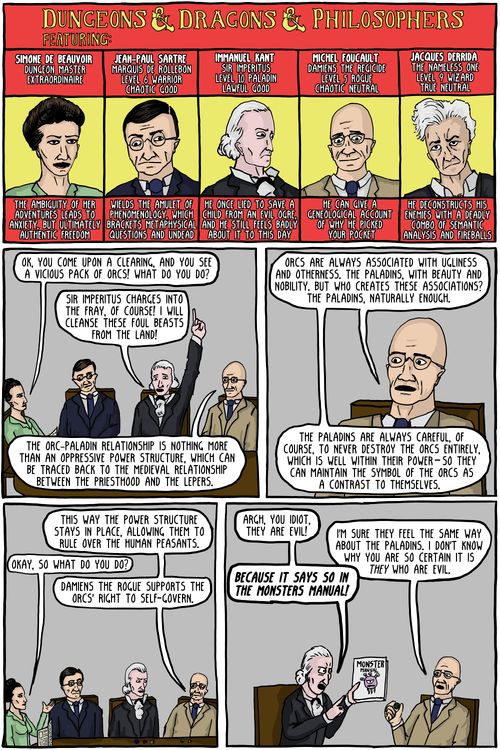
Dungeons and Dragons and Philosophers
Over at Existential Comics:
Five Ways of Looking at Steve Reich

David Meir Grossman in Tablet (Steve Reich, 2005. (Photo treatment Tablet Magazine; original photo Jeffrey Herman):
1. “You’re floating 10 feet off the Earth. Try to put your feet on the ground and ask the next question.” It’s Wednesday, March 26, and Steve Reich is haranguing me for my sucky interviewing skills. We’re talking over the phone because it’s two days before the Big Ears Festival, in Knoxville, Tenn., which Reich is headlining. That he’s less than pleased with my interviewing ability is in fact only making me more nervous, because Reich is a legitimate genius who has changed the shape of his chosen field. The New York Times called him “our greatest living composer,” and The New Yorker has said he’s “the most original musical thinker of our time.” So, if he says I’m blowing this, he’s probably right.
Reich is impatient, a quality that surely comes from having a mind that works 10 times faster than everyone else’s, most definitely including mine. At one point in our conversation I try to suggest that “WTC 9/11,” his disturbing 15-minute meditation on Sept. 11 that came out in 2011, reminds me of the Internet. The piece, written for the Kronos Quartet, uses one of Reich’s several trademark techniques, that of vocal sampling. Unlike other Sept. 11-related pieces, “WTC” does not offer redemption. Reich bumps the pre-recorded voices—friends, air-traffic controllers, first responders, cantors—shoulder-to-shoulder and cuts off the words mid-sentence, only to complete them later. It’s a tension-filling technique and can call to mind the way conversations take place over the Internet. Reich sees where I’m going with this and pointedly cuts me off. “I don’t follow chats, I don’t find it very interesting to do that. What I was doing on ‘WTC’ had nothing to do with the Internet whatsoever, OK?”
More here.
Wherever You Live, it is Probably Egypt: Thoughts on Passover

Corey Robin in Crooked Timber (image from Wikimedia Commons):
The first night of Passover is on Monday, and I’ve been thinking about and preparing for the Seder. I had a mini-victory this morning, when I was shopping for fish in Crown Heights. The guy at the fish store told me that thanks to the Polar Vortex, 90% of Lake Huron is frozen. Which means no whitefish. Which means no gefilte fish. So I put on my best impression of Charlotte in Sex and the City —”I said lean!”—and managed, through a combination of moxie and charm, to get him to give me the last three pounds of whitefish and pike in Crown Heights. Plus a pound of carp. Which means…gefilte fish!
Food is the easy part of the seder. The hard part is making it all mean something. When I was a union organizer, I used to go to freedom seders. Being part of the labor movement, I found it was easy to to see points of connection between what I was doing and this ancient story of bondage, struggle, and emancipation (a story, however, that we never seem to really tell at Passover).
Then, as my feelings about Zionism became more critical, I found a new point of connection to Passover: using the Seder, and the Exodus story, as a moment to reflect upon the relationship between the Jews, the land of Israel, and possession of that land, to ask why we think of emancipation in terms of possession. For a while there, we’d hold seders with readings fromMichael Walzer’s Exodus and Revolution and Edward Said’s brilliant critique of Walzer inGranta: “Michael Walzer’s Exodus and Revolution: A Canaanite Reading.”
But nowadays, the Seder is harder for me. I’m more puzzled by the meaning of slavery and emancipation; I find it more difficult to make the connections I used to make. The Haggadah seems stranger, more remote, than ever.
More here.
Parental Involvement Is Overrated

Keith Robinson and Angel Harris in the NYT (image from Wikimedia Commons):
Over the past few years, we conducted an extensive study of whether the depth of parental engagement in children’s academic lives improved their test scores and grades. We pursued this question because we noticed that while policy makers were convinced that parental involvement positively affected children’s schooling outcomes, academic studies were much more inconclusive.
Despite this, increasing parental involvement has been one of the focal points of both President George W. Bush’s No Child Left Behind Act and President Obama’s Race to the Top. Both programs promote parental engagement as one remedy for persistent socioeconomic and racial achievement gaps.
We analyzed longitudinal surveys of American families that spanned three decades (from the 1980s to the 2000s) and obtained demographic information on race and ethnicity, socioeconomic status, the academic outcomes of children in elementary, middle and high school, as well as information about the level of parental engagement in 63 different forms.
What did we find? One group of parents, including blacks and Hispanics, as well as some Asians (like Cambodians, Vietnamese and Pacific Islanders), appeared quite similar to a second group, made up of white parents and other Asians (like Chinese, Koreans and Indians) in the frequency of their involvement. A common reason given for why the children of the first group performed worse academically on average was that their parents did not value education to the same extent. But our research shows that these parents tried to help their children in school just as much as the parents in the second group.
Even the notion that kids do better in school when their parents are involved does not stack up.
More here.
The Real Darwin Fish
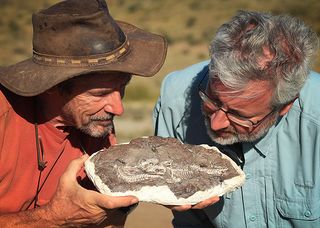
Chris Mooney in Slate (photo via PBS):
We all know the Darwin fish, the car-bumper send-up of the Christian ichthys symbol, or Jesus fish. Unlike the Christian symbol, the Darwin fish has, you know, legs.
But the Darwin fish isn't merely a clever joke; in effect, it contains a testable scientific prediction. If evolution is true, and if life on Earth originated in water, then there must have once been fish species possessing primitive limbs, which enabled them to spend some part of their lives on land. And these species, in turn, must be the ancestors of four-limbed, land-living vertebrates like us.
Sure enough, in 2004, scientists found one of those transitional species: Tiktaalik roseae, a 375-million-year-old Devonian period specimen discovered in the Canadian Arctic by paleontologist Neil Shubin and his colleagues. Tiktaalik, explains Shubin on the latest episode of the Inquiring Minds podcast, is an “anatomical mix between fish and a land-living animal.”
“It has a neck,” says Shubin, a professor at the University of Chicago. “No fish has a neck. And you know what? When you look inside the fin, and you take off those fin rays, you find an upper arm bone, a forearm, and a wrist.” Tiktaalik, Shubin has observed, was a fish capable of doing a push-up. It had both lungs and gills. In sum, it's quite the transitional form.
More here.
doc watson
peter mathiessen (1927-2014)
a smile to remember
Class war exposes India’s dark heart
Kavita Bhanot reviewsThe Gypsy Goddess by Meena Kandasamy in The Independent:
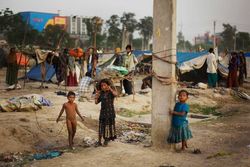
In some of the novel's most stunning passages, the attack itself is described, as the fire “lick[s] away” at its victims. Then there is the battle for justice, an impossible fight when the police are on the side of the landlords, when the political and legal system are disconnected from the lives of those at the very bottom. The long trial, in a language they don't understand (English) is like an absurd play for the villagers who seek justice: “How can they sit for so long in one place and silently listen?” asks one of the characters. “Even my buttocks have fallen asleep on this bench.”
More here.
Sunday Poem
The Tree
.
The tree my father grew
from his garden I take an axe
and branch by branch
I break the tree
and set to work
the million maddened bits,
the fire of night.
Only for ash I keep.
.
by Daljitt Nagra
from Look We Have Coming Dover
Faber and Faber, London 2007
Saturday, April 12, 2014
Brandeis and the Cancellation of Ayaan Hirsi Ali’s Honorary Degree

First, Ali Gharib in the Forward makes the case for the cancellation, at The Forward's Foward Thinking:
The university, in tandem with its notice to Hirsi Ali that her award was rescinded, invited her to campus to expound on her views in a forum that did not confer upon her any honor.
That latter invitation was the lynchpin in Brandeis’s strategy to correct its mistake — the initial offer of an honor — in the best way possible: by preserving the notion that universities should be bastions of free thought, even for deeply unpopular ideas.
And it is that invitation which renders moot Hirsi Ali’s complaint that “neither Brandeis nor my critics knew or even inquired as to what I might say. They simply wanted me to be silenced.” The issue with honoring Hirsi Ali was never what she may say — hence the standing invitation to speak — but rather what she has said.
Hirsi Ali’s record is plump with remarks that any tolerant, liberal institution should view with caution. Her personal narrative and work on women’s rights may tell a different, laudable story, but not one that outweighs the pattern of hostility toward a major world religion.
This hostility crosses boundaries beyond atheistic skepticism and into literal militant opposition to one faith in particular: Islam. Hirsi Ali claims her “critics have long specialized in selective quotation – lines from interviews taken out of context – designed to misrepresent me and my work.”
More here. Ayaan Hirsi Ali comments on the whole incidence, in The Weekly Standard:
When Brandeis approached me with the offer of an honorary degree, I accepted partly because of the institution’s distinguished history; it was founded in 1948, in the wake of World War II and the Holocaust, as a co-educational, nonsectarian university at a time when many American universities still imposed rigid admission quotas on Jewish students. I assumed that Brandeis intended to honor me for my work as a defender of the rights of women against abuses that are often religious in origin. For over a decade, I have spoken out against such practices as female genital mutilation, so-called 'honor killings,' and applications of Sharia Law that justify such forms of domestic abuse as wife beating or child beating. Part of my work has been to question the role of Islam in legitimizing such abhorrent practices. So I was not surprised when my usual critics, notably the Council of American-Islamic Relations (CAIR), protested against my being honored in this way.
What did surprise me was the behavior of Brandeis. Having spent many months planning for me to speak to its students at Commencement, the university yesterday announced that it could not “overlook certain of my past statements,” which it had not previously been aware of. Yet my critics have long specialized in selective quotation – lines from interviews taken out of context – designed to misrepresent me and my work. It is scarcely credible that Brandeis did not know this when they initially offered me the degree.
More here.
“Against World Literature”: The Debate in Retrospect

Gloria Fisk in The American Reader:
“World literature” is as heavily freighted as any of Apter’s Untranslatables, and many of its common usages have only slight relation to literary texts. It has worked historically to map the lines of inheritance—cultural and otherwise—that separate high from low, smart from dumb, timeless from temporary, haves from have-nots. When Goethe invoked weltliteratur in the early nineteenth century, it was to imagine how German poetry would supersede other nations’ to become “the universal possession of mankind, revealing itself everywhere and at all times in hundreds and hundreds of men.” That assertion of the global value of local goods was built intoweltliteratur from the start, and Karl Marx borrowed the term decades later to theorize the economic value Goethe implied. For Marx, world literature was a cultural effect of economic compulsion, a testimony to the market imperative that “chases the bourgeoisie over the surface of the whole globe,” compelling them to “nestle everywhere, settle everywhere, establish connections everywhere.”
World literature still connotes an expansionary move that is distinctly capitalistic, and Apter makes that connotation work for her purposes. Addressing an audience that imagines the university in opposition to corporate interests, she yokes the scholarly impulse to “anthologize” and “curricularize” to the imperative to monetize that chased Marx’s bourgeoisie across their national borders. Establishing that loose rhyme between world literature and the economic processes of globalization, she frames her argument about Untranslatables as a critique of them both, although she does not address any economic questions directly. She renders herself an occupier of Wall Street—and an opponent of corporate influence in higher education—without leaving the subject of literary theory.
More here.
7 Lectures on Nietzsche by Raymond Geuss
The first lecture was not uploaded, but you can find an intro summary here.
Sue Townsend – ‘a lone voice, a humanist and a genius’
Ian Rankin, Michael Rosen, Jonathan Coe, Alexis Petridis, Bob and Roberta Smith, Susan Calman, Frank Cottrell Boyce, Robin Ince, Luke Wright, Isy Suttie in The Guardian:

More here.
The Cubs of Wall Street
Chris Hayes in The New York Times:
As chronicled in Kevin Roose’s “Young Money,” this is basically how the first two years of a Wall Street investment banker’s life work. Roose found eight young aspirants who agreed to let him into their lives in exchange for anonymity, and he follows their trajectories as they move from college internships to grueling lives as Wall Street grunts. (One note of caution: In order to protect his sources’ anonymity, Roose writes in a prologue that “many personal details have been altered or obscured, and a few events have been reordered chronologically or given minor tweaks to make them less recognizable to the people involved.” That stuck with me as I read the book and had to wonder just what “events” and “personal details,” which are the stuff of narrative, weren’t actually accurate.)
More here.
money

Most people are used to owing money to others, but few think about what money may owe us: an equitable society, a functioning political system, a peaceful economy that can stay off the exhausting roller coaster of financial booms and crashes.
We don’t usually think of money as a tool to accomplish all that, but Felix Martin, an economist and former World Bank official and author of the compulsively readable new book “Money: The Unauthorized Biography,” says that money can give us all those things; it can deliver “both stability and freedom.” The catch is that we must radically rethink money itself. It’s not a fixed, physical thing, he argues, but a virtual “social technology” that should be used to enable a more democratic and equitable world, bring order to the banking system and foster “peace, prosperity, freedom and fairness.” Sign me up.
Martin’s best stories remind us of the quirky ways money existed in the past. He opens the book late in the 19th century in Yap, a Pacific island that favored as its currency enormous stone wheels the size of boulders. One especially rich family’s only proof of their wealth was a boulder at the bottom of the sea. (Talk about underwater homeowners.)
more here.
the unique literature of lydia davis
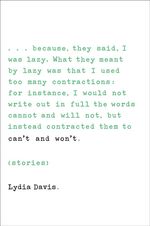
We seem to be reaching a consensus that there is something distinctly new about what Lydia Davis does. After awarding her the 2013 International Booker Prize over a slate of titans like Marilynne Robinson, Russia’s Vladimir Sorokin, and India’s Intizar Husain, the author and critic Tim Parks said that Davis deserved the award because he and his co-jurists “felt that we were reading something we hadn’t read before in any shape or form—that it really was sparkling and new and fresh, a new form for the short story, and that carried the day in the end.” Even discounting the hyped-up language of major literary awards, the claim is staggering: he essentially says that Davis is head and shoulders above nine of the greatest living writers in the world.
Such heady praise may owe something to the International Booker’s provincialism (Davis is their third Anglo out of five awards), but bear in mind that Parks is an estimable reader, and, more importantly, he is not alone. In awarding Davis one of its prestigious fellowships in 2007, the MacArthur Foundation raved, “eschewing the conventions of plot, character, and drama, Davis shows how language itself can entertain, how all that what one word says, and leaves unsaid, can hold a reader’s interest.” She “grants readers a glimpse of life’s previously invisible details, revealing new sources of philosophical insight and beauty.”
more here.
On the music of Kurt Cobain, 20 years after his death

Grunge was often defined by its negativity. It was not a rebellious negativity but a passive negation, a cancelling out. If you asked grunge what it was for, the answer was, supposedly, “Nothing.” The same answer might be given if you asked grunge what it was against. This sentiment was encapsulated by Kurt Cobain’s famous – and perhaps most enduring – lyric, “Oh well, whatever, nevermind.” The sullen indifference (sometimes referred to as irony) of grunge – and the generation that produced it – was mind-boggling and infuriating to the generation of the 1940s, 50s and 60s, generations defined by wars and causes. Grunge had no external wars, no causes that felt immediate enough to be worth fighting for. The grunge generation was said to be internal – in other words, self-absorbed. This was true. Grunge looked mostly inward, as its war was with and about itself. Musically speaking, grunge’s most direct influence was punk. But where the full-blown nihilism and shock of punk still had the touch of theatre and play, grunge was all the more desperate for feeling it had nothing really to show. Punk was shredded, ripped-apart, exploded. Punk was dyed in brilliant colors, adorned with metal and combat boots. Punk was furious. “Kick over the wall, cause government’s to fall,” sang The Clash. Grunge was torn, faded, uncombed. It was the sweater your friend found in a thrift store and annoyingly left on your floor for a month, which you decided to start wearing for lack of initiative to get your own sweater. The image of grunge was, essentially, that of a homeless person.
more here.