
Category: Recommended Reading
Ali Dayan Hasan: The Wrong Kind of Pakistani
Ali Dayan Hasan in Guernica:
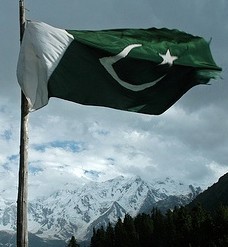
I should just be grateful that my friend Raza is alive. I was. I am.
But then, to come to terms with my relief, I engaged in an act of self-destructive rebellion—foolhardy, irresponsible and potentially fatal. I went for a long drive through the streets of Lahore, alone. As people often do. As I did often until “security-related restricted movement” became an embarrassing part of my life. As Raza could have possibly, until recently, when the price of life became self-imposed house arrest or exile for him.
More here.
Massachusetts Maverick
Amy Chozick in The New York Times:

…Before she ran for office, she had become a leading expert in debates about predatory lending practices and bankruptcy legislation, as well as a thorn in the financial industry’s side. The idea that some banks are too big to fail, Warren writes in “A Fighting Chance,” “allows the megabanks to operate like drunks on a wild weekend in Vegas.” Families who fall behind on their debts are usually “desperately ashamed of their situation,” and have been saddled with health care costs or tricked into taking out subprime mortgages with egregious terms hidden in the fine print. That message first brought Warren national attention with her 2003 book, “The Two-Income Trap: Why Middle-Class Parents Are Going Broke,” written with her daughter, Amelia Warren Tyagi. In that book, they wrote about a meeting with Hillary Clinton in 1998 to discuss bankruptcy protections for struggling middle-class families. (Before Warren began her pitch the first lady “snapped her head sharply to the side and called to no one in particular, ‘Where’s lunch? I’m hungry.’ ”)
More here.
Saturday Poem
Pigs
Us all on sore cement was we.
Not warmed then with glares. Not glutting mush
under that pole the lightning's tied to.
No farrow-shit in milk to make us randy.
Us back in cool god-shit. We ate crisp.
We nosed up good rank in the tunnelled bush.
Us all fuckers then. And Big, huh? Tusked
the balls-biting dog and gutsed him wet.
Us shoved down the soft cement of rivers.
Us snored the earth hollow, filled farrow, grunted.
Never stopped growing. We sloughed, we soughed
and balked no weird till the high ridgebacks was us
with weight-buried hooves. Or bristly, with milk.
Us never knowed like slitting nor hose-biff then.
Nor the terrible sheet-cutting screams up ahead.
The burnt water kicking. This gone-already feeling
here in no place with our heads on upside down.
by Les Murray
from Translations from the Natural World, 1992
Thomas Piketty on Wealth, Income and Inequality
The Accidental Controversialist: Deeper Reflections on Thomas Piketty’s “Capital
Thomas Palley over at his website [h/t: Mona Ali]:
Using a conventional marginal productivity framework, Piketty provides an explanation of rising inequality based on increases in the gap between the marginal product of capital, which determines the rate of profit (r), and the rate of growth (g). Because capital ownership is so concentrated, a higher profit rate or slower growth rate increases inequality as the incomes of the wealthy grow faster than the overall economy.
The conventional character of Piketty’s theoretical thinking rears its head in his policy prescriptions. His neoclassical growth framework leads him to focus on taxation as the remedy. There is little attention to issues of economic institutions and structures of economic power because these are not part of the neoclassical framework. That substantially explains progressive economists’ diffident embrace of the book. Furthermore, even if technically feasible, Piketty’s tax prescriptions are politically naïve given capital increasingly controls the political process.
These features have led some critics to raise old “Cambridge” arguments about the intellectual incoherence of marginal productivity income distribution theory. Critics also assert Piketty conflates physical and financial capital, overlooking the role of finance in determining rates of return and patterns of income and wealth distribution. There are two problems with these responses. First, mainstream economists determined long ago to turn a blind eye and deaf ear to such arguments. Second, these arguments miss the bulls-eye which is the nature of capitalism.
A better response is for critics to stick with the rate of profit versus growth argument while dumping the neoclassical marginal productivity aspect of Piketty’s theoretical argument. Mainstream economists will assert the conventional story about the profit rate being technologically determined. However, as Piketty occasionally hints, in reality the profit rate is politically and socially determined by factors influencing the distribution of economic and political power.
More here.
Friday, April 25, 2014
Revolutionary Russia

In all revolutions there comes a moment when the high ideals of the revolutionaries crash onto the hard rocks of reality. In Russia that moment came in March 1921, when the Bolsheviks retreated from their first attempt to introduce a planned economy—by which they had thought to impose communism by decree—and let back elements of private trade to rescue their regime from popular rebellions.
Chronic shortages had built up over seven years of war, revolution, and the Civil War, especially in the austere years of the latter, between 1918 and 1920, when the Red Army had fought against the Whites, and leather-jacketed commissars had waged another war on the market.
Townsmen traveled to the countryside to barter with the peasants, who were reluctant to sell foodstuffs for paper money when there was nothing they could buy with it. They left with bags of clothes and household goods to sell or exchange in the rural markets and returned with bags of food. The railways were paralyzed by these armies of “bagmen.”
more here.
Thomas Piketty Undermines the Hallowed Tenets of the Capitalist Catechism
Jeff Faux in The Nation:

“Abundance”, observed the late sociologist Daniel Bell was “the American surrogate for socialism.” As the economic pie expands, everyone’s slice grew bigger.
The three-decade long boom that followed World War II seemed to prove Bell’s point, tossing Karl Marx’s forecast of capitalism’s collapse into the dustbin of history.
Marx predicted that as markets expand, profits from technological innovation would gradually dry up, depressions would get more severe and capitalists would drive labor’s share of income in the advanced industrial economies so low that revolution was inevitable.
But twentieth-century capitalism proved more resilient than Marx thought. New technologies continued to generate more profits and jobs. Keynesian fiscal and monetary policies prevented cyclical business downturns from triggering depressions. And the investor class, threatened by the specter of communism, agreed, grudgingly, to the New Deal model of strong unions, social insurance and other policies that forced them to share the profits from rising productivity with their workers.
More here.
writing john updike
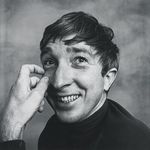
Updike’s longtime friend Joyce Carol Oates has published more books than he did. His admirer Philip Roth has won more prizes and awards. (Roth has accumulated something like fifty-five to date; Updike racked up more than thirty, including the Bad Sex in Fiction Lifetime Achievement Award, in 2008, an honor that has thus far eluded Roth.) But Updike acquired, early on, a singular reputation for effortless virtuosity and steady professional recognition.
He began as a prodigy—in his nineteen months as a staff writer, The New Yorkerpublished eighty items by him—and he somehow remained one. His style never chastened or mellowed or became grand with age. He was forever the wise boy. Even after he had published all those books and won all those prizes, he still radiated precocity.
All of which makes him a challenge for a biographer. Updike spent almost his entire life writing; he had very few professional tribulations; and whatever personal adventures he had, no matter how private, he turned into fiction.
more here.
Would Chekhov have stood up to Putin?
Rosamund Bartlett in The Telegraph:
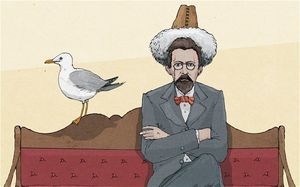
Chekhov never imagined that his bracing account of the practical obstacles involved in pursuing amorous liaisons would see the light of day, and for nearly a century after his death it didn’t. Along with salacious accounts of encounters with Japanese prostitutes and outspoken references to indelicate parts of the anatomy, it was surgically excised from editions of his Collected Works first by Chekhov’s squeamish sister, who lived until the Fifties, and then by the Soviet establishment.
More here.
Recycling: You May Be Doing It Wrong
Helen Thompson in Smithsonian:

Don’t put your recyclables in a plastic bag.
It’s not that we don’t have the technology to recycle plastic bags. They just cause a lot of issues in the recycling process. Though the type of plastic (#2 and #4) that’s used to make plastic bags is recyclable, throwing them in with the rest of your recycling has ramifications down the line. “Plastic bags cause problems in all of our operations,” says Reed. “They wrap around and jam recycling equipment. They contaminate paper bales. They cause problems at our compost facilities. They blow off of landfills and wind up in waterways and oceans and seas.” If you accumulate a lot of plastic bags, your best options might be recycling programs that focus exclusively on them. Many grocery stores collect plastic bags, and some city recycling programs offer plastic bag pick-up or drop-off programs. In some cases, recycling programs may ask users to put items like packing chips or shredded paper in plastic bags.
More here.
Let the Past Collapse on Time!
Vladimir Sorkin in NY Review of Books:

The fury of our politicians’ and bureaucrats’ response to the mass destruction of Soviet idols in Ukraine is revealing. You might think, why pity symbols of the past? But Russian bureaucrats understand that their beloved Homo sovieticus crumbled along with Lenin. “They are destroying monuments to Lenin because he personifies Russia!” one politician exclaimed. Yes: Soviet Russia and the USSR, the ruthless empire, built by Stalin, that enslaved whole peoples, created a devastating famine in Ukraine, and carried out purges and mass repressions. The recent Ukrainian revolution was indeed directed against the heirs of that empire—Putin and Yanukovych. It is telling that pro-Russian demonstrations in Crimea and eastern parts of Ukraine invariably took place next to statues of Lenin.
Unfortunately, what happened in recent weeks in Ukraine did not happen in Russia in 1991. Yeltsin’s revolution ended up being “velvet”: it did not bury the Soviet past and did not pass judgment on its crimes, as was the case in Germany after World War II. All those Party functionaries who became instant “democrats” simply shoved the Soviet corpse into a corner and covered it with sawdust. “It will rot on its own!” they said.
Read the rest here.
It Wasn’t Just a European War: WWI in Arabia
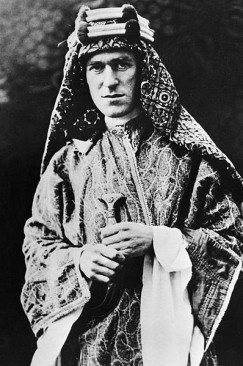
Shehryar Fazli in the Los Angeles Review of Books:
More here.
Alan Lightman: Is the Universe an Accident?
The Hamid Mir case: ‘In Pakistan, they used to censor journalists – now they shoot us’
On Saturday in Karachi, one of Pakistan's most famous journalists survived being shot six times. Soon after, the TV news channel he works for blamed the feared Inter-Services Intelligence agency for the attack. Author Mohammed Hanif reports on a fourth estate under siege.
Mohammed Hanif in The Guardian:
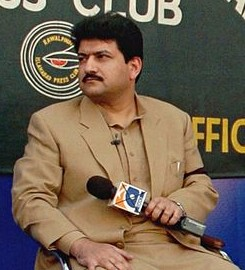
Mir is upstairs recuperating. He took six bullets – in the ribs, thigh, stomach and across his hand – in an assassination attempt on Saturday as he came out of the airport to present a special broadcast on Geo, Pakistan's largest news channel. Mir had warned about a possible assassination. He had also named his would-be killers. That's what his brother claims, that's what his colleagues and managers at the channel say. Geo, just after the attack, broadcast the allegation and, in an unprecedented move, also flashed the picture of the accused: the head of Pakistan's Inter-Services Intelligence chief, Lieutenant General Zaheer ul-Islam. In that picture he comes across as a big man. We are not supposed to know much about him except the fact that he is a very professional general. According to an internet myth very popular in Pakistan, the ISI has been rated as the world's No 1 intelligence agency: Mossad is No 5 and MI6 languishes at No 9. According to television ratings, the man with three bullets still in his body is Pakistan's top-rated TV journalist and one of the most vocal critics of Pakistan's military and intelligence agencies.
More here.
Friday Poem
Porpoise
Every year, when we're fly-fishing for tarpon
off Key West, Guy insists that porpoises
are good luck. But it's not so banal
as catching more fish or having a fashion
model fall out of the sky lightly on your head,
or at your feet depending upon certain
preferences. It's what porpoises do to the ocean.
You see a school making love off Boca Grande,
the baby with its question mark staring
at us a few feet from the boat.
Porpoises dance for as long as they live.
You can do nothing for them.
They alter the universe.
by Jim Harrison
from The Shape of the Journey
Copper Canyon Press, 1998
Thursday, April 24, 2014
The War on Reason
Paul Bloom in The Atlantic:
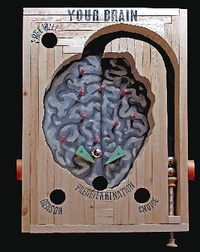
This conception of what it is to be a person fits poorly with our sense of how we live our everyday lives. It certainly feels as though we make choices, as though we’re responsible for our actions. The idea that we’re entirely physical beings also clashes with the age-old idea that body and mind are distinct. Even young children believe themselves and others to be not just physical bodies, subject to physical laws, but also separate conscious entities, unfettered from the material world.
More here.
Capital in the Twenty-First Century: A Discussion with Thomas Piketty, Joseph Stiglitz, Paul Krugman, Steven Durlauf, and Branko Milanovic
DeLong on Piketty
Brad DeLong over at his blog (image from Wikimedia commons):
How to sum up the argument of and the reaction to Thomas Piketty?…
In the communities in which I live and work, everybody is very impressed with Thomas Piketty's Capital in the Twenty-First Century. We are impressed with the amount of work that he and his colleagues have put into data collection, data assembly, and date cleaning. We are impressed with the amount of thought that has gone into the caddies attempt to understand the issue. Very impressed with how skillfully he has written his book. We are impressed with how much Arthur Goldhammer has sweated blood with the translation. And we are impressed with the intelligence with which he is constructed as arguments.
Now everybody has their complaints.
Everybody has 10-20% of the argument that they disagree with, and perhaps another 10 to 20% that they are unsure about. But it is a different 30% for everybody. There is not consensus but majority agreement that each piece of the book is roughly correct. And so there is rough near-consensus that the argument of the book is, broadly, right.
What are the serious complaints?
1. That Piketty tacks back-and-forth between a market value–the capitalized current value of all claims on income that are not brow-sweat– and a physical quantity conception of capital in a way that is not legitimate. That leads his argument astray in places, particularly in that it hides the fact that the capital accumulation that makes the rich so much richer also strengthens, or ought to strengthen, the bargaining power in the labor market of the not-so-rich, and so increased relative immiserization of the masses goes along (or ought to go along) with increased absolute prosperity.
2. That Piketty's framework conceptualizes the issues in an unclear and counterproductive way by speaking of “tendencies” that can be counteracted, rather than doing the normal MIT economics thing–calculating a steady-state equilibrium growth path to which the economy converges over time, and then calculating how that equilibrium steady-state growth path can and does jump in a comparative-statics should the background economic conditions that determine where it is located shift.
3. That Piketty has no theory of what determines the rate of profit, and he badly needs one. And since he doesn't have a real theory of the rate of profit, he doesn't have a real theory of the rate of wages.
4. That Piketty wants to assume that the rate of profit has a floor below which it will not fall–and so increased capital accumulation certainly reduce the labor share of income and may lead to little or no trickle-down to real wages from the increased productivity that ought to flow from increased wealth accumulation–but this argument needs to be spelled out.
More here.
When Hitler Was Curator
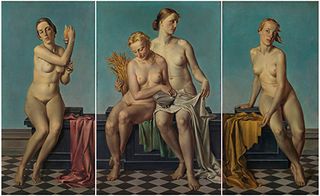
Morgan Meis in The Smart Set (image: “The Four Elements: Fire, Earth, and Water, Air,” Adolf Ziegler (1937) Pinakothek der Moderne, Bayerische Staatsgemaeldesammlungen, Munich Photo credit: bpk, Berlin/Art Resource, NY):
Hitler loved art. His taste tended toward classicism. The Greek ideal of beauty was his general standard in aesthetics. He once wrote the following memorandum about how he guaranteed that he would get “good” art for the Munich Museum. “I have inexorably adhered to the following principle,” Hitler wrote.
If some self-styled artist submits trash for the Munich exhibition, then he is a swindler, in which case he should be put in prison; or he is a madman, in which case he should be in an asylum; or he is a degenerate, in which case he must be sent to a concentration camp to be “reeducated” and taught the dignity of honest labor. In this way I have ensured that the Munich exhibition is avoided like the plague by the inefficient.
And it was. I suspect a number of contemporary curators and museum directors feel roughly the same way Hitler did about artists who “submit trash.” But what made Hitler, Hitler — and not just your average Museum Director — was that he was willing to go that extra mile. He did, actually, send artists to prison, the asylum, and the concentration camp.
The current show at the Neue Galerie in New York City (“Degenerate Art: The Attack on Modern Art in Nazi Germany, 1937”) mostly displays art that appeared in the now-infamous “Degenerate Art” exhibits organized by the Nazis in Munich and then taken to other cities around Nazi Germany. The point of the “Degenerate Art” exhibits was to demonstrate just how bad modern art had become, according to the Nazi sensibility.
In the late 1930s, Hitler made it Goebbels’ responsibility to purge art of degeneracy. Goebbels appointed Adolf Ziegler, who happened to be one of Hitler’s favorite painters, to the position of Director of the Reich Chamber of Visual Art. Ziegler looked around and declared many of the artworks of his time, “the products of insanity, of impudence, of ineptitude, and of decadence.” Ziegler went about the process of seizing much of this “degenerate” art, some of which appeared in the “Degenerate Exhibit” before being sold off to other countries or destroyed.
More here.