
Category: Recommended Reading
Before I Knocked by Dylan Thomas
The Growing Pains of the Ancient Hajj
Dan Stone in National Geographic:
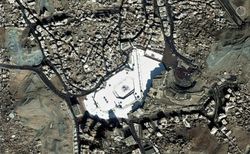
…Eyesores can be ignored; designer stores can be shunned. But a changing Mecca brings questions of how the centuries-old tradition of the pilgrimage itself could change. The word hajj in Arabic means “a great effort.” That effort—of walking through the holy sites and interacting with fellow Muslims to learn how Islam is practiced all over the world—is intended to deepen the pilgrim’s spirituality. Sardar, the author and Mecca scholar, argues that if that experience is diluted, the great virtue of traveling thousands of miles for a one-time experience may lose meaning. More people may show up, but with diminishing returns. Those who come will leave with less and less.
More here.
Sunday Poem
The Story of the Arjun and the Krishnachura
The Arjun tree stood alone in that field
An Aryan male – a pillar of aristocracy
All the other trees bowed to it
This was merely the beginning of the story
From somewhere came the Krishnachura seed
A few years later she was a young woman
A Santhal girl, with crimson in her hair
At once Arjun wanted her as his own
She was not a girl who would submit
In spring she dressed up without help, alone
She wasn't drawn to the Aryan male
She was busy making the buds bloom
Last night's flowers had fallen from her hair
Rippling leaves had woven clothes for her
Arjun – he was an Aryan male, who thought
Only he could claim beauty so fair
From the distance the Arjun tree could see
The Krishnachura's cascading heart
Bewitched by beauty, his perplexed eyes
Wondered when he'd find his way to it
I'd better finish this story quickly
The Krishnachura is far too obstinate
Her pride won't let her sell herself
She'd rather be a neighbour or a friend
The story isn't quite so simple
Arjun shed his bark, sheds it still
But the Santhal girl can shed blood
The Aryan male accepts he cannot win
Be reborn as an Arjun tree
Consider the Krishnachura a friend
Don't confuse me with others, upright one
When I bleed, shed your bark and call me then
by Mandakranta Sen
from: Hridhay Abadhya Meye
publisher: Ananda Publishers, Kolkata, 1999
translation: Arunava Sinha
from: After the Last Kiss
publisher: HarperCollins India
Saturday, November 1, 2014
Peter Schneider’s ‘Berlin Now’ and Rory MacLean’s ‘Berlin’

For centuries Berlin has had something of a chip on its shoulder. It lacks the ancient ruins of Rome or the sophisticated beauty of Paris. It is landlocked and flat, with a climate that can be frigid, gray and unpleasant up to eight months out of the year. “Imagine Geneva, lost in a desert,” Balzac wrote in 1843, “and you have an idea of Berlin.”
That quotation surfaces in another book timed to the 25th anniversary of the fall of the wall by the Canadian travel writer Rory MacLean. With a few exceptions, “Berlin: Portrait of a City Through the Centuries” is a series of loose biographical sketches of both famous and everyday Berliners, past and present. The very first concerns a 15th-century poet and singer, Konrad von Cölln, who was prone to debauchery. He had his tongue cut out for defying Prince-Elector Irontooth, and was then executed.
MacLean sees the dualities of sex and violence, freedom and fascism as central to the city’s character and its appeal. A worker in a factory kitchen inadvertently kills herself trying to induce a miscarriage by eating the tips of 160 phosphorous matches.
more here.
When the Wall fell 25 years ago…
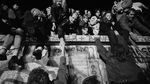
From its construction in 1961 to its destruction in 1989, the Berlin Wall was the world’s most compelling symbol of the moral and material bankruptcy of communism. Other dictatorships, from Albania to North Korea, laid mines and put up barbed wire to stop their oppressed peoples from fleeing to freedom. But no monument to incarceration was more visible and damning of its creators than the Wall, a hideous 156km-long complex of watchtowers, searchlights, anti-tank obstacles, dog patrols and ditches that cut through the once bustling centre of the historic German capital.
East German border guards, with the support of their Soviet-backed masters, fired upon scores of people who tried to escape over the Wall. They were responsible, during its 28-year life, for 136 Wall-related shootings and other deaths. Hundreds more were killed on the inner German border that divided West Germany from East Germany (the German Democratic Republic, or GDR). Right to the end, the East German communist party stuck to the brazen lies that there was no official policy of shooting would-be escapees, and that the Wall’s sole purpose was to repulse an attack from the “imperialist” west.
more here.
denis johnson, anarchy, madness

This territory of anarchy and madness — let's call it derangement — is one to which Johnson has returned throughout his career. His 1992 collection “Jesus' Son,” which sits on a short shelf of the finest American fiction of the last quarter-century, traces in 11 spare, linked stories the experiences of a recovering drug addict trying to find a place in an incomprehensible world.
“Tree of Smoke,” which won a 2007 National Book Award, uses Vietnam as setting and metaphor, portraying derangement on a national scale.
“Reality is an impression, a belief,” Michael tells Nair in “The Laughing Monsters,” referring to the post-9/11 world in which the novel unfolds. In Johnson's view, however, this is less a political than a metaphysical posture, which makes “The Laughing Monsters” primarily a portrait of a character on the edge.
“I follow world events,” Johnson explains, “but I'm not obsessed with politics, and that's probably because — it's occurred to me more than once — as a white North American I find things on this planet ordered pretty much in my favor. But as a storyteller I'm drawn to realistic, contemporary situations and to figures caught up in danger and chaos.”
more here.
An interview with David Winters
Matt Jakubowski in his blog, Truce:
David Winters is a literary critic living in Cambridge, England. His reviews, essays and interviews have appeared in a wide variety of print and online publications, including the Times Literary Supplement, The Guardian, The Literary Review, The White Review, The Quarterly Conversation, and the Los Angeles Review of Books. A collection of his literary criticism, titled Infinite Fictions, is forthcoming from Zero Books in January 2015; it can be pre-ordered here. He is currently co-editor in chief of 3:AM Magazine, where he commissions criticism and nonfiction. He can be found online at davidwinters.uk.
I’d like to hear a little bit about your beginnings as a critic. Was there a particular experience that triggered your interest in writing criticism?

More here.
This Philosopher Wants to Change How You Think About Doing Good
Uri Bram in Cafe:

MacAskill started off thinking about altruism the same way most of us do: trying to balance his own ideas of the good life with a desire to give back to the world. His day-to-day life as an undergraduate in philosophy was happily consumed by obscure questions about language and logic, but when looking for summer work he sought out options with a social impact. He worked at a care home (once, among the hazards of the job, he was punched in the face by an old lady on steroids), volunteered as an English teacher at a school in Ethiopia, and worked for a major international development charity as a street fundraiser—what people in the U.K. call a chugger, a charity mugger. When MacAskill talks about his younger self, I can't help feeling a twinge of recognition of my own self now. “It was more a feeling of guilt that I wasn't really doing things,” says MacAskill. “I had this real ambivalence between normal pressures, but at the same time feeling that I ought to be doing more to make a difference.” He pauses, and frowns. “But then not really acting on that.”
More here.
Saturday Poem
Granizo
To have been gone so long
But to have forgotten hail,
its name in Spanish, granizo,
until a storm, as I drove
toward a place named Golondrinas,
eight miles from the main highway
because I was enchanted by the name
I was home again,
if only for a while, after eighteen years
I remembered my grandfather, his cornfield
Somehow granizo belongs to him
He named it each summer
as he sat and watched, defined its terror
An old enemy, the way only water,
if it isn't gentle rain, can be
by Leroy Quintana
from After Atzlan, Latino Poets of the Nineties
Godine Publishing, 1992
Standard burial and cremation take tons of energy and resources. So what’s the most environmentally sound way to deal with a dead person?
Shannon Palus in The Atlantic:
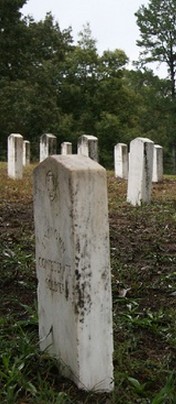
Most of the bodies Olson prepared in his family's funeral home would then be buried in traditional cemeteries, below a lawn of grass that must be mowed, watered, sprayed with pesticides, and used for nothing else, theoretically until the end of time.
Cemeteries “are kind of like landfills for dead bodies,” says Olson. Today, as a philosopher at Virginia Tech, his work looks at the alternatives to traditional funeral practices. He has a lot to think about: The environmentally friendly funeral industry is booming, as people begin to consider the impacts their bodies might have once they’re dead. Each year, a million pounds of metal, wood, and concrete are put in the ground to shield dead bodies from the dirt that surrounds them. A single cremation requires about two SUV tanks worth of fuel. As people become increasingly concerned with the environment, many of them are starting to seek out ways to minimize the impact their body has once they’re done using it.
More here.
What a pilot sees landing at one of the world’s most dangerous airports
Baddies in books: Captain Ahab, the obsessive, revenge-driven nihilist
Chris Power in The Guardian:

Ahab is an enigma whose “larger, darker, deeper part remains unhinted”. What can we say we know about him? That he is a “grey-headed, ungodly old man”. He has eyes “like powder pans”. His crew say he never sleeps, only tosses in bed. Dough-Boy the steward tells Ishmael that every morning: “He always finds the old man’s hammock clothes all rumpled and tumbled, and the sheets down at the foot, and the coverlid almost tied in knots”, and Ahab’s pillow hot to the touch, “as though a baked brick had been on it”. He has a scar, too, a “slender rod-like mark, lividly whitish”, running from head to toe. None of the crew knows where he got it, but they all know how he lost his leg. In the Pacific, a year before the events Ishmael describes in the novel, Ahab found himself surrounded by “the chips of chewed boats, and the sinking limbs of torn comrades”, all churning in the “white curds of the whale’s direful wrath”. Moby Dick took Ahab’s leg, “as a mower a blade of grass in the field”, and now the captain uses a peg leg carved from whalebone.
More here.
How America Became a Safe Haven for Hitler’s Men
Deborah E. Lipstadt in The New York Times:
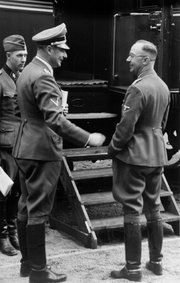
America began reaching out to leading Nazis months before the Germans surrendered. In March 1945, while the war still raged, the American spy chief Allen Dulles conducted a friendly fireside chat in the library of a Zurich apartment with the Nazi general Karl Wolff, the closest associate of the SS leader Heinrich Himmler for much of the war. The Scotch-lubricated conversation convinced Dulles that Wolff, despite his ties to Himmler and his role as a leader of the Waffen SS, was a moderate who deserved protection. When prosecutors sought to try Wolff, one of the highest-ranking SS leaders to survive, at Nuremberg, Dulles worked to have his name removed from the list of defendants. While Wolff was in Allied custody, he was permitted to take a yacht trip, spend time with his family and carry a gun. Nonetheless, he complained that what he endured was “much more inhumane than the extermination of the Jews.” He said the Jews had been gassed in a few seconds, while he did not know how long he would be held. (His imprisonment lasted four years.) While Jews languished in the camps after Germany’s defeat (“We felt like so much surplus junk,” one survivor said), the United States gathered up Nazi scientists. Had only leading scientists been enlisted, it would have been distasteful if understandable. But of the more than 1,600 scientists brought over, some had pedestrian skills. Others had developed the chemicals for the gas chambers, or conducted experiments on concentration camp prisoners. Even the State Department protested. But we did not stop with scientists. The C.I.A. and the F.B.I. sought out spies and informants who had participated in genocide.
More here.
Sex is Serious

Elizabeth Stoker Bruenig in Boston Review:
It is a strange season when culture warriors and women’s studies departments find common cause, though not unheard of—think pornography. But while Gail Dines’ Pornlandwon acclaim from The Christian Post, conservative Christian sex ethics and feminist sex ethics maintain disparate opinions of sex itself. For the conservative Christian, sex has always been a matter of the most sincere gravitas, the ultimate (and sometimes sacramental) union; feminist sex ethicists have a more liberal view of the matter, favoring personal experience over some sublime essence. In other words, the two don’t seem to share a conception of the kind of thing sex is.
This gap appears to be closing.
In late August, the California legislature passed bill SB 967, a bundle of regulations pertaining to educational institutions receiving public funding. Most notably, it enforces a standard of ‘affirmative consent’ in sexual assault proceedings. Roughly a month later, Governor Jerry Brown signed the bill into law. According to the text of the law, a standard of affirmative consent
means affirmative, conscious, and voluntary agreement to engage in sexual activity. It is the responsibility of each person involved in the sexual activity to ensure that he or she has the affirmative consent of the other or others to engage in the sexual activity. Lack of protest or resistance does not mean consent, nor does silence mean consent. Affirmative consent must be ongoing throughout a sexual activity and can be revoked at any time. The existence of a dating relationship between the persons involved, or the fact of past sexual relations between them, should never by itself be assumed to be an indicator of consent.
No, in other words, means no. But nothing also means no, and a variety of intermediate expressions between perhaps and absolutely now must also be presumed to mean no, and body language is also no longer sufficient to communicate consent.
More here.
Friday, October 31, 2014
Profs Bumble Into Big Legal Trouble After Election Experiment Goes Way Wrong
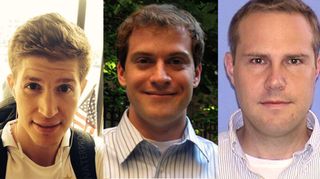
Dylan Scott in TPM:
Political scientists from two of the nation's most highly respected universities, usually impartial observers of political firestorms, now find themselves at the center of an electoral drama with tens of thousands of dollars and the election of two state supreme court justices at stake.
Their research experiment, which involved sending official-looking flyers to 100,000 Montana voters just weeks before Election Day, is now the subject of an official state inquiry that could lead to substantial fines against them or their schools. Their peers in the field have ripped their social science experiment as a “misjudgment” or — stronger still — “malpractice.”
What went so wrong?
Last Thursday, the Montana Commissioner of Political Practices started receiving complaints from voters who had received an election mailer (see below) bearing the state seal and describing the ideological standing of non-partisan candidates for the Montana Supreme Court. The fine print said that it had been sent by researchers from Dartmouth College and Stanford University, part of their research into voter participation. But that wasn't satisfactory for the voters who received the flyers or the state officials to whom they complained.
Jonathan Motl, the state commissioner, told TPM that the flyer has elicited the most complaints that his office has seen this election cycle. It describes the candidates in two Montana Supreme Court elections — who are supposed to be non-partisan — on an ideological scale. The candidates are placed on a line graph that compares them to President Barack Obama and Mitt Romney.
It is titled as a “2014 Montana General Election Voter Information Guide” with the state of Montana seal featured prominently. Only the fine print identifies the mailer as part of a research project.
“This particular flyer triggered such a strong reaction among Montanans for two reasons. No. 1, it used the state seal. Just based on the people I've talked to, that was strongly offensive. They didn't like their state seal being appropriated,” Motl said. “The second thing that's confusing about it is the intimation that it serves a research purpose. Because in the judgment of the people looking at it, it doesn't serve a research purpose, it serves a political purpose.”
More here.
Why is the World Ignoring the Revolutionary Kurds in Syria?
David Graeber in The Guardian:
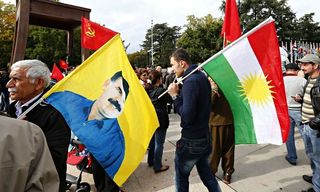
The autonomous region of Rojava, as it exists today, is one of few bright spots – albeit a very bright one – to emerge from the tragedy of the Syrian revolution. Having driven out agents of the Assad regime in 2011, and despite the hostility of almost all of its neighbours, Rojava has not only maintained its independence, but is a remarkable democratic experiment. Popular assemblies have been created as the ultimate decision-making bodies, councils selected with careful ethnic balance (in each municipality, for instance, the top three officers have to include one Kurd, one Arab and one Assyrian or Armenian Christian, and at least one of the three has to be a woman), there are women’s and youth councils, and, in a remarkable echo of the armed Mujeres Libres (Free Women) of Spain, a feminist army, the “YJA Star” militia (the “Union of Free Women”, the star here referring to the ancient Mesopotamian goddess Ishtar), that has carried out a large proportion of the combat operations against the forces of Islamic State.
How can something like this happen and still be almost entirely ignored by the international community, even, largely, by the International left? Mainly, it seems, because the Rojavan revolutionary party, the PYD, works in alliance with Turkey’s Kurdish Worker’s Party (PKK), a Marxist guerilla movement that has since the 1970s been engaged in a long war against the Turkish state. Nato, the US and EU officially classify them as a “terrorist” organisation. Meanwhile, leftists largely write them off as Stalinists.
But, in fact, the PKK itself is no longer anything remotely like the old, top-down Leninist party it once was. Its own internal evolution, and the intellectual conversion of its own founder, Abdullah Ocalan, held in a Turkish island prison since 1999, have led it to entirely change its aims and tactics.
The PKK has declared that it no longer even seeks to create a Kurdish state. Instead, inspired in part by the vision of social ecologist and anarchist Murray Bookchin, it has adopted the vision of “libertarian municipalism”, calling forKurds to create free, self-governing communities, based on principles of direct democracy, that would then come together across national borders – that it is hoped would over time become increasingly meaningless.
More here.
Crisis in Mexico: Could Forty-Three Missing Students Spark a Revolution?

Francisco Goldman in The New Yorker (photo by Macro Ugarte/AP):
On Sunday morning, a heartbreaking headline appeared on the news Web site SinEmbargo, which is based here in Mexico City: “I Know My Son Is Alive and That He Will Be a Teacher.” The speaker was Manuel Martínez, the thirty-five-year-old father of a seventeen-year-old boy named Mario, who has been missing since September 26th, along with many of his classmates at the Ayotzinapa Normal teacher-training school. That night, according to witness testimonies and the confessions of those arrested in the case, six students from the school were murdered by municipal police and other gunmen, and forty-three others were “disappeared” in the small city of Iguala, in the Pacific-coast state of Guerrero.
The Martínezes are indigenous Huave from the impoverished seaside village of San Mateo del Mar, in Oaxaca. Martínez told SinEmbargo’s Humberto Padgett that he’d also studied at Ayotzinapa, twenty years before, and that his son had long dreamed of following in his footsteps. Like many other rural schoolteachers, Martínez built his little school with his own hands, out of planks and zinc sheeting. “All the rural schools are bad,” he said. “Here and in the country, education is in terrible shape. … In my school, we don’t even have electricity. The students live in the same conditions we do, or a little worse, because they live on just corn and beans, and from their tomato and chile harvests. … None of them owns a pair of shoes; they use huaraches or sandals.”
Martínez went on, “The authorities should pay for what they’ve done because they’ve done the very worse that you can do, to the most humble of people.”
The country has been seized by the story of the missing forty-three, though many refuse to believe the worst until it can no longer be denied—my dentist, for example, says that this is all just a student prank that went too far, and that the students will turn up any day now, sheepish and contrite.
More here. Also see Esteban Illades's piece in The New Inquiry.
Friday Poem
In a Neighborhood in Los Angeles
I learned
Spanish
from my grandma
mijito
don't cry
she'd tell me
on the mornings
my parents
would leave
to work
at the fish
canneries
my grandma
would chat
with chairs
sing them
old
songs
dance
waltzes with them
in the kitchen
when she'd say
niño barrigón
she'd laugh
with my grandma
I learned
to count clouds
to point out
in flowerpots
mint leaves
my grandma
wore moons
on her dress
Mexico's mountains
deserts
ocean
in her eyes
I'd see them
in her braids
I'd touch them
in her voice
smell them
one day
I was told:
she went far away
but still
I feel her
with me
whispering
in my ear
mijito
by Fancisco Alarcón
from After Atzlan
Godine Publishing, 1992
What an Intact Family Has to Do with the American Dream, in Six Charts
Wilcox and Lerman in National Review:

More here.