the novel is really and truly dead

Printing-press-001Will Self at The Guardian:

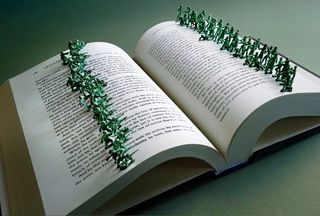
There is now an almost ceaseless murmuring about the future of narrative prose. Most of it is at once Panglossian and melioristic: yes, experts assert, there's no disputing the impact of digitised text on the whole culture of the codex; fewer paper books are being sold, newspapers fold, bookshops continue to close, libraries as well. But … but, well, there's still no substitute for the experience of close reading as we've come to understand and appreciate it – the capacity to imagine entire worlds from parsing a few lines of text; the ability to achieve deep and meditative levels of absorption in others' psyches. This circling of the wagons comes with a number of public-spirited campaigns: children are given free books; book bags are distributed with slogans on them urging readers to put books in them; books are hymned for their physical attributes – their heft, their appearance, their smell – as if they were the bodily correlates of all those Gutenberg minds, which, of course, they are.

The seeming realists among the Gutenbergers say such things as: well, clearly, books are going to become a minority technology, but the beau livre will survive. The populist Gutenbergers prate on about how digital texts linked to social media will allow readers to take part in a public conversation. What none of the Gutenbergers are able to countenance, because it is quite literally – for once the intensifier is justified – out of their minds, is that the advent of digital media is not simply destructive of the codex, but of the Gutenberg mind itself. There is one question alone that you must ask yourself in order to establish whether the serious novel will still retain cultural primacy and centrality in another 20 years. This is the question: if you accept that by then the vast majority of text will be read in digital form on devices linked to the web, do you also believe that those readers will voluntarily choose to disable that connectivity?

more here.

Norman Mailer’s A Fire on the Moon: a giant leap for reportage

Geoff Dyer in The Guardian:

ScreenHunter_658 May. 28 20.35Mailer starts with the news of Hemingway's death; I'll start with Ezra Pound's claim, in The ABC of Reading, that literature “is news that STAYS news”. The appeal of having one of America's best-known writers cover the biggest news story of the decade – probably of the century, conceivably of all time – was obvious, and Mailer was a natural fit. Back then a lot of people were quoting the opinion that he was the best journalist in America. One of those people was Mailer himself who took umbrage at the praise as it tacitly downgraded his achievements as a novelist. Imagine Laurence Sterne with a huge subject, a big advance and a looming deadline, and you have some sense of the conflicting pressures at work on Of a Fire on the Moon (the original American title).

The deadline needs emphasising. Other writers had plenty to say about the moon landing – everyone had something to say about it – but few would have had the chops to bang out 115,000 words for publication in three issues of Life magazine, the first tranche of which, Mailer groans, was due less than three weeks after the astronauts splashed down in the Pacific. That, to put it mildly, is a lot of words in a very short time: not quite as challenging a task as the one set out by John F Kennedy in 1961 – to land a man on the moon and return him safely to earth by the end of the decade – but a serious job of work all the same. So the question today, for anyone under the age of 45 who was unable to experience the event, let alone read about it as news, is the extent to which the result is compromised or enhanced by the circumstances of its occasion and composition. Now that the subject matter is the stuff of history – when the word astronaut might be used in the context of historical as opposed to science fiction – does Mailer's book pass Pound's testing definition? And where does it stand within two quite different contexts: that of other books about the moon landings, and within the large scope and wildly mixed quality of Mailer's work as a whole?

More here.

Maya Angelou, Lyrical Witness of the Jim Crow South, Dies at 86

Margalit Fox in the New York Times:

ScreenHunter_657 May. 28 20.22Maya Angelou, the memoirist and poet whose landmark book of 1969, “I Know Why the Caged Bird Sings” — which describes in lyrical, unsparing prose her childhood in the Jim Crow South — was among the first autobiographies by a 20th-century black woman to reach a wide general readership, died on Wednesday in her home. She was 86 and lived in Winston-Salem, N.C.

Her death was confirmed by her longtime literary agent, Helen Brann. No immediate cause had been determined, but Ms. Brann said Ms. Angelou had been in frail health for some time and had heart problems.

As well known as she was for her memoirs, which eventually filled six volumes, Ms. Angelou very likely received her widest exposure on a chilly January day in 1993, when she delivered the inaugural poem, “On the Pulse of Morning,” at the swearing-in of Bill Clinton, the nation’s 42nd president, who, like Ms. Angelou, had grown up poor in rural Arkansas.

It began:

A Rock, A River, A Tree

Hosts to species long since departed,

Marked the mastodon,

The dinosaur, who left dried tokens

Of their sojourn here

On our planet floor,

Any broad alarm of their hastening doom

Is lost in the gloom of dust and ages.

But today, the Rock cries out to us, clearly, forcefully,

Come, you may stand upon my

Back and face your distant destiny,

But seek no haven in my shadow,

I will give you no hiding place down here.

Long before that day, as she recounted in “Caged Bird” and its five sequels, she had already been a dancer, calypso singer, streetcar conductor, single mother, magazine editor in Cairo, administrative assistant in Ghana, official of the Southern Christian Leadership Conference and friend or associate of some of the most eminent black Americans of the mid-20th century, including James Baldwin, the Rev. Dr. Martin Luther King Jr. and Malcolm X.

More here.

A Better Path to High Performance

Erin O'Donnell in Harvard Magazine:

AnxietyWhen forced to perform in a high-pressure situation—addressing a room of skeptical colleagues, meeting with a demanding boss, or singing for a crowd—keep calm! That, at least, is the conventional wisdom. Yet new research by social scientist Alison Wood Brooks, assistant professor of business administration at Harvard Business School, suggests that people in fact perform best not when they try to relax, but when they take simple steps to get excited about the challenge at hand.

In previous work, Brooks studied how even run-of-the-mill anxiety (Did I remember to turn off the stove? Will I meet my deadline?) can harm decision-making. Her research revealed that anxiety is a drain on cognitive resources, using up brain power and information-processing ability and reducing confidence. “Feeling anxious is very unpleasant,” she says, so people go to great lengths to avoid it. If they are involved in negotiations, for example, “they exit early, they make large concessions, they respond very quickly to counteroffers, and ultimately they perform poorly.” Yet anxiety doesn’t always harm performance. The Yerkes-Dodson Law, formulated in the early twentieth century, maintains that “a moderate amount of anxiety can actually be motivating and energizing,” Brooks explains: it may prompt thorough preparation for a high-stakes presentation. If arousal and anxiety build, though, performance begins to decline.

More here.

Old cancer drug gets fresh look

Heidi Ledford in Nature:

CellsWhen Dave deBronkart was diagnosed with advanced kidney cancer in 2007, he learned about a treatment called high-dose interleukin-2 (IL-2) that fires up the body’s immune system to fight the disease. The response rate was not great — tumours shrank in only about 15% of patients. And as many as 4% of people died from the treatment. But some of those who responded survived for years or even decades. DeBronkart’s prognosis was grim — only 8% of people with his disease survive for five years past diagnosis. He says that he was willing to risk what life he might have had left for the possibility of stopping his cancer’s growth: “I said, ‘Lethal side effects? OK.’ ” Now, nearly seven years after his treatment, deBronkart’s immune system continues to hold his cancer in check.

When researchers gather this week for the annual American Society of Clinical Oncology (ASCO) meeting in Chicago, Illinois, the spotlight will be on immunotherapies — a class of drugs that, like IL-2, kindle the immune system’s ability to fend off cancer (see Nature 508, 24–26; 2014). Attendees will hear the latest about a new generation of these drugs — particularly those targeting a protein called PD-1, which cancers use to fend off immune-system attack. Pharmaceutical companies are racing to bring these PD-1 inhibitors to market. Other data to be presented at the meeting suggest that IL-2, the drug that saved deBronkart and the first cancer immunotherapy approved by the US Food and Drug Administration (FDA), may be on the verge of a revival after having fallen out of favour. Two years after he finished the therapy, deBronkart learned that because of IL-2’s risks, three-quarters of eligible patients are never told that it is an option. “There are patients who are dying without ever getting a potentially curative treatment,” says Steven Rosenberg, an oncologist at the US National Cancer Institute in Bethesda, Maryland. “It’s a real problem.”

More here.

Wednesday Poem

On a Marriage that Was to Take Place atop Half Dome in Yosemite National Park

for Nick and Katie

1.
Yesterday, right when our call got dropped,
I was going to tell you something about marriage.

I was going to tell you something gnomic,
a maxim worth getting engraved.

I’ve since forgotten,
but I believe it was akin to saying that, like Truth,
marriage is impossible to define in verbal space.

So, I guess I’m glad I forgot. The words
would’ve seemed either too hastily conceived for their subject matter
or else weightless, enigmatic – without impact.

I think it was Auden who whined, “Marriage is rarely bliss,”
though he lightened the phrase by encapsulating it in the context of modern
physics –
namely, at least it has the ability to take place,
and that should be enough to bring bliss equal to Buddha’s Emptiness.

So, I’m happy our call got
dropped,
for the dial tone was
the pithiest aphorism on marriage any sentient life could’ve produced.

The key word is “produced.”

2.

This is what marriage is not:

Socrates gurgling hemlock
on his dusty prison cot,
giggling as he glimpsed a dikast’s deformed cock;

glittering light on a sundial,
in front of which two boys, dressed
to give witness at trial,
fight. Both of them give it their best

as red balloons filled with helium
become tiny, nondescript dots
against a sunset and fumbled rum
speckles their t-shirts with spots;

Nietzsche tenured for philology
at Basel; Nietzsche feverishly etching
Fick diese scheiße! on a Jena clinic’s wall; biology
predetermining the team for which he was pitching;

a poem; a hot dog; cocaine;
a discharged Kalashnikov
engendering generational pain
somewhere in Saratov

circa 1942;
this is what marriage is not:
hatred, jealousy, ballyhoo,
obsessive yearnings for a yacht;

this is what marriage is not:
anything one pair of hands has wrought.

by Christopher Gorrie
from Aaduna, Winter/Spring 2014

Tuesday, May 27, 2014

The End of a Douchebag: Dinesh D’Souza Facing Jail Time

Ben Cohen in The Daily Banter:

ScreenHunter_656 May. 28 11.52There are few things more enjoyable in life than watching a genuine asshole get their comeuppance. Dinesh D’Souza, a man who made a career out of smearing President Obama using every dishonest tactic in the GOP handbook, is almost certainly going to jail after pleading guilty on Tuesday to a campaign finance law violation.

D’Souza avoided a prolonged and embarrassing trial, acknowledging that the case brought against him by U.S. Attorney Preet Bharara was beyond dispute. Bharara charged him with using “straw donors” in order to give funds to Republican Wendy Long’s New York U.S. Senate campaign in 2012. D’Souza pleaded guilty to one criminal count of making illegal contributions in the names of others.

According to the Reuters report: “Lawyers for both sides agreed that under advisory federal sentencing guidelines, D’Souza faces between 10 and 16 months in prison.”

As Bob Cesca pointed out, there is “a delicious irony” in someone who accused the president of being a fraud, himself being indicted for fraud. In his breathtakingly dishonest (and ultimately racist) documentary “2016: Obama’s America”, D’Souza essentially claimed that Obama is an undercover radical, anti colonialist, propelled to success by guilty whites (whom he hates), and is ultimately out to destroy America from the inside.

More here.

Judging Spinoza

Steven Nadler in the New York Times:

ScreenHunter_655 May. 27 17.50In February of 1927, the historian Joseph Klausner stood before an audience at Hebrew University in Jerusalem and delivered a lecture on the “Jewish character” of Baruch Spinoza’s philosophy. As he neared the end of his talk, Klausner dropped the usual academic idiom and, with great passion, announced his intention to bring Spinoza, excommunicated in 1656 by the Portuguese-Jewish community in Amsterdam, back into the Jewish fold. “To Spinoza the Jew,” he declared: “The ban is nullified! The sin of Judaism against you is removed and your offense against her atoned for. You are our brother! You are our brother! You are our brother!”

Klausner’s theatrical performance was the first of several efforts in the 20th century to revoke Spinoza’s excommunication. No less an eminence than David Ben-Gurion, the first prime minister of Israel, publicly argued for “amending the injustice” done to the philosopher, insisting that the 17th-century rabbis had no authority “to exclude the immortal Spinoza from the community of Israel for all time.”

All these efforts were unsuccessful (not to mention unauthorized). Unlike most of the bans issued by the Amsterdam Portuguese in that period, the ban on Spinoza was never rescinded. In fact, in 1957, Rabbi Solomon Rodrigues Pereira of Amsterdam even reaffirmed the excommunication. Like Galileo, disciplined by the Roman Catholic Church just two decades before him, Spinoza has gone down as one of history’s great thinkers punished by intolerant ecclesiastic authorities for his intellectual boldness.

More here.

How ants optimize food search

From Phys.org:

ScreenHunter_654 May. 27 17.35Ants are capable of complex problem-solving strategies that could be widely applied as optimization techniques. An individual ant searching for food walks in random ways, biologists found. Yet the collective foraging behaviour of ants goes well beyond that, as a mathematical study to be published in the Proceedings of the National Academy of Sciences reveals: The animal movements at a certain point change from chaos to order. This happens in a surprisingly efficient self-organized way. Understanding the ants could help analyze similar phenomena – for instance how humans roam in the internet.

“Ants have a nest so they need something like a strategy to bring home the food they find,” says lead-author Lixiang Li who is affiliated both to the Information Security Center, State Key Laboratory of Networking and Switching Technology, at the Beijing University of Posts and Communications, and to the Potsdam Institute for Climate Impact Research. “We argue that this is a factor, largely underestimated so far, that actually determines their behavior.”

The Chinese-German research team basically put almost everything that is known about the foraging of ants into equations and algorithms and fed this into their computers. They assume that there are three stages of the complex feed-search movements of an ant colony: Initially, scout ants indeed circle around in a seemingly chaotic way. When exhausted, they go back to the nest to eat and rest. However, when one of them finds some food in the vicinity of the colony, it takes a tiny piece of it to the nest, leaving a trail of a scent-emanating substance called pheromones.

More here.

Pope Francis Visit to Palestine

Richard Falk in Global Justice in the 21st Century:

ScreenHunter_653 May. 27 17.24Pope Francis’ visit to the Holy Land raises one overwhelming question: ‘what is the nature of religious power in our world of the 21st century?’ ‘can it have transformative effects’?

Media pundits and most liberal voices from the secular realm approve of this effort by Francis to seek peace through the encouragement of reconciliation, while dutifully reminding us that his impact is only ‘ceremonial’ and ‘symbolic’ and will not, and presumably should not, have any political consequences beyond a temporary cleansing of the political atmosphere.

The June 6th prospect of Mahmoud Abbas and Shimon Peres praying together in the Vatican as a step toward a peaceful end of the long struggle is, I fear, an ambiguous sideshow. For one thing, Peres as President of Israel is about to leave the office, and in any event, his position exerts no discernible influence on the head of state, Benjamin Netanyahu, or the approach taken by Israel in addressing Palestinian concerns. It has long been appreciated that Peres is less than he seems, and beneath his velvet globe is a steel fist. Also, Abbas, although the formal leader of the Palestinian Authority and Chair of the PLO, is a weak and controversial leader who has yet to establish a unity government that includes Hamas, and finally provides political representation for the long suffering population of the Gaza Strip within global venues.

Yet it would be a mistake to ignore the significance, symbolically and materially, of what Pope Francis’ visit to Palestine heralds.

More here.

How ‘Pick-Up Artist’ Philosophy and Its More Misogynist Backlash Shaped Mind of Alleged Killer Elliot Rodger

“I’m the perfect guy, and yet you throw yourselves at all these obnoxious men, instead of me, the supreme gentleman,” Rodger complained in the video. “I will punish all of you for it.”

Amanda Marcotte in The American Prospect:

ScreenHunter_652 May. 27 16.54Women—hot young women, really—owed him sex and, because they reneged on their obligations, Elliot Rodger would get his revenge by going on a killing spree. That was the thesis of a video titled “Elliot Rodger’s retribution,” featuring the angry rantings of the 22-year-old college student before he allegedly went on a murderous rampage through Isla Vista, California, which resulted in six murders, thirteen people injured, and Rodger himself dead.

“You denied me a happy life, and in turn, I will deny all of you life,” he threatened. “It’s only fair.”

This video and others that Rodger put on his YouTube channel were full of language that was immediately recognizable to many: He was speaking the lingo of the “pick-up artist” (PUA) community that feminists have been raising alarms about for many years now, arguing that it’s a breeding ground for misogynist resentment and may even be encouraging violence against women.

“Alpha,” PUA lingo for a dominant male, was in the video threatening the mass murder. Rodger identified as an “incel,” which means “involuntarily celibate,” a term that was developed on web-based bulletin boards devoted to PUA enthusiasts that weren’t finding much luck getting laid. His theories about what “women” are thinking and why they are denying him the sex he felt entitled to came straight out of the theories of mating and dating that underlie the entire concept of PUA.

More here.

Mao’s Little Red Book: a Global History

MaoamoJohn Gray at The New Statesman:

In 1968 a Red Guard publication instructed that scientists must follow Mao Zedong’s injunction: “Be resolute, fear no sacrifice and surmount every difficulty to win victory.” Expert knowledge was not valid, and might be dangerously misleading, without the great leader’s guidance. Examples of revolutionary science abounded at the time. In one account, a soldier training to be a veterinarian found it difficult to castrate pigs. Studying Mao’s words enabled him to overcome this selfish reaction and gave him courage to perform the task. In another inspirational tale, Mao’s thoughts inspired a new method of protecting their crops from bad weather: making rockets and shooting them into the sky, peasants were able to disperse the clouds and prevent hailstorms.

By the time the Red Guard publication appeared, Mao’s Little Red Book had been published in numbers sufficient to supply a copy to every Chinese citizen in a population of more than 740 million. At the peak of its popularity from the mid-1960s to the mid-1970s, it was the most printed book in the world. In the years between 1966 and 1971, well over a billion copies of the official version were published and translations were issued in three dozen languages. There were many local reprints, illicit editions and unauthorised translations.

more here.

Did Chris Marker think history is a sacred book?

Schwabsky_favouritehallucinations_ba_img_0Barry Schwabsky at The Nation:

Did Marker also think history to be not only an infinite book but a sacred one? Whatever his early religious yearnings, they seem to have been forgotten or disregarded, at least by his critics, who pass over his early associations with a Catholic magazine and a Catholic publishing house, not to mention his having translated an American author best known for his acuity in writing about the lives of priests. And as late as 2003, in an interview with Libération, Marker spoke of how he’d been moved by a Japanese critic remarking that in both La jetéeand Sans soleil, his goal had been to “overcome death by prayer.” Marker seems never to have relinquished the hope that the ontological character of the image might hold some salvific potential; however irrational this hope might seem, it probably accounts for the poignant intensity of the gaze that makes his films and photographs unforgettable.

Unforgettable above all is the gallery of faces that Marker has left us—especially the female faces. It is impossible not to notice how his camera lingers more searchingly, even almost desperately, on the faces of women. In the Petite Planète series he edited in the 1950s, a woman’s face appears on the cover of each book, as if this is the key to his attachment to the world. He speaks of women as one of “my favorite hallucinations,” and it is impossible not to wonder if, in his Catholic days, he was particularly devoted to Mary.

more here.

The 100 best novels: No 36 – The Golden Bowl by Henry James (1904)

Robert McCrum in The Guardian:

The-Golden-Bowl-005There's an old joke (which only makes complete sense in Britain) that there are three, not one, manifestations of Henry James: James the First (The Portrait of a Lady); James the Second (The Turn of the Screw); and the Old Pretender (The Wings of the Dove; The Golden Bowl). As we approach another giant in this series – for some, the only American writer of greater significance than Mark Twain or F Scott Fitzgerald – I've chosen to skip James I and II, and settle on late James, the Old Pretender, and his masterpiece, The Golden Bowl, a novel that takes its title from Ecclesiastes 12:6-7 (“Or ever the silver cord be loosed, or the golden bowl be broken, or the pitcher be broken at the fountain, or the wheel broken at the cistern… then shall the dust return to the earth as it was…”).

I've made this choice for three reasons. First, because it addresses James's essential theme, the meeting of two great cultures, English and American, and mixes it with the sinister menace of his middle period. Second, because the novel is so intensely (maddeningly, some would say) Jamesian, often hovering between the difficult and the incomprehensible. And finally, because his last novel places him where he belongs, at the very beginning of the 20th century. The Golden Bowl opens with Prince Amerigo, a charming Italian nobleman of reduced means, coming to London for his marriage to Maggie Verver, the only child of the wealthy widower Adam Verver, an American financier and art connoisseur. The plot then reprises a Henry James short story of 1891 (The Marriages), in which a father and daughter become hopelessly caught up in “a mutual passion, an intrigue”, a complex tale of treachery and betrayal made more complex by the fact that James, who suffered acutely from writer's cramp, dictated it to a typist every morning over a period of 13 months. Not since the blind John Milton dictated chunks of Paradise Lost to his daughters has a prominent writer expressed so much of his vision through the medium of the spoken word.

More here.

How to Win the Lottery (Happily)

John Tierney in The New York Times:

LotIf you have won the lottery, or if you plan to do so, please keep reading this column. The information is vital not just to your happiness but also to the progress of social science.

You have a chance to dispel the notion of the curse of the lottery, which is blamed whenever a big winner ends up divorced, depressed, destitute or dead. Journalists like to explain that the curse is no mere legend — the futility of winning the jackpot has been demonstrated by actual scientists with jobs at accredited universities. The evidence comes from an influential paper in 1978 reporting that lottery winners were not any happier than their neighbors or more optimistic about the future. In fact, they weren’t any more optimistic about their future happiness than a group of people who had been in accidents that left them paralyzed. It was one of the first studies testing the theory that we’re all stuck on a “hedonic treadmill,” a term coined by the paper’s lead author, Philip Brickman, for the idea that good or bad events don’t permanently affect our levels of happiness. The theory remains popular with many psychologists, and the lottery study is still one of the prime pieces of supporting evidence.

More here.

Monday, May 26, 2014

We just need 20 more readers to subscribe and we are done!

DanAzra3QD

Daniel C. Dennett and Azra Raza

It is time for 3QD's summer subscription drive. As you know, we are able to run the site only because our regular readers support us through subscriptions or one-time payments. Whichever you'd like to do, please take a couple of minutes and use the appropriate button near the top of the left-hand column to make a contribution. Please do it now!

We are trying to get just 20 more subscriptions now.

As always, thank you for your generous support!

Mohsin Hamid to Judge 4th Annual 3QD Arts & Literature Prize

UPDATE 06/23/14: Winners announced here.

UPDATE 06/12/14: Finalists announced here.

UPDATE 06/12/14: Semifinalists announced here.

UPDATE 06/03/14: Voting round is now open. Click here to see full list of nominees and vote.

Dear Readers, Writers, Bloggers,

ScreenHunter_630 May. 19 10.12We are very honored and pleased to announce that Mohsin Hamid has agreed to be the final judge for our 4th annual prize for the best blog and online writing in the category of arts and literature. Details of the previous three arts and literature (and other) prizes can be seen on our prize page.

Mohsin Hamid is the author of the novels Moth Smoke, The Reluctant Fundamentalist, and How to Get Filthy Rich in Rising Asia. His award-winning fiction has been featured on bestseller lists, adapted for the cinema, shortlisted for the Man Booker Prize, and translated into over 30 languages. His essays and short stories have appeared in the New York Times, the Guardian, the New Yorker, Granta, and many other publications. Born in 1971 in Lahore, he has spent about half his life there and much of the rest in London, New York, and California.

As usual, this is the way it will work: the nominating period is now open. There will then be a round of voting by our readers which will narrow down the entries to the top twenty semi-finalists. After this, we will take these top twenty voted-for nominees, and the editors of 3 Quarks Daily will select six finalists from these, plus they may also add up to three wildcard entries of their own choosing. The three winners will be chosen from these by Mohsin Hamid.

The first place award, called the “Top Quark,” will include a cash prize of 500 dollars; the second place prize, the “Strange Quark,” will include a cash prize of 200 dollars; and the third place winner will get the honor of winning the “Charm Quark,” along with a 100 dollar prize.

(Welcome to those coming here for the first time. Learn more about who we are and what we do here, and do check out the full site here. Bookmark us and come back regularly, or sign up for the RSS Feed.)

The schedule:

May 19, 2014:

  • The nominations are opened. Please nominate your favorite blog entry by placing the URL for the blog post (the permalink) in the comments section of this post. You may also add a brief comment describing the entry and saying why you think it should win. (Do NOT nominate a whole blog, just one individual blog post.)
  • Blog posts longer than 4,000 words are strongly discouraged, but we might make an exception if there is something truly extraordinary.
  • Each person can only nominate one blog post.
  • Entries must be in English.
  • The editors of 3QD reserve the right to reject entries that we feel are not appropriate.
  • The blog entry may not be more than a year old. In other words, it must have been written after May 18, 2013.
  • You may also nominate your own entry from your own or a group blog (and we encourage you to).
  • Guest columnists at 3 Quarks Daily are also eligible to be nominated, and may also nominate themselves if they wish.
  • Nominations are limited to the first 200 entries.
  • Prize money must be claimed within a month of the announcement of winners.

June 2, 2014

  • The nominating process will end at 11:59 PM (NYC time) of this date.
  • The public voting will be opened soon afterwards.

June 9, 2014

  • Public voting ends at 11:59 PM (NYC time).

June 16, 2014

  • The finalists are announced.

June 23, 2014

  • The winners are announced.

One Final and Important Request

If you have a blog or website, please help us spread the word about our prizes by linking to this post. Otherwise, post a link on your Facebook profile, Tweet it, or just email your friends and tell them about it! I really look forward to reading some very good material, and think this should be a lot of fun for all of us.

Best of luck and thanks for your attention!

Yours,

Abbas