Anoosh Chakelian in New Statesman:
How cartoonists around the world reacted to the murder of journalists and cartoonists at the French satirical magazine, Charlie Hebdo.
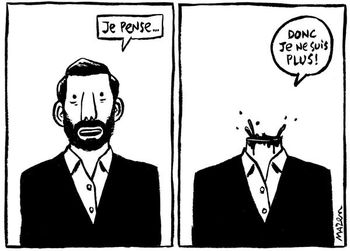
I think, therefore i am not anymore.
More here.

Anoosh Chakelian in New Statesman:
How cartoonists around the world reacted to the murder of journalists and cartoonists at the French satirical magazine, Charlie Hebdo.
I think, therefore i am not anymore.
More here.
Chris Millington in HistoryToday:
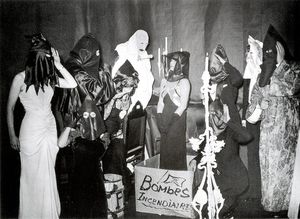
As anarchism receded after the First World War a new ideology, fascism, inspired home-grown terrorists in France. In November 1937, the Comité Secret d’Action Révolutionnaire, otherwise known as the Cagoule, was exposed by the French police authorities. The Cagoule had emerged from the extreme right-wing street politics of the decade that had afflicted France as elsewhere in Europe. The Cagoule did not commit indiscriminate attacks against civilians; it assassinated several prominent Italian antifascists who were resident in France in return for arms from Mussolini. Yet its master plan was to overthrow the democratic Third Republic and install a fascist regime in its place. To achieve this goal, Cagoule activists committed several anonymous bombings, notably in Paris, hoping to spread the fear that the communist party had in fact perpetrated the attacks and that social revolution was imminent. Yet the group failed to convince its friends in the army to take pre-emptive action against the left and the authorities uncovered the plot. Political violence continued throughout the so-called ‘Dark Years’ of the Occupation.
Picture: Parisian members of the Cagoule at a party celebrating the terrorist organisation's activities, December 3rd, 1937
More here.
Michael Schulson in Aeon:
Over the millennia, cultures have expended a great deal of time, energy and ingenuity in order to introduce some element of chance into decision-making. Naskapi hunters in the Canadian province of Labrador would roast the scapula of a caribou in order to determine the direction of their next hunt, reading the cracks that formed on the surface of the bone like a map. In China, people have long sought guidance in the passages of the I Ching, using the intricate manipulation of 49 yarrow stalks to determine which section of the book they ought to consult. The Azande of central Africa, when faced with a difficult choice, would force a powdery poison down a chicken’s throat, finding the answer to their question in whether or not the chicken survived – a hard-to-predict, if not quite random, outcome. (‘I found this as satisfactory a way of running my home and affairs as any other I know of,’ wrote the British anthropologist E E Evans-Pritchard, who adopted some local customs during his time with the Azande in the 1920s).
More here.
Tehmina Kazi in Left Foot Forward:
False Assumption One
‘Charlie Hebdo magazine was needlessly provocative’
Manufacturers of outrage and assorted agitators do not need any kind of ‘provocation’ for their actions. When Jyllands-Posten published the Danish cartoons in September 2005, protests in Muslim-majority countries did not start until four months later.
Mona Eltahawy’s interview with Jytte Klausen, the Danish-born author of the Yale Press’s forthcoming book, Cartoons That Shook the World, recognised that lag. According to Yale Press’s Web site, she argues that Muslim reaction to the cartoons was not spontaneous but, rather, that it was orchestrated “first by those with vested interests in elections in Denmark and Egypt”, and later by “extremists seeking to destabilize governments in Pakistan, Lebanon, Libya, and Nigeria”.
Further, Quilliam Foundation director and Liberal Democrat prospective parliamentary candidate Maajid Nawaz re-tweeted a ‘Jesus and Mo’ cartoon on 12 January 2014. Most of the people who called for his de-selection – and helped to whip up the resultant furore – conveniently ignored his earlier mention of the cartoons on the BBC’s Big Questions programme. The broadcast itself attracted barely a whisper on social media.
False Assumption Two
‘The Left should defend all expressions of Islam at all costs’
Professor Karima Bennoune said it best in her article, ‘Why Bill Maher and Ben Affleck are both wrong‘:
“We do not need either stereotypical generalizations or minimising responses to fundamentalism, however well-intentioned.
“What we need is a principled, anti-racist critique of Muslim fundamentalism that pulls no punches, but that also distinguishes between Islam (the diverse religious tradition) and Islamism (an extreme right-wing political ideology). We need support, understanding and to have our existence recognised.”
More here.

But then after class I went and looked at an online archive of Charlie Hebdo cartoons, and I apologize to the academics among you who think language and other symbolic acts can be violent in the same way shooting someone in the head with a machine gun is violent, but reviewing this work, with which I have long been passively familiar, my principal thought was: these cartoons are fucking great! Charb, in particular, is a genius. They have nothing in common with the uninspired image of Mohammed with a turban-bomb in the Jyllands-Posten, which is one of the distal causes of today's attack. They are light and joyous. They don't just condemn one way of looking at the world; they also celebrate another way. That way is the raunchy and ridiculous way, for which I have a deep personal fondness.
I've been disturbed over the evident lurch at Charlie Hebdo over the past few years from its longstanding commitment to French-style liberté de la parole and to exposing all species of rottenness, to an unhealthy obsession with the menace of Islam and the specter of a future 'Eurabia'. But as Marco Roth reminds today, Charlie Hebdo has not only published satirical cartoons aimed at radical Islam, they have also been “relentless in exposing corruption among French government officials, especially during the Chirac years, and also corruption among members of the Front National.” We could also add the exposure of the inhumanity of the blockade of Gaza, bullfighting…
more here.
Morgan Meis in The Smart Set:
Walter Benjamin told this story in an essay about Robert Walser written for Das Tagebuch in 1929. Benjamin argued that there is something distinctively Swiss about Walser’s writing style. Benjamin called this Swiss quality Scham, which Rodney Livingstone translates as “reticence.” You can also hear the English word “shame” in the German word “Scham.” The three Swiss at the Inn silently agree that it is embarrassing to express a thought or observation. Silence is best because it is safest. But silence is also hard to do. So, we talk. Then, inevitably, we feel disappointment at what we’ve just said.
According to Benjamin, Robert Walser deeply understood and experienced this kind of embarrassment. The funny thing about the embarrassment of talking is that it can lead to streams of words. When Walser does talk (and his writing is basically a stream of talking captured on the page), the words pour out in a torrent, stumbling over one another as they come. The incredible clumsiness of Walser’s writing, which is also the source of its delight, is the result, thinks Benjamin, of this root sense of shame. The desire to stop language results, paradoxically, in its profusion.
More here.

I recall two versions of me as I look back over the first few months of living with Doris. One conforms to a description in Doris’s 1974 novel, Memoirs of a Survivor, of how 12-year-old Emily Cartwright settled in with the unnamed female narrator she’d been left with. The child is handed over and makes the narrator (in the film she was called ‘D’) extremely uneasy. The narrator interrogates her own feelings about this imposition: ‘[Emily] was watching me, carefully, closely: the thought came into my mind that this was the expert assessment of possibilities by a prisoner observing a new jailer.’ Emily is described as having ‘a bright impervious voice and smile’, of being ‘an enamelled presence’. The narrator looks for something in Emily that she might be able to like, but Emily always responds like ‘a self-presenting little madam’. Mostly Emily keeps to herself, huddled in her bedroom with her creature, Hugo, a dog-like cat, or a cat-like dog. When she comes out she is immoderately polite, excessively grateful. The narrator recognises Emily’s manner as an act, yet ‘while I was really quite soft and ridiculous with pity for her, I was in a frenzy of irritation, because of my inability ever, even for a moment to get behind the guard she had set up.’ Emily is indolent, unlike the industrious narrator, sitting for hours in a chair looking out of the window, while ‘she entertained me with comment: this was a deliberate and measured offering; she had been known, it was clear, for her “amusing comments”.’ Emily spears passers-by and neighbours with her acid insights and cruel stories. The narrator sees ‘a sour little smile, as if she was thinking: I’ve got you, you can’t escape me!’ She almost enjoys listening to Emily’s too-accurate comments, ‘but I was reluctant too, watching the knife being slipped in so neatly, so precisely, and again and again.’ This narrator, who has other things to do, has been presented, for no obvious reason, with a damaged child, too clever by half, whom she accepts as her obligation, but struggles to like.
more here.
Amartya Sen in The Guardian:

The usual reason given for not attempting to provide universal healthcare in a country is poverty. The United States, which can certainly afford to provide healthcare at quite a high level for all Americans, is exceptional in terms of the popularity of the view that any kind of public establishment of universal healthcare must somehow involve unacceptable intrusions into private life. There is considerable political complexity in the resistance to UHC in the US, often led by medical business and fed by ideologues who want “the government to be out of our lives”, and also in the systematic cultivation of a deep suspicion of any kind of national health service, as is standard in Europe (“socialised medicine” is now a term of horror in the US).
One of the oddities in the contemporary world is our astonishing failure to make adequate use of policy lessons that can be drawn from the diversity of experiences that the heterogeneous world already provides. There is much evidence of the big contributions that UHC can make in advancing the lives of people, and also (and this is very important) in enhancing economic and social opportunities – including facilitating the possibility of sustained economic growth (as has been firmly demonstrated in the experience of south-east Asian countries, such as Japan, South Korea, Taiwan, Singapore and, more recently, China).
More here.
Raffi Khatchadourian in The New Yorker:
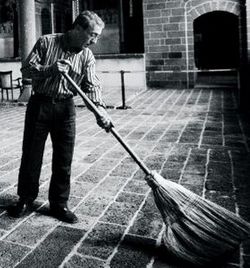
I never had the chance to meet him. I was born in the nineteen-seventies, on Long Island, and he was born in the eighteen-eighties, in the Ottoman Empire, near the Euphrates River. He died in 1959—the year that the first spacecraft reached the moon, Fidel Castro seized power in Cuba, and Philip Roth published “Goodbye, Columbus,” though I suspect he would have known nothing of those things. What he knew was privation, mass violence, famine, deportation—and how to survive, even flourish, amid such circumstances.
My grandfather spent most of his life in Diyarbakir, a garrison town in southeastern Turkey. Magnificent old walls surround the city; built of black volcanic rock, they were begun by the Romans and then added to by Arabs and Ottomans. In 1915, the Ottomans turned the city, the surrounding province, and much of modern-day Turkey into a killing field, in a campaign of massacres and forced expulsions that came to be known as the Armenian genocide. The plan was to eradicate the empire’s Armenians—“a deadly illness whose cure called for grim measures”—and it was largely successful. The Ottomans killed more than a million people, but, somehow, not my grandfather.
More here.
Freddie deBoer on his blog:
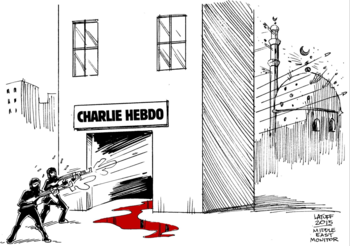
We are having a series of loud, impassioned, righteous conversations about questions like “Should people murder?” and “Should we have the right to publish cartoons?” We’re debating, in other words, dead moral questions, and for the same reason we always do: because that debate allows us to ignore the ones that might lead us to a different place than the celebration of our own liberal righteousness. To read the people writing about this attack, this is the fundamental question at hand: were these killings OK? If that were actually a moral question worth asking, then it would provoke disagreement. And yet I see no disagreement. None at all. Please: point me to any piece that endorses these killings that does not come from the looniest fringes of our political order. This Jacobin piece is getting passed around as an example of left-wing illiberalism, and yet in its very first paragraph, it asserts what absolutely everyone else is asserting: that there are no justifications for this, that the attacks are abhorrent, that free speech must be defended. Please, point me in the direction of a defense of these attacks that is anything resembling prominent or empowered. You are all debating an idea that no one at all is advancing.
The question of the price that Muslims will pay for these attacks– that is a live question, the security and rights of the Muslim people is very much uncertain, indeed. If there is anything that this country has stood for in the last 15 years, it is its willingness to sacrifice anything to fight Muslim extremism, and in the process, innocent Muslims. We have invaded multiple Muslim countries, sent secret raids into far more, killed Muslims with drones and bombs, wiretapped Muslims at home and abroad, sent agents to infiltrate their mosques, thrown dozens of them into a prison camp without trial or judicial review, assassinated them without due process, tortured them, and spent billions of dollars and thousands of lives in doing so. Of all the things that you should fear your government will lose the resolve to do, fighting Muslim terrorists should be at the absolute bottom of your list. There is no function that our government has performed more enthusiastically for years. Can any credible person doubt our commitment to fighting Muslim terrorists, in 2015?
Peter Beinart and Ross Douthat and Jon Chait and hundreds more will take the time in the week to come to beat their chests and declare themselves firmly committed to brave ideas like “murder is bad” and “free speech is good.” None of them, if pressed, would pretend that we are at risk of abandoning our commitment against murder or in favor of free speech. None of them think that, in response to this attack, we or France or any other industrialized nation is going to pass a bill declaring criticism of Islam illegal. In fact, all of them would, if pressed, likely admit that the result will be literally the opposite: that we will become more belligerent against Muslim extremism, not less; that we will become more aggressive in our posture against Islam, not less; that the public mood, already dark towards Islam, will grow only darker. They know all of this. They simply won’t tell you about it.
Read the full post here.
Agnes Poirier in New Statesman:
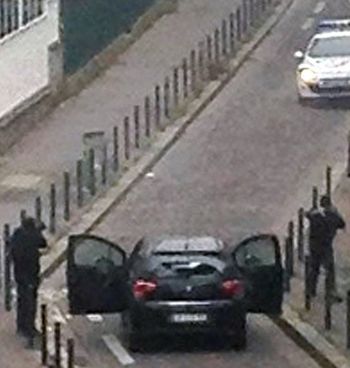
Editor’s note: on 7 January 2015, the office of Charlie Hebdo was attacked by gunmen. 12 people are so far reported dead, and more injured. As context, we republish this 2007 article about the magazine.
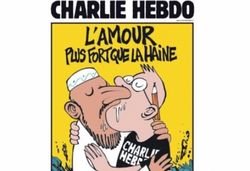
The background to this trial begins in September 2005, when the conservative Danish daily Jyllands-Posten published 12 cartoons depicting the Prophet in different ways. Islamist imams staged official protests throughout the world. Then all hell broke loose: burning of embassies, torching of flags, reprisal killings. In total, 140 people died in extremely violent clashes. Europe, taken aback by such violence, seemed almost absent-minded. Its media were unusually quiet. In Britain, the historical bastion of freedom of speech, none of the national dailies published the cartoons. Jack Straw, the then foreign secretary, praised the country's editors for “considerable sensitivity” in not printing the cartoons, and attacked European publications for doing so: “The republication of these cartoons has been disrespectful and it has been wrong.” Across the Channel, France-Soir published them all, and as a result its managing editor was sacked. Soon after, Charlie Hebdo, to show solidarity, reprinted the Nordic cartoons and commissioned more drawings from its cartoonists. This act, from a satirical weekly respected for its staunch secularism (and one that even Christian fundamentalists wouldn't dream of suing for “disrespect” and “insensitivity”, let alone “blasphemy”), triggered unexpected reactions.
Picture: “Love is stronger than hate”: the cover of Charlie Hebdo after the building was attacked in 2011.
More here.
Letting Go
I love the abandon
of abandoned things
the harmonium surrendering
in a churchyard in Aherlow,
the hearse resigned to nettles
behind a pub in Carna,
the tin dancehall possessed
by convolvulus in Kerry,
the living room that hosts
a tree in south Kilkenny.
I sense a rapture
in deserted things
washed-out circus posters
derelict on gables,
lush forgotten sidings
of country railway stations,
bat droppings profligate
on pew and font and lectern,
the wedding dress a dog
has nosed from a dustbin.
I love the openness
of things no longer viable,
I sense their shameless
slow unbuttoning:
the implicit nakedness
there for the taking,
the surrender to the dance
of breaking and creating.
.
by Michael Coady
from Oven Lane
The Gallery Press, Oldcastle, 1987
From KurzweilAI:

…The first studies of resveratrol in the early 2000s had suggested that it exerts some of its positive effects on health by activating SIRT1, also thought to be a longevity gene. But SIRT1’s role in mediating resveratrol’s reported health-boosting effects has been questioned lately. The team’s experiments showed, however, that the TyrRS-PARP-1 pathway can be measurably activated by much lower doses of resveratrol — as much as 1,000 times lower — than were used in some of the more celebrated prior studies, including those focused on SIRT1. “Based on these results, it is conceivable that moderate consumption of a couple glasses of red wine (rich in resveratrol) would give a person enough resveratrol to evoke a protective effect via this pathway,” Sajish said. He also suspects that effects of resveratrol that only appear at unrealistically high doses may have confounded some prior findings.
More here.
George Packer in The New Yorker:
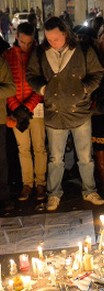
They are only the latest blows delivered by an ideology that has sought to achieve power through terror for decades. It’s the same ideology that sent Salman Rushdie into hiding for a decade under a death sentence for writing a novel, then killed his Japanese translator and tried to kill his Italian translator and Norwegian publisher. The ideology that murdered three thousand people in the U.S. on September 11, 2001. The one that butchered Theo van Gogh in the streets of Amsterdam, in 2004, for making a film. The one that has brought mass rape and slaughter to the cities and deserts of Syria and Iraq. That massacred a hundred and thirty-two children and thirteen adults in a school in Peshawar last month. That regularly kills so many Nigerians, especially young ones, that hardly anyone pays attention.
More here.
by S. Abbas Raza
Salman Rushdie has just given a statement about the attack. It is here.

I’ve been thinking today of Stanisław Barańczak, the Polish poet and translator who died last month at sixty-eight. He was known for flouting state censors with poems that mocked the euphemistic language of communism, and his work was seditious enough that in the seventies he was barred from publishing in Poland, though he continued to publish underground. By the early eighties, his politics had cost him his job as a professor in Poznan, and he decamped to the U.S. to lecture at Harvard. In a famous speech he likened life as a dissident to breathing underwater, with a nod to a science-fiction story by Stanisław Lem:
Bubbling sounds were the only acceptable means of communication, the official propaganda emphasized the advantages of being wet, and occasional breathing above water was considered almost a political offense—although everyone had to do it from time to time …
I wonder what Barańczak would’ve made of the new PEN International report, published this morning, on writers and government surveillance. It suggests that free expression around the world—even in the U.S., where what we’ve come to call “content producers” aren’t in the habit of fearing violence from the state—is in some ways more embattled now than it’s been since the Cold War.
more here.
What you notice in the historical movements of this show is how much the act of photographing has turned from public vision to private realities. Early works here rest often on travels. The 19th century French archeologist Désiré Charnay photographed ancient ruins in Mexico and the Yucatan. Maxime du Champ’s stark images of ruined temples and building facades from his many trips to Egypt, Palestine and Syria, shimmer in their distance and realism. Near these images sit American photographer Carleton Watkin’s expansive views of Yosemite in the 1860s. And just a few photographs from these we encounter two iconic 20th century images of Bernd and Hilla Becher’s German industrial silos from 1968, looking stoic and solemn. It is unclear how the Becher’s industrial countryside fit into the street views. This confusion underscores the shows frenetic movement across geographies and time periods. While the organization is clearly a walk through time with each section of the show, there is an unacknowledged history of interests and intents by the photographers here — an intent that defines what and how we are asked to see the world they present us.
Consider one of the first works in the Crowd Sourcing section: John Forbes Watson and John William Kaye’s book People of India. The book presents over 400 images of India. The particular page we look at is of three “low cast Hindoos” standing against a stone wall, holding roughly hewn sticks, and gazing into the camera looking uncomfortably confused. Watson and Kaye began this project in 1868, ten years after British rule was established in India. The photographs, the exhibition text tells us, were “taken by a dozen different photographers most of whom were government and military officials.” What are we to make of this historical fact?
more here.

Yet more to the point, by 2115, it’s possible that only about 600 languages will be left on the planet as opposed to today’s 6,000. Japanese will be fine, but languages spoken by smaller groups will have a hard time of it. Too often, colonialization has led to the disappearance of languages: Native speakers have been exterminated or punished for using their languages. This has rendered extinct or moribund, for example, most of the languages of Native Americans in North America and Aboriginal peoples of Australia. Urbanization has only furthered the destruction, by bringing people away from their homelands to cities where a single lingua franca reigns.
Even literacy, despite its benefits, can threaten linguistic diversity. To the modern mind, languages used in writing, with its permanence and formality, seem legitimate and “real,” while those that are only spoken—that is, all but a couple hundred of them today—can seem evanescent and parochial. Few illusions are harder to shed than the idea that only writing makes something “a language.” Consider that Yiddish is often described as a “dying” language at a time when hundreds of thousands of people are living and raising children in it—just not writing it much—every day in the U.S. and Israel.
more here.