
Karen Stollznow at Aeon Magazine:
 In its most literal sense, a bitch is a female dog, and this is also the word’s earliest meaning. Because bitch feels so contemporary, so casually present in everyday speech, it’s easy to assume it’s a relatively recent addition to the language. The etymology, however, tells a different story. ‘Bitch’ meaning ‘female dog’ dates to around 1000 CE, giving the word a pedigree that stretches back more than 1,000 years. It is older than ‘fuck’ and ‘cunt’, and older than many of the insults we now think of as timeless.
In those early centuries, the word didn’t quite look, or sound, the same. Bitch is an Old English word, inherited from Germanic, and during the Anglo-Saxon period it would have been unfamiliar to modern readers. Old English was the spoken and written language of the time, though literacy was limited, and bitch appeared as bicce, pronounced roughly as ‘bitch-eh’. The earliest recorded use of bitch is from a medieval text known as the Medicina de Quadrupedibus – Medicines from Four-Footed Creatures: a compendium of traditional remedies made from animal parts. Originally written in Latin and translated into Old English in the 11th century, the manuscript contains two early examples of bitch used in its literal sense.
more here.
Enjoying the content on 3QD? Help keep us going by donating now.
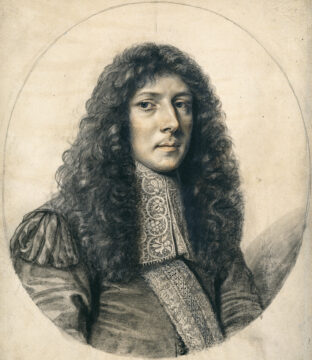 An Oxford-educated Wiltshire gentleman who lost his small estates to lawsuits and debts after the Civil Wars, he was somehow set free by this personal disaster to live, in Auden’s words, ‘a wonderful instead’. Instead of worrying about lawsuits and estate work, he lived on and with his innumerable friends. He travelled and observed places, traditions and monuments, always with a sense that many of his contemporaries, especially during the wars, were intent on the destruction of all these things. His drawn records of the megaliths at Stonehenge and Avebury are still valued today; but so are his records of people’s customs, songs and beliefs, which he gathered in Remaines of Gentilisme and Judaisme (1686–7). Both comic and melancholy, his writings offer a paper museum of people and things. ‘How these curiosities would be quite forgot,’ he writes in his celebrated Brief Lives, ‘did not such idle fellows as I am put them down.’
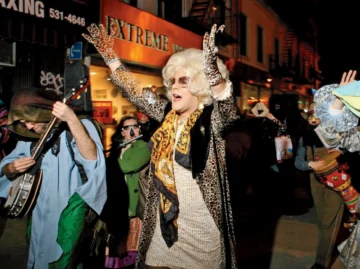 Sabbath Queen
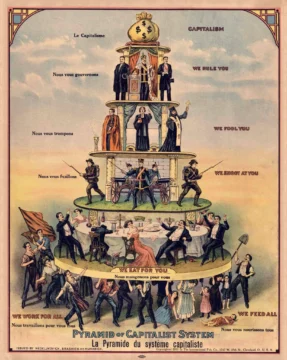 In 2003, the literary theorist Fredric Jameson wrote that it was “easier to imagine the end of the world than to imagine the end of capitalism.” Trevor Jackson seems to agree, but only to a point. In “The Insatiable Machine: How Capitalism Conquered the World,” Jackson says that the prevailing economic system has already gone a long way toward destroying our “finite planet.” He argues that if we don’t find a way to change course, the end of the world won’t be something we have to imagine; it will actually arrive.
 The Photography Show
 Chuck Norris once gave a horse an uppercut and now we have giraffes.
 Robert Trivers, who died on March 12, 2026, was arguably the most important evolutionary theorist since Darwin. He had a rare gift for seeing through the messy clutter of life and revealing the underlying logic beneath it. E. O. Wilson called him “one of the most influential and consistently correct theoretical evolutionary biologists of our time.” Steven Pinker described him as “one of the great thinkers in the history of Western thought.”
 There used to be an academic discipline centered on a straightforward question: what helps poor countries get richer? It was called development economics, and it was the intellectual engine behind sprawling government bureaucracies: USAID, Britain’s Department for International Development (DfID), the World Bank, and many others.
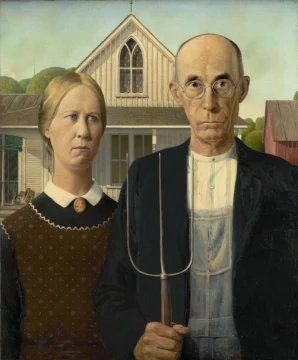 You’re not hallucinating the great weirding of America. The visual evidence is everywhere. Start with what you can see.
 Higher education is no longer expanding; it is contracting, or transforming to the point of total discontinuity with what it had once been. It is only natural that this transformation should bring with it a rediscovery of the historical fact that there is nothing intrinsically “elite” about reading Homer or Shakespeare. Yorkshire coal miners used to do it, together, with great joy and satisfaction. It was a lie and a betrayal on the part of the hermeneuticists of suspicion to have told their students—and their deans—that humanistic inquiry is, in its essence, anything but democratic. The humanities are democratic precisely because they do not come down to us through blood ties, but must be cultivated anew over the course of an individual life. As Seneca said: “If there is any good in philosophy, it is this—that it never looks into pedigrees. All men, if traced back to their original source, spring from the gods.” (Of course, since the early 20th century the dominant strain of Anglophone philosophy has sought to distance itself from the humanities and to find its niche somewhere closer to the positive sciences—yet another case of hoverflies sneaking into the beehive. But this has been a futile effort—one which, again, we’ll have to address on another occasion.)